Unknown's avatar

Model Behavior

I don’t have a television, so I don’t see a lot of commercials. Still, I find NBA games on the internet and catch a few ads in the process. There’s one for a fried chicken franchise that particularly bothers me. Here’s the set-up: two teenaged kids have made a rare venture out of their rooms to join their parents for dinner. They are still plugged into their media devices and never speak or make eye contact with the camera or their parents. The African-American family sits in the living room with a bucket of chicken on the coffee table. Mom & Dad tell the camera that the chicken is the occasion for them to have this special “family” experience. Dad jokes that if the batteries run down, they might actually have a conversation.

 Sigh. Is this an accurate snapshot of our current culture? Rewind about 100 years.

 I’m reading a book called Nothing To Do But Stay: My Pioneer Mother by Carrie Young. The author describes her life in North Dakota during the Great Depression. Her mother had acquired land as a homesteader, married and raised 6 kids on the farm. Her sisters struggled to become educated and get jobs as school teachers in local one-room schoolhouses. One particularly brutal winter, their parents found it more sensible to drop off the 18-year-old daughter, the teacher, with the two younger sisters at school and let them stay there during the week instead of transporting them back and forth through the snow drifts by horse-drawn wagon. The week turned into months. Fresh supplies were delivered every week, but these 3 young ladies spent that winter relying on their own resourcefulness for their daily life — with no electricity, simply a coal-burning furnace in the basement and a woodstove with one burner in the classroom. How is that possible? I’m sure that life was one that their parents had modeled for years.

 Compare these two snapshots and imagine the changes that have swept through our country. What has “adult living” become? What do we model for our children these days? What skills are being delegated to machines or service companies or ‘experts’ that used to be more universal and personal? Besides modeling tasking skills, how do we model social and moral skills in this decade?

 When more families were farming, children grew up alongside their parents and were incorporated into communal activities. They helped milk the cows, tend the garden, and make the food and clothing they all needed to live. In the 50s, when more families lived in cities and suburbs, Dad would drive off in the morning and work out of sight of his kids all day while Mom would turn on appliances to do the chores around home. The kids learned consumerism. Then the Moms left the house and went into the workforce leaving the kids in daycare. In 1992, someone came up with “Take Your Daughters To Work Day”. That was expanded to include boys a decade later. What was first perceived as a Feminist issue of role modeling was recognized as a parenting void: children had no clue how adults spent their work days.

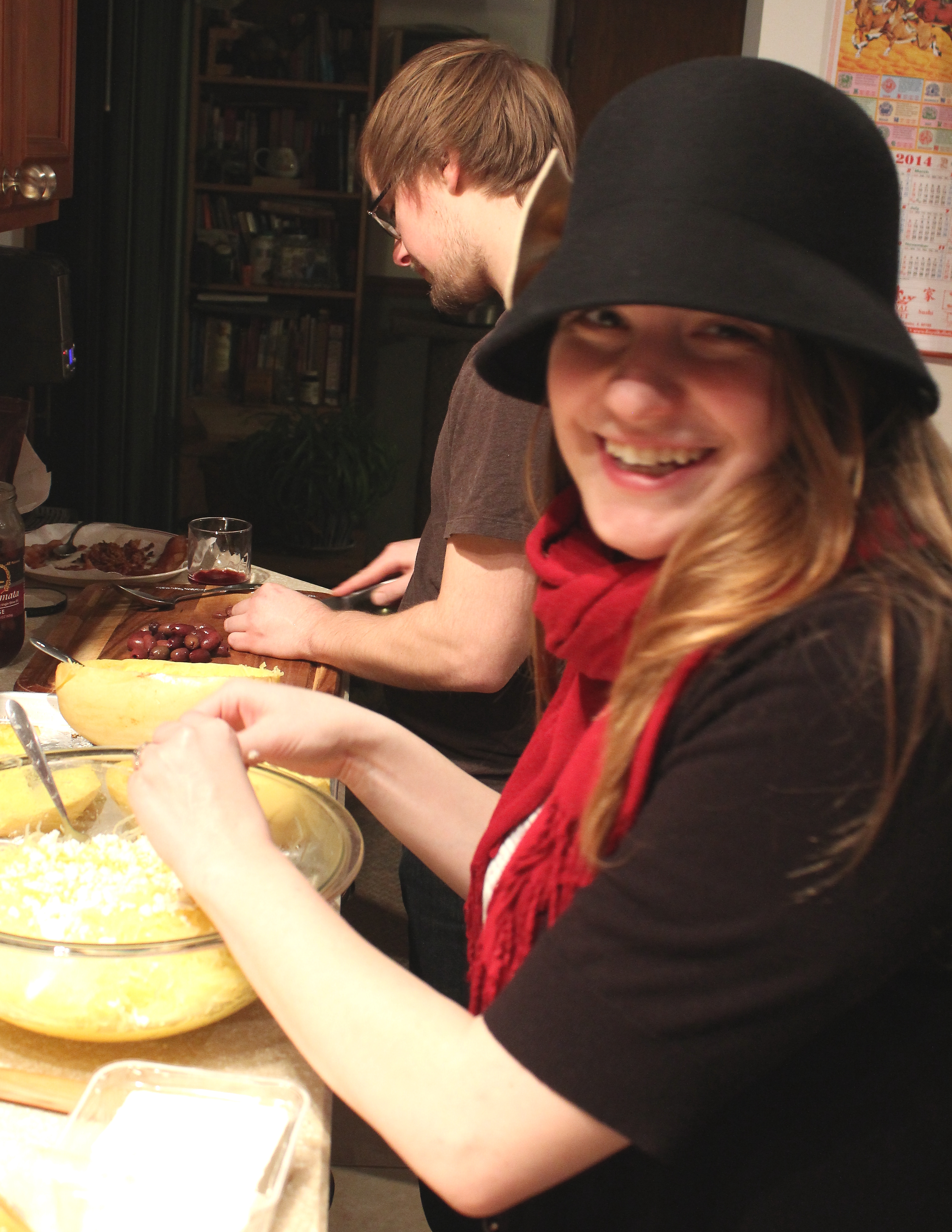
 Musing about these changes made me consider what my own children had learned from my husband and me. My daughter made a calligraphy sign when she was in High School: “My father didn’t tell me how to live; he lived and let me watch him do it.” (Clarence B. Kelland) She was 23 when her father died. What we intended to model and what she actually learned are most likely two different things. One thing I do know. She did learn to cook her own chicken.

joy 2

© 2014, essay and photograph, Priscilla Galasso, All rights reserved
Unknown's avatar

Good Gawd, Y’all!

Another school shooting hit the news yesterday. The impact seems dull. Repetition has begun to numb my response. The predictable media storm continues, but just as raindrops seem less penetrating after your clothes are soaked, I simply can’t absorb this horror. And that is rather shocking.

 I Googled “List of school shootings in the U.S.” The Wikipedia article’s chronology goes by decade, starting with the 1760s. There is one entry there. The next listing is 9 decades later. Two items there. The narration continues to list shootings for every decade. When we get to this millennium, the bullet points are replaced by a chart. From 2000 – 2010, there are 46 different shooting events chronicled. From 2010 – 2014 (n.b. Not even half a decade!) there are 65, including yesterday’s. And I may have lost count of one while scrolling down through the list.

 Obviously, this storm is escalating. This is a flood. Our country is awash in violence being perpetrated against school children. School children! What can that be about? What madness has overtaken our culture that young people at their studies have become targets? I’m pretty sure it’s not so much about the targets as it is about target practice.

 Our culture has target practice deeply embedded in its psyche and readily available in its entertainment, military and politics. Angry? Take aim. Proud? Take aim. Patriotic? Take aim. Need security? Take aim. Impoverished? Needy? Insulted? Invisible? Defiant? Miffed? Whatever the uncomfortable feeling you have, you can get relief by pulling out a weapon and taking aim at some target. Children in school apparently make a pretty easy gallery.

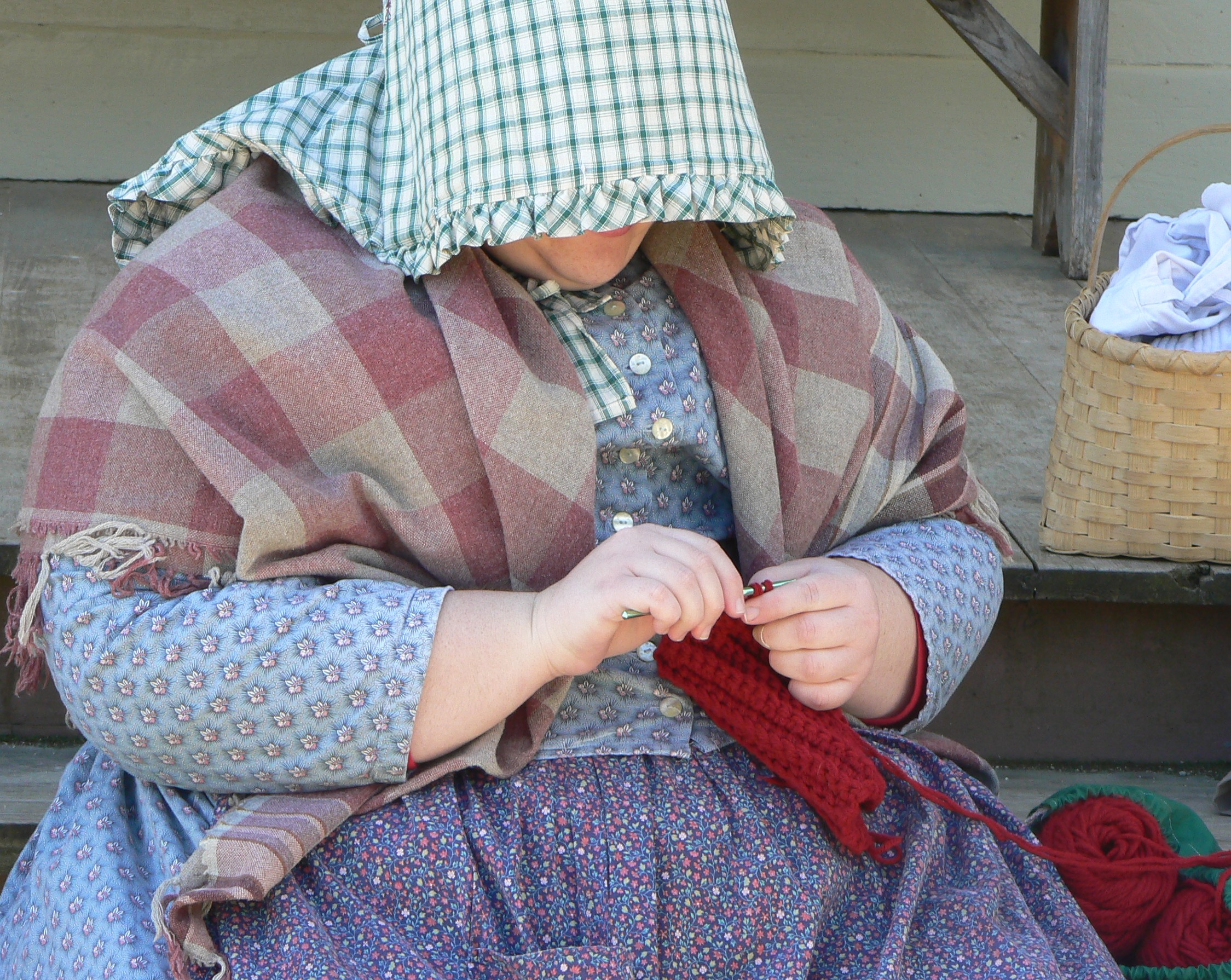
 This approach is like using the same tool for every situation, no matter what it is. Would you use a hammer to wind your watch or play your piano or punch down your bread dough or crochet a sweater? No. And how did you learn to lay your hands on the appropriate tool for each of these situations? Most likely, at a very young age, you watched someone do it. A role model. Perhaps a parent or grandparent. Someone you trusted, who spent time with you, doing everyday kinds of things.

P1040287

 Let’s look around. Where are the role models that are pulling out weapons for every crisis? Where are the role models who are negotiating, discussing, creatively engaging, brainstorming and experimenting with different non-violent approaches? Who are the role models who have multiple tools in their belts and use the appropriate ones for the situation? And violence, what is it good for? Is it ever the best tool for the job?

 And, c’mon, let’s be creative. Why does our entertainment have to follow this unimaginative formula of violence? There are a million other options. There are a million other roles to play. Playing something different will make us smarter, wiser, more flexible, more open, more like children. School children….our vanishing resource.

© 2014, essay and photograph, Priscilla Galasso, All rights reserved
Unknown's avatar

Relationships: Why U R Doin’ It Wrong

Steve brought me a book we’d sold. “There are a few light pencil marks in the quiz section. Could you please erase them before we ship this out?” I glanced at the cover. Getting To “I Do”: The Secret to Doing Relationships ‘Right’ by Dr. Patricia Allen.

Oh, dear.

I breathe a sympathetic sigh. I grieve for our culture, for social creatures with neuroses fueled by the media, insecurities about whether or not we will be loved, cared for, valued, mated and saved from personal extinction. Our fears are inflamed, and then ‘experts’ step in to tell us the magic or the scientific formula that will save us. Just take a look at the Yahoo! “Dating Tips & Advice” section: How to Stop Falling for Ms./Mr. Maybe, Happiest Couples, Tips to Get the Love You Want Instead of Settling, Traits Unhappy Couples Have in Common, etc. I imagine it’s big media business. How many of these articles simply recycle the ‘statistics’ from identical studies which probably report varying results? We are in a research culture that strives to control and predict, a desperate attempt to apply a balm to those neuroses that we irritate with obsessive attention.

Let’s take a step out of that arena, shall we? Let’s take the relationship out of the Petri dish and place it back into the organic garden. How do you learn about a growing organism? Attention, observation, action and response. Over time, the bloom becomes less a ‘specimen’ than a personality. It is unique. It is dynamic. It is not ‘right’ or ‘wrong’. It IS. And the more honest you are in your interactions with it, the more you trust it…to be itself.

And where do we find guidance in this garden of real relationships? In stories. There are billions and billions of relationship stories out there. Some are fact, some are fiction. Many of the fictions center around the magical or formulaic as well, but the ones that really inspire are the ones that are singular and sincere. They give us the hope that our own inimitable story may be just as satisfying.

delicate

I have relationship stories of my own, and they are very important to me. I have a yearning to share them, with my children and with anyone else who may be listening. Why? Because I hope that my practice of observing and appreciating the slow unfolding of a delicate bloom will spark the same in someone else, that our posture in relationships will become less that of a victim on the couch, more that of a poet in the garden.

© 2014, essay and photograph, Priscilla Galasso, All rights reserved

Unknown's avatar

Playing Solitaire

The cards float down onto the screen from a magical heaven, and there they are, all laid out before you in orderly disarray, just waiting for you to sort deftly and arrange with a crisp CLICK from your mouse. You start to work, matching and categorizing, strategizing and prioritizing like an executive assistant. Your attention to detail is keen. Your task is accomplished in a matter of minutes. You are a Free Cell goddess! One additional click, and you can begin the process anew, amassing an empire of ‘wins’ and improving your statistics.

Inevitably, your mind starts to wander. “I’m supposed to be finding a job. I’m supposed to be updating my resume. I’m supposed to be generating income.” CLICK. CLICK. Drag….CLICK. Minutes tick by. You are mesmerized by a brilliant shower of red and black and white, diamonds in spades. Fireworks follow. Then you ask yourself, “Have I accomplished anything?”

Perhaps.

I am becoming aware of myself. Of my work ethic, my motivation, my skill set. I find routine incredibly easy. I find detail work effortless. And I find them both supremely boring, but somehow, not boring enough to get me angry in the moment. I become perturbed after the fact.

I want to be productive. I want to be useful, informative, inspirational. I want to be honest, authentic, and open. I want good and meaningful engagement with the world. And I keep sucking away my life at things like computer games.

Why am I stuck? Why don’t I begin something BIG?

I am afraid of failure. I shame myself constantly by mental audiotape. “You’re not qualified. You don’t have the expertise. You don’t have the style they want. You won’t follow through. It’ll be too difficult. It won’t happen.” Buzz words from the samples you just read ring in your ears.

“Go-getter. Self-starter. Highly motivated (fill in the blank) SEEKS…”

Is everyone more hard-working than I am? Or just more eager to appear so? Am I highly motivated to help Consolidated So-And-So get ahead? No, I’m not. I’m not philosophically supportive of this capitalistic system at all. I would like to earn an honest wage, live simply (at least by American standards) and physically, and keep contributing to something important until the day I die. Pay me $15,000/year to write passionately about the environment, to teach and inspire a visitor, to file and proofread and make coffee and encouraging remarks, and I will die happy. Each day would be an adventure, and I might leave for serial adventures in other employs, but I think that would be a fine life for me.

Right now, I’m in this dialogue. Free/Cell. Am I free? A jack-of-no-trades? How do I stop playing the game and start living the life?

Unknown's avatar

Advent Day #19 – Divinity

Have Some Divinity

The premise is this: for each day in December, instead of counting down on an Advent calendar, I’m counting the free gifts we all get every day.  Today’s gift is divinity, but I don’t mean the candy.  I mean The Divine, The Sacred, The Holy and experiences of them.  Don’t we all have the opportunity to receive that every day?  If you look for it, will you find it?  I think so.

So, what is sacred?  How do you recognize the divine and holy?  In art, there’s always a halo or a sunbeam to give you a clue.  What about here on earth?

‘Namaste’ is the Sanskrit greeting recognizing the existence of another person and the divine spark in that person, with the hands pressed together in front of the heart chakra.  I think the divine spark exists in every living thing as the breath of life.  Every encounter with a living thing is an experience of the divine.  We hardly ever act like that is true, however.  But we could.  Native Americans and many African tribes have hunting rituals that celebrate the sacred exchange of life.  The hunted animal is divine, sacrificing itself for the life of the hunter, and the hunter shows a holy appreciation.  Often, when I look at macro photography of living things, flower stamens, insects, mosses, I am compelled to worship the divine in the detail.  Life is sacred and beautiful.  Looking closely and deeply is a way to practice recognizing that.


Seeing macro, but lacking the lens

In a dualistic world view, the mundane and the divine are polar opposites.  One is worldly, one is sacred.  If this world were imbued with holiness, if God became incarnate and entered flesh in this world, those opposites would run together like watercolors.  Many cultures believe this is the truth about life.  The waters under the firmament and the waters above the firmament are separated in one telling of the creation story, but the Spirit of God was moving over all of the waters from the very beginning, even in that story.  The understanding that divinity is everywhere has inspired people all over the globe for centuries.  This place we inhabit is special; it’s valuable.  It’s all holy.  This is the beginning of respect for the Universe and everything in it.  Somewhere in Western history, that idea lost its power.  Earth and everything in it became base and fallen.  Good turned to bad and life turned to death.  I’m not sure if that new idea has been very helpful.  I rather think it hasn’t.  And I don’t think it has to be that way.  It’s an idea, after all.  So if it’s not a helpful idea, why support it?  How would you rather live?  In a fallen world or in a world where the sacred and divine can be found everywhere?  Just wondering out loud.  I’m not saying that one idea is right and the other wrong.  The glass is neither half full nor half empty.  It’s a glass, and there’s water in it.  The rest is conceptual.  Why argue?  Choose how to live with the glass and the water.   As for me and my house, “I choose happy.”  (One of Jim’s conclusive statements.)

I hope this gives you something to ponder for today.  If you like, you can add a scene of Edmund Pevensie in Narnia being asked by the White Witch what he craves.  “It is dull, Son of Adam, to drink without eating.  What would you like best to eat?”  “Turkish Delight, please your Majesty!” he responds.  What if he had said, “Divinity”?  Same story, nuanced.  I would like to taste the sacred in this world, and I believe it’s here.

Unknown's avatar

Came home from work with a poem in my pocket…

Ever had one of those days?  Decidedly moody, unable to focus, liable to shed tears at any moment.  It started as I was driving in to work.  By lunch break, I had a poem scribbled on the back of a museum map in my pocket.  By afternoon break, I had texted my children just to tell them I missed their dad.  Lovely souls that they are, they reached back immediately with cyber hugs.  (thanks, kids!)  So here’s the poem – no title came with it.

What can I do?

                 — it’s October

the sumac is red and my poor, backward head

is flooding nostalgia like liquid amber. 

If I picked up guitar and a blues-country twang

                — and sang

it’d be you in the sunshine

white overalls, your shirt as blue as your eyes

walking me home from school

sweet, musky sweat

your warm, solid arm

the newness of the world in the flash of your smile

               — Hell. 

Now 35 Octobers gone

I’ve aged like a maple leaf

Fall-ing, as once for you,

now with you, in spirit

falling, scattering, lifting

like ashes in a sunbeam

like milkweed in the wind

Shouldn’t I settle in the present?  How can I?

             — in October

when you’re long gone…

Unknown's avatar

I’m still alive

Hebba-lubbo, frebbends! (Does anyone remember the PBS show Zoom?  Ubby-Dubby language?  Anyone?  Beuller?)  Are you wondering where I’ve been?  Why I went AWOL?  Have you missed me? *looking up, fluttering my lashes*  Well, I feel a need to justify my absence anyway.  Silliness aside, I need to take time to write again. 

I am anticipating the end of the season for my job at the living history museum, Old World Wisconsin.  By the end of next month, I will need to make up those wages by doing something else.  Fortunately, my previous employer still values my skills as a proofreader, and I have been able to contract with them for some work I can do at home.  Hopefully, I will be able to pick up some new voice students as well.  I have been spending my home days working on those enterprises and helping Steve with the book business.  So, I have not been spending my home time in leisurely rambles of creative writing.  And the memory card in my camera is full, so I haven’t been taking pictures.  I have been thinking, though….

Steve and I will soon be hitting the 5-year milestone in our relationship.  Our first date was October 4.  The evolution of our partnership has been an intense journey toward maturity, and keeping that energy going is quite a commitment.   The other day, I went back to some of our early e-mails (yes, I still haven’t deleted them) and came face-to-face with my former self: a grieving widow struggling to be a single Mom for the first time.  Yikes!  The more dramatic e-mails were the ones I exchanged with my 17-year old daughter.  Our grief, our survival, was such a strong agenda that we were hardly communicating anything besides our fears, our wants, our upset feelings.  It was very hard for us to listen to each other and be generous.  Steve stepped into that gap and calmly spoke his observations without judgment, even when my daughter’s anger was focused on his role in my life.  A metaphor that he uses is “clearing the windshield”.  We often have so much mud covering up the clarity of what life is and how we want to live it.  Steve has always come back to articulating his vision, one that he’s known since he was very young.   He’s been very patiently illustrating it over these past 5 years, and I’ve only recently felt that my windshield has been clear enough to see it. 

I have been reading a little book he gave me — Finding the Still Point: A Beginner’s Guide to Zen Meditation by John Daido Loori.  Here’s the nugget I will keep returning to:

“From birth we have been conditioned by different events and people — our teachers, parents, country, culture, neighborhood, friends, and peers.  Everything we cherish — our positions, attitudes, opinions, all of our attachments, all the things we think give our life identity — is found in our conditioning.  Now here we are, decades later, trying to live our lives out of this random programming we call “my life”.  We feel so strongly about parts of the program we are ready to die for it.  And it is all created in our own mind.

There is no escaping the fact that getting beyond this accumulated conditioning is a long process.  Thirty or forty years of programming takes time to work through.  We look at the thoughts, acknowledge them, let them go, and come back to the breath.  Day by day, we uncover what is underneath all of the conditioning.  What we discover is called freedom.  It is called human life.  It is called wisdom and compassion.  It’s the nature of all beings.”

Living freely is the reward of maturity.  Cleaning the windshield is an arduous, stinky task at times.  I am tempted to hide behind the caked-on guck and call it my safe cocoon, expecting my partner to join me there.  He will not.  Is that ungenerous?  Or the most loving thing a friend can do?  Sometimes I have a hard time deciding.  Even when he doesn’t join me there, he has waited for me to emerge.  He finds that very frustrating at times.  He would like to see me free.  He would like to see all people free, including himself.  His sadness and disappointment when we are not free shows in his face and posture.  I think of where my daughter and I used to live.  We have emerged joyfully from that place.  We know freedom.  But we are still cleaning the windshield.  There is more to be done, and the view from that one clear corner is my inspiration to continue the work. 

I am alive.  I am maturing.  I am working on my life.  And I enjoy taking time to write about it every once in a while.  Thanks for listening!


Unknown's avatar

Shine On!

One of my followers has awarded me with the Shine On! Award, so I am gratefully acknowledging this compliment with an extra post this week.  The Soul Driven Mind strikes me as a very earnest blog by a man who seems to walk the intersection of hard core systems like the Air Force and IT while keeping his head outdoors or on Mars.  I applaud him for challenging himself to widen and deepen his vision, to keep in touch with his natural, creative self and to let that place speak freely and inform him on a regular basis.  Whether that routinely clashes with his profession, I’m not sure, but I can imagine it would sometime.  I wish him great courage and fortitude in his quest and the ability to make the tough choices with joy!

I am to state 7 things about myself, so here’s what comes off the top of my head:

1) I am currently very excited about my oldest daughter’s wedding next month, and by excited, I mean a little out of my depth and emotionally charged in many ways.  If her dad were still alive, the social roles would be much easier to figure out, and I would be guided and shielded by his very confident, extroverted personality.  As it is, I am forging a new path on my own, not always predictable.  I cry, feeling sad and angry that he’s not present.  I put my own quirky self out there, vulnerable and honest, and wonder if that will be acceptable and satisfying to myself and my family.  But these are people whom I deeply love, and to give myself, however frightening that may be, is the best I have to offer.  So, it’s pretty thrilling all around!

2) I am hatching a huge creative project.  I just bought a 5 subject notebook at Walgreen’s yesterday, and I plan to fill it with all kinds of brainstorming notes.  I don’t want to reveal just yet what it’s about, but it’s an embryo that gives me a secret glow.

3) I ordered a dress from India to wear to the wedding.  It’s waiting at the Post Office for me to pick it up.  Does every woman have fantasies about being radiant for some occasion and fears about being merely ordinary?  What is the Middle Way of beauty?  Seeing myself as lovely and alive and sacred but no higher than any other creature on the planet, I suppose, even the graceful little mosquitoes who may show up at this outdoor event!

4) I love the smell of Wisconsin in the summer: that humid, earthy, rain-soaked fragrance of Girl Scout camp makes me feel like I’m 8 years old again.

5) I love children’s books, and I looked very much like Sal in Robert McCloskey’s books “One Morning in Maine” and “Blueberries for Sal”.  Bobbed blond hair swept to the side in a barrette, jeans with an elastic waistband at the back, sneakers, sweatshirt.  Pictures of pre-school me growing up in Massachusetts are an uncanny likeness of her. 

6)  The last movie I watched was “A Wedding”, the Robert Altman film starring Carol Burnett, Desi Arnaz, Jr., Mia Farrow, etc.  A comedy without a laugh track, satirical and ambiguous.  We don’t have TV and don’t feel interested in the movies that are being made these days, but there are lots of good films in the archives to provide social commentary and philosophical and psychological fodder for conversation and introspection.  Taking on weddings and family dysfunctions seemed like a good project for this week. 🙂

7) I love good food.  I went to the Farmer’s Market on Saturday and bought a pint box of Sugar Snap Peas.  They are so fresh and sweet, all raw and fertile, that I wish it were summer all year so that I could enjoy them more frequently.  But then, I suppose, I would stop paying attention.  The habitual way of putting calories into my mouth is so uninteresting.  I like focusing on something unusual and life-giving.  The last meal I really regretted was a Culver’s butter burger basket.  So much grease!  Never again….

This last part is always the most difficult for me.  I’m supposed to nominate 15 other blogs for this award and link to them and notify them of the award requirements.  First of all, I don’t follow very many blogs because I simply haven’t the time to read them.  The ones I do follow, I’ve already given awards to (if they even accept them).  I also refuse to tell anyone that there’s a requirement for receiving an award.  My appreciation is offered without obligations attached.  That said, I will share the new blogs that I’ve been following:

Jeff Sinon Photography: Nature Through The Lens

Steve McCurry’s Blog (you know the guy who photographed that iconic Afgan woman with the haunting eyes for the cover of National Geographic?  Yup, the same man.)

Into the Bardo: A Blogazine (I’ve actually been added as a contributor to this one, and all the contributors are people whose work I would recommend.)

I hope the short list doesn’t disappoint anyone.  Thank you for contributing to the expressive community of artists, thinkers, and humans that make this blogosphere so interesting and worthwhile!  I am pleased to be among you!

Unknown's avatar

Honoring My Father (Reblog)

George William Heigho II — born July 10, 1933, died March 19, 2010.

Today I want to honor my dad and tell you about how I eventually gave him something in return for all he’d given me.

My dad was the most influential person in my life until I was married.  He was the obvious authority in the family, very strict and powerful.  His power was sometimes expressed in angry outbursts like a deep bellow, more often in calculated punishments encased in logical rationalizations.  I knew he was to be obeyed.  I also knew he could be playful.  He loved to build with wooden blocks or sand.  Elaborate structures would spread across the living room floor or the cottage beach front, and my dad would be lying on his side adding finishing touches long after I’d lost interest.  He taught me verse after verse of silly songs with the most scholarly look on his face.  He took photographs with his Leica and set up slide shows with a projector and tripod screen after dinner when I really begged him.  He often grew frustrated with the mechanics of those contraptions, but I would wait hopefully that the show would go on forever.  It was magic to see myself and my family from my dad’s perspective.  He was such a mystery to me.  I thought he was God for a long time.  He certainly seemed smart enough to be.  He was a very devout Episcopalian, Harvard-educated, a professor and a technical writer for IBM.  He was an introvert, and loved the outdoors.  When he retired, he would go off for long hikes in the California hills by himself.  He also loved fine dining, opera, ballet, and museums.  He took us to fabulously educational places — Jamaica, Cozumel, Hawaii, and the National Parks.  He kept the dining room bookcase stacked with reference works and told us that it was unnecessary to argue in conversation over facts.

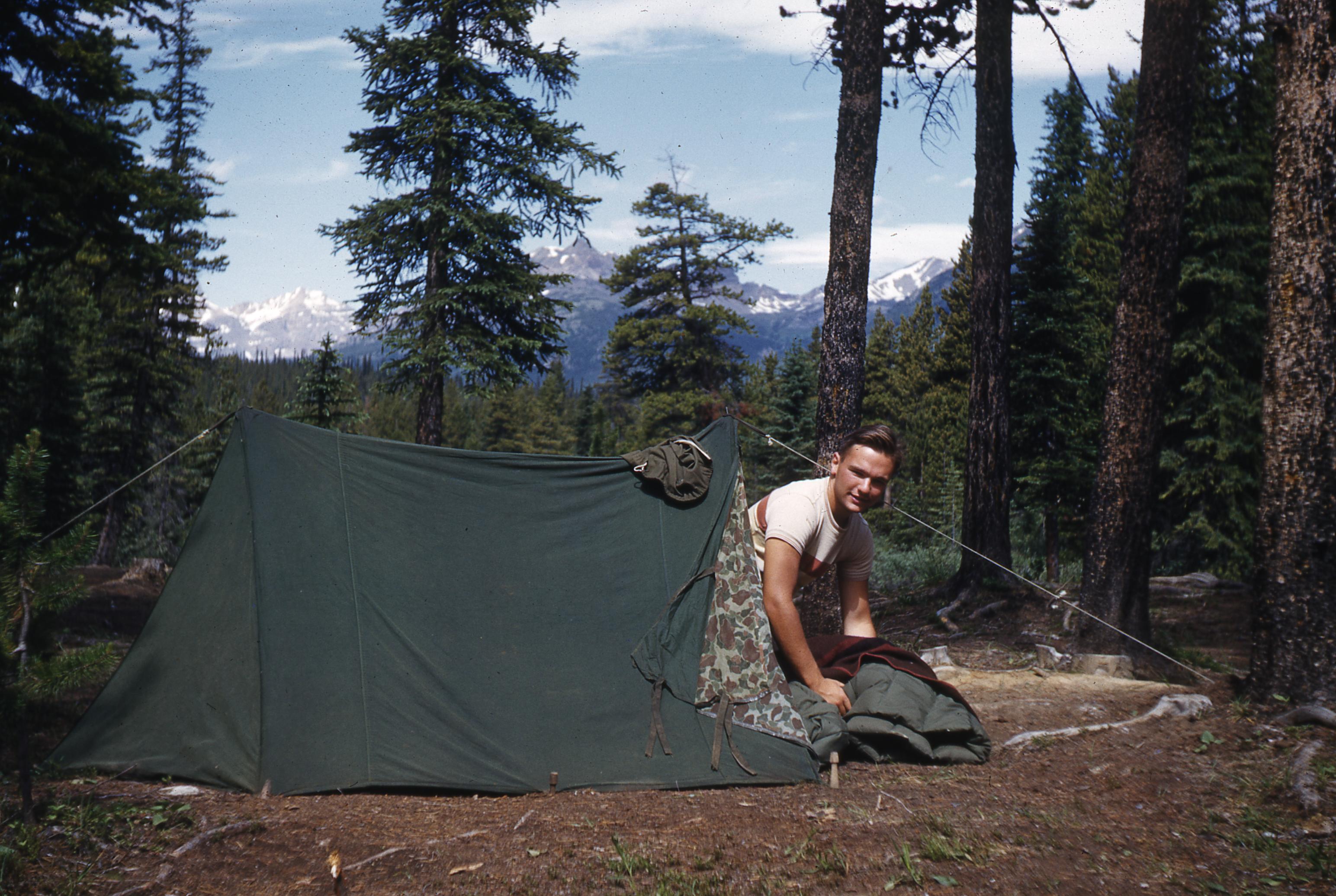
Camping in Alaska the summer after his senior year in High School: 1951.

My father was not skilled in communicating about emotions.  He was a very private person.  Raising four daughters through their teenaged years must have driven him somewhat mad.  Tears, insecurities, enthusiasms and the fodder of our adolescent dreams seemed to mystify him.  He would help me with my Trigonometry homework instead.

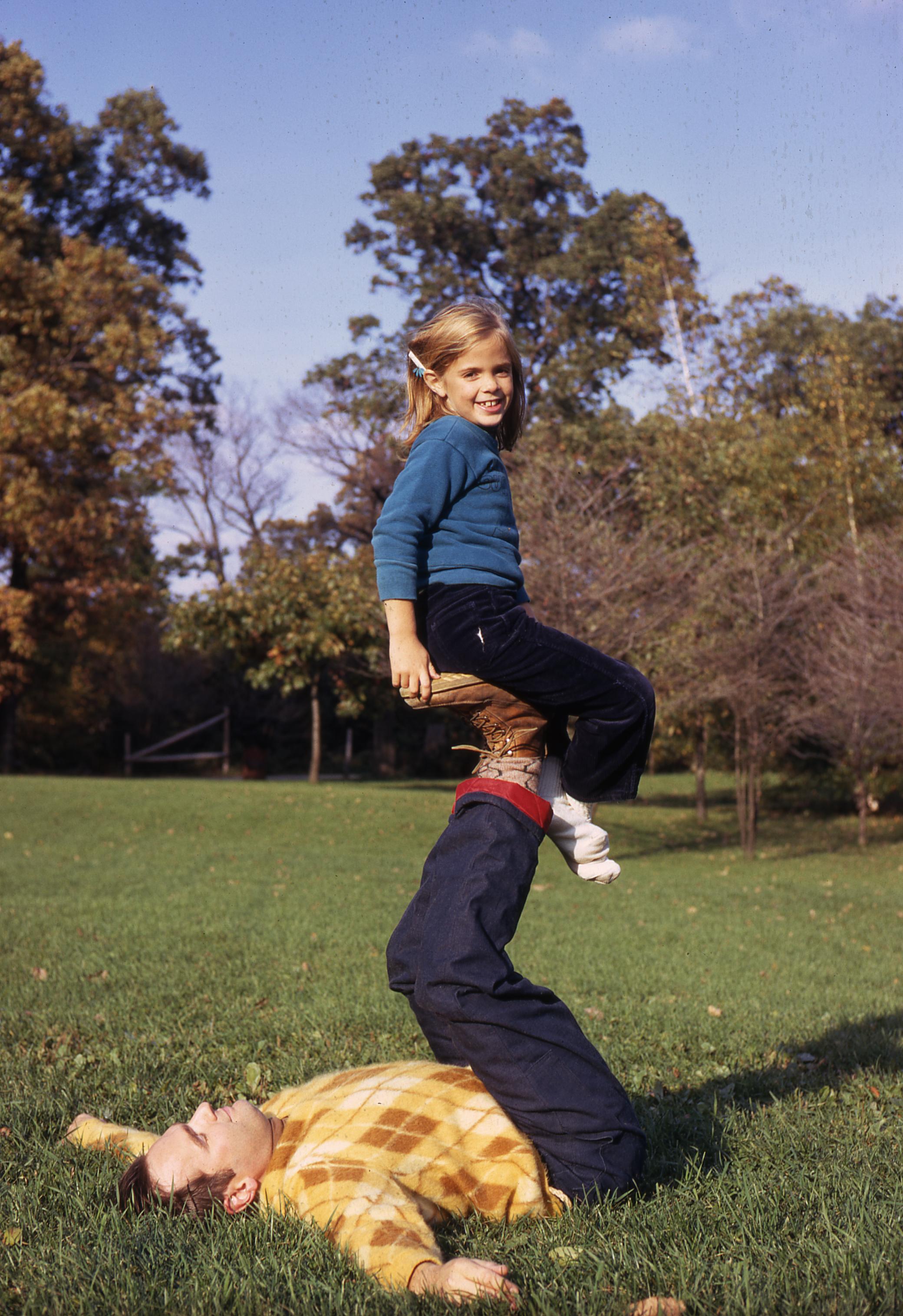
Playing with my dad, 1971.

I married a man of whom my father absolutely approved.  He walked me down the aisle quite proudly.  He feted my family and our guests at 4 baptisms when his grandchildren were born.  I finally felt that I had succeeded in gaining his blessing and trust.  Gradually, I began to work through the  more difficult aspects of our relationship.  He scared my young children with his style of discipline.  I asked him to refrain and allow me to do it my way.   He disowned my older sister for her choice of religion.  For 20 years, that was a subject delicately opened and re-opened during my visits.  I realized that there was still so much about this central figure in my life that I did not understand at all.

Grandpa George

In 2001, after the World Trade Center towers fell, I felt a great urgency to know my father better.  I walked into a Christian bookstore and picked up a book called Always Daddy’s Girl: Understanding Your Father’s Impact on Who You Are by H. Norman Wright.  One of the chapters contained a Father Interview that listed dozens of questions aimed at bringing out the father’s life history and the meaning he assigned to those events.  I decided to ask my father if he would answer some of these questions for me, by e-mail (since he lived more than 2,000 miles away).   Being a writer, this was not a difficult proposition for him to accept.  He decided how to break up the questions into his own groupings and sometimes re-phrase them completely to be more specific and understandable and dove in, essentially writing his own memoirs.   I was amazed, fascinated, deeply touched and profoundly grateful at the correspondence I received.  I printed each one and kept them.  So did my mother.  When I called on the telephone, each time he mentioned how grateful he was for my suggestion.  He and my mother shared many hours reminiscing and putting together the connections of events and feelings of years and years of his life.   On the phone, his repeated thanks began to be a bit eerie.  Gradually, he developed more symptoms of dementia.  His final years were spent in that wordless country we later identified as Alzheimer’s disease.

I could never have known at the time that the e-mails we exchanged would be the last record of my dad’s memory.  To have it preserved is a gift that is priceless to the entire family.  I finally learned something about the many deep wounds of his childhood, the interior life of his character development, his perception of my sister’s death at the age of 20 and his responsibility in the lives of his children.   My father is no longer “perfect”, “smart”, “strict” or any other concept or adjective that I could assign him.  He is simply the man, my father.  I accept him completely and love and respect him more holistically than I did when I knew him as a child.  That is the gift I want to give everyone.

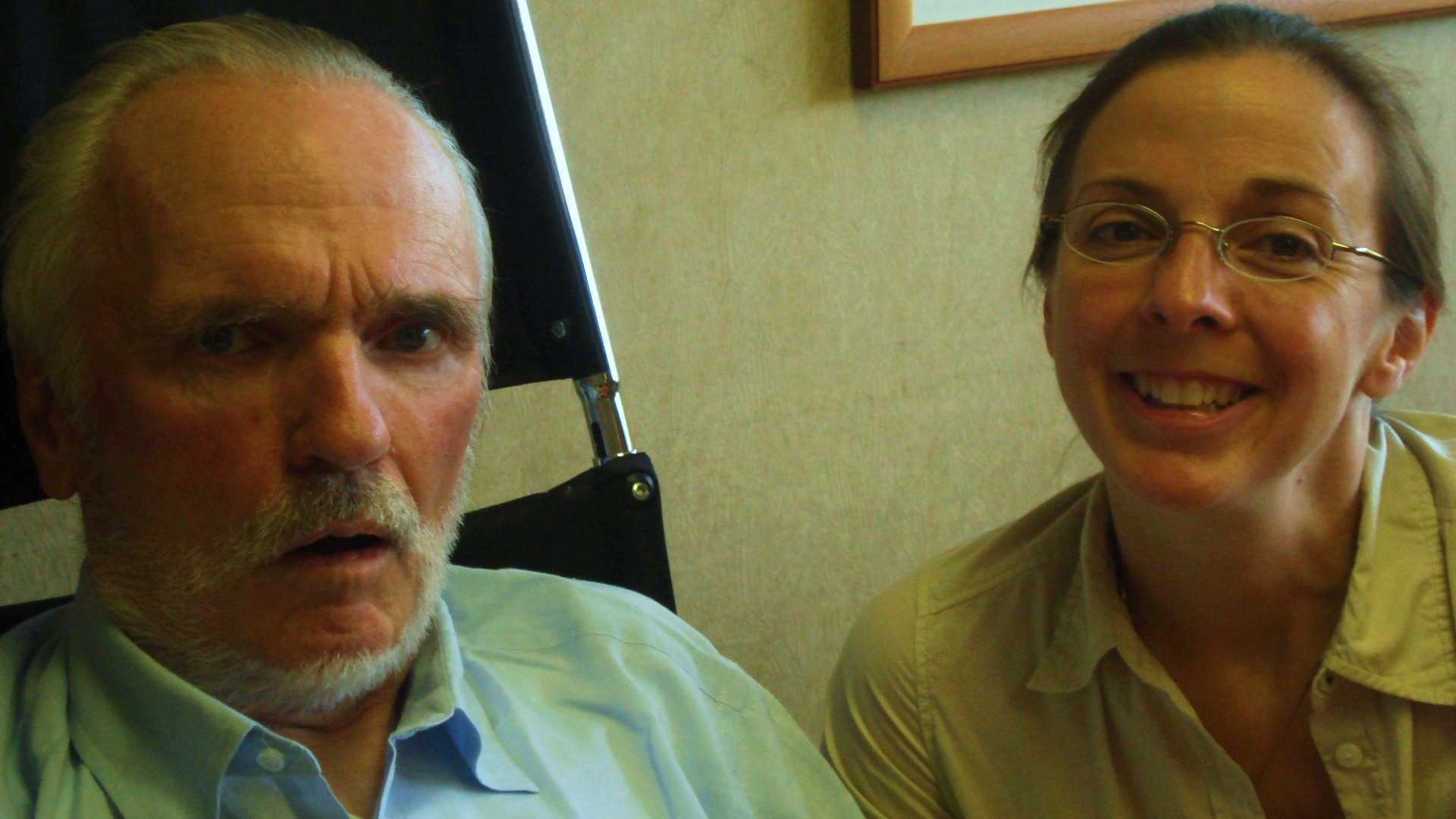
I will close with this photo, taken in the summer of 2008 when my youngest daughter and I visited my father at the nursing home.  I had been widowed 6 months, had not yet met Steve, and was anticipating my father’s imminent passing.  My frozen smile and averted eyes are fascinating to me.  That I feel I must face a camera and record an image is somehow rational and irrational at the same time.  To honor life honestly is a difficult assignment.  I press on.

Unknown's avatar

Memorial Day: A ‘Hair’ Piece (Part 2)

Alice and I were two of four daughters growing up in the 1960s when hair was a revolution. My mother’s practical and aesthetic notions of hair were of the previous generation. She preferred our hair bobbed and easy to care for, and since we inherited her thin, fine locks, that was what often looked best on us. Somehow Alice managed to get permission to grow hers long when the rest of us didn’t. Since there was more of it, it seemed thicker, more luxurious than mine. I begged to be allowed to brush it, comb it, braid it, style it and pet it. It was a special bonding time between us, and my affection for Alice was cemented during the hours I spent grooming her. Our other sister competed for this opportunity for devotion as well. We sometimes quarreled over who would be allowed this privilege. Alice enjoyed arranging hair as well, and learned how to cut it, too. She cut our brother’s hair and our father’s hair. When she died, at the age of 20, this task was passed on to me. The summer that she died, she also cut my boyfriend’s hair. I swept it off the porch and stuffed it in a red, heart-shaped pillow I made. Jim became my husband 4 and a half years later.


Alice and Mike - summer 1979

Alice and Mike – summer 1979

Jim’s hair was a true marvel, not just to me, but to everyone who knew him. It was thick, curly, blond and the crowning glory of this California dream man. In his late teens, he had the “surfer dude” look: in the humidity of the ocean air, a front lock would fall down on his forehead just like Superman’s. When he took a job in the 80s, it was shorter, casually parted in the center, and more like Huey Lewis’. He didn’t have to use “product” to achieve that decade’s big hair, while I was perming and mousse-ing like crazy. As he aged, he very gradually acquired some gray strands at the temples. He died at the age of 47 of heart disease and complications from diabetes. Our priest remarked at observing his body in the funeral parlor, “Look at his hair – barely gray and still as stylish as a Ken doll.”

 Jim in England

My father died of Alzheimer’s disease two years later. He was thirty years older than Jim ever got to be, his emphatically straight hair a dazzling white. As a young man at IBM, he parted his hair to one side and kept it meticulously short and neat. When he moved to California, he began to comb it straight back from his forehead and let it grow a little longer in back. As a teenager, I would cut it for him while he sat on the redwood deck in the back yard. I only needed to even the ends at his neck and trim around his ears. As the clippings fell to the boards at his feet, he would reflect on the change in the color mixture. Each year, more gray and white, less dark brown. The most wonderful aspect of cutting my father’s hair was that I was allowed to touch him, to smooth and caress his noble head. This was as intimate and affectionate as I could imagine being with him, and it was like knowing God to me.


Grandpa George

Grandpa George

My daughter Susan visited me the other day. It was our Mother’s Day and Master’s Graduation celebration, in a way, but really just a lovely, rainy day to be together, talk about her upcoming wedding, do a jigsaw puzzle, cook a meal, drink martinis and listen to jazz. And play with her hair. When she was in high school, I would fashion her hair into an “up-do” for proms and homecoming dances. I could probably do a decent job for her wedding day; why pay an expensive stylist? We began to experiment. Her silky soft, light brown hair felt like her baby’s locks in my hand. The wispy ends of a layered cut growing out gave the outline of that toddler hair I remember so well, framing her youthful, round cheeks. The tactile experience of this person whom I love stays with me, in my mind and memory, in my fingers, in my heart. I will have wedding photos soon to go along with the graceful curl in her baby book and the little red heart pillow, strands of love and memories woven together over time. A satisfying memorial, to my mind.