Unknown's avatar

Maple Sugar!

Never let me get dogmatic about anything.  (That word again….one of Steve’s most over-used!)  I had resisted the excitement around the Wehr Nature Center surrounding the upcoming Maple Sugar festival because I just don’t care for the taste of maple.  I had a bad experience as a candihapped kid.  My parents were strict about candy.  We didn’t have it just lying around in big, glass jars on the kitchen counter like my best friend did.  We weren’t allowed to eat our fill out of pillow cases at Halloween like my best friend did.  We weren’t allowed to chew bubble gum like my best friend did.  So where did I hang out?  At my best friend’s house mooching as much candy as I could.  And then, a miracle occurred.  My parents brought home Maple Sugar Candy from a trip, or maybe it was a gift or a find at a specialty shop.   Somehow, these little leaf-shaped, brown, sparkly candies were available IN OUR HOUSE, and I went berserk.  I probably yanked one without permission and gobbled it up to destroy the evidence in a matter of seconds.  My wise friends at the Nature Center told me this morning that the only way to consume maple sugar is in tiny, slow doses.   Maybe that’s where I went wrong.  My overdose at a young age left a very bad taste in my mouth about the whole maple business.  I’ve avoided it for years on pancakes, French toast, spice cake frosting, bacon, you name it.  Somewhere along the line, the real maple sugar and the imitation corn syrupy stuff that’s advertised as “maple syrup” got blurred together in my memory.  It was all bad.  Well, today, I got to go back to the source and re-learn everything I knew about the taste of maple.

Giving blood

This is a new tap in a sugar maple.  The spout is called a spile.  You can see a previous tap above it to the left that has healed over.  Some of the kids think these look like bellybuttons.   The sap drips out and gets collected in a bag.  I tasted a drop of sap that I captured on the back of my hand.  It was just like water with a very slight sweetness.

A stand of sugar maples is called a “sugar bush”.   Tapping trees have at least an inch of sapwood under the bark.  They are the more mature trees, ones about 45 inches in circumference.   You can get sap from any tree, but not every sap will make a syrup that will taste good on pancakes.  Pine sap can be made into turpentine.  Birch sap can be made into root beer.  Oak sap can be made into tannins for tanning leather.  Maple sap has a sugar content of about 2.5%.  It takes about 40 gallons of sap to make 1 gallon of syrup.  Remove even more water, and you have maple sugar.   It’s very sweet, but it doesn’t make me sick in tiny amounts.  You know what does make me sick?  Imitation maple syrup.  That’s really the stuff I loathe.  We do a taste test with the kids.  They get a drop from bottle A and one from bottle B to see if they can tell the difference.  Bottle A leaves a trailing thread of stickiness wherever it goes.  It looks like a hot glue gun.  It tastes super sweet and leaves a tinny bitterness in your mouth.  Yuck!  It’s imitation maple flavoring, MAYBE a smidgeon of real maple syrup, and mostly corn syrup.   Real maple syrup is not as harsh; it’s sweet, but with a lower viscosity.

I looked at these bright, vulnerable blue bags hanging in plain sight in the woods and asked, “Don’t you get animals coming after this sweet stuff?”  Oh, yes.  Weasels.  Gnats.  Snow fleas.  Raccoons.  Squirrels.  They get wise to what we’re doing out here eventually.  So they tell us to replace any bags that have holes, and we strain the sap before we start cooking it.  I haven’t seen that part yet, the cooking.  They save that for the big festival in late March.

So now I have a better understanding and appreciation of maple syrup and maple sugar.  I do not hate the taste of it; I do hate imitations of it.  I still prefer honey on my pancakes, though.   I can’t wait to see and taste the Wehr Nature Center’s version of that, too!
Unknown's avatar

Fascination

I’ve always believed that I have a great capacity for fascination…until a few days ago when I began to read Annie Dillard’s An American Childhood.  She has it in spades, and has always had it, in a way that makes me feel distracted and dull by comparison.  Here’s an excerpt from that memoir:

“Our parents and grandparents, and all their friends, seemed insensible to their own prominent defect, their limp, coarse skin.

“We children had, for instance, proper hands; our fluid, pliant fingers joined their skin.  Adults had misshapen, knuckly hands loose in their skin like bones in bags; it was a wonder they could open jars.  There were loose in their skins all over, except at the wrists and ankles, like rabbits.

“We were whole, we were pleasing to ourselves.  Our crystalline eyes shone from firm, smooth sockets; we spoke in pure, piping voices through dark, tidy lips.  Adults were coming apart, but they neither noticed nor minded.  My revulsion was rude, so I hid it.  Besides, we could never rise to the absolute figural splendor they alone could on occasion achieve.  Our beauty was a mere absence of decrepitude; their beauty, when they had it, was not passive but earned; it was grandeur; it was a party to power, and to artifice, even, and to knowledge.  Our beauty was, in the long run, merely elfin.  We could not, finally, discount the fact that in some sense they owned us, and they owned the world.

“Mother let me play with one of her hands.  She laid it flat on a living-room end table beside her chair.  I picked up a transverse pinch of skin over the knuckle of her index finger and let it drop.  The pinch didn’t snap back; it lay dead across her knuckle in a yellowish ridge.  I poked it; it slid over intact.  I left it there as an experiment and shifted to another finger.  Mother was reading Time magazine.

“Carefully, lifting it by the tip, I raised her middle finger an inch and released it.  It snapped back to the tabletop.  Her insides, at least, were alive.  I tried all the fingers.  They all worked.  Some I could lift higher that others.

“That’s getting boring.”  “Sorry, Mama.”

“I refashioned the ridge on her index-finger knuckle; I made the ridge as long as I could, using both my hands.  Moving quickly, I made parallel ridges on her other fingers — a real mountain chain, the Alleghenies; Indians crept along just below the ridgetops, eyeing the frozen lakes below them through the trees.”

What rare child in this century, surrounded by electronic stimulators of all descriptions, would spend a half an hour fascinated by her mother’s hand, I wonder?  I had the chance to meet 56 kindergarteners at the Wehr Nature Center this morning.   This is what we brought out to fascinate them:

Boxy

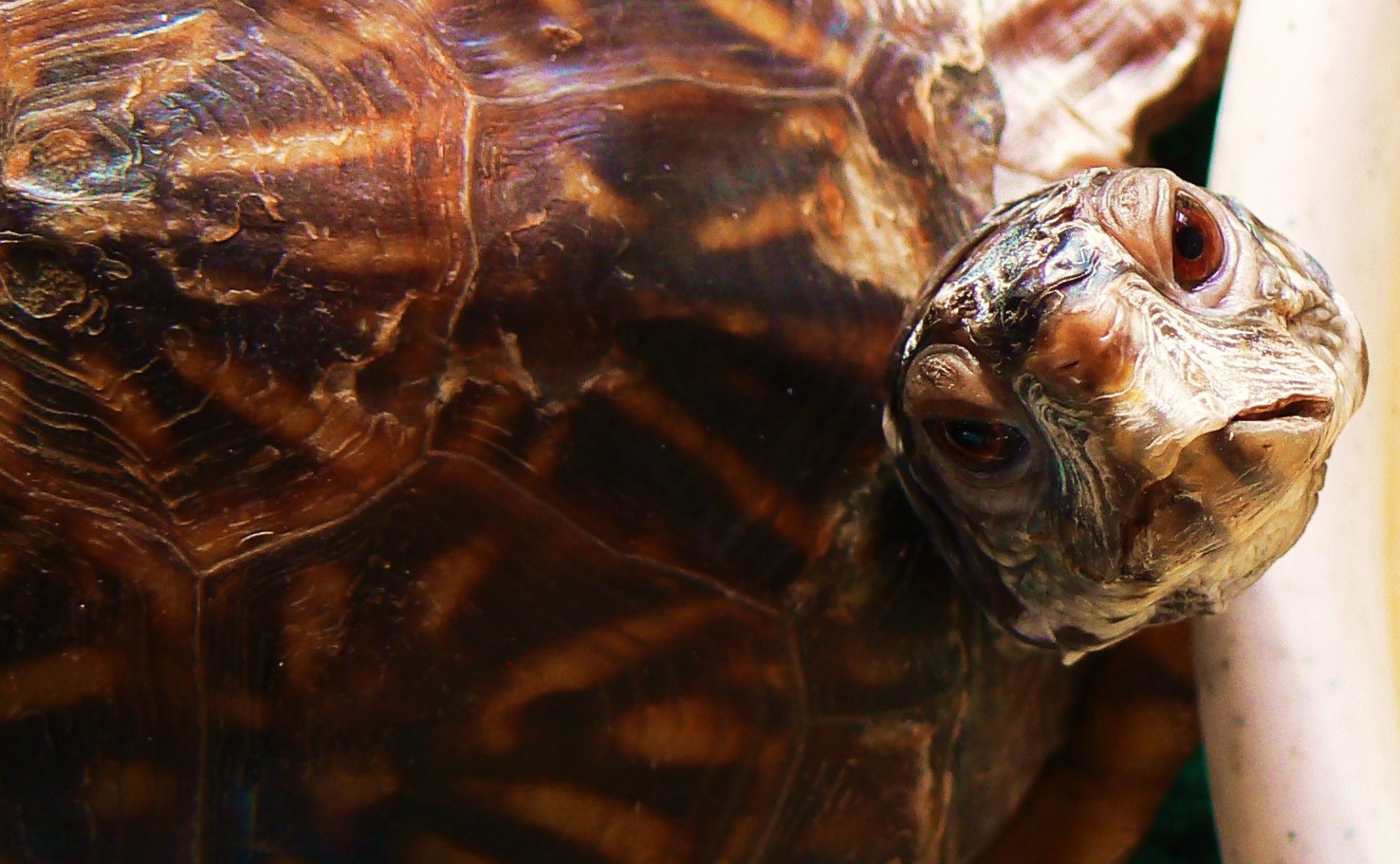
Now that’s an ancient face I could stare at for hours!  Meet Boxy, the ornate box turtle.  Her species is found primarily in southwestern Wisconsin, where there are sandy prairies and is currently endangered and protected.  She came to the nature center about 25 years ago; she may be about 10 years older than that.  How do I know to call Boxy ‘she’?  Brown eyes.  Male box turtles have red eyes.  Also, Boxy laid some eggs a few years after she came to the center (not that she had been with a male while she was there).  Occasionally, Boxy has her beak trimmed.  It can get overgrown because she’s not in the wild digging and wearing it down.  I wonder if the vet has ‘styled’ her expression…she looks sad to me.  She was quite chipper this morning, though.  It’s noticeably warm for this time of year.  She and the other reptiles were moving rapidly and eagerly in their cages.  We put Boxy down in the middle of the circle of children, and she set out at a brisk pace to examine the perimeter, craning her neck up at the faces around her.  She is a bit of a celebrity, as she meets about 10,000 kids every year.  She may live to be as many as 70 years old.  I wonder if the Nature Center will still be around or if she’ll live out her last days somewhere else.

Boxy has her own beauty, her own fascinating skin.  ” The lover of nature is he whose inward and outward senses are still truly adjusted to each other; who has retained the spirit of infancy even into the era of manhood….Standing on the bare ground, –my head bathed by the blithe air, and uplifted into infinite space, — all mean egotism vanishes.  I become a transparent eye-ball.  I am nothing.  I see all.  The currents of the Universal Being circulate through me; I am part or particle of God…I am the lover of uncontained and immortal beauty.”  (Ralph Waldo Emerson)

What uncontained and immortal beauty will you discover to love today?


Unknown's avatar

Looking at Life: The Photography Metaphor

So, my son’s visit has come to an end.  It was good to offer him a retreat from his everyday routine, a chance to slow down and reflect, the reassurance of support and the challenge of articulating his thoughts, feelings, and desires.  Making your way in the world as a young adult is hard work; there’s so much to process and so many options.  As I mess around with photos, sliding tint and color saturation and cropping and brightness tools around, I think of all the different ways there are to look at the world.  How do you land on the one you want to “apply”?  What is the result you’re looking for?  How do you recognize that result or closer approximations of it?

I keep asking myself those questions, and the answers do change.

My son remembered some of my “dragon lady” moments as his mom, those angry “This is not the result I want!” rejections of his behavior.  I had forgotten the specific events, but I remember the frustration.  As always, I had (at least) three options: run/hide, change the situation, change yourself.  I spent a lot of energy trying to change situations.  “I wouldn’t be this frustrated if I could get these kids to obey me!”  I tweaked and cajoled, but I never managed to break their spirits and get them to comply completely.  They had their own will, just like a photograph whose focus is already determined.  The one thing I can’t do with my photos in post processing is sharpen the focus.   So what do I do then?   Change myself.  This is a fuzzy picture and it will never be crisp.  But I can learn to understand fuzziness as a quality that represents a true thing in the universe and so makes a valid image.

I think I’ve evolved to be a closer approximation of the person I want to be.  Less of a “dragon lady” or control freak or perfectionist.  More tolerant and compassionate.  More honest and willing to look at things as they are and drop the tyranny of looking at things in comparison to how I wish them to be.  Kinder, more open, less anxious.  Oh, but I still have some more adjustments to try.  I may get closer still.  Meanwhile, here are some examples of the results I got with pictures from yesterday.

"Canyonland" in a decaying willow


Slimy tendrils of ice


Blue lagoon, Wisconsin style

Unknown's avatar

Down By The Riverside

Gonna lay down my burden…

I ain’t gonna study war no more.

Gonna lay down my sword and shield…

Took a walk by the Mukwonago River yesterday.  Heard lots of geese honking raucously, actually ridiculously.  “Sounds like a barnyard!”  I said, imagining donkeys braying and cows lowing.  Actually, there was a barnyard of sorts across the river.  On the slope leading to the water there were about a dozen white domestic geese.  All along the waters edge, there were wild Canada geese splashing about, enjoying the sunshine.   I wonder how they size each other up?  I wonder what their honking was all about?

We watched a video from the “Life” series, narrated by David Attenborough (our hero!) that featured footage of killer whales and leopard seals hunting.  I had seen a clip on the internet somewhere of killer whales tossing a seal around and many people commented about how cruel it was that they were playing with their unfortunate victim.  David Attenborough, narrating the scene of a leopard seal eating a penguin, described how it has to fling the body away from the piece its teeth are holding in order to rip off a manageable chunk of meat.   That made a lot of sense to me, and it dawned on me that the killer whales were probably doing the same thing.  Are non-human animals ever cruel, I wonder?   I’ve seen a real game of cat-and-mouse, but I’m not sure that’s about cruelty.  Then again, we have bred animals to demonstrate cruelty.  Fighting animals and hunting animals who attack other animals for reasons other than their own survival can be said to be cruel, I suppose.   Is it a human notion to cultivate violence for other ends, like status, power, sport and such?  Or do animals have that trait as well?

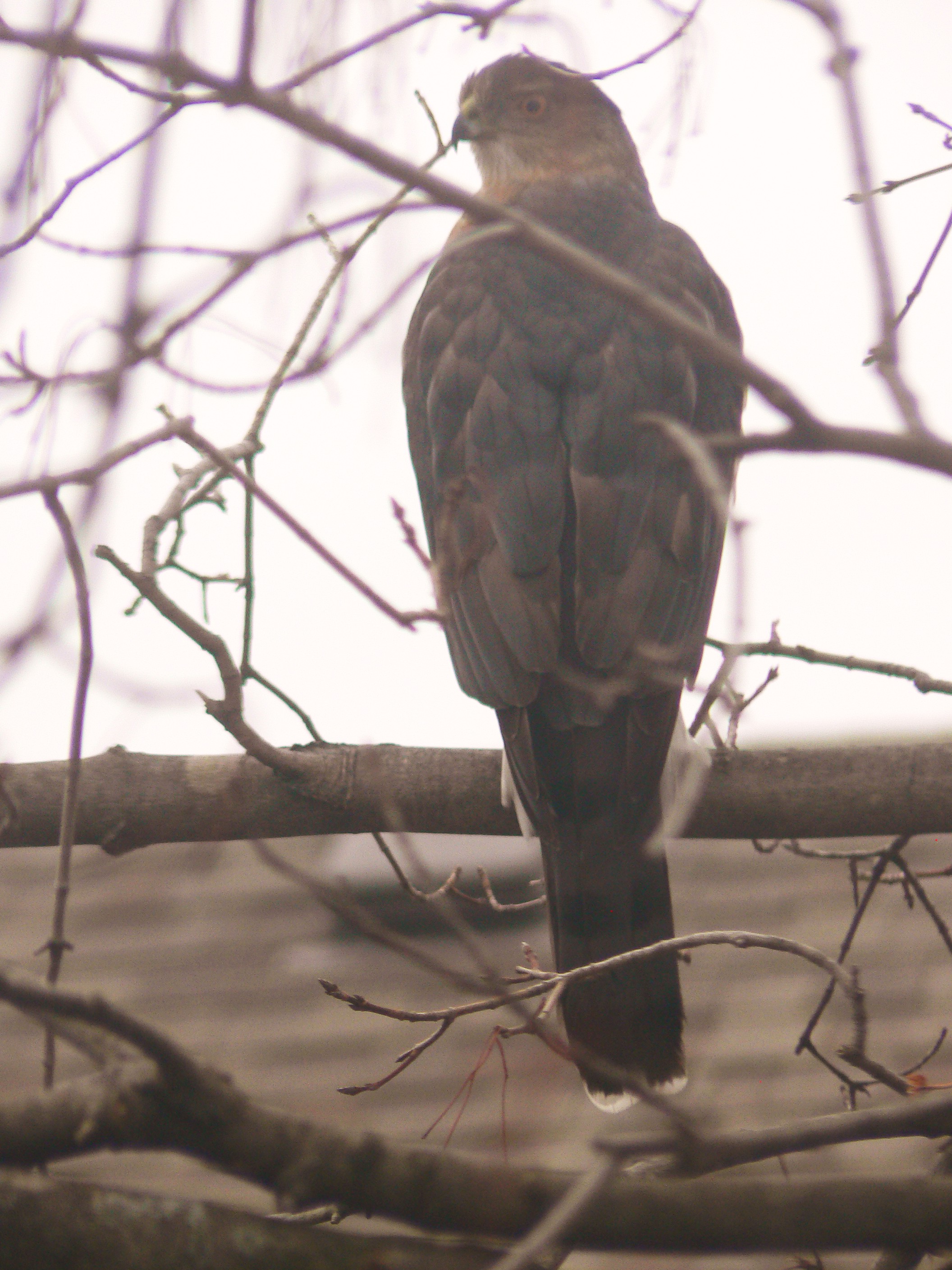
As I am typing this, a hawk has come to perch in the maple tree outside my bedroom window.  He is probably waiting for the sparrows and squirrels and cottontail rabbits that come to my garden chair looking for bread crumbs and popcorn kernels.   Here’s a shot I just took through my dingy window:

He’s still there, swiveling his head about, looking with his sharp eyes for his next meal.   It isn’t about war, it’s about food.  He takes no more than he needs.  What about us?  When we take more than we need, are we at war?  And what do we really need?

A sheltered place to bed down for the night


Fresh water, clean air, plants and sunshine

I don’t want to be burdened with war, status, power, ego or contention today.  I want to live like they live “down by the riverside”.  It seems peaceful and natural.  I could just watch this hawk all day….

Unknown's avatar

While the gettin’s good…

All of our snow seems to be falling on Europe this year, so we’re going to seize the opportunity to do some spring hiking in February!  “Let’s get while the gettin’s good!”, as they say.  (They who?  Not really sure who says this any more…)

Here are some early spring photos from my walks this weekend:

First robin in a ginko tree

Red-tailed hawk feathers

Fertile farmland

Blue and gold (for Helen)

Enjoy the white stuff, my friends across the pond!  I’m going mud walking!

Unknown's avatar

Let’s Make Tracks!

It was tracking day at the Wehr Nature Center for a group of 24 third graders.  They made plaster molds of animal tracks and then went outside in the bright sunshine to find some animal evidence.  Those hearty species who stick out the Wisconsin winter without migrating or hibernating include squirrels, weasels & mink, deer, raccoon, opossum, fox, skunk, cottontail rabbit, pheasant, and a bunch of birds (cardinals, chickadees, woodpeckers, doves, nuthatches).  Of course, we didn’t see all these, but we did find clues: tracks, scat, and browse marks where they’d eaten branches and bark.

This is how we draw the kids' attention to a find

Whose little hands have been here?

And then, the sunshine creates lines and angles everywhere.

And the water that isn’t frozen ripples and sparkles, creating more textures of light and shadow.

I’m liking the black and white idea today.  Steve & I are planning to see “The Artist” this afternoon, a new silent film in black & white.  Sometimes, the world seems just too much to comprehend, so we break it down into stylized bits and patterns so that we can wrap our feeble brains around some part of it.   What would it be like to walk around open to everything at once, without compartmentalizing or simplifying?  Would we explode?

Unknown's avatar

The Power of Concepts

Steve and I have been talking about concepts lately.  We humans think conceptually, like it or not.  Words, thoughts, concepts and the associations they suggest invariably bring with them emotional reactions and suffering.  Trying to leave concepts behind, or to do without them somehow, is what “enlightenment” points to…I think.  Maybe it’s not so much trying to eradicate them as it is to acknowledge their fabrication and refrain from investing them with a lot of meaning or credence.

The most troubling concept for me is death or mortality.  I have huge emotional associations with that concept that do tend to exert a lot of influence on me.  And yes, this causes suffering.  I suppose I can say that I come by this honestly, having had both my sister and my husband die at my side during my lifetime.  Consequently, I often feel the weight of a burden hanging around my head and shoulders, casting a shadow over my footsteps, causing me to be slow and rather plodding instead of eager and light on my feet.  You might call this a certain level of pervasive depression.  I find that, as I get older, I am more circumspect, less enthusiastic, and can easily convince myself out of an adventure.  I can never dismiss the danger of death with a casual “Oh, that’ll never happen to me!”  Instead, I tend to think: Why bother?  What’s the point?  Why start anything now, with the end so near in sight?  That kind of thing.

Let me direct your attention to Exhibit A:  Stephen Hawking.

As many of you know, Dr. Hawking celebrated his 70th birthday today.  When he was 21, and shortly before his first marriage, he was diagnosed with ALS (Lou Gehrig’s disease) and told that his life expectancy was about 2-3 years.  “Why start anything now?” was a question that occupied his thoughts to some extent as he wrestled with the idea of starting his doctorate.  Wikipedia reports that the turning point came with his marriage. “When his wife, Jane, was asked why she decided to marry a man with a three-year life expectancy, she responded, ‘Those were the days of atomic gloom and doom, so we all had a rather short life expectancy.”‘

We all still have a rather short life expectancy.  None of us has a guarantee on the next minute.  What do you do with that concept?  “Refrain from investing (it) with a lot of meaning or credence.”  What do you invest in?  Your passion.  Your bliss.  That’s what Stephen Hawking did.  The speech he would have delivered today in person included this admonition: “Remember to look up at the stars, not down at your feet. Try to make sense of what you see and wonder about what makes the universe exist. Be curious.”

I took a walk along the Ice Age Trail at dusk.  Driving home, I asked Steve to pull over at a cornfield so that I could look up.  Here’s what I saw:

And this is just with my own myopic vision through some vari-focal glasses and a point and shoot digital camera.  I am curious about my experiences.  I am curious about how I think about them.  In the end, though, I think I want to concentrate mostly on being aware of being alive.

Unknown's avatar

Twelfth Night

We have been experiencing some very unusual weather for January here in Wisconsin.  We have no snow, and it’s 50 degrees Fahrenheit.  Now, we often get what I call a “January thaw”, but this year, it’s been all thaw and no freeze.  I worry about the polar bears further north trying to adjust to these conditions.  And while I’m sure that climate changes are part of the natural process, I can’t imagine that 7 billion people aren’t having an impact on this.

I did another training day at the Nature Center.  We were learning about winter tracking.  Well, there isn’t any snow to see tracks in.  But there’s mud and other evidence that critters are alive and well, even in winter.  I like the fact that Wehr Nature Preserve is a “passive recreation” area.  That means that we don’t allow jogging, biking, skiing, snowmobiling, or pets on the trails.  There are plenty of other places for that.   Believe it or not, though, my most exciting animal encounter yesterday happened at dusk at a city park, right near a noisy train track and a major through road.  In the stream by the sidewalk, this muskrat was heading toward his home with a bit of a root in his mouth.

I snapped this picture as he headed under the footbridge where I was standing.  On the other side, he swam about 8 more feet away and then disappeared under the water with a flip of his tail.  The underwater entrance to his burrow must have been nearby.  I was so excited to see him with his vertical tail rudder, just skimming happily through the stream!

And then, the sky….I couldn’t stop taking pictures.

On a night like last night, I could well imagine setting off on a camel to follow yonder light just because its luminescence compelled me.  It invites me to slow down and enter a silent world, removed, far off.   The traditions of the ancient festivals of Twelfth Night and Epiphany support an opportunity to view the world differently, upside down, where God comes in and shakes up our status quo, socially, politically, theologically.  Things are not as we suppose they are.  They are always changing, always new and more mysterious than we can fathom.  Time stands open for us to feel a great discovery.  “Aha!  There!  I see it!”  The great challenge is then never to put that experience into a box, or build a booth around it, a tabernacle or edifice.   Be stupefied and humbled forever.  And keep your eyes open for the next epiphany.

Unknown's avatar

“Weasel”ing Out of This One

I enjoy feeling like a little kid.  Doing my training at the Nature Center affords me to opportunity to look wide-eyed and ask questions, blurt out associations that spring to mind, and sometimes just be the smart alec  in the front row.   I find myself pointing at things for the rest of the day, going “Oh!  Look at that!”  The world is amazing.  So, I’m just going to post some photos today as my way of poking you in the shoulder and saying, “Lookee, lookee!”

Guess what we learned about at the Nature Center?  Winter camouflage.  The short-tailed weasel becomes the ermine in winter.  He gets to change his name as well as his coat.

They're smaller than I thought, about 6 inches without the tail.

From my bedroom window, I can watch the sun set at about 5pm each evening.  Last night, we got some intense colors.  I wish I had a better camera.  I’d set up a tripod…maybe on the porch roof, looking west, and do a long exposure.

I found this poor Canada goose just off the sidewalk of a church.  I wonder if he fell from the sky or tried to land on the parking lot.  There’s no open water anywhere in the vicinity.

We ask our 3 year old class what the colors of winter are.  I always think of blue: sky blue, ice blue, pale blue.

And in the “they just don’t make ’em like they used to” category…

I’m going to go take my inner 4-year old outside again.  The sun is still shining, and we have very little snow.  Carpe Diem!

Unknown's avatar

A Magical Bond

Last night we watched Werner Herzog’s film “Grizzly Man”, an amazing documentary featuring Timothy Treadwell’s video footage of grizzly bears in Alaska.  He spent 13 summers among them, mostly alone, and eventually he and his girlfriend were attacked and eaten by one.   This man was quite a character — often childlike, flamboyant, furious, arrogant, gentle, fearless and completely whacked.  At the core, though, he seemed to be straining toward a connection he deeply valued.  He wanted to bond with the bears, he may have even imagined he could become a bear.  It approximates a desperately unrequited love.  His affection for them (and for the foxes that follow him around and play with him like puppies) is palpable, although sometimes articulated in a corny, self-help guru fashion.  “Thank you, Mr. Chocolate, for being my friend…”  Okay, Fred Rogers he’s not; more like Richard Simmons.  It’s kinda weird.  But, still, he loves them; he would rather die with them than be anywhere else.  The pristine wilderness shots convey the aching beauty of the ideal.  The close ups reveal more reality: flies cover the lens and buzz around the speaker without ceasing.  Then there’s the inherent danger.  Treadwell is aware of the risks he’s taking; he talks about them quite theatrically to the camera, but they do not seem important.

Is he nuts?  Is he an idealist?  Is he wrong?  Is he inspiring?  What do we tell our kids about such passions?

I led 4 small groups of Boy Scouts on nature hikes this morning.  They were earning their Webelos Naturalist merit badge.  I had one directive: teach them about decomposers, producers, and consumers.  I added a goal of my own — introduce the Four As: awareness, appreciation, attitude, action.   For 10-year-olds, I thought this might fly.  I suppose I secretly hoped to see some of that childlike enthusiasm, the wonder and joy that can be ignited by spending a half hour on the trail.  Well, there weren’t many ‘Eureka!’ moments.  I forgot that boys can get more interested in hitting things with sticks and calling each other names than looking at mushrooms and picking up litter.   ‘Awareness’ to them meant “look out for things that could hurt you” instead of “look out for everything because the world is awesome!”  I think I may have impressed some of them by leading them to a decomposing deer carcass.  That may have provoked a “Cool!” from a few.  I wish I could do a one-on-one hike, take more time to slow down and eliminate some of the group social pressures, but these kids come with a program, so I only get one shot with a group of 8 for 30 minutes.   I wish I had taken more time to do this with my own 4 kids.

One thing to be aware of at Wehr

How do we bond with nature?  Will we ever fit in?  Are our brains just too big to allow us play nicely in the sandbox with the rest of the world?  Will we always be too distracted, too confused, too technological, too exploitative, too manipulative, too dominant, or too tasty?  I have to admit that to survive for 13 summers in Alaska among grizzlies is probably about the best record on that front.  Jane Goodall’s 45 years spent among chimpanzees is another monolithic example.   Will there be anyone like that in this next generation?  I can only hope…and volunteer to take as many as I can out on the trails.