Unknown's avatar

Spontaneity

Okay, so we didn’t set off on our camping trip today.  Steve’s feeling a bit…odd.  Low energy.  So, instead, we’re going to see a foodie film that’s part of the Milwaukee Film Festival (“El Bulli – Cooking in Progress”), and we’ll set out tomorrow.  We also picked out a new novel to read aloud.  This is a tradition that we started the first year we were dating.  We began with Tess of the d’Urbervilles by Thomas Hardy, and now we’ve begun The Plumed Serpent by D.H. Lawrence.  Also, check out my new blog bling, Brighter Planet’s 350 Challenge Patch.  It’s at the end of my posts.  One week from yesterday is the Diabetes Step Out Walk.  There’s a link to that down there, too.

My personal gold star for the day was letting Steve sleep in until 11am without getting anxious about a change in our plans.  I am becoming a more spontaneous person.  My kids will applaud.

Unknown's avatar

Slowing Down

The morning after a splendid dinner party looks like this:

A kitchen full of dirty dishes

Four people, five beverages, three courses = dishes to wash.  Oh, but it went quickly and painlessly.  Then I took naps.  Three so far.  We’re both feeling a bit out of it today, not sure why.  Not hungover or anything, just slow and wobbly.  Plus, it’s been raining steadily.  Seasonal changes and changes in habit seem more noticeable as I grow older.  That’s good, though.  I want to be more aware; I want to slow down and notice life.

Tomorrow, we plan to head north into the upper peninsula of Michigan and camp in the Porcupine Mountains.  I’ve never been there.  I want to take lots of pictures and write blog entries in a journal to post when I return.  I want to keep my eyes open and learn.  I also want to figure out how to recycle the empty propane canisters for the Coleman stove.  We’ve collected 5 now, and the best information I can gather from the Coleman website is that perhaps a steel recycling place will take them, perhaps not.  I remember finding one in a fire pit once and digging out fibrous pieces that looked like asbestos or something.  With any luck, we’ll find enough dry wood that we won’t need to use another one.

Today’s reading material was from the book of Job and Walt Whitman’s Leaves of Grass.  Radical affirmations of the mystery, sanctity and loveliness of life.  “Have you comprehended the expanse of the earth?  Declare, if you know all this.”  I cannot comprehend, but I can love.

Unknown's avatar

The Ultimate Simplicity of Unity

Health comes from wholeness.  This is true for every individual body on the face of the planet right up to the Earth itself.  If the spherical (3-dimensional) network of interconnections is intact and working in harmony, we enjoy good health.  Damaging those connections and setting up division between body and soul, body and earth, ourselves and others, creates a loneliness that we compensate using violence and competition.  Violence to part is violence to the whole.  We undo the fabric of life this way.  Whenever we insist on the “rights of the individual”, we chip away at those connections.  (see Jessa’s comment on the last post)  How do we practice unity and health?  How do we take up a posture of balance in our relationship to Creation or the Universe?  Do we have the maturity and courage to desire this responsibility on our own so that it isn’t an “obligation”?

This morning, I have been reading an essay by Wendell Berry called “The Body and The Earth” from The Unsettling of America published in 1977.  It is an extremely articulate and broad analysis of that “spherical network” that moves fluidly from agriculture, to Shakespeare and suicide, to sexual differences and divisions, and more.  Here is an excerpt from the beginning which describes the mythic human dilemma:

“Until modern times, we focused a great deal of the best of our thought upon such rituals of return to the human condition.   Seeking enlightenment or the Promised Land or the way home, a man would go or be forced to go into the wilderness, measure himself against the Creation, recognize finally his true place within it, and thus be saved both from pride and from despair.  Seeing himself as a tiny member of a world he cannot comprehend or master or in any final sense possess, he cannot possibly think of himself as a god.  And by the same token, since he shares in, depends upon, and is graced by all of which he is a part, neither can he become a fiend; he cannot descend into the final despair of destructiveness.  Returning from the wilderness, he becomes a restorer of order, a preserver.  He sees the truth, recognizes his true heir, honors his forebears and his heritage, and gives his blessing to his successors.  He embodies the passing of human time, living and dying within the human limits of grief and joy.”

Last night, Steve handed me his own definition of living holistically: establishing (or re-establishing) a personal responsibility towards all aspects of the universe.  He defines responsibility here as love, that is “presence with or an acknowledged relationship with” and the desire to improve that relationship.  He noted that this responsibility comes from free will, not as an obligation.  This is the posture of openness, the basic attitude to begin any discussion about living sustainably or in unity and harmony.  Think of it as the beginning of a tai chi exercise or a yoga session.  You take a balanced position: heels together and toes out for tai chi; heels together, toes together, palms together in front of your heart for yoga.  Breathe deeply, opening connections to the respiratory system, the digestive system, the circulatory system.

Steve assumes the position

This is only the beginning, but as Mary Poppins would say, “Well begun is half done.”  This part takes practice, just like meditation.  Return to your breath.  Return to a position of openness as you try to save the planet.  We are not gods and we are not fiends.  We are humans who love the universe, who desire to improve our relationship with every aspect of it.

Unknown's avatar

C’mon People Now; Ev’rybody Get Together

Harambee is a Swahili word that means “all pull together”.   Many community organizations use it in their name.  I understand this concept very clearly, being the linear thinker that I am.  I visualize a load at the end of a rope.  The object is to move the load in one direction, so everyone grabs the rope and pulls together in that direction.  I would love to figure out how to jump onto that rope line and move the planet back from the brink of disaster.  Problem solved, “ta-dah”, now we party.  However, our interconnected web of global systems presents a more complicated “load”.  If you start pulling in one direction, something else will be effected and will move.  How will that effect everything else?  That’s something to take into consideration.  In fact, the whole thing has to be considered at the same time, holistically.  So how do you visualize that?  Steve was talking about a gyroscope-type model, with himself as the hub.  He mentioned staying balanced and grounded in that center.  I thought that sounded rather egocentric, but then he spoke about the Buddhist idea that “no one can be at peace until we’re all at peace”.  Then, I visualized a round tabletop that was balanced on top of a ball at the center.  With all of life on the tabletop, we would have to arrange ourselves simultaneously and evenly around the table so that it doesn’t tip in any one direction.  Nature sort of works like this.  Take populations: when one gets too large, the food web makes a sort of correction to bring it back in balance.  Human beings are way out of balance on that tabletop.  We have tipped everything in our direction; we are way too heavy in many different ways.  How do we pull back in toward the center and make room for all the rest of life to be in balance?  How do we look at the entire tabletop at once?

Steve has often pointed out to me that I am “not an athlete” (for example, when I’m getting in his way while he’s carrying a heavy box of books).  He talks about how really good athletes have a way of anticipating how and where to move in just the right way to be in the right place at the right time.  Think of soccer goalies or basketball rebounders.  They seem to have eyes in the back of their head or peripheral vision and electromagnetic sensors that enable them to assess the total situation far better than the average person.  There’s a grace and an instinct that gives them that special edge over the merely agile and strong. We need to have that kind of sense about our global situation.  How do we move to counteract the imbalances in our systems?

I wish I were more of a visionary and that I had an answer for you.  I am a freight train in many ways.  I pull slowly and persistently, but I’m not the leader you’re looking for.  I may be the droid, though. : )  But I believe that leadership is out there.  There must be athletes in global perspective somewhere on this planet.  Let’s start a forum.  Let’s get together to work on sustainability.  Let’s balance this tabletop before we all go crashing over the edge.

On track to sustainability

Unknown's avatar

Biological Diversity

Today, a group of special needs adults came to the Wehr Nature Center for a field trip.  They saw a puppet show about how animals survive the winter.  We passed the puppets among them to let them meet the characters before the show.  Afterwards, we passed some real animals around, a box turtle and a snake named Fancy, for them to touch “with one finger”.   Then, we divided the group in half and went outside.  Those that were more ambulatory took a walk around the nature center, the others sat up on the observation deck overlooking the pond.  This was a very diverse group, and I couldn’t tell what they were noticing or taking in.  We tried to point out things that they could see, hear, touch, or smell (we didn’t dare do any tasting!).  Some of them were pretty absorbed by their own selves and other people in the group.  Some were able to engage at times in what was around them on the path.  One man, Charlie, pointed up to a tree covered with Virginia creeper vines that had turned red and just started laughing!  He was so excited!  I loved that reaction.  That made my day.  Lester spent the time pointing out behaviors in the group or hiding behind people.  He held my hand for a while on the trail.  When we all congregated on the observation deck, he introduced some of his friends to the staff, one by one.  Finally, we got them all loaded back on the bus and waved good-bye.  There were 30 in all, including 2 in wheelchairs.  Most were men.  All the caregivers were women.

This made Charlie laugh

I am grateful to have been reminded that biological diversity includes every species and every variation in the species, including ours.  Respecting and including all of life is an exercise in awareness every moment of every day.  I want to be able to be gracious and friendly to every living thing I encounter, and I want to put myself in a position to encounter a wide variety.  I suppose that is my desire for my own edification, but I think that it is advantageous for everyone and builds tolerance and peace in the world.  Observing people in nature is interesting.  Some of the volunteers were talking about kids who react negatively to things in nature.  One girl got very agitated and upset over the sticker-burrs that were clinging to her sweater after a hike.  It makes you wonder how unfamiliar she must have been with the outdoors.  We are often scared by things that are unknown.  As we understand things better, we are able to be more compassionate.  Steve’s favorite Bible verse is “For God so loved the world…” and he stops there.  God loves the world.  Steve loves the world.  What would be the result if more people learned to love the world and taught their children to do the same?  “And it was very good.”

I love Turtles

I love the colors and textures under my feet

Unknown's avatar

Saving the Planet: a Rational and Emotional Goal

We were going to watch another episode of The Life of Mammals featuring Steve’s hero, David Attenborough.  Somehow, despite a huge allergy attack and the resultant stuffed up head, Steve’s critical mind was able to detect something nagging at him.  The media, entertainment, and complacency: is this a distraction from what we really want to pursue?  Sure, it’s about animals and nature, but is it likely to help us get closer to saving our desperate planet?  Are we sinking into a kind of complacency and pacifying our outrage by convincing ourselves that we’re doing the best we can just by appreciating nature through the media?  What is the best we can do?  How about coming up with solutions to systemic problems?  Why would that be impossible?  It’s no more impossible than writing a dissertation or an 800 page book on the life of Henry VIII.  It takes energy and research and time and focus.  That’s all.

Okay, at 9:30pm, I am not up to solving systemic problems, or even thinking about them.  I had a headache and a backache, and I started crying.  So I took a couple of ibuprofen and suggested we talk about it in the morning.

So, this morning I wake up with this phrase in my head, “If you’re not part of the solution, then you’re part of the problem.”  Well, of course I’m part of the problem.  I drive a gasoline-operated vehicle.  I contribute to an economic system that is full of gross inequalities.  There is plenty on that side of the list.  I would like to be part of the solution.  I would like to know what the solution is first, though.  That seems rational to me.  Steve counters that in order to be motivated to find a solution, we need the energy of emotion.  My British heritage and upbringing say, “No way.  You can’t motivate me by appealing to emotion.  I want to be rational.  I want to do the right thing for a rational reason.”  Is there a rational reason to do the right thing?  Why do you want to do something beneficial?  Because it’s good to do good.  Ah, but that is a tautological argument.  Good = Good doesn’t prove anything.  It’s like saying, “Because I said so.”   Okay, fine.  I do want to be part of the solution for an emotional reason.  And the minute I say that, I want to back away from it.  “Emotion never got anything done; it’s so uncivilized.”  Wow, does that sound British or what?  Ah, but the energy that comes with emotion can be very useful.  Are we ever going to make drastic changes in our destructive trajectory if we don’t get angry or scared or fed up or sad in some way about how things are?

It's not easy being green

Okay, so how about striking a balance and coming up with a both/and approach?  Rationally, polluting the planet and alienating ourselves from all life around us through exploitation and indifference is not wise.  It may lead to our ultimate destruction.  Emotionally, the defacing of the original cathedral of our adoration, all of life, makes me sad, angry and scared.  I want to put energy, research, time and focus into finding ways to live differently.  Recognizing that “all life” is interconnected, this will involve looking critically at economic systems, ecological systems, biological systems, psychological systems, political systems, sociological systems, philosophical systems, religious systems, etc.  A complete overhaul.  Why not? What else have I got to do with my life?  I could just sit back and be complacent or sneer and be cynical or throw up my hands and despair, but I think I’d rather just get to work.  I don’t expect the first attempts will be perfect or even adequate, but we may as well point the canoe and start paddling.

Is this nuts?  Is this manic?  Is this taking responsibility?  What do you think?


Unknown's avatar

Cold Snap

In my tree-house bedroom, I sleep with an open window 3 feet from my head.  The moon shines on my pillow, the air rushes in off the waving branches.  It got down to 37 degrees Farenheit last night.  We wondered if we’d find many insects on this morning’s nature walk with a home school group.  We found a few live ones, a bunch of dead ones, and some merely sluggish ones.   One spider was keeping warm by wrapping a big leaf around itself  and its egg case.  I found a wooly bear caterpillar that didn’t even make it to the beginning of winter.  Change and impermanence.  And beauty.  Here are some shots from the Nature Center.

Follow the goldenrod path

Or go down the silver tunnel

Riches all around.  Seize the day, bottle the sunshine, put up some vegetables, ’cause change is in the air.   I have a ham bone in the freezer from Aunt Rosie.  Anybody have a good pea soup recipe?

Unknown's avatar

The Daily Planet

Awareness, Appreciation, and Action.   I have an idea about awareness.  Here’s the issue: our culture has gotten so technical and anthropocentric that we are no longer aware of the changes and events of the planet.  We live mostly in cities, far removed from wilderness or even farmland and our connection to the earth.  We are more aware of Lindsay Lohan’s activity in the fashion world than we are of the seasonal changes happening in the natural world.   I get “news” items popping up on my browser all the time about some celebrity and her latest beau or who was seen wearing the same red dress and who wore it better.  OMG!  Is this news?  I don’t think so.  What if I could replace all those items with some news about the natural world?  What is happening in monarch migration, for example.   Or how are various species preparing for the winter?  Who hibernates, who sleeps, who migrates, who stays put?  And I would want local news for each area.  We know so little about our local ecology.  What if we had a daily conservation report similar to the Dow Jones?  How are soils doing in my area?  How is the water and the air?  What species became extinct today across the nation?   Which species are making a comeback?   The Old Farmer’s Almanac is still being published; it covers weather patterns, moon cycles and gardening advice.  How many people still read even this much information about the earth?  We just had a gorgeous harvest moon last night.  How many people in my city know what a “harvest moon” is, and how many do you suppose looked up and noticed it?   More to the point: how many care?

An American goldfinch takes his daily echinacea

Caring for our planet is our responsibility.  The Bible talks about stewardship, Buddhism talks about respecting all of life.  As technology advances, it seems that we develop new and more elaborate ways to abuse and exploit the planet faster than we come up with ways to protect it and safeguard its resources.  How backwards is that?  Carl Sagan wonders in his Cosmos series if the reason we haven’t been contacted by other intelligent life forms is that once a civilization develops to the point of having the technology necessary for galactic space travel, they have destroyed themselves and their planet in the process.  A sobering thought.

I care.  I want to be more aware.  I appreciate lots and want to know more.  Most of all, I want to know what actions I can take to really do something about the care of our planet.  I figured education would be a good place to start.  Tomorrow I’m off to the Wehr Nature Center to help run a field trip program about insects.  What do you know about creatures who “Fly, Flutter and Crawl”?   Would that kind of information be more important to you than knowing which celebrity pasta sauces scored highest in a taste test?  Just wondering, not judging.

Unknown's avatar

I Heart Wisconsin

I love my weekdays.


I Heart Wisconsin

Being unemployed and self-employed, we get to do what we want.  So, if it’s going to be in the 80s for one more day this year, we get to go outside and revel in it.   Which we did.  We ended up on the Ice Age Trail somewhere near Milton, Wisconsin.  There are 2 wildlife refuge areas nearby.  Walking is a pleasure.  Despite the high temperature, the breeze was cool and dry, especially off the little lake we found.  The Ice Age Trail is well maintained, so I could wear shorts without risking poison ivy or thistle scratches.  We saw familiar friends: a great blue heron, a red-tailed hawk, frogs, squirrels, chipmunks, spiders, etc.  And a black cat on the trail ran from us and into a cornfield, reminding me that Halloween is not too far away.  Walking behind Steve “Happy Long Legs”, watching that little bounce in his step, was the perfect way to spend the afternoon.  Wisconsin is a great state.  Aldo Leopold and John Muir lived here; its beauty is the stuff that fuels naturalists for life.  I am truly lucky to be here.  Here are a couple of thousand more words about that:

No, that’s not poison ivy, just a kiss before I leave this place.  Follow your bliss, people.  Why live any other way?

Unknown's avatar

In Other News…..

Today is September 11, 2011.  It is National Grandparents’ Day and the 105th anniversary of the beginning of Ghandi’s non-violent protest campaign in South Africa.  It is also a sunny, bright, warm fall day in the Midwest, just as it was 10 years ago.  The 4 U.S. plane crashes on this day a decade ago have almost completely commandeered the date and the collective memory.   Pivotal days have a way of doing that…or not.  What I remember of September 11, 2001 is similar to what I remember of August 18, 1978.  Many people died on the first date, none of whom I knew personally.  My sister died on the second date, while I sat beside her in her overturned car.   What I remember is how blue the sky looked behind a stalk of prairie grass on the side of the interstate.   I went to the prairie on 9/11, and the sky was a brilliant blue that day, too.   Life as I knew it changed forever, and didn’t change.  It’s peculiar how our minds perceive things and how we turn the world on our own anthropocentric axis, meanwhile the universe keeps “unfolding as it should”.

Please don’t misunderstand my musing.  I don’t mean to say that the plane crashes were something that “should” have happened or that my sister’s crash “should” have happened.  I also don’t mean to say that they “shouldn’t” have happened.  They did happen, and other stuff happened.  Where I attach importance, though, is exactly that – me attaching importance, and I want to keep that in mind.

In Buddhism, there are 3 described causes of suffering: attachment, aversion and ignorance.  Attaching importance to something can cause suffering.  My daughter remembers an early crushing loss: we were driving home from a church event, and she had a balloon animal in her hand that was whisked out of the car window by a gust of fast air.   She was so surprised to be so suddenly bereft of her “mousie” and cried all the way home.  I was curious how she got so attached to something she’d only had for an hour.   I can’t quite imagine how to live without any attachments, but I am becoming more aware of the nature and consequences of attachments.  I still choose to be attached to some things, knowing that I may have to suffer their loss one day.

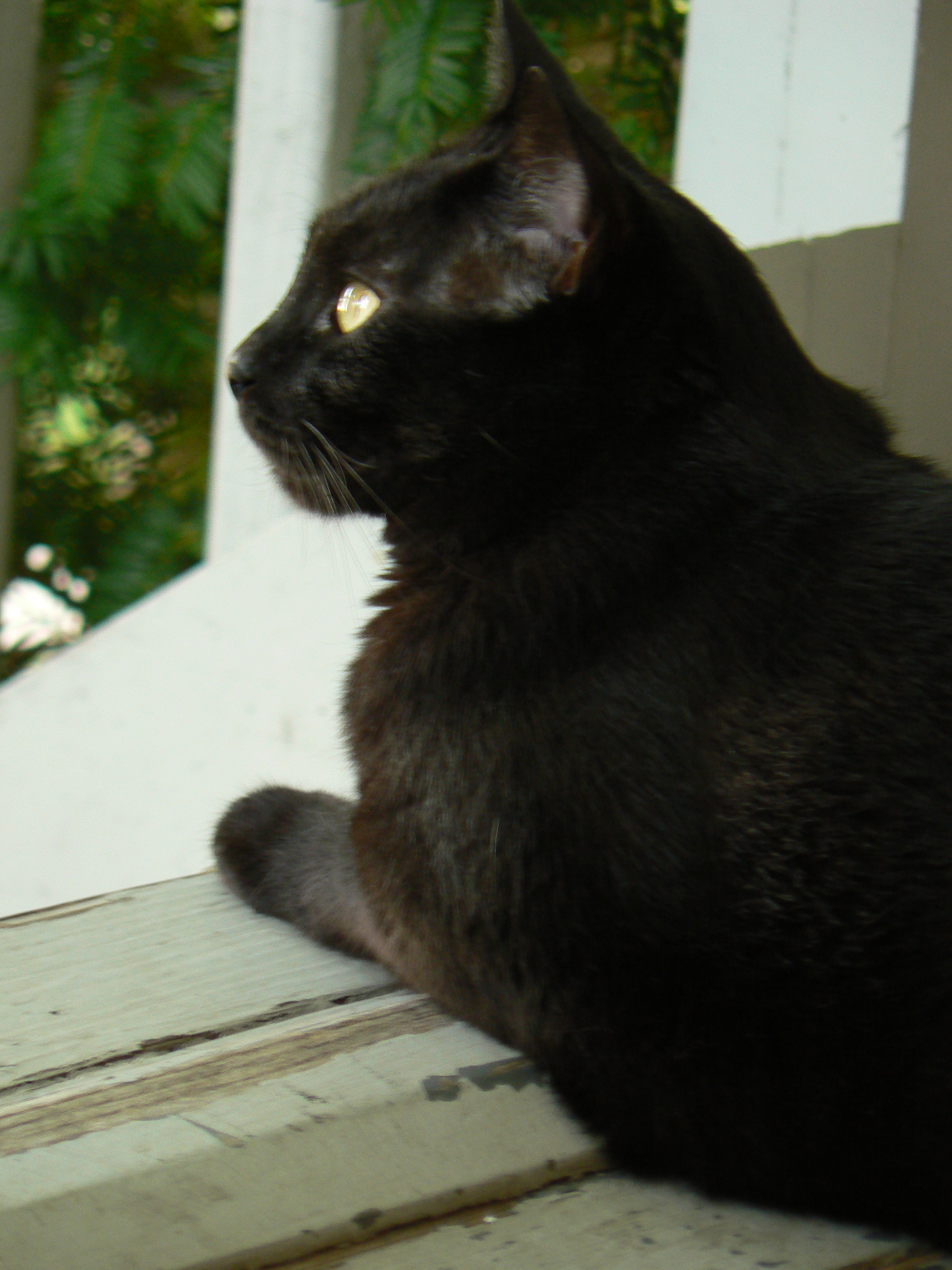
We got attached to Pinkle. She doesn't seem to miss us at all. Cats are very Zen.

What do we teach our children about attachment?  What do we teach ourselves?  When do we say, “Get over it” and when do we say, “That’s terrible!”  What do we do with a cultivated love for impermanent things?   I have a cultivated love of summer: warm temperatures, sunny skies, green things all around.  I feel the changes in the air, the shortening of the daylight hours and begin to suffer from my attachment a little.   I remind myself that I love Fall as well.  My very favorite colors in the universe show themselves wherever I look.   Rich red burgundies, intense golden yellow, muted soft green.  Then the branches are bare, and I begin to despair until the first gentle snowflakes against a night sky drop magic all around.  When it’s piled up 18 inches here in Wisconsin for the 8th week in a row,  I get SAD (S. A. D.) until a crocus peeks out bright green in the mud.   The cycle keeps turning.   Steve did an identity exercise some years ago that brought him to this conclusion: I am the joy in change and movement.  That has been his touchstone ever since.  I am beginning to relax and enjoy the change and movement in life and fight against it a little less each day.   Every day is pivotal and beautiful, just like that morning ten years ago.