Unknown's avatar

Alice Through My Lens

Blue eyes.  That was one thing that made her unique among 4 sisters.  She had our father’s eyes.   She was the shortest among us; I believe I grew to have at least a half an inch over her.  But that took a while.  Since she was 3 years older, I trailed behind her most of my life.  I definitely didn’t mind following in her footsteps.  I adored her.  She was the sweet sister, the kind one, the one who loved children and animals and had friends.  She somehow spanned the gap between being a nerd and being popular.  Not that she wasn’t picked on early in grade school.  We all were, and she was very sensitive to it.  When she was 10, she ran away from a boy who was chasing her down the sidewalk.  He caught up to her and managed to grab the back of her coat hood. He yanked her down hard, and she fell backwards onto the sidewalk, hitting her head and fracturing her skull.  The boy was sent to military school, and Alice recovered amid cards and gifts and angels surrounding her bed. 

She started dating first among us, though she wasn’t the oldest.  I wanted to learn how this “boyfriend” business worked, so I watched her very closely, sometimes through the living room drapery while she was on the porch kissing her date goodnight.  She modeled how to be affectionate in the midst of a distinctly cerebral family, shy about demonstrating emotion.  She gave me my first pet name: Golden Girl or Goldie, and then the one that stuck in my family, PG or sometimes Peej.  By the time I was 16, we were very close friends as well as sisters.  She invited me to spend Spring Break with her at college, and enjoyed “showing me off”.  She told me that the boys were noticing me and that she’d need to protect me.  I was thrilled!

Alice and Mike in Los Gatos, summer 1979

We spent that summer at home together in CaliforniaI introduced her to my new boyfriend, who eventually became my husband.   She begged our parents to allow me to be her passenger on a road trip back to campus at the end of the summer.  She had just bought a car, and although I couldn’t drive, I could keep her company, sing with her along the way, and be her companion.  The road trip was a travel adventure flavored with freedom, sisterly love, and the sense of confidence and brand new responsibility.  We flopped the first night in a fleabag motel in the same bed.  She woke earlier than I and told me as I roused and stretched how sweet I looked cuddling the stuffed bunny my boyfriend had bought me.  Then we stayed with her friends in Colorado.  Our next day’s journey was to go through the heartland of the country and hopefully, if we made good time, get to Chicago for the night.  We never made it.

Nebraska is flat and boring.  We’d been driving for 6 hours.  I was reclined and dozing when we began to drift off the fast lane, going 80 mph.  Alice over-corrected, and we flipped.  She had disconnected her shoulder strap, and flopped around, hitting her head on pavement through the open windowHer fragile, gentle head, with two blue eyes.  She was dead by the time we came to rest in the ditch.

Life is an experience, a journey of unexpected and unimagined happening, a verb in motion, not a noun.  Alice was in motion, at 20, and may be even now…somewhere, in some form.  I still taste her sweetness floating near me from time to time. 
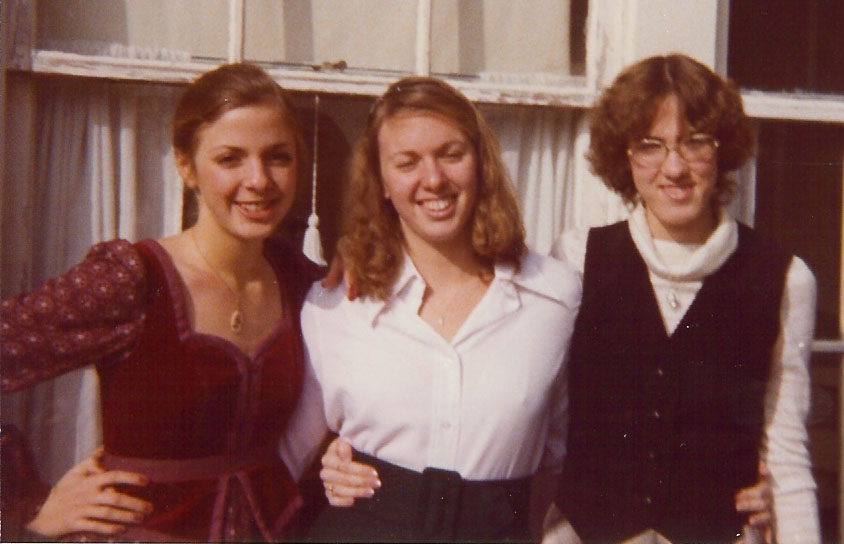
Three of four sisters, Christmas 1978
Unknown's avatar

The Man of My Dreams

A song from the past floats into my head as I’m falling asleep.  I’m a teenager, listening to one of the first albums I bought with my own money.  Barbra Streisand: A Star is Born.  It’s the end of the story.  Esther Hoffman Howard is a widow, taking the stage for the first time since the accident.  “With one more look at you…” she begins.  “I want one more look at you.”  I want one more chance to put it all together and make it make sense.

My husband Jim is in my dreams again.  But I don’t know I’m dreaming.  I can touch him.  I feel his hair, strangely coarse, actually, compared to the thick, loosely curled, soft stuff I remember.  But he’s there, in the flesh, inexplicably, and so am I.  I want answers.  How is it you’re here again, and so often?  Was I wrong when I thought you’d died?  Has there been a mistake?  Are you back for good?  Where, exactly, have you been?  Speak to me.

He begins to talk, and I hang on every word.  He is telling me the secrets of the Universe, of life and death, and I had better remember this accurately later, when I wake up.  When I wake up…does that mean that this is just a dream?  Logic gets all loose and wiggly again, and consciousness creeps back into my head.   Suddenly, I’m awake and sweating hot.  I’m in a room by an open window on a street in suburban Milwaukee.  And this doesn’t seem to make much sense, either. 

Anger. Denial. Bargaining. Depression. Acceptance.  What are the emotions driving these dreams?  What is my subconscious trying so hard to reconcile? I keep struggling for meaning.  I am angry, I suppose.  I deny that Jim died at the age of 47.  That was too soon.  It doesn’t fit into my perception of How Things Ought To Be.  I do not accept it.  Even now, more than four years later.  Although, even in my dreams, I know that he is dead, and that is Real. 

Enlightenment is, roughly, when you accept all that is…without the ‘you’.  Ego is inconsequential.  Acceptance, peace, wholeness.  All Is.  I guess I’m not at that point yet.  I work on it through the night.  I imagine Jim trying to help me out, but his input just confuses me.  And I’m still too involved, trying too hard to wrap my little brain around the incomprehensible.  How can I simply let it go?  Accept ambiguity.  Accept mystery.  Accept it all.  Accept.      Accept.

Unknown's avatar

Try a Triolet

Day #2 of NaPoWriMo today!

I am learning a lot.  The prompt for today is to write a “triolet”, which is an 8 line poem where lines 1, 4 & 7 are identical and lines 2 & 8 are identical.  The rhyme scheme goes like this: ABaAabAB.  Having never studied poetry, this is all new to me and fascinating to engage.  What do you do with a structure?  Play with it for a while, then take it apart and do something else, like with toy blocks?  There’s no “right” way to play, is there?  I think not.  So I go ahead and see what happens.

I was thinking about the repetitive nature of this particular pattern, and it reminded me of a conversation I had with Steve on a recent neighborhood walk.  We were talking about getting old, how older people spend their time until they die, the change in energy and the prelude to death.  My husband was technically “working” the day before he died, although by that time, he was working from home at the dining room table, from a laptop equipped with Zoom Text that made each letter on the screen about 4 inches high.  My father, in the advanced stages of Alzheimer’s, didn’t move or eat or do anything on his own.  He eventually succumbed to pneumonia after he lost the ability to swallow food without aspirating it.   My grandmother died in a nursing home rather uneventfully.  She had lived with us for several years before moving into a place that could care for her more comprehensively.  She spent her days watching TV in her room and would come to the dinner table and try to make conversation, often beginning with “They say….”  My father always insisted she cite her sources.  “Who says?  Where did you hear that?”

Our concepts of dying are so complicated and irrational.  What makes “sense” economically often offends morally.  Questions, decisions, choices, preferences and emotions arise.   What do we do with them?  How do we communicate our wishes for life and death?  To whom?  I don’t have any definite answers.  I hope I get to communicate what’s important to me to someone who is listening.  I hope my views are respected.  What that might look like, I cannot tell.  Steve mentioned casually at breakfast that he’d like Schubert’s Octet played at his funeral.  I asked him who he thought might be there.  He couldn’t even say.  I guess what matters is that I heard him when he said it.


Triolet for My Grandmother

There was nothing good on TV that day.

She turned her face toward the wall and died.

The years had slipped by while she wasted away.

There was nothing good on TV that day.

She’d listened and heard what they had to say.

They might have been right, but often they lied.

There was nothing good on TV that day.

She turned her face toward the wall and died.

(photo credit: Josh)

Unknown's avatar

Honoring My Father

George William Heigho II — born July 10, 1933, died March 19, 2010.

Today I want to honor my dad and tell you about how I eventually gave him something in return for all he’d given me.

My dad was the most influential person in my life until I was married.  He was the obvious authority in the family, very strict and powerful.  His power was sometimes expressed in angry outbursts like a deep bellow, more often in calculated punishments encased in logical rationalizations.  I knew he was to be obeyed.  I also knew he could be playful.  He loved to build with wooden blocks or sand.  Elaborate structures would spread across the living room floor or the cottage beach front, and my dad would be lying on his side adding finishing touches long after I’d lost interest.  He taught me verse after verse of silly songs with the most scholarly look on his face.  He took photographs with his Leica and set up slide shows with a projector and tripod screen after dinner when I really begged him.  He often grew frustrated with the mechanics of those contraptions, but I would wait hopefully that the show would go on forever.  It was magic to see myself and my family from my dad’s perspective.  He was such a mystery to me.  I thought he was God for a long time.  He certainly seemed smart enough to be.  He was a very devout Episcopalian, Harvard-educated, a professor and a technical writer for IBM.  He was an introvert, and loved the outdoors.  When he retired, he would go off for long hikes in the California hills by himself.  He also loved fine dining, opera, ballet, and museums.  He took us to fabulously educational places — Jamaica, Cozumel, Hawaii, and the National Parks.  He kept the dining room bookcase stacked with reference works and told us that it was unnecessary to argue in conversation over facts.

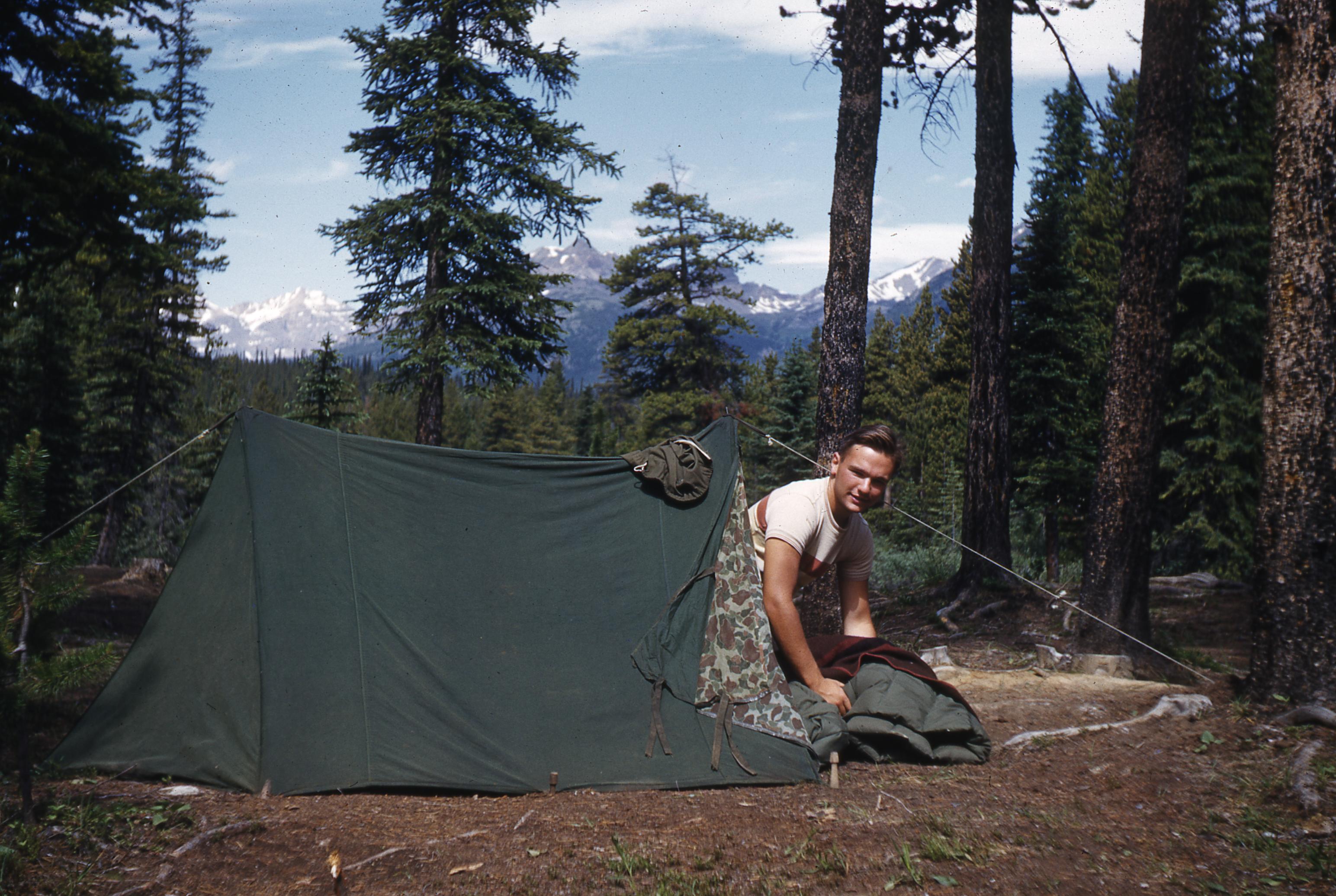
Camping in Alaska the summer after his senior year in High School: 1951.

My father was not skilled in communicating about emotions.  He was a very private person.  Raising four daughters through their teenaged years must have driven him somewhat mad.  Tears, insecurities, enthusiasms and the fodder of our adolescent dreams seemed to mystify him.  He would help me with my Trigonometry homework instead.

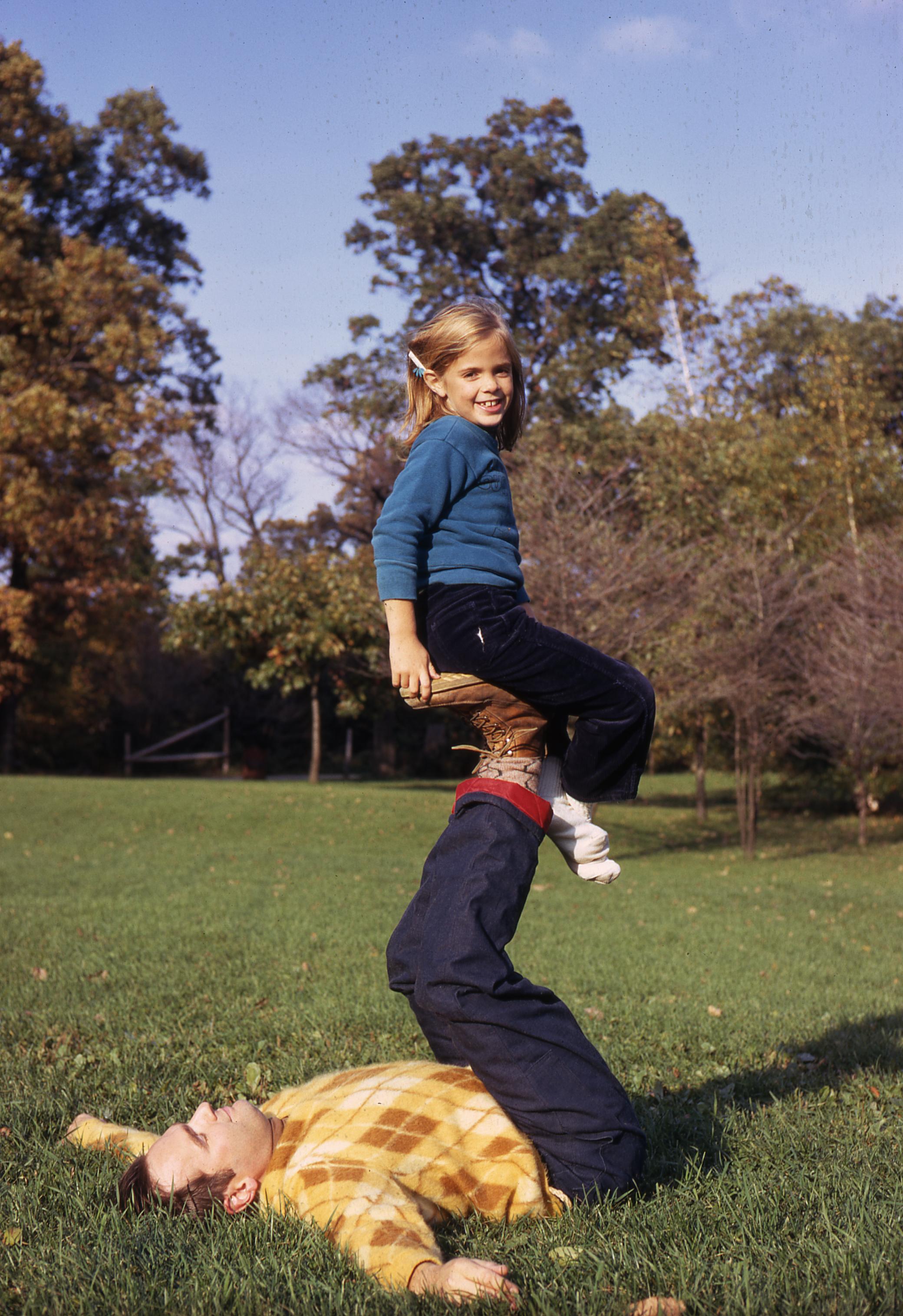
Playing with my dad, 1971.

I married a man of whom my father absolutely approved.  He walked me down the aisle quite proudly.  He feted my family and our guests at 4 baptisms when his grandchildren were born.  I finally felt that I had succeeded in gaining his blessing and trust.  Gradually, I began to work through the  more difficult aspects of our relationship.  He scared my young children with his style of discipline.  I asked him to refrain and allow me to do it my way.   He disowned my older sister for her choice of religion.  For 20 years, that was a subject delicately opened and re-opened during my visits.  I realized that there was still so much about this central figure in my life that I did not understand at all.

Grandpa George

In 2001, after the World Trade Center towers fell, I felt a great urgency to know my father better.  I walked into a Christian bookstore and picked up a book called Always Daddy’s Girl: Understanding Your Father’s Impact on Who You Are by H. Norman Wright.  One of the chapters contained a Father Interview that listed dozens of questions aimed at bringing out the father’s life history and the meaning he assigned to those events.  I decided to ask my father if he would answer some of these questions for me, by e-mail (since he lived more than 2,000 miles away).   Being a writer, this was not a difficult proposition for him to accept.  He decided how to break up the questions into his own groupings and sometimes re-phrase them completely to be more specific and understandable and dove in, essentially writing his own memoirs.   I was amazed, fascinated, deeply touched and profoundly grateful at the correspondence I received.  I printed each one and kept them.  So did my mother.  When I called on the telephone, each time he mentioned how grateful he was for my suggestion.  He and my mother shared many hours reminiscing and putting together the connections of events and feelings of years and years of his life.   On the phone, his repeated thanks began to be a bit eerie.  Gradually, he developed more symptoms of dementia.  His final years were spent in that wordless country we later identified as Alzheimer’s disease.

I could never have known at the time that the e-mails we exchanged would be the last record of my dad’s memory.  To have it preserved is a gift that is priceless to the entire family.  I finally learned something about the many deep wounds of his childhood, the interior life of his character development, his perception of my sister’s death at the age of 20 and his responsibility in the lives of his children.   My father is no longer “perfect”, “smart”, “strict” or any other concept or adjective that I could assign him.  He is simply the man, my father.  I accept him completely and love and respect him more holistically than I did when I knew him as a child.  That is the gift I want to give everyone.

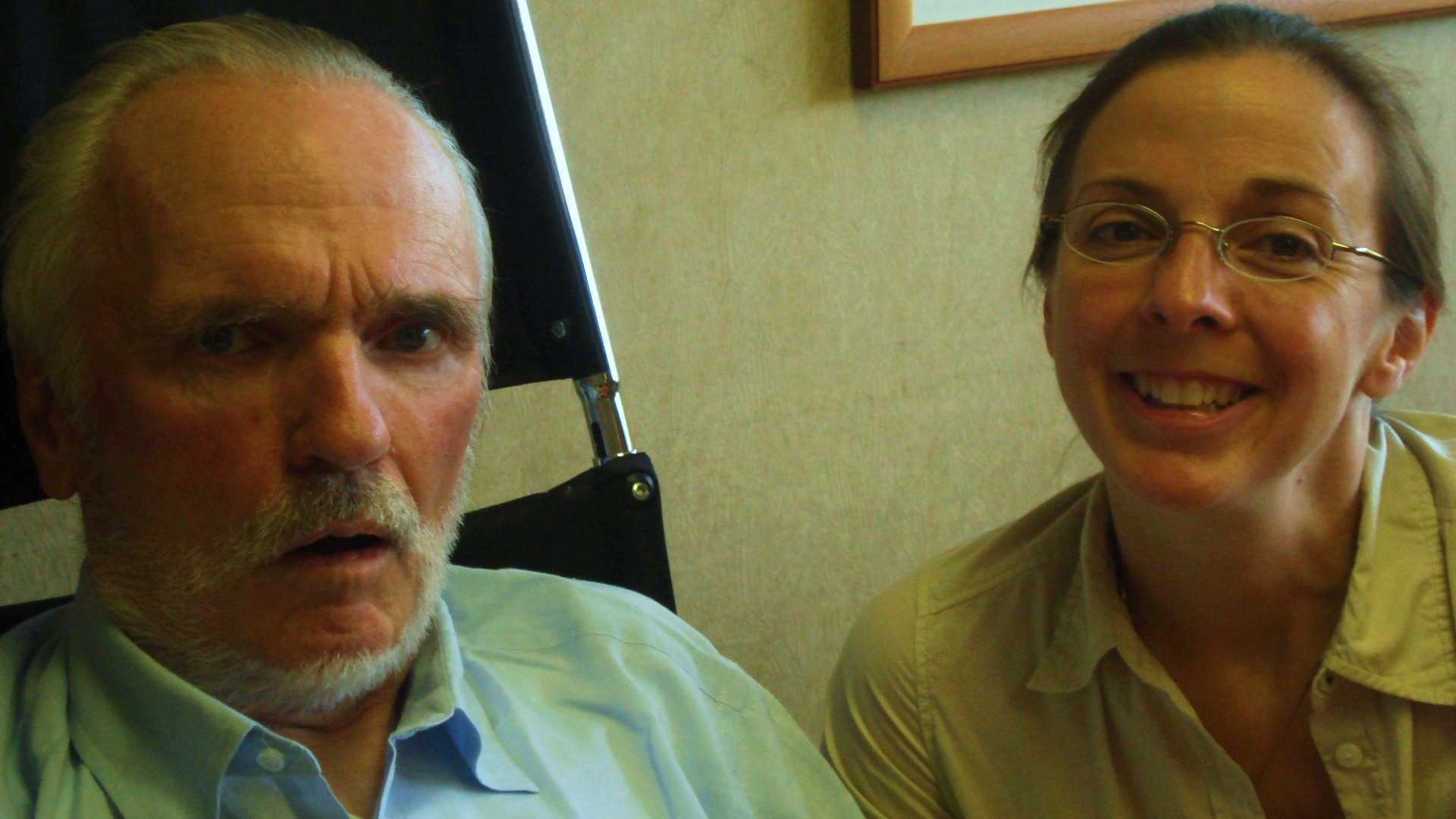
I will close with this photo, taken in the summer of 2008 when my youngest daughter and I visited my father at the nursing home.  I had been widowed 6 months, had not yet met Steve, and was anticipating my father’s imminent passing.  My frozen smile and averted eyes are fascinating to me.  That I feel I must face a camera and record an image is somehow rational and irrational at the same time.  To honor life honestly is a difficult assignment.  I press on.

Unknown's avatar

While You Were Sleeping

As usual, he called me at the office that afternoon while he was working from home.  “Hi.  How are you doing?”  I probably mentioned something about my ordinary frustrations on the job or something about our daughters.   Then it was down to business.  “What are you doing tonight?”  It was Friday night.  Our youngest had a rehearsal at a church only a few blocks from our house, starting about a half an hour after I got off work.  “Do you want to go out to dinner?”  “SURE!”  It was cold, the roads were icy.  We didn’t want to go far, so we dropped her off and went to a bar & grill  that had just opened behind the strip mall in our little town.  It was full of activity: TVs were on, people bustled about, artwork from the public schools was displayed on the wall.  There was lots to look at and hear.  The menu was new to us.  Teriyaki green beans sounded good.  So did fried artichokes.  I ordered a beer; I think he did, too.  We had sandwiches as well.  Then he got a call on his cell phone.  Our daughter was not feeling well and was leaving rehearsal early.  We said we’d meet her at home.  We all talked in the living room for a little while, as he sat on the couch gathering his strength for the climb upstairs.  He seemed pretty tired.  He’d come home from the hospital just 10 days earlier with 2 cardiac stents implanted.  In the bedroom, he turned on the flat screen TV, took his medications (all 23 of them) and hooked up his dialysis machine and his sleep apnea mask.   In our big, squishy bed, we watched an episode of “NUMB3RS”, and then the movie “Regarding Henry” came on.  I’d seen it before: Harrison Ford and Annette Bening in a good story about marriage, change and intimacy.  It complimented the mood perfectly.  We were feeling secure, companionable, close.  I fell asleep beside him, holding his hand.   I awoke at 6:30 AM.  His body was still and cold.

That day was exactly four years ago. What did he dream about that night?  Did he feel any pain?  Did he try to get up?  Did he try to call out or wake me?  Did he see a brightness as his neurons flashed for the last time?  Was it peaceful?  I can only imagine.

I can imagine him firing up feelings of love and bathing in them, floating on a surge of endorphins while images of his babies rushed by.  I can imagine him strolling an endless golf course of rolling green fairways, tree-lined and bright.  I can imagine him soaring with the tenor section in an angel choir, his energy trembling and resonating with clouds and stars.  I can imagine him satisfied and proud and smart and good and kind.  I can imagine him wrapped in the embrace of the Universe…forever.

I can imagine him, but can I know him any better, any more?  I still feel open to him, and as I continue to try to expand my awareness, I wonder about that.  I know that I don’t know what I might be able to know.  What is memory? What is sleep?  What is consciousness?  What is death?  Are they ‘real’?  I don’t know.  What is ‘real’?  What I know is that I don’t know.  What I feel is that he mattered and still matters.  I feel that he is.

Unknown's avatar

Playing Chess with Death

Last night, I watched Ingmar Bergman’s film “The Seventh Seal”.   There’s nothing like hitting a gray mood smack on the head with a black & white film about Death!  Yargh!  Into the breach, mates….

First of all, the photography.  Beach scenes, faces, clouds and silhouettes, clean, stark, intense.  They just put me in a mood to ponder dark and light without looking away.  Bring it!

Characters.  One of the questions Steve always asks after we watch a film together is “which character do you think is most like you?”  The characters in this film are icons of human stereotypes, in a way, but rather like the roles in a medieval morality play.  The knight is questing, always.  He wants to know and understand; his intellect is never satisfied.  Steve has a lot of that in him.   Jof, the juggler, is a childlike observer.  He is easy-going and happy, and he has visions.  He sees with his heart and doesn’t understand why others don’t see what he does, but he doesn’t preach about his visions, he writes songs about them.  I think Steve has some of that in him, too.  I identify with Jof myself.  The squire is shrewd, ironic, confident and direct.  He seems very grounded in his ego.  There are some other players, more simply drawn: the actor, the cuckold smith and his loose wife, Jof’s young wife and their baby, a silent girl who attaches to the squire, a witch and of course…Death.

How each of these folks engage with Death is fertile ground for the imagination.  If you’re questing, trying to find answers, strategically engaging Death in a game of chess, what is the lesson you are likely to learn?  That Death doesn’t have any answers, but he’s going to win the game.  And how would you take that?  It makes me think of my younger days, when I was in the throes of religious fervor, convinced that I was learning the big answers to the most important questions.  I wrote terribly pretentious poetry and harbored judgments about everything.  I thought I was going to “figure it all out” eventually.  That was after Death’s first visit to me, and before his second.  I had a few close calls in between that made me think I might be on the right track.  His re-appearance convinced me that I wasn’t really onto anything.  So, the questions remain.  I like how the knight gets increasingly comfortable with inviting Death to sit down and join him.  He learns a few things, he postpones the inevitable, he diverts Death’s attention away from his friends for a while, and he even shows Death that he can be happy while they play.  I am learning from his example.

The scariest part of the film is the depiction of fear itself.  The wailing and flailing and pleading for mercy is utterly desperate and triggers all kinds of panicky feelings in me as I watch.  I do NOT want to slide into that.  That’s the worst evil in the film.   Those people are being tortured and destroyed from the inside out.  It gives me the shivers!   This is a great example for me, too.  I don’t have to engage with Death in this manner.  I have other options.

The storm scene reminded me of a camping trip we took one spring.  After a balmy evening, a thunderstorm rolled in from across the hills to the west.  The sun had set and it grew quite dark, but just over the ridge, the lightning blazed up like bombs in a great war.  It was like watching a WWII movie, all black and white explosions in the distance.  And we were the only campers in the park, in a little nylon tent.   I was kind of scared.  I thought about doing the “safe and prudent” thing, striking camp and driving away.  Steve asked me, “Why?”  Well, because something bad could happen!  Bad like what?  We could get wet.  We could get hit by a falling tree or lightning.  We could, but it’s not highly likely.  We could just watch it and see what we learn.  And we can always get in the car, too, if we want.

So we stayed.  We did get wet.  We eventually went to the car.  We went home the next day.  But we saw the most amazing light show and felt the wind and heard the rain fall on every surface with a different sound.   And we experienced it together, present, honest, alive.   Take that, Fear!  Check!

Unknown's avatar

Stressed for Success?

My very astute sister once pointed out to me that all stress is not created equal.  There’s daily stress, the normal result of a body functioning without rest for 16 hours or so, which is alleviated after 8 hours of sleep.  There’s distress, which gives us the feeling of being overwhelmed or upset by the amount of stress we experience, and then there’s eustress, which according to Wikipedia is “a term coined by endocrinologist Hans Selye which is defined…as stress that is healthy, or gives one a feeling of fulfillment or other positive feeling. Eustress is a process of exploring potential gains.”  Examples of eustress could include climbing a mountain, running a marathon or sky-diving.  Or surviving a nautical disaster.

I was intrigued by a comment I read from one of the survivors of the cruise ship, Costa Concordia, that sank in the Mediterranean this past week.   ABC News reported:

‘Australian miner Rob Elcombe and his wife, Tracey Gunn, told Melbourne’s Herald Sun Newspaper they booked a spot on the Concordia as a last ditch effort to save their marriage.  Instead, the couple found themselves trying to save their lives when they boarded the very last lifeboat to leave the ship with survivors. “This has made our bond much, much stronger,” Elcombe told the paper. “Who needs couples counseling, when you survive a Titanic experience?” ‘

An adventure.   Stress worked into a feeling of gain.  Is it possible to turn your distress into eustress?

Peace like a river

Another news story I ran across came under this headline: Wife Slips Into Madness As Husband Dies of Brain Tumor. (ABC News)  Catherine Graves wrote a book called Checking Out: An In Depth Look At Losing Your Mind describing the distress of caring for her husband.  The headline rather sensationalizes an experience of overwhelming stress that is shared by a lot of people who find themselves in the role of caregiver.  I can relate.  I went through depression and Post Traumatic Stress Syndrome during my husband’s illness and after his death.  Like Mrs. Graves, I was widowed at 45.  But did I lose my mind?  Not irretrievably, I don’t think.  Maybe what I’m doing now, being unemployed, slowing down, is my way of turning that distress into eustress.

There’s an old hymn that I’ve affectionately heard referred to as “The Playtex Hymn” (after the girdle).  The first line is “How firm a foundation, ye saints of the Lord, is laid for your faith in His excellent Word”.   It was written by John Keith in 1787.  My favorite verse goes like this:

“When through the deep waters I cause thee to go,
The rivers of woe shall not thee overflow;
For I will be with thee thy trouble to bless,
And sanctify to thee thy deepest distress.”

For some reason, singing that verse always causes me to choke up with emotion.  I know how it is to feel like I’m drowning.  I have a gasp reflex that reminds me of this almost daily.  It shows up lightning fast in moments when my reptilian brain senses danger.  It first became noticeable when I was trying to teach my kids to drive.  I would gasp and grab the handle above the passenger side door at the slightest correction of the steering wheel or touch of the brake.  It happened to me again just this morning.  I was stacking packages on the table and the tower toppled over.  I gasped.  “I must be drowning!” I laughed.  It’s probably a rather annoying habit for those who live with me.   I appreciate their patience.

There’s another hymn that follows this theme.  “It Is Well With My Soul” was written by Horatio Spafford in 1873.  The story behind it is quite amazing.  In brief, according to Wikipedia:

“This hymn was written after several traumatic events in Spafford’s life. The first was the death of his only son in 1871 at the age of four, shortly followed by the Great Chicago Fire which ruined him financially (he had been a successful lawyer). Then in 1873, he had planned to travel to Europe with his family on the SS Ville du Havre, but sent the family ahead while he was delayed on business concerning zoning problems following the Great Chicago Fire. While crossing the Atlantic, the ship sank rapidly after a collision with a sailing ship, and all four of Spafford’s daughters died. His wife Anna survived and sent him the now famous telegram, “Saved alone . . .”. Shortly afterwards, as Spafford traveled to meet his grieving wife, he was inspired to write these words as his ship passed near where his daughters had died.”

And here’s the lyric:

When peace like a river, attendeth my way,
When sorrows like sea billows roll;
Whatever my lot, Thou hast taught me to say,
It is well, it is well, with my soul.

I am trying to re-train my brain to believe that my deepest distress can be sanctified.  I don’t think this is an exclusively Christian perspective at all.  The Noble Truths of Buddhism are all about addressing the suffering (distress) of this world and how we think about it.   I hope that as I “explore potential gains”, my drowning will become floating, and all will be well with my soul.

Unknown's avatar

The Rose

I think I have a pretty active dream life.  I usually remember something of my sleeping hours upon awakening.  Perhaps that indicates the level of my anxieties and neuroses; I’m not sure.  Steve says he hardly ever dreams, and he thinks it’s because he is so aware of his conscious mind while he’s awake.  Well, fine for you, then.  I blink my eyes open and forget where I am.  I need decompression time every morning.  My dreams almost always include my late husband, who has been dead almost 4 years.  It gives me a rather fluid sense of reality.  Jim is real and Steve is real, they’re just never real at the same time, in the same place.  Is that weird?  Oh, probably.  I’m getting used to it.

The other thing I do in dreamland is sing.  I wake up singing a song, or with a song stuck in my head.  This morning, it was “The Rose”, a song Bette Midler recorded some years back.  I think I learned it from one of my kid’s elementary school music programs. The line I was stuck on went like this: “Some say love, it is a river, that drowns the tender reed.  Some say love, it is a razor, that leaves your soul to bleed.  Some say love, it is a hunger, an endless aching need.  I say love, it is a flower, and you, its only seed.”

Now why in the world would something like that be dominating my waking transition?  I thought about that for a while.  Then I began to cry.  This is how I know when I’ve hit on some repressed emotion, some way that I think about myself that I don’t like to admit.  For some reason, I was associating with that tender reed, drowned in a river of love.  I was 15 when I met my husband, 21 when we married, 45 when I was widowed.  My youth was engulfed in loving him.  I don’t feel a great resonance with the bleeding soul bit.  Ah, but the hunger, the aching need; yeah, that gets to me, too.  I feel that for my kids as well.  I call it “yearning”.  I yearn for my kids all the time, no matter where they are.  It’s a visceral thing.  I once learned in a Bible study that there is a Hebrew word for God’s loving-kindness that translates to a verb form of the same word that’s used for a mother’s womb.  Womb-love.  God “wombs” us.  I “womb” my kids.  I also “womb” my dead husband.

Now the last line of that first verse, I will take exception to.  “You, its only seed” just sounds too exclusive and attached.  It doesn’t fit the scope of the rest of the song, either, in my opinion.  Second verse: “It’s the heart afraid of breaking that never learns to dance; and it’s the dream afraid of waking that never takes a chance.  It’s the one who won’t be broken, who cannot learn to give; and the soul afraid of dying who never learns to live.”  Okay, you could probably guess that verse gets to me all over (see yesterday’s post).  Although, in my case, it’s the heart that once danced, the dream that once dared, the one who gave everything already who is afraid to live again and invest all that…again.  So, here’s the key change and the big finish: “When the night has been too lonely and the road has been too long, and you think that love is only for the lucky and the strong, just remember in the winter, far beneath the bitter snows, lies the seed that with the sun’s love, in the spring becomes the rose.”   At this point, I want to give credit to Amanda McBroom who wrote these lyrics.  Good job.  I love the idea of seeds beneath the snow.  It appeals to the naturalist in me, even though we STILL don’t have any snow this winter in Wisconsin.  I love the idea of hope and new life.  And this is where I get to re-write that last line in the first verse.  The seed of love isn’t a person.  It’s LIFE, life itself.

Steve and I were talking about this yesterday as we drove out to hike the Ice Age trail.  He was urging me, again, to talk about what I want in life, how I want to live, why I want the things I might want.  “Why do you want to have land and grow food?”  I want to nurture living things; I loved raising kids.  I loved because they lived.  I want to live life loving.  Whatever I do.  It’s a cyclical thing, the flower that comes from a seed and begets more seeds that become more flowers.  Life begets love which nourishes life…and so on.  Okay, maybe this is sounding like drivel to you.  There is something going on here, though, and it’s about a flow of energy passing from living thing to living thing, and some of us call it love.  I don’t like the idea of that energy being confined to one “beloved”.  That’s where I think I’m getting stuck.  I say love, it is a flower and all of life can be its seed.

There.  Sorry Amanda, but I have re-worked your song so that it fits my dreaming and waking life a little better.  Hope you don’t mind.

Unknown's avatar

The Power of Concepts

Steve and I have been talking about concepts lately.  We humans think conceptually, like it or not.  Words, thoughts, concepts and the associations they suggest invariably bring with them emotional reactions and suffering.  Trying to leave concepts behind, or to do without them somehow, is what “enlightenment” points to…I think.  Maybe it’s not so much trying to eradicate them as it is to acknowledge their fabrication and refrain from investing them with a lot of meaning or credence.

The most troubling concept for me is death or mortality.  I have huge emotional associations with that concept that do tend to exert a lot of influence on me.  And yes, this causes suffering.  I suppose I can say that I come by this honestly, having had both my sister and my husband die at my side during my lifetime.  Consequently, I often feel the weight of a burden hanging around my head and shoulders, casting a shadow over my footsteps, causing me to be slow and rather plodding instead of eager and light on my feet.  You might call this a certain level of pervasive depression.  I find that, as I get older, I am more circumspect, less enthusiastic, and can easily convince myself out of an adventure.  I can never dismiss the danger of death with a casual “Oh, that’ll never happen to me!”  Instead, I tend to think: Why bother?  What’s the point?  Why start anything now, with the end so near in sight?  That kind of thing.

Let me direct your attention to Exhibit A:  Stephen Hawking.

As many of you know, Dr. Hawking celebrated his 70th birthday today.  When he was 21, and shortly before his first marriage, he was diagnosed with ALS (Lou Gehrig’s disease) and told that his life expectancy was about 2-3 years.  “Why start anything now?” was a question that occupied his thoughts to some extent as he wrestled with the idea of starting his doctorate.  Wikipedia reports that the turning point came with his marriage. “When his wife, Jane, was asked why she decided to marry a man with a three-year life expectancy, she responded, ‘Those were the days of atomic gloom and doom, so we all had a rather short life expectancy.”‘

We all still have a rather short life expectancy.  None of us has a guarantee on the next minute.  What do you do with that concept?  “Refrain from investing (it) with a lot of meaning or credence.”  What do you invest in?  Your passion.  Your bliss.  That’s what Stephen Hawking did.  The speech he would have delivered today in person included this admonition: “Remember to look up at the stars, not down at your feet. Try to make sense of what you see and wonder about what makes the universe exist. Be curious.”

I took a walk along the Ice Age Trail at dusk.  Driving home, I asked Steve to pull over at a cornfield so that I could look up.  Here’s what I saw:

And this is just with my own myopic vision through some vari-focal glasses and a point and shoot digital camera.  I am curious about my experiences.  I am curious about how I think about them.  In the end, though, I think I want to concentrate mostly on being aware of being alive.

Unknown's avatar

Bridal Wave of Memories

On this day 28 years ago, I was married to my high school sweetheart in my parents’ church in northern California.  I was 21 years old.  Jim was 23.  I wore the veil that my mother and grandmother wore on their wedding days.  I wore the hoop petticoat that my mother wore in 1955 under her similarly long-sleeved and high-colored wedding gown.  I also wore the wedding present Jim had given me a year before: a beautiful cameo pin that he had purchased on the Ponte Vecchio in Firenze.  My dress had been made by a local seamstress using pattern ideas, material and trim that my mother and I had picked out.  My mother and I selected the caterer, the photographer, and the florist together.  My mother secured the musicians: a flute player she knew to play in the church with our organist, and a jazz trio to play at the reception.  My parents issued the Banns of Marriage in the bulletin of the mass the week before my wedding, inviting everyone in the parish to attend.  The reception was held in the Parish Hall behind the church.

My bridesmaids included my two older sisters and two friends.  Jim’s groomsmen included his half-brother, my brother, and two friends.  We selected other friends to participate in reading the Scriptures.  Since we knew so many semi-professional singers personally, we decided not to have any soloists.  Instead, we included congregation hymns that we could all sing together.  The whole affair was pretty simple, but elegant, and definitely traditional.  I did not have a manicure or pedicure, I did my own hair and make-up, we did not have a DJ or MC or dancing.  I did throw my bouquet, but I gave my garter to my husband…to keep.  We did have lots of champagne and loaded the unopened bottles into the station wagon (nothing like a limo) when we took off afterwards for our honeymoon, driving back down to Southern California where I would continue the second semester of my senior year at college.

My grandmother was appalled that Jim and I arranged to meet each other the morning of our wedding day to drive out to a county arboretum and spend some time together.  She kept insisting that it was bad luck for the bride to see her future husband before joining him at the altar on her wedding day.  She also kept asking if someone was going to sing “I Love You Truly” at the service.  These were not the traditions that we were interested in honoring, though.  We were not about superstition or sentimentalism, or so we thought.  We wanted to be sacramental and sincere.  I suppose there are slippery slopes and fine lines involved in those distinctions.  What I do remember thinking about is how to conceptualize a lifetime together.  I figured that might be 50 years or more.  I could barely conceptualize the two decades I had actually experienced.  I realized that it had to come down to faith.  I couldn’t imagine or predict what our marriage would be like.  I could only promise  to live it moment by moment as lovingly as I could “until we are parted by death”.  I did that to the best of my ability, I believe.  That parting occurred almost four years ago, now.

January is often a month of looking into the future, making uncertain plans, vowing to try to live in particular ways.  “Pointing your canoe”, as we like to put it.  Don’t let it frighten you.  Paddling is slow work, with plenty of time to correct, re-align, look around, and get inspired.  You can even drift for a while, if you like, without causing harm.  Forgiveness can arise.  Consequences will arise as well.  There’s no need to cast blame.  Look lovingly on the scene, on yourself, on your partner, on the world.  I enjoy marking the milestones, and I’m finding I even enjoy moving on.