Unknown's avatar

A Magical Bond

Last night we watched Werner Herzog’s film “Grizzly Man”, an amazing documentary featuring Timothy Treadwell’s video footage of grizzly bears in Alaska.  He spent 13 summers among them, mostly alone, and eventually he and his girlfriend were attacked and eaten by one.   This man was quite a character — often childlike, flamboyant, furious, arrogant, gentle, fearless and completely whacked.  At the core, though, he seemed to be straining toward a connection he deeply valued.  He wanted to bond with the bears, he may have even imagined he could become a bear.  It approximates a desperately unrequited love.  His affection for them (and for the foxes that follow him around and play with him like puppies) is palpable, although sometimes articulated in a corny, self-help guru fashion.  “Thank you, Mr. Chocolate, for being my friend…”  Okay, Fred Rogers he’s not; more like Richard Simmons.  It’s kinda weird.  But, still, he loves them; he would rather die with them than be anywhere else.  The pristine wilderness shots convey the aching beauty of the ideal.  The close ups reveal more reality: flies cover the lens and buzz around the speaker without ceasing.  Then there’s the inherent danger.  Treadwell is aware of the risks he’s taking; he talks about them quite theatrically to the camera, but they do not seem important.

Is he nuts?  Is he an idealist?  Is he wrong?  Is he inspiring?  What do we tell our kids about such passions?

I led 4 small groups of Boy Scouts on nature hikes this morning.  They were earning their Webelos Naturalist merit badge.  I had one directive: teach them about decomposers, producers, and consumers.  I added a goal of my own — introduce the Four As: awareness, appreciation, attitude, action.   For 10-year-olds, I thought this might fly.  I suppose I secretly hoped to see some of that childlike enthusiasm, the wonder and joy that can be ignited by spending a half hour on the trail.  Well, there weren’t many ‘Eureka!’ moments.  I forgot that boys can get more interested in hitting things with sticks and calling each other names than looking at mushrooms and picking up litter.   ‘Awareness’ to them meant “look out for things that could hurt you” instead of “look out for everything because the world is awesome!”  I think I may have impressed some of them by leading them to a decomposing deer carcass.  That may have provoked a “Cool!” from a few.  I wish I could do a one-on-one hike, take more time to slow down and eliminate some of the group social pressures, but these kids come with a program, so I only get one shot with a group of 8 for 30 minutes.   I wish I had taken more time to do this with my own 4 kids.

One thing to be aware of at Wehr

How do we bond with nature?  Will we ever fit in?  Are our brains just too big to allow us play nicely in the sandbox with the rest of the world?  Will we always be too distracted, too confused, too technological, too exploitative, too manipulative, too dominant, or too tasty?  I have to admit that to survive for 13 summers in Alaska among grizzlies is probably about the best record on that front.  Jane Goodall’s 45 years spent among chimpanzees is another monolithic example.   Will there be anyone like that in this next generation?  I can only hope…and volunteer to take as many as I can out on the trails.

Unknown's avatar

Homework

So here’s my assignment for the week: write a description of one of the characters who will be in your memoir.  Here’s what I have written.

“When I met Jim, he was a warm, charismatic 17-year old. Everything about him was golden and good. He was an A student parented by professional educators, a member of the Mormon Church who spent an hour in seminary every day before school, an athlete competitive in tennis, a baritone soloist with the school choir, a blue-eyed blonde with thick, curly surfer locks and a regular California dream. And the crowning touch? His grandfather was an Italian immigrant. I was introduced to him at our high school’s International Talk-In, where locals were given the opportunity to mingle with exchange students. I was then the Vice President of the Italian Club, a thorough Anglo hopelessly enamored of all things italiano. My best friend at the time, the President of the Club, Lynn Panighetti, introduced us. Jim enclosed my right hand in a bear paw and then wouldn’t let go. His long lashes fluttered in befuddlement as he pretended our hands were magically glued together. He was a flirt, a funny one, and I was instantly flattered and powerfully attracted.

His right hand was broad with short, stubby fingers. He would later lament how often he “fat fingered” the keys of his computer. He had a scar on his fourth finger from a machine accident he had while working in a cannery at age 15. He told me after we’d been dating for a few years that I could have all of him except the thumb and two middle fingers of his right hand – he needed them for bowling. Eventually, he qualified for PBA membership; he always pushed himself to achieve the highest level possible in any of his pursuits. His hands matched the rest of his mesomorphic frame. At 5 feet 8 inches tall, with a massive barrel chest, he resembled a friendly teddy bear, especially to my 15-year old eyes. I nicknamed him Winnie the Pooh.

Thirty years later, that stocky body was swollen with toxins and dialysis solution as a result of his failing kidneys. His barrel chest sported a 6-inch scar where they had split his sternum to perform double bypass surgery on his 31-year old heart. A longer scar down his right calf marked the place where they had harvested a vein for the graft. The kids called his lower legs “cankles” because they looked like calves and ankles combined after neuropathy and edema developed. His polar bear feet with the sideways little toes were in pretty good shape for a diabetic. He had lost only one toenail to ulcerating infection. His hair was still thick, too short to be very curly, and just barely graying at the temples. His beautiful Italian mouth fringed by the ginger mustache looked about to smile, but it wouldn’t. His ears were blue with what our daughter identified as ‘circumaural cyanosis’. (“See, Daddy, I’m really smart,” she sobbed.) He was dead.”

I have become rather moody while taking this course.  Finished Joan Didion’s memoir about her husband’s death (The Year of Magical Thinking) last night and did a little research.  Her only child died at the age of 39 just a month before it was published.  Recent images of her are gaunt and haunted.  Interesting that she was an Episcopalian, like me.  Her New York life reminds me a little of Madeleine L’Engle’s (another Episcopalian), but she is more neurotic, less serenely spiritual.   L’Engle’s memoir of her marriage to actor Hugh Franklin was a favorite of mine about 20 years ago.  (Two-Part Invention)  I feel rather like I’m swimming in the shallow end of their private pool.

Unknown's avatar

Affairs of the Heart

“Sudden massive coronary events” are dominating my thinking lately.  I am reading Joan Didion’s account of her husband’s death in The Year of Magical Thinking and recently browsed the pertinent pages of Ekaterina Gordeeva’s book My Sergei while waiting for Steve to glean salable items from Good Will on Tuesday.   I am also writing my own memoirs of my husband Jim in a Continuing Ed course.  What struck me this morning was the role of the grieving person’s best friend as hero.  Not the knight-in-shining-armor type hero, but the simple, calming presence modelling a way to be.  In a moment when shock obscures all notions of how to act, having a trusted person exhibit some caring, helpful behavior is a distinct grace.

My mother was that hero to me when my sister was killed in a car crash.  She and I were traveling across country together, enjoying the freedom of being 20 and (almost) 17 when it happened.  My mother cobbled together connecting flights to reach me in Nebraska the next morning.   She got me discharged from the hospital and set up in a hotel with her while she went through all the details of bringing Alice’s ashes back to California.  We went to the mortuary the next day.  I was still rather zombie-like while my mother handled the business.  Then the director asked us if we would like to see the body.  “Absolutely,” was my mother’s reply.  For some reason, I hadn’t realized that was why we were there.  I hesitated.  Mom led me into the room while the director closed the door.  “Oh, honey,” she sighed as she approached the table.  “No, she’s not there.  She’s gone.  Look here…” she began to comment on Alice’s wounds, on her swollen face and how old she looked, as if she were a battered wife decades in the future.  My mom said something about all the suffering her daughter had been spared.  Then she tenderly bend down and kissed that pale, waxy forehead.  My mother has never looked more beautiful to me in all my life than she did at that moment.  Strong, compassionate, wise and incredibly beautiful.  I wanted to be like her, so I kissed my sister’s forehead, too.

My mom (photo credit DKK)

Gordeeva writes about her coach, Marina, prompting her to go into the ICU room where her husband lay.  “Don’t be afraid.  Go talk to him.  He can still hear you.”  She goes in and begins to unlace his skates, a normal gesture that helps loosen her words, her tears, her emotions.  I remember our priest asking me and two of my daughters if we’d like to anoint Jim with some olive oil, bathe his face, and prepare his body to be taken away.  It was a relief to excuse ourselves from the people downstairs in the living room and go up to him together, to say our goodbyes together, to touch him one more time.  I am so grateful someone thought of allowing us that right then.  We had another opportunity to say goodbye to his body at the funeral home later when my two other children came home.  By then, I could take the lead with them and encourage them to approach.  I can’t remember who started humming “Amazing Grace”, but we all joined in, musical family that we are, and swayed together, arms and bodies entwined.

In the aftermath of Jim’s death, my youngest daughter and I fought frequently.  I didn’t know how to talk to her, to listen to her anger directed at me and recognize that she wasn’t hateful, only grieving.  Steve was the one who suggested that she was hurt, not hurtful and agreed to sit by me while we attempted an honest conversation.  My instinct was to run away.  I was grateful to observe someone who could be calm and present, reasonable and compassionate in the face of powerful emotions that frightened me.  He is adamant about not rescuing me, but equally determined to be the best friend he can be.

I hope that I will have opportunities to be a great friend to someone in grief.  I would like to be a conduit of such grace.

Unknown's avatar

Morning Pages

With the time change, morning daylight becomes precious.  It’s dark by 5pm now, so I like to get up and get going early.  My partner, however, stays up working late into the wee hours and sleeps in.  I woke up at 7, but decided to stay in bed.  Early morning brain work is often my most productive, so I just lay there and thought about my Memoirs assignment.  How would I describe my late husband in detail?  As I pictured him from toe to head, each part brought back associations and memories spanning the 30 years we were together.  Doing this in the quiet, safe, wordless place where I sleep was a great indulgence.  I didn’t feel the need to come up with verbiage or sentence structure or decide what might be better left unsaid.  My brain wandered through different decades and moments without the need to assign chronology.  In this floating place, I felt more connected with his entire person, without delineation.  When Steve rolled over, I put a hand on his shoulder and suddenly began to weep.  Why just then?  Perhaps the absence of tangibility in my relationship with Jim just would not be denied at the moment I became aware of touch.

We are still one.

He sat at the edge of the bed, his naked back to me.  He was working up to rising, about to stand on his unsteady, swollen, deadened feet and shuffle off to the bathroom.  Something prompted me to scoot forward and wrap my legs around his waist and lay my cheek between his shoulder blades.  “You will always be the love of my life,” I whispered.  “You know that, don’t you?”

He did.  He does.

Unknown's avatar

To Ad or Not To Ad

That is the question: whether it is nobler to support the hosting web manager directly or to suffer the slings and arrows of outrageous advertisements that defray his costs.  Or to take up arms against capitalism and occupy cyberspace, thereby ending it.

My apologies to the honorable Bard.  I woke to a dilemma this morning when my sister noticed a “goofy” ad showing up on my blog that was totally incongruous to the serious, graceful tone that I’m trying to achieve.  I found out that through the Terms of Service that I agreed to when I started this blog, I had given my permission for WordPress to run ads on my page to defray their costs.  If I want to ensure that there will be no ads on my blog page, I can pay a yearly fee of about $30.  So much for the idea of truly “free” hosting.   To be fair, though, this is only the second time since August I have seen an ad on ANY blog that I’ve visited.  I suppose I harbor a vain hope that there is a way to avoid capitalism in my daily life, and unfortunately, that is just not possible.  What I do have is choices about how I will interact with this system.

What kind of choices do I get to make?  Well, I can choose to avoid advertising by paying the fee, like I would do with Public Television (if I had a TV).  I can choose to support local small businesses, like the family operations that fixed my car this week.  I can choose “no ad” products at the market and avoid mega-stores and franchises.   I can unsubscribe to all the junk mail I get online or through the Postal Service.  Come to think of it, I need to find a better way of doing that.  I am still getting junk mail in my late husband’s name at my current boyfriend’s address, which is kind of creepy in an absurd sort of way.  It will be four years in February since he died.  How do you turn that sewage off??

The fact that advertising is so ubiquitous is one of the things that makes it so objectionable.  We are bombarded to the point that we stop paying attention.  Our awareness is compromised, and that goes against the very thing I am trying to develop in my life.   How many advertisements do you see in your average day?  If someone came up with statistics about how many you encounter, how much time you spend reading them or viewing them in video, how much time you spend trying to dispose of them or avoid them, how much money you spend funding them (whether directly or indirectly), and how much noise and visual pollution they add to the environment, don’t you suppose you’d be surprised?  Possibly appalled?  Angry? Or wouldn’t you care?

I think that the sheer volume of advertising and the phoniness of it creates an atmosphere that is potentially damaging to the human spirit.  I want to point my canoe in another direction entirely.  My relationship with my blog host is not one that will allow me to get away from using currency, but I can get away from using advertising.  I wish I could trade singing lessons or a home cooked meal for the use of cyberspace. … Yeah, that would be neat.

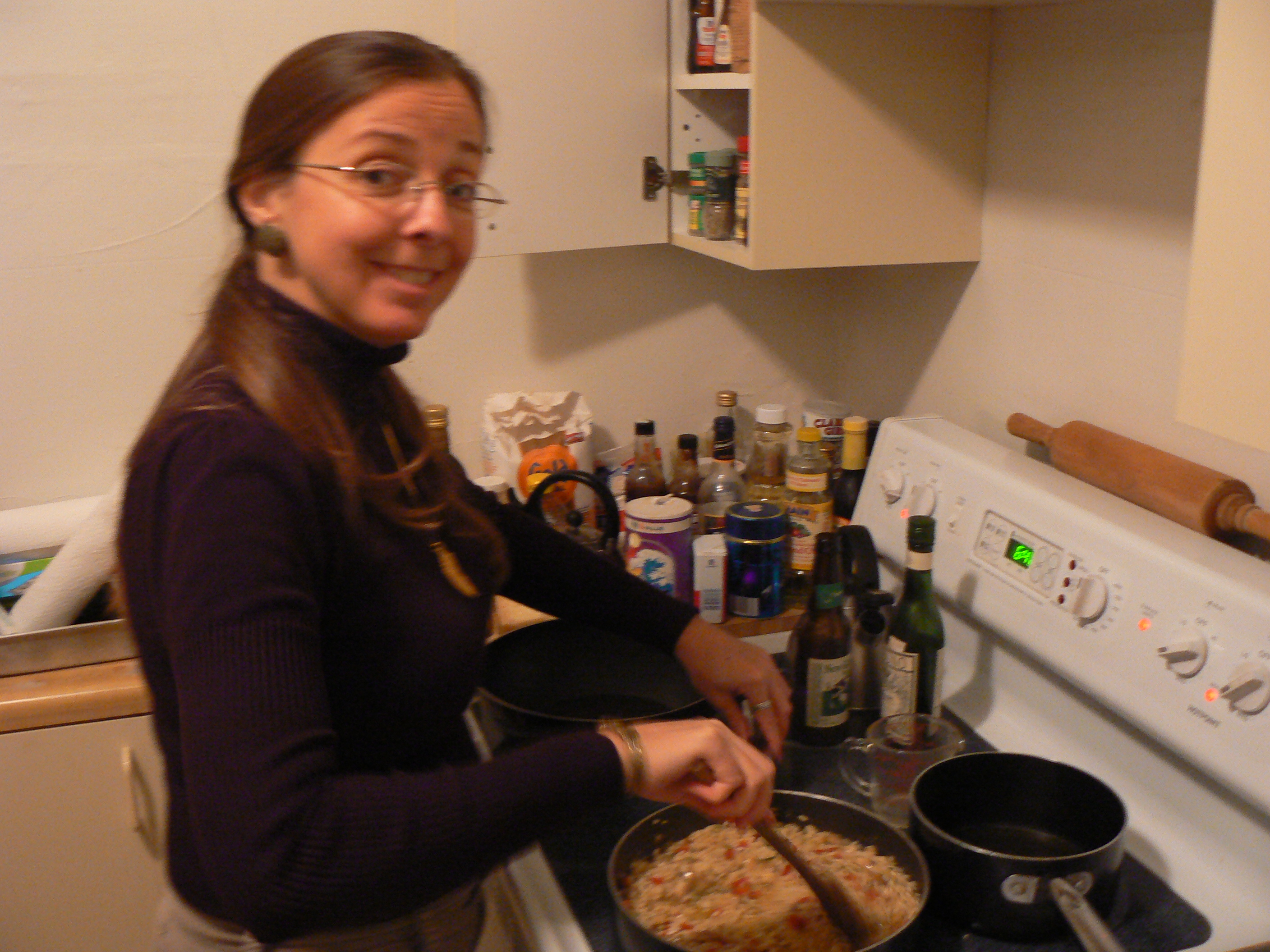
Hey, WordPress! I'm making risotto tonight!

Unknown's avatar

Encounters

I went for a walk on Saturday morning.  Unfortunately, or maybe fortunately, I didn’t bring my camera.  The day was sunny and warm enough to be autumn.  On greyer days this week, it seemed more like winter.  Consequently, many of my fellow suburbanites were outside exhibiting their leisure preferences.  We are an odd lot, I think.  Some quirky, some staunchly mainstream seeking credence for their peculiar habits.  If you have a dog or a bicycle or Spandex athletic gear, you are allowed to be out on the paths.  You fit in.  No one stares.  If you’re wearing a mink, a wedding gown, or sitting in the lotus position on a fallen tree, you’re a little more suspect.  I have a story about all three of these.

At the end of my block lives an elderly lady with a cocker spaniel.  She takes him out to the sidewalk on a leash regularly.  The last two times I saw her, she was wearing a midi-length fur coat about the same color as her dog.  As I walked down the street, she faced me full on.  When I got within about 20 feet from her, she called out, “He’ll jump on you!”  I stopped.  “Would you like me to cross the street?” I asked.  “I don’t care what you do.  If you come near him, he’ll jump on you.  It doesn’t matter to me.”  I crossed the street.  “My, your hair is very long!  It goes all the way down to your waist!” she called.  “Yes, it does.”  “Do you live with Scott Peterson?”  “No, I live at the end of this street, at the corner.”  When I am older, can I make blunt comments out of the blue at passers-by?  I hope so.  I like the directness.  No little niceties required.

When I got to the park, I saw a bride, a photographer and a small entourage.  It seems like every weekend someone’s getting their picture taken in that park.  It has a nice bridge, and the fall colors are pretty.  High school seniors and brides and families who send photo Christmas cards love it.  This bride was picking her was across the grass with four people holding up her skirt.  Her shoes were whitish-gold strappy heels adding about 5 inches to her height.  Her hair was in a blonde up-do with tiara and veil.  She might have been a fairy-tale princess except for the odd way she was walking…and her voice.  Despite the outfit, she was a rather pedestrian pedestrian, another modern bride having her day.

I made my way toward the woods.  Just outside the parking area for the pool is a bike trail and a train track.  A speedy middle aged guy in a helmet wheeled in front of me up the path.  When I got to the crest of the train trestle, I saw an older woman in sweatpants stooping over to part the fallen leaves with her hand.  She wasn’t a biker, didn’t seem like a hiker, either.  I think she was looking for mushrooms.  An Old World forager.  I walked past the golf course and headed into the woods.  I didn’t recognize any trails, so I simply made my way across a dry stream bed and found a fallen tree.  I wasn’t too far from the road, but I was surrounded by trees and leaves and moss.  It was pretty quiet.  I flung my coat over the trunk and sat atop it.  From where I was, I could spot a paper wasp nest, woodpeckers, squirrels, and single leaves spiraling gracefully to the forest floor.  I looked up and breathed a sigh.  This is how I recreate.  No Spandex necessary.  One solitary walking man and two men and their dogs eventually strolled by, crunching their way through the underbrush.  They looked at me.  I looked away.  One of the dog walkers went by quite close and made eye contact.  I said hello.  He greeted me and kept his head turned toward me as he walked away smiling.  What?!  I’m sitting in the woods; you got a problem with that?  I suppose I can be defensive in my head.  I often feel awkward socially, perceiving judgment when there’s no reason to.

Later that day, we went to the top of Lapham Peak in the Kettle Moraine park.  The day had turned cloudy again, and smoke from burning leaf piles gave the atmosphere a mournful grey haze.  Our species has its own way of living on the land.  I find it interesting, diverse, idiosyncratic.  Almost as fun as watching squirrels.

Unknown's avatar

Getting Along

Sundays will always prompt me to meditate.  How should I behave?  How can I walk in a good and gracious and loving and peaceful path today?  Contentiousness makes me squirm uncomfortably.  Much of it is social, but it can lead me to deeper awareness.  For example, who cares if you rake the leaves off your lawn and why?  I have had conversations about this topic with Steve, his mother, and my neighbors.  Each of them has a perspective on this, and they are not all in agreement.  Which of these are important to me?  What rationales am I giving for my behavior in this situation?  Well, finally I decided to rake the leaves up this morning while Steve was sleeping.  I had a dream last night that some teenagers were assigned by community service sentences to rake the leaves on our property.  I saw that they had done it, and I was relieved.  If I feel this relief in my dream, I figured I should just relieve myself.  So I raked and encountered my landlord during the process.  I feel I have a better relationship with myself and my neighbors now.  The leaf relationship with Steve and his mother is still a work in progress.

Our reading time with D.H. Lawrence’s The Plumed Serpent reached a rather dramatic point.  Ramon, who is ushering in the age of Quetzlcoatl, removes the images and statuary from the local Catholic church and burns them in a big bonfire.  He exclaims through a hymn that Jesus and Mary have left Mexico and gone back to heaven.  Adios, they sing.  Quetzlcoatl is returning.  I can tell there’s going to be a religious war in the upcoming chapters.  Somewhere deep in my psyche a little voice is saying, “Uh-oh.  That’s really bad.  You are going to be in SOOOO much trouble for reading this book about de-throning Jesus!  It’s bad enough that you stopped going to church, etc.”  Wow.  So what is a gracious and peaceful path in the midst of a religious war?  How do we engage in philosophical exploration and practice peaceful co-existence when we’ve been taught to have red flags and warning lights go off whenever we venture into this dangerous territory?  Is it real danger or is the danger manufactured to scare us into our corners?

I feel estranged from my former church friends, and I’m still trying to figure out how to deal with that gracefully.  I was very active there for 20 years.  I haven’t been in communication with any of them much for the last 3 years, and I wonder about that a lot.  Were those true friendships?  It was a very social church.  Was it just about acquaintance and pleasantries?  Was the intimacy that sometimes arose merely circumstantial?  Today I got an e-mail from my dearest friend from there.  She is suffering.  I feel so moved that she included me in her update that I keep tearing up as I write this.

I have changed so much over the last few years.  I have stripped off a lot of familiar ways of being in order to try some newer, more open, more aware versions.  I still feel very tentative and emotional about it sometimes.   But I am really grateful to be in a place where I examine my motivations and actions more closely than ever.   It is a lively place, and I think I will see grace here.

Unknown's avatar

Slanting Sun

My home is on the top of the world.

Having rolled over in orbit, I feel sun on my backside.

It’s summer in the underbelly; lucky Argentina.

The light angles in like a flashlight under my chin,

All ghoulish, accentuating contrast.

South windows are a dusty liquid filtering rays like pond scum.

I blub like a sluggish fish.

November runs on borrowed energy, bounced off a distant prism.

Unknown's avatar

Winter Metaphysics

Winter is setting in.  We had some flurries yesterday.  I spent a lot of time writing online, concentrating on ideas, thoughts, feelings, and other stuff in my head.  It made me feel restless and a bit dyspeptic.  I wanted to walk; I needed to walk.  The harvest moon rose full at sunset, and we walked around the wetlands of the county grounds.  The cold was sharp and stung my nose and ears.  I felt my thighs and feet going numb.  It was a welcome discomfort, inviting me to feel my body and feel alive, real and physical.

Winter can be a time of cabin fever when things feel insular and unreal.  There are so many ways to distract myself from the basics, ways I can move from one bubble to the next without popping up for clear air.  So today, I felt like working with my hands.  I took my tools out to the backyard and broke apart the CD cabinet that’s been sitting there for 11 months.  It was good to observe rot and rust and decomposition.   I put the flat boards back down on the ground to make a home for insects and their relatives.  Come spring, I know where I can find some specimens for my nature walks.  I took a few other boards to make a bird feeder station on the old wicker chair.  Later, I’m going to make some broccoli cheddar soup.

Work, things, tools.  How do you see your relationship to the world?  Are things merely static objects?   Are things actually doings or beings as Alan Watts would suggest (e.g.  this isn’t a ‘tree’, it’s a ‘treeing’ – a dynamic process)?  If I pick up a dishrag and begin to clean, I am entering a relationship with the rag, the dishes, the water, the soap.  I want to know more about each of these things, pay attention and appreciate their qualities and how I experience them.

Is it living?

Sometimes, this seems like an unnecessary complication.  I learned from Sesame Street that certain things are alive and others aren’t.   Does that mean that I can control those inanimate objects and do whatever I want with them?  Great.  That sounds simple.  But what if that’s just one way of looking at things and not The One Correct Way?  What would I learn or experience about life if I looked at everything as a being?

These might be good questions for next week’s Socrates Cafe meeting.   Meanwhile, there are some pots and pans in the kitchen sink longing for a relationship with me.

Unknown's avatar

“I’m sorry; we can’t do that.”

You know how once you get pregnant, all you see around you is pregnant women?  I want to trigger that phenomenon in this post and bring awareness to something I feel is pretty common in our fast-paced American life.  I want to see how often people come up with the “I’m sorry; we can’t do that” line when what they really mean is something else.  Something like, “I’m sorry; I haven’t been trained to do that” or “I’m sorry; my computer can’t do that, and I don’t know how to do anything without the computer” or “I’m sorry; we aren’t willing to do that.  Your request is not as important as other things.”  The real answer is absolutely valid and a fine place to begin negotiations.  The problem is, we don’t often get the real answer.

I worked in customer service for a few years, and I remember the nervousness that accompanied requests to depart from policy.  I didn’t know if I had the authority to make exceptions.  I often didn’t want to be in the position of the middle man going back and forth from the customer to my superior.  It made me feel caught in a conflict that wasn’t mine, especially if it dragged on and on.  Eventually, I got to the point where I rather enjoyed listening to people and trying to come up with creative compromises.  But then I was told that I was spending too much time on these discussions and I should simply state the policy and get off the phone.

Dealing with people is tricky.  They require your time, and time is money.  To be an efficient society, we must streamline our systems.  Any person who does not comply with procedure is throwing a monkey wrench into the works.  So what do we value more, the “works”, the people, or some other ideal?  Once you become aware that you’re getting an “I’m sorry; we can’t do that” response, what do you do?

Here are a few examples of this kind of exchange in real life.  The first one is “How do you want your coffee?”  Steve does not like the prevalent custom of serving coffee in disposable containers.  He likes to drink his latte from a mug.  He rarely orders anything “to go”.  He values conservation of resources and energy and is not too concerned with “convenience”.  We have breakfast often at a local cafe that has recently been hiring new staff.  Young staff.  I am patient and cheerful and as helpful as I can be when I’m placing our order.  I got to ordering Steve’s latte and said, “With that breakfast, I want a latte in a mug with 2% milk.”  “Um, okay.  What size?”  “In a mug.”  “I’m sorry; we can’t do that.”  We happened to have had breakfast there just the day before.  “Well, yesterday you could.”  A more veteran server came up behind him and whispered, “Yes we can.  It’s served in a soup mug.”

I’m not saying this young person did anything wrong.  It was probably about his third day on the job.  The point is that we often get streamlined into making concessions in our decision-making and forget that there are other options.  We don’t have to take the disposable option.  We don’t have to take the profitable option if profit is not our highest goal.   We don’t have to have a lawn or rake our leaves or live in the city or send our kids to public schools or give birth in a hospital.  We don’t have to go “up and to the right” and continue to support a growth economy.  But we’ll probably be told when we suggest an alternative, “I’m sorry; we can’t do that.”

Here’s another example.  I am following a discussion on a blog about an architectural idea coming out of Italy.  The title of the article is “Milan’s Vertical Forest”.  http://pensci.wordpress.com/2011/11/07/milans-vertical-forest   The premise of the idea is to create a “less crowded, less polluted, less inhumane” city by erecting high-rise buildings with open balcony space on all four sides to accommodate trees and greenery that would help clean the air and provide a natural aesthetic.  It sounds great, but it makes me wonder whether it’s assuming “we can’t” do something else instead.  If what Milan wants is forest, why not tear down the high-rises and convert the land into open green space?  If what Milan wants is urban housing, why are they calling it a forest when in reality, it’s just apartments with more balcony space?  Are potted trees really going to thrive there?  And will people actually use all that space for vegetation instead of storing their bicycles and grills and laundry there?  If we really want the city to be less crowded and polluted, why not encourage people to move out and work the small farms in France that are being abandoned, for example?  No, “we can’t do that”, we have to think of solutions that keep people in the city and promote more construction and more growth.  Well, we don’t have to.  Let’s just be honest about what our goals are and discuss from there.

So what happens when you “throw a monkey wrench” into the system and ask for a different option?  Do you get an honest negotiation?  I would like to gum up the works of the political machine and ask for a candidate who would admit that s/he is not perfect in character, is not superior in knowledge about every facet of American life and doesn’t necessarily have to be the prime ideologue, but who would be a skilled administrator willing to represent the people and carry out their ideas.

I don’t want a cardboard cup with the shiny logo and a snappy lid.  I just need a teacup to hold some tea long enough to get it to my mouth.  Any Buddhist will tell you, it’s not about the teacup, it’s about the tea.