Category Archives: Family
Weekly Photo Challenge: Treasure
Treasure: pirate’s booty, artifacts from an ancient tomb, shiny objects stashed in your nest, things you collect and wrap carefully.
I do not think of myself as a materialistic person because I don’t like shopping and buying, but I do have a collection of stuff that I have found or been given. These semi-precious items are housed in special places like shelves, curio cabinets, and glass-fronted cupboards in my home. It’s rather like a museum, which is perfectly appropriate to my interests and personality. (I work at 2 museums.) When I think of my collecting behavior, it probably started with rocks and “glassies” (beach glass) as a kid. As an adult, I collected eggs…a symbol of the Trinity, of life, and nature to me. Now, most of my egg collection is in storage, and I have begun accumulating elephants (mostly from Steve’s Aunt Rosie, who, having a habit as a flea market addict and having identified my taste, seems to present me with additions every time I see her!). Elephants are a symbol of matriarchal wisdom and compassion to me. My first beloved stuffed animal was Babar. I treasure the idea of elephants in the wild and feel great pain at their destruction. I would like to see some in their natural habitat some day.
But there is something that I collect and value even more, I think. I keep them close to me in places where I see them every day: on my computer screen, on my phone screen, on my living room shelves and in great boxes under my bed. They are photographs of my family. I’m guessing this is something that most people on the planet treasure…maybe hidden in a chest, tucked into a scrap of cloth, hanging on a chipping plaster wall or stashed in a suitcase in less technologically developed cultures. In fact, in our “museum inventory”, we have quite a few photographs of complete strangers, gleaned from estates sales – black and white faces in various poses, symbols of human connection. One day I’d like to give them new life in some art form so they might be treasured once again.
Weekly Photo Challenge: Family
This photo challenge is one of those too-easy ones. What photographer doesn’t have a picture of his/her family? So, how do I do it uniquely? Well, the simple answer is that every family is unique, so any photo of my particular family will be unique. Having already stretched my little gray cells in composing another post this morning (Model Behavior), I’m going to take a pretty direct route on this one. “My family” could be my family of origin or the one that I built and raised. In this case, though, I’m going to show you 3 generations of my family. Three women, to be more specific. Three brown-eyed eldest daughters. Three highly intelligent, brown-eyed eldest daughters. Three creative, well-educated, highly intelligent, brown-eyed eldest daughters…who can cook and knit and make music and converse about practically anything under the sun. Their accomplishments and credentials are staggering. I am in awe of them. And very proud. May I present: my sister Sarah, my mother, and my daughter Susan. Sarah’s got a Master’s degree in Anthropology and Museum studies. My mother has an undergrad degree in English from Radcliffe (now merged with Harvard) and a Master’s in church music (or nearly…not sure if she completed that). My daughter has a Master’s degree in Linguistics. They are voracious readers and always have been. I listen to threads of shared knowledge dance and weave through their conversations, and I marvel at the connections that bridge the generations. And I realize that even if they weren’t related by blood, they would be related by the experience and consciousness of their humanity. And THAT is something that makes us all…..FAMILY.
Model Behavior
I don’t have a television, so I don’t see a lot of commercials. Still, I find NBA games on the internet and catch a few ads in the process. There’s one for a fried chicken franchise that particularly bothers me. Here’s the set-up: two teenaged kids have made a rare venture out of their rooms to join their parents for dinner. They are still plugged into their media devices and never speak or make eye contact with the camera or their parents. The African-American family sits in the living room with a bucket of chicken on the coffee table. Mom & Dad tell the camera that the chicken is the occasion for them to have this special “family” experience. Dad jokes that if the batteries run down, they might actually have a conversation.
Sigh. Is this an accurate snapshot of our current culture? Rewind about 100 years.
I’m reading a book called Nothing To Do But Stay: My Pioneer Mother by Carrie Young. The author describes her life in North Dakota during the Great Depression. Her mother had acquired land as a homesteader, married and raised 6 kids on the farm. Her sisters struggled to become educated and get jobs as school teachers in local one-room schoolhouses. One particularly brutal winter, their parents found it more sensible to drop off the 18-year-old daughter, the teacher, with the two younger sisters at school and let them stay there during the week instead of transporting them back and forth through the snow drifts by horse-drawn wagon. The week turned into months. Fresh supplies were delivered every week, but these 3 young ladies spent that winter relying on their own resourcefulness for their daily life — with no electricity, simply a coal-burning furnace in the basement and a woodstove with one burner in the classroom. How is that possible? I’m sure that life was one that their parents had modeled for years.
Compare these two snapshots and imagine the changes that have swept through our country. What has “adult living” become? What do we model for our children these days? What skills are being delegated to machines or service companies or ‘experts’ that used to be more universal and personal? Besides modeling tasking skills, how do we model social and moral skills in this decade?
When more families were farming, children grew up alongside their parents and were incorporated into communal activities. They helped milk the cows, tend the garden, and make the food and clothing they all needed to live. In the 50s, when more families lived in cities and suburbs, Dad would drive off in the morning and work out of sight of his kids all day while Mom would turn on appliances to do the chores around home. The kids learned consumerism. Then the Moms left the house and went into the workforce leaving the kids in daycare. In 1992, someone came up with “Take Your Daughters To Work Day”. That was expanded to include boys a decade later. What was first perceived as a Feminist issue of role modeling was recognized as a parenting void: children had no clue how adults spent their work days.
Musing about these changes made me consider what my own children had learned from my husband and me. My daughter made a calligraphy sign when she was in High School: “My father didn’t tell me how to live; he lived and let me watch him do it.” (Clarence B. Kelland) She was 23 when her father died. What we intended to model and what she actually learned are most likely two different things. One thing I do know. She did learn to cook her own chicken.
© 2014, essay and photograph, Priscilla Galasso, All rights reserved
Relationships: Why U R Doin’ It Wrong
Steve brought me a book we’d sold. “There are a few light pencil marks in the quiz section. Could you please erase them before we ship this out?” I glanced at the cover. Getting To “I Do”: The Secret to Doing Relationships ‘Right’ by Dr. Patricia Allen.
Oh, dear.
I breathe a sympathetic sigh. I grieve for our culture, for social creatures with neuroses fueled by the media, insecurities about whether or not we will be loved, cared for, valued, mated and saved from personal extinction. Our fears are inflamed, and then ‘experts’ step in to tell us the magic or the scientific formula that will save us. Just take a look at the Yahoo! “Dating Tips & Advice” section: How to Stop Falling for Ms./Mr. Maybe, Happiest Couples, Tips to Get the Love You Want Instead of Settling, Traits Unhappy Couples Have in Common, etc. I imagine it’s big media business. How many of these articles simply recycle the ‘statistics’ from identical studies which probably report varying results? We are in a research culture that strives to control and predict, a desperate attempt to apply a balm to those neuroses that we irritate with obsessive attention.
Let’s take a step out of that arena, shall we? Let’s take the relationship out of the Petri dish and place it back into the organic garden. How do you learn about a growing organism? Attention, observation, action and response. Over time, the bloom becomes less a ‘specimen’ than a personality. It is unique. It is dynamic. It is not ‘right’ or ‘wrong’. It IS. And the more honest you are in your interactions with it, the more you trust it…to be itself.
And where do we find guidance in this garden of real relationships? In stories. There are billions and billions of relationship stories out there. Some are fact, some are fiction. Many of the fictions center around the magical or formulaic as well, but the ones that really inspire are the ones that are singular and sincere. They give us the hope that our own inimitable story may be just as satisfying.
I have relationship stories of my own, and they are very important to me. I have a yearning to share them, with my children and with anyone else who may be listening. Why? Because I hope that my practice of observing and appreciating the slow unfolding of a delicate bloom will spark the same in someone else, that our posture in relationships will become less that of a victim on the couch, more that of a poet in the garden.
© 2014, essay and photograph, Priscilla Galasso, All rights reserved
A Cup of Kindness
Today is my mother’s birthday. She is 79. She is one of the most positive, enthusiastic, intelligent, and wise women I have ever known. She continues to inspire me. A week ago, she moved from her home of 36 years into an apartment at The Meadows, the assisted living facility where my sister and I worked as college students and where my father died in 2010. She is having an absolute ball collecting stories from the residents, entertaining dinner companions, playing the piano in the chapel and lobby, and making connections within her collage of life. She says that her Bucket List has been reduced to a Shot Glass List, and she’s grateful and content with all that she has enjoyed. She told me that she doesn’t ‘make’ New Year’s Resolutions, she allows them to ‘surface’. She shared that the phrase that is surfacing for her this year is “Live peace; take joy”. That conversation made me think of what is surfacing for me. What is surfacing is Shame. And I’m resolved to do something about it.
I have been thinking about shame for some time. Listening to Brene Brown’s TED talks on vulnerability and shame has brought about some introspective reflection on my history and patterns. I was raised by a very authoritarian father, a devout and dogmatic Christian. He was an intellectual, and my mother very candidly told me last night that although he could understand rationally that our behaviors and social constructs must evolve and change and that they weren’t based in any ultimate reality, he didn’t know how to navigate the emotions involved, and so he would fearfully nail those down into a ‘safe’ corner to protect himself. What he then communicated to me, his daughter, was that we are all fallen creatures, sinners whose nature it is to be not good enough, and that we couldn’t be trusted, so to be saved, we must follow a carefully prescribed path and check ourselves frequently for deviation. Our wills are suspect; God’s will is perfect. My deepest desire was to please my father and to be loved by him, so I became a very compliant child. And I bought the idea that whatever I wanted was probably not good, or good enough, and that I would fail to be good most of the time. My best hope was to be obedient, and so I did that to the best of my ability. I became accomplished in being obedient. As I grew up and my father became less central in my daily life, I transferred that obedience to God, the Church, my husband. Finally, after my husband died, I think I took that authority and transferred it to myself, but I ended up carrying out the same message. Now, I tell MYSELF that I am not good, or good enough, and am likely to fail to be good most of the time. In other words, I have taken over my dad’s role in shaming myself.
Needless to say, this is not freeing me to take risks, be vulnerable, be creative, be self-determinant or self-reliant. Instead, it is keeping me in ‘customer service’ when Steve is itching to make me a full partner in a home business (or series of them) so that we can be self-employed and embody the values and lifestyle that WE find important. How do I make the changes necessary to gain this freedom? First, I have to stop telling myself that I can’t. Or shouldn’t. I have to stop shaming myself. I have to become aware of the times when I do it, and I have to let go of them. Like the bubbles surfacing in my champagne. POP! “So, here comes that shaming bubble. I don’t have to analyze it, give it power, or trace it back to someone to blame. I will just notice it, watch it pop and let it be gone.” That’s my resolution for this coming year. Take a cup of kindness, and stop shaming yourself, Priscilla! Then move on.
I am also posting my blog summary for 2013 today. I want to give big cyber hugs to my Bestest Blogger Buddies – Helen, Stuart, Jamie, Naomi and Elena. Thank you for supporting this vulnerable venture and helping me trust myself to create something. (Something ‘worthy’? Something ‘good enough’? STOP. You don’t need to judge it. Create something. And just leave it at that.)
And here’s a sample of what I’ve created on this blog this year. If you’re new and see something you like, please browse around!
Weekly Photo Challenge: Joy
“Joy to the world! All the boys and girls! Joy to the fishes in the deep blue sea! Joy to you and me!”
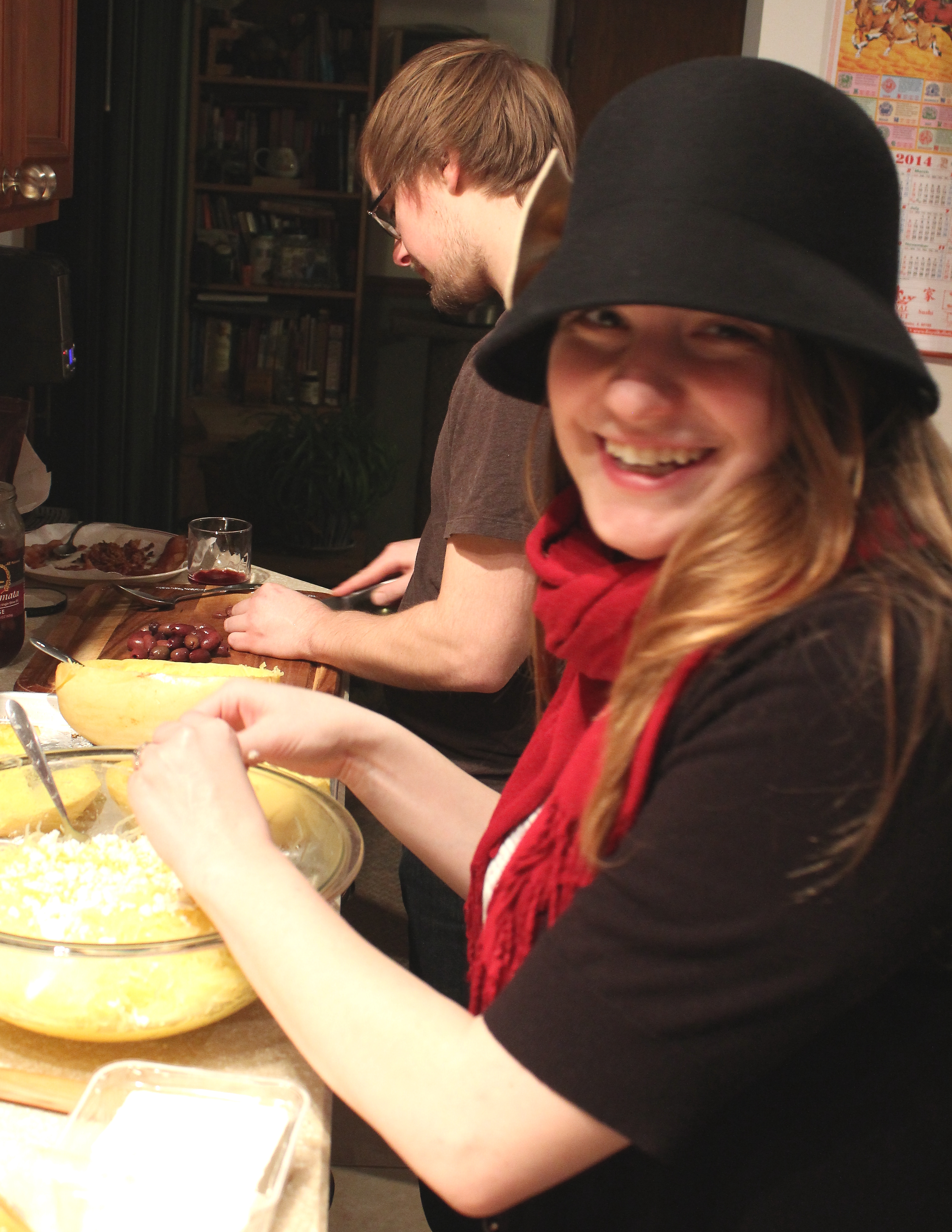
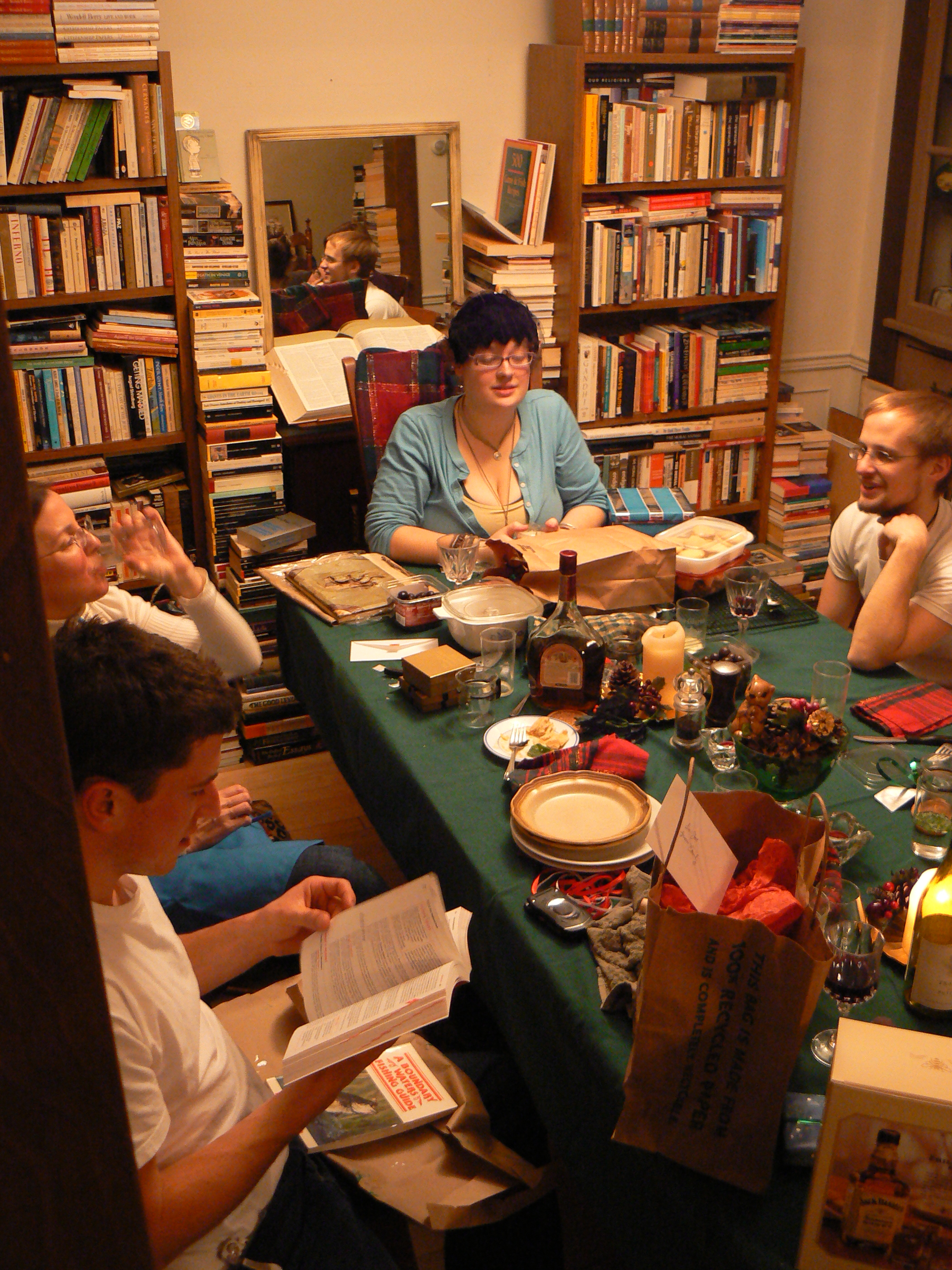
I had to wait until after my holiday celebration with my kids to post this contribution. I knew that there would be plenty of joy to photograph when we got together. My kids have great, big, laughing faces, exuberance, enthusiasm, and loads of energy…and they always have. But now that they’re in their 20s, they also have the ability to focus on a serious philosophical conversation and communicate deeply personal insights…for a while, anyway. The spontaneous laughter, the spontaneous song with harmony, the spontaneous dance around the room – these are part of every Galasso get-together. Costumes and hats frequently make an appearance as well. It is really a privilege to be related to these young people because we all genuinely like each other. We are good, kind, positive, broad-minded folk, to be honest, and I am grateful for all the circumstances that helped that to happen.
And food! I have to mention food. It is such a joy to gather to prepare and eat from the marvelous bounty that sustains and delights. Wine (in a long-stemmed sippy cup, no less! Sometimes preschool isn’t so remote, even after you’ve grown up), cheese (truffle gouda & goat cheese, espresso hard cheese), roast beef with Yorkshire pudding and pickled watermelon rind, potato salad with fresh tarragon, broccoli & kale salad with bacon vinaigrette, Mediterranean spaghetti squash with feta and olives, mince pie, and Fireball whiskey bread pudding. Next morning: creme brulee French toast. So much tasty! Very goodness! Wow!
I wish you all joy and peace in the coming year, and an increasing ability to take joy in every moment of being alive. Celebration is an attitude that can be part of every single day, no matter what. I like to remember that.
Advent Day #24 – Love
This is the last entry from my series of posts two years ago. Not much has changed in my love for my family, except that those “significant otters” have become more formally (and legally) incorporated into the clan and that the arena of family celebration has moved from my duplex to my daughter’s house (and will take place on Saturday). The snow is deep and sparkly here in Milwaukee. Steve was out the door before 6 a.m. to deliver mail and packages for the US Postal Service. Last night, he didn’t come home until 8:30 p.m. The temperature is -2 degrees Fahrenheit (without the wind chill factor) this morning. If you get a mail delivery today, give your carrier a warm smile and your gratitude and appreciation. Remember the free gifts that come to you each day, regardless of season, with no carbon footprint. Live life in gratitude and happiness and peace. The world will benefit.
How About Love?
My December countdown was completed yesterday. I did not have a chance to post about the gift of love because I was living it. My four children plus two “significant otters” came over for feasting and gifting and sleeping over. All six of them ended up on the living room floor under mountains of sleeping bags and pillows and blankets, just like they used to when they were kids in a cousins pile. Except now, they’re all adults — beautiful, interesting, caring, amazing adults who actually like each other. And me. How did I get to be so blessed? This morning, I repaid them all for years of running in and jumping on my king-sized bed full of eager energy at an early hour on Christmas. I dived onto their sleeping bags one at a time and gave them a great big hug and kiss.
We have lived through a lot together. And we have lived through a lot separately. Their lives matter to me in a way that I can barely describe. Steve keeps challenging me to come up with ways to articulate what this is. He has no children, and philosophically wonders why family is esteemed so highly. “Oxytocin,” my daughter replied one day. That explains one level of it, I suppose. My biology has loaded me with hormones that make me love my kids. My religion loaded me with beliefs that urged me to love my kids. My experience of life has loaded me with the joys of loving my kids. And my kids are just plain lovable. I can agree with the reasoning behind his argument that all people are equally valuable, but I just can’t help feeling that my kids are more valuable…to me. Yes, I’m playing favorites shamelessly without really understanding why. Is it possible that evolution favors fiercely loving families? Do they tend to be larger and survive better? This might have negative effects on the planet in terms of population. Would it be better for the world if we were less filial and more agape in our love? Less sentimental and more altruistic?
Table fellowship
I don’t think that I am going to do justice to the topic of love in a scholarly way when I am full of mince pie, chocolate, and happy memories of the hours I just spent. I am starting to sink into that melancholy that bubbles up when all of the guests have gone home and you ask yourself if you can be truly happy without that rush of energy and affection. Of course, I am happy and even more peaceful living without all my children still under my roof. I am in love with the world, in love with my partner, and in love with my children every day. And it is marvelous.
Advent Day #23 – Peace
Peace On Earth
It is Day #23 in the December countdown. Today’s gift is Peace. Ahh, peace. Take a deep breath. Relax the muscles around your skull; feel your ears and eyebrows pull backward; close your eyes and roll your head. Do you feel a sense of well-being? Julian of Norwich claims that God himself spoke these often quoted words to her, “All shall be well, and all shall be well, and all manner of thing shall be well.” Do you believe that’s true? Do you believe that’s possible? I do, although I don’t always act as though I do. I forget.
Wikipedia uses these phrases to define peace: “safety, welfare, prosperity, security, fortune, friendliness… a relationship between any people characterized by respect, justice and goodwill… calm, serenity, a meditative approach”. Where does peace come from? Buddha, the Dalai Lama and many others will tell you that peace comes from within, not without.
“The first peace, which is the most important, is that which comes within the souls of people when they realize their relationship, their oneness with the universe and all its powers, and when they realize that at the center of the universe dwells the Great Spirit, and that this center is really everywhere, it is within each of us.” – Black Elk
But perhaps, there are things outside of you that will remind you of the peace which dwells within you.
“Climb the mountains and get their good tidings. Nature’s peace will flow into you as sunshine flows into trees. The winds will blow their own freshness into you, and the storms their energy, while cares will drop away from you like the leaves of Autumn.” – John Muir
Do you feel peace in your mind and body and soul all at once? Do you descend into peace from your head down?
“I do not want the peace which passeth understanding, I want the understanding which bringeth peace.” – Helen Keller
I suppose each of us must find his/her own journey into peace. Anxieties and conflicts are particular and personal. Facing each one head on is not a passive task. Making peace is not for the weak of heart. “Blessed are the peacemakers, for they shall be called children of God.” Is God about making peace? Is making peace the work of the Universe? Is it perhaps that joyful effort that gives life meaning?
“Peace is not merely a distant goal that we seek, but a means by which we arrive at that goal.” – Martin Luther King, Jr.
If we can make peace between ourselves and God, ourselves and Nature, can we then make peace between ourselves and others?
“If we are peaceful, if we are happy, we can smile and blossom like a flower, and everyone in our family, our entire society, will benefit from our peace.” – Thich Nhat Hahn
“What can you do to promote world peace? Go home and love your family.” – Mother Theresa
Steve constantly reminds me that in every situation, especially in those that cause anxiety and conflict to arise, I have 3 choices. I can hide/run away. I can try to change the situation. I can change myself. The first option doesn’t exactly make peace; it simply avoids confrontation. You can hide away all day long and still feel the fear of whatever it is that scared you. So, why do I often employ that choice? Because I lack courage and I’m lazy. I sometimes pick that choice first to give me time to screw up my will and motivation. I don’t want to get stuck there, though.
Trying to change the situation requires engagement. Making peace with hunger, poverty, sickness, and distress this way requires an understanding of causes and effects on all different levels. It requires negotiation, and it requires cooperation. You don’t always get all that is required to change a situation. Not all situations can be changed. Death is the big one that comes to mind here. You can’t hide or run away from it, and you can’t change the situation so that you don’t have to experience it. Now what?
Change yourself. Sometimes the only way to make peace with something is to change your thinking, your belief, your approach, your attachment, your aversion, your ignorance or some other aspect of yourself. “If you can’t beat ‘em, join ‘em!” is the simplistic way to say it. If you’d “rather fight than switch” (old cigarette commercial – pop philosophy at its finest), then you have chosen to fight, not to make peace. Our egos make it really tough to change ourselves. Sometimes we’d rather fight, sometimes we’d rather die, sometimes we’d rather do anything than change ourselves. You have to ask yourself very seriously what your ultimate goal is to get past this one. Is your goal to keep your ego intact or is your goal to make peace? I’ve come across a lot of phrases that address this ego dilemma: “take up your cross”, “turn the other cheek”, “deny yourself”, “die to self”. I think that dogma is probably more an ego thing than a peace thing. If you can’t let go of your religious beliefs in the interest of peace, then your religion is more about yourself than it is about God, in my humble opinion. I love the part of the movie “Gandhi” where he counsels a Hindu man who is distraught at having murdered a Muslim child. “Raise a Muslim child and make sure you raise him as a Muslim, not as a Hindu. This is the only way you can purge your sins.” This is true wisdom about peace.
Give peace a chance. It requires your will, it requires your strength, and it requires you to lay aside will & strength. I am looking forward to enjoying the peace that my family and I have created. We are still creating it, and will be our whole lives long.
Advent Day #20 – Wisdom
Wise and Otherwise
December 20. The 20th free gift of the month is something that can be acquired, but cannot be bought. I don’t think that it can be given, either. The gift is Wisdom. According to Wikipedia, “Wisdom is a deep understanding and realization of people, things, events or situations, resulting in the ability to apply perceptions, judgements and actions in keeping with this understanding.” In other words, “To recognize the significant in the factual is wisdom.” (Dietrich Bonhoeffer) However, “We are made wise not by the recollection of our past, but by the responsibility for our future.” (George Bernard Shaw) And finally, “It is unwise to be too sure of one’s own wisdom. It is healthy to be reminded that the strongest might weaken and the wisest might err.” (Mohandas K. Gandhi)
It would seem, then, that wisdom is something that can be acquired in living with awareness and engaging humbly with experiences. It seems to me, though, that you can’t give someone the benefit of this process. You might point out the process and talk about its benefit, you might set up the beginning of the process, but you can’t impart the journey or the result. It has to be lived. I’m a mother; trust me on this. I wanted to give my children wisdom more than anything, probably for selfish reasons. I wanted to be spared the pain. I wanted to spare them the pain. I asked God to give them wisdom…like on a magic platter descending from heaven…but spare them the pain. Can’t be done. Wisdom is born of pain and suffering and effort and failure. You have to be awake through it all as well. You can’t gain wisdom while you’re anesthetized. I’ve made a great discovery, though. This process is a great equalizer. Keeping Gandhi’s wisdom in mind, my children and I are fellow travelers on this path. We share our stories as friends, we perhaps contribute insights to this process, but we cannot assume the roles of provider and receiver. I try to remember that as I talk to them. It is too easy for me to slip into the “teacher” role and begin to spew language about what they “should” do and what is the “right” way to do something. I often issue too many reminders and begin to sound like I’m micro-managing them. They notice. They mention it. I have to challenge myself to be wiser and trust them to be wise.
I remember the day my father told me that something I said was wise. It felt like a great victory for me. I was 19 or 20. I had been talking to my oldest sister about some article I had read in an evangelical Christian newsletter taking issue with science and carbon dating. My father was eavesdropping from the breakfast room and jumped on the subject by voicing some objection to the fact that the money he was paying for my college education hadn’t stopped me from discoursing like an ignoramus. I was scared of his strong emotion, ashamed of myself, and angry at his insult. Embarrassed and hurt, I fled. We didn’t speak for 3 days. I realized that he wasn’t going to apologize to me or mention the event on his own, so I decided I needed to take the initiative to talk to him about my emotions, clear the air, and try to restore our relationship. I’d never talked to my father about our relationship very much before. He was always right, often angry, and anything that was amiss was my fault. I also knew that he would not show his emotions, that it would be a “formal discussion” on his part, but that I would probably not be able to contain my tears, making me feel foolish and not his equal. I decided to brave the consequences and approach him with Kleenex in hand. I began to talk, and cry, and tell him how I felt. Then he asked me if I wanted an apology. “What do you want me to say?” I told him that part was up to him. My dictating an apology to him would be meaningless. That’s when he said, “That is very wise.” Suddenly, I felt I had grown up and been respected as an equal to my father in some way. What I understood or didn’t understand about evolution and carbon dating and creation didn’t matter to me any more. That I had been able to navigate emotions with my father and repair a broken relationship was far more significant.
Dad & me in 1992. Photo by my 8 year old daughter.
Wisdom isn’t easy to get, but it is available. If you pursue it, you’ll probably get it eventually. It’s completely avoidable, though, if you so choose. I know which way I want to go, so I’ll keep paddling my canoe and checking the horizon. For those of you heading the same way, STEADY ON! I salute you.