Unknown's avatar

A Day is a Miracle

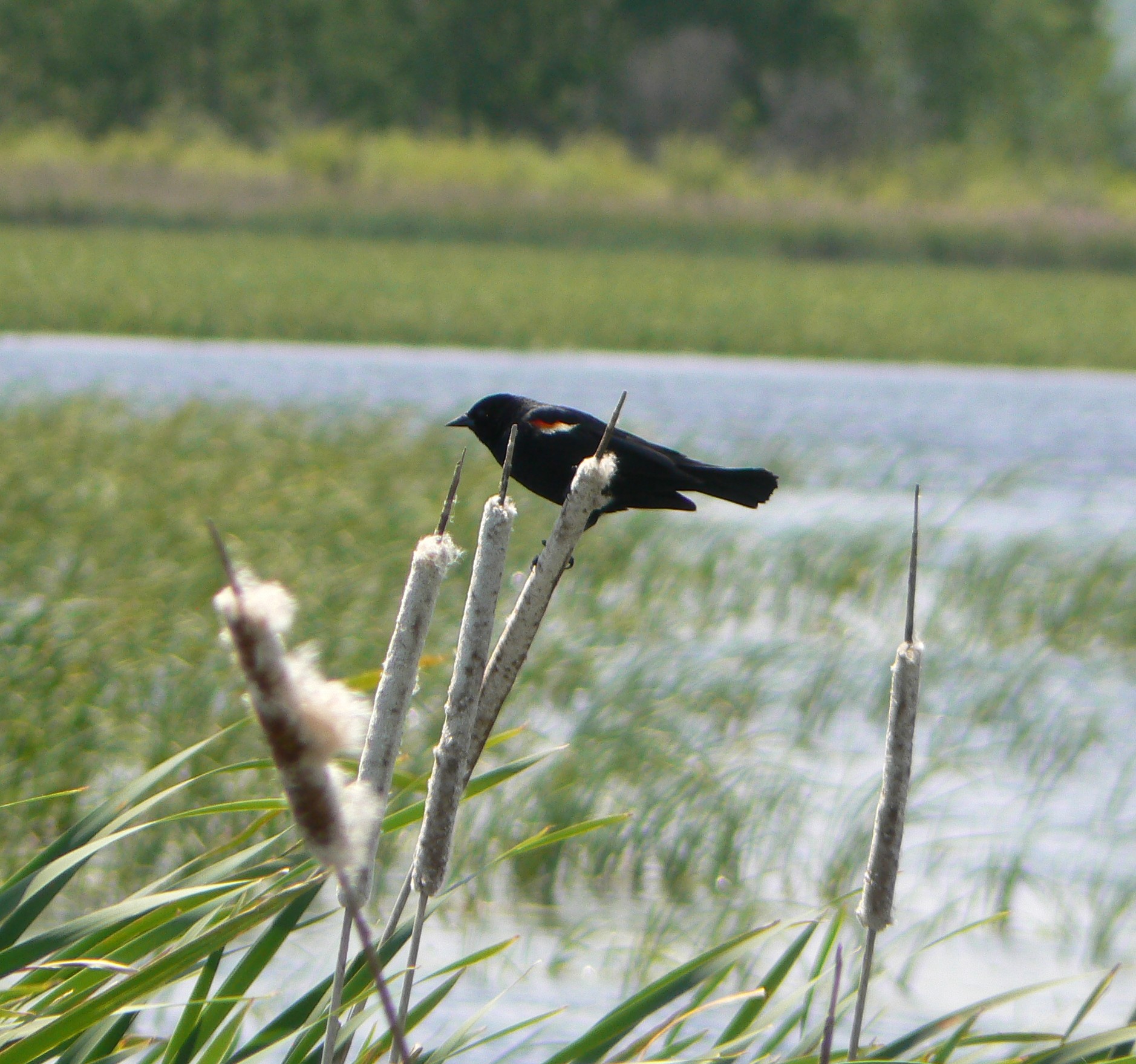
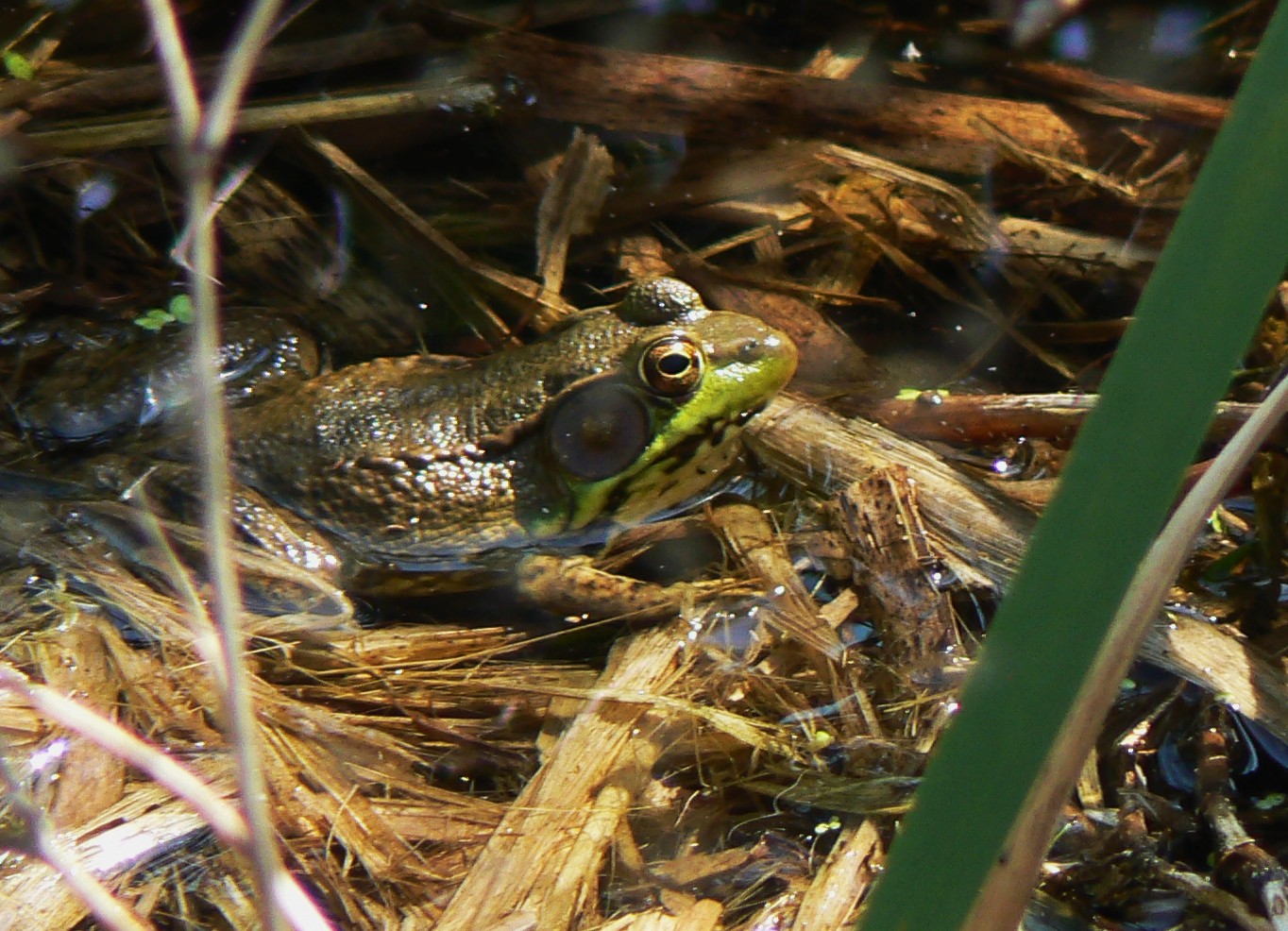
Because today was our day off from working at Old World Wisconsin, Steve & I decided to take a walk at Vernon State Wildlife Refuge.  This marshy wetland is a favorite place to visit in all the seasons to see the changes in flora and fauna.  I think the last time I posted pictures, it was November.  Today, it was sunny, 78 degrees and very breezy.   The Canada geese had goslings following them everywhere.  The Sandhill cranes were nesting.  We saw a group of 3 flying in formation.  Why three?  No idea.  We saw lots of red-winged blackbirds pairing up, swallows, American gold finches, a snowy egret and two new ones to me that I had to look up: the yellow-headed blackbird and the rose-breasted grosbeak.

Sitting on the bank of the river looking at the puffy cumulus clouds streaming sunlight through their crisp edges brought me to tears.  It seems to me that the world is an absolute miracle, every day, every moment, but usually, the miracle that strikes us is that we finally slowed down long enough to see it.  I wonder about how to arrange my life to put more of this experience in.  Perhaps the trick is simply to arrange it so that I’m not shutting most of it out. 

Scumscape

Enjoy the miracle of life!

Unknown's avatar

Living Mystery

I am reading a book called After the Fire: The Destruction of the Lancaster County Amish by Randy-Michael Testa.  Kirkus’ Review sums up the basics thus: “As a Harvard graduate student, former third-grade teacher at a Denver private school, and serious ethical thinker of Catholic persuasion and “morally tired” condition, Testa spent the summer of 1988 living with an Amish family in Lancaster County, where he conducted fieldwork for a Ph.D. thesis exploring a “community of faith”.”

Here is an excerpt that echoes all the discussions Steve & I have about living a life that embodies our values, a grounded life, a life of depth.

“…Dorothy Day once quoted from the Archbishop of Paris: ‘To be a witness does not consist in engaging in propaganda or even in stirring people up, but in being a living mystery; it means to live in such a way that one’s life would not make sense if God did not exist.’

   “I stand barefooted thinking of Elam.  Earlier in the week, he and I trooped across the Franklin and Marshall College campus to the library to look for some maps of the county.  In lieu of classes, campus had been taken over for the summer.  Everywhere there were boys in soccer gear and coaches in black shorts and white and black striped shirts blowing whistles and clapping their hands and yelling, ‘Atta boy!  Good work!  Good WORK!’

   “Elam and I had just driven in from the farm.  I had been up since five working in the sweltering barn, where I am regularly stung in the eyes by sweat rolling off my head.  My white shirts are permanently stained yellow.  I have gained ten pounds and back muscles.  I sleep so soundly in the Stoltzfus house I sometimes awaken myself with my own snoring.  So for all that, hearing the word ‘work’ in teh context of a soccer camp seemed like complete insanity.

   “Elam turned to me and asked, ‘What is this?’

   ‘It’s a soccer camp,’ I said.  I felt my soul tense.

   ‘What is ‘soccer’? Elam asked blank-faced.

   ‘It’s a sport.  Like baseball.’ (I knew some Amish played baseball at family outings.) ‘These boys are here to learn how to play it better,’ I replied quickly.

   ‘But why?  It’s a game,’ Elam said, puzzled.

   ‘These boys have paid money to come here to learn how to play a sport better,’ I repeated tersely.

   ‘But why would they go to school to learn a sport?’ he persisted.

   ‘Because the outside world doesn’t have or value productive, meaningful work for its young men, so it teaches them that it’s important to know how to play a sport well.  This keeps them occupied until they go to college and THEN THEY PAY A LOT OF MONEY TO COME HERE AND ASK WHAT IS THE MEANING OF LIFE!!!’

   “I practically turned on him- and my own world.  I shocked Elam with my vehemence.  I shocked myself as well.  I wondered what was happening to my view of the world.

   “Now, standing in Levi’s meadow in the middle of the night, suddenly I understand what has happened.  At this hour, in this stillness, among these people, life makes perfect sense.  The outside world does not.  I have become a witness.

   “I return to the upstairs bedroom as the blue mantel clock in Elam and Rachel’s room chimes three, and fall asleep to a cow lowing in the moonlight.”

To live in a way that embodies your deepest values, despite persecution, propaganda, and perspiration.  That seems like an honest life to me.  I hope I have the courage to live like that.

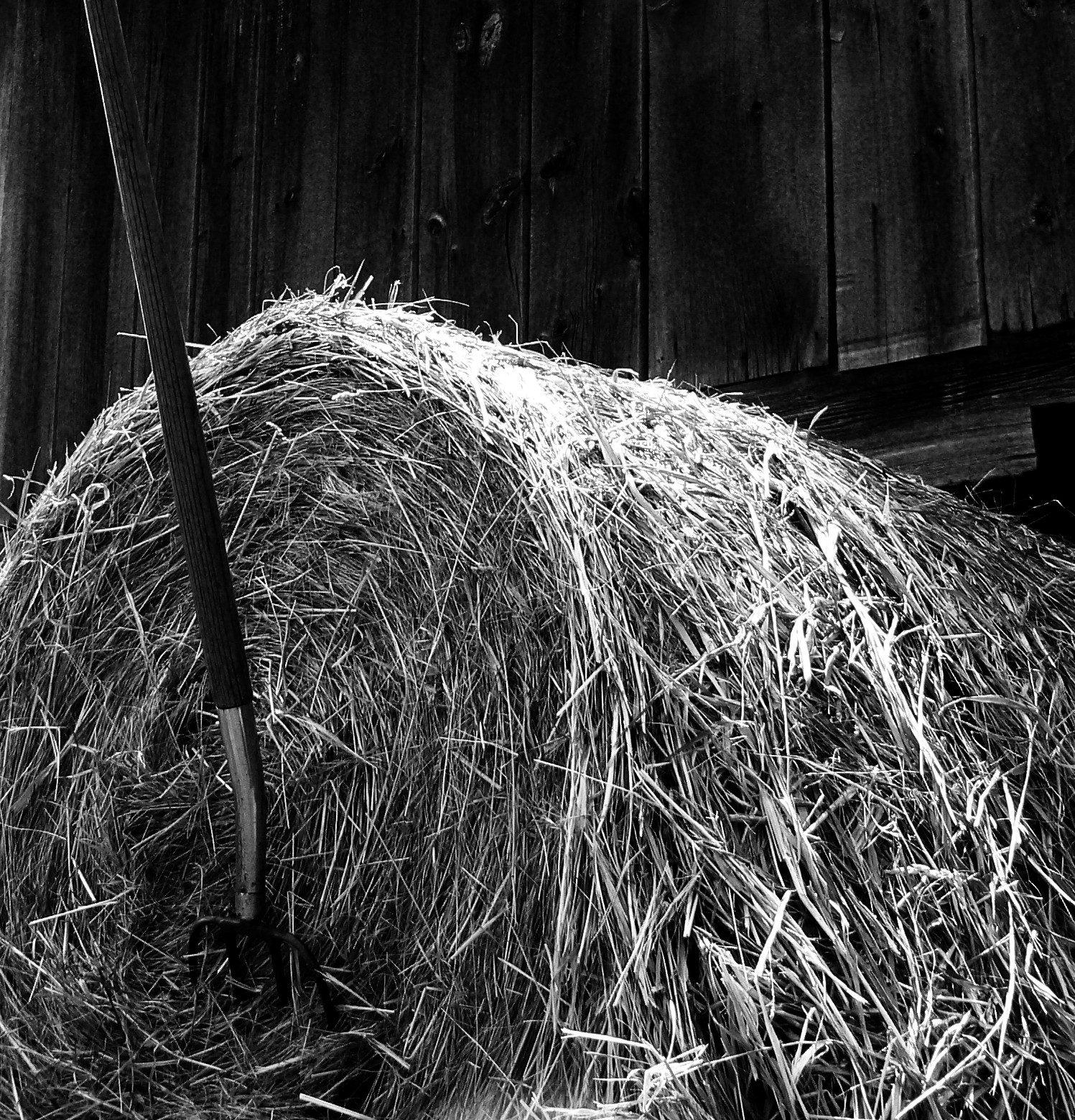
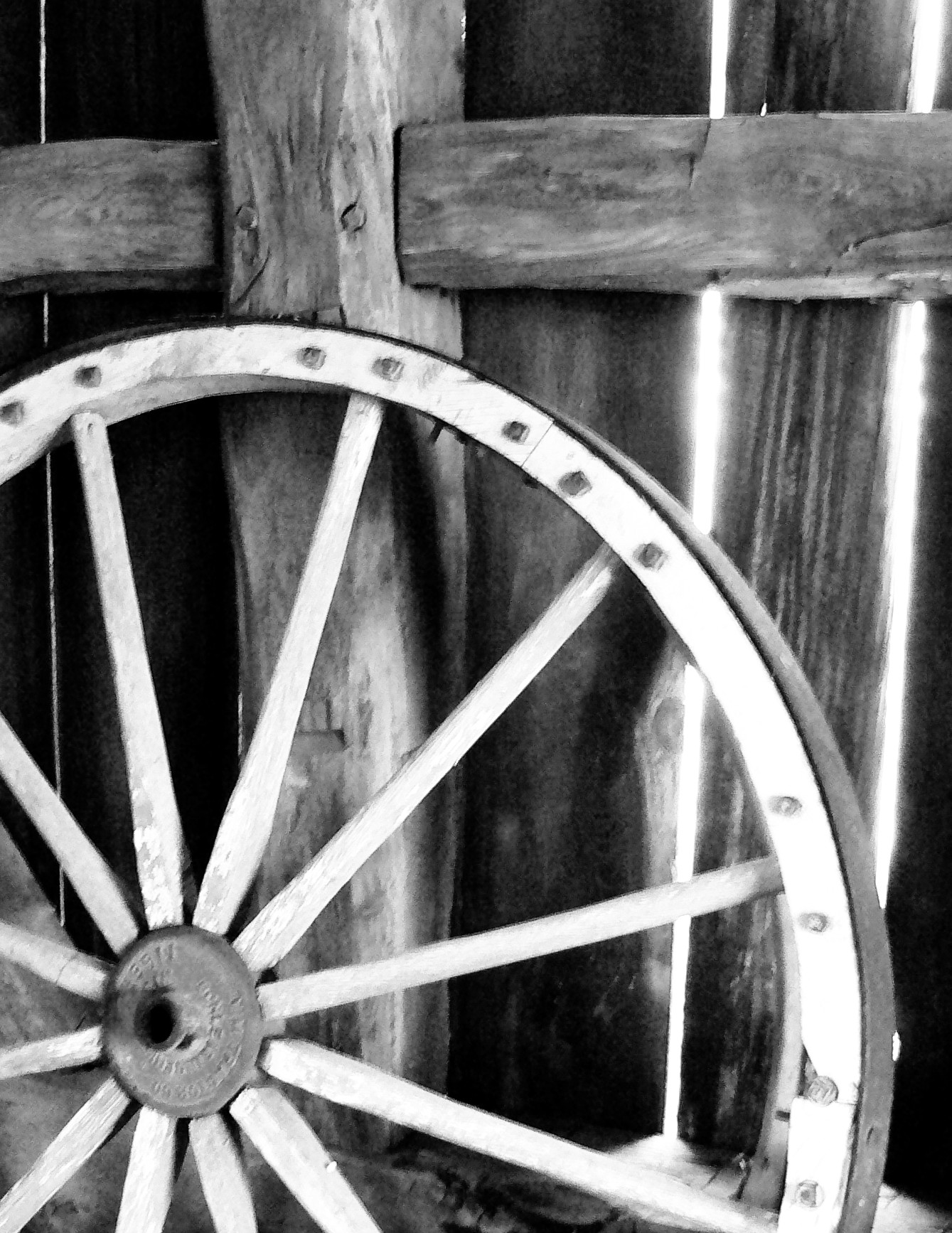
(photos taken at Old World Wisconsin, the living history museum where I work as a costumed interpreter)

Unknown's avatar

The Melting Pot

One of the school boys doing a tour at the Schottler farm at Old World Wisconsin asked me, as he was working with rye dough, “Did they make pizzas?”  I told him that pizza is an Italian food and that these German immigrants probably would have no idea what that was.  This boy looked to be Hispanic.   Would it be an epiphany for a 10 year old to look around at all the things that seem to be “normal” to his life and realize that they all came about in a particular way and have a particular story?  How did pizza get to be part of life in America?  Another kid said that he thought the dough smelled like beer.  How did beer get to be part of life in America?  Other kids said that they were making tortillas.  Or pita bread. 

I wonder what kind of connections they’re making….or not making.  In 20-minute rotations through so many presentations and activities, what kind of sense are they making about all this converging and co-mingling history?

Migration, immigration and assimilation are fascinating.  Everyone approaches it differently.  Some people are very proud of their origins and hang on to ways of life and culture with a firm grip.  Others push to assimilate as quickly as possible and let go of the old ways.  Some have their culture systematically stripped from them, often under the pretense that it’s “for their own good”.   Just tracking down how a family name has been changed can reveal a lot.  Who changed it?  Under what circumstance, and why?

I suppose the thing that I’m learning most is this: respect everyone’s history.  We are all inter-connected, we all change each other. 

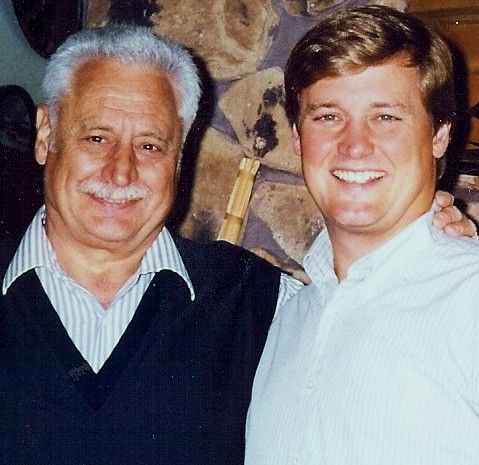
I am thinking also today of the man who was my father-in-law for 24 years.  Today would have been his 78th birthday.  I carry his family name with me and intend to do so until I die.  Maurice Galasso’s dad, Antonio, was born in Italy.  He emigrated to the United States and eventually moved to the Monterrey Peninsula.  Mo (as my father-in-law was called) recalled that his father had various jobs, for example, gelato vendor and dance instructor.  Antonio died when Mo was only 7.  As the “man of the house”, little Maurice was quite resourceful and ingenious.  He eventually became a highly respected structural engineer and owned his own company.  Their family story is full of struggle, creativity, serendipity, stubbornness and grace.  As is, perhaps, everyone’s.  The more I listen to stories, the more I understand about people, and the more compassionate I am capable of becoming.  I want to honor Maurice Galasso today and thank him for the connections I have because of him.  

Maurice and his son, Jim Galasso

Mo and his Galasso grandchildren (my kids). Taken at the grave site after the interment of Jim’s ashes.


Unknown's avatar

Back to Wehr

Steve is working at Old World Wisconsin today, but I’m not.  This morning, I had another volunteer stint at the Wehr Nature Center instead.  I led three groups of preschoolers on a nature hunt.  Each child got a colored pipe cleaner wrapped around his/her wrist, and they kept their eyes peeled for that color on our walk.   There were plenty of purple, yellow, white and pink flowers to find. 

The little guy with light blue was a bit sad faced until I told him there was lots of that color to be found, but he’d have to look way up high.  The clouds had dispersed after a night of thunderstorms, and the sky was a beautiful blue, just like the boy’s eyes.   Orange was the most surprising color of all.  The first group saw a pair of Baltimore orioles chasing each other.  I had seen their teardrop-shaped nest on an earlier walk.  The second group saw a butterfly with orange and black wings, probably not a monarch or a viceroy yet, more likely a Red Admiral.  With the third group, I wasn’t able to spot either of those things, but then a discarded orange peel caught my eye.  Maybe not as exciting, but it was orange.  Red came in dark maroon, the prairie trillium and red maple buds.  I heard a cardinal but didn’t see him.  Black and brown was the mud beneath our feet, the tree trunks and black walnuts. Also the logs in the middle of the lake. 

Some of those dark bumps are actually painted turtles.  They wear many colors, but they were too far away to see.  And of course, green…green….green in every shade, every where, overhead, underfoot, and even under water.

It’s so much fun to get down on a three-year old’s level and go exploring.  The world is a wonderful place!  Enjoy it today!


Unknown's avatar

Opening Day

May Day!  The first day of the season for Old World Wisconsin.  We were open to the public as well as conducting school tours.  In the German area, there was only one school of 68 students that came through.  In the Crossroads Village, they had 3 tours with students from 4 schools, one of which was a group of 8th graders from France.  I also had a single adult visitor, an adult couple, and a family with 3 children from Arizona come by.   In other words….PEOPLE.   Real, live people with stories and questions and backgrounds making connections.  This is living history, after all.  And I love it!  I had so much fun with the 3 kids from Arizona who shaped dough and pounded the froe to chop kindling, and smiled and talked the whole time.  They were enjoying themselves, and their parents were snapping pictures and asking questions.  They were learning and engaging in a very comfortable way…they were homeschooling.  I really like the small group interaction involved:  3 adults, 3 kidsVery nice.  Somehow, when it’s a group of 21 kids and 3 chaperones, there’s almost more crowd control going on than learning.   Or so it appears.  I hope they learned something; I hope they were listening and paying attention to more than just their classmates and the instructions the chaperones were giving. 

So all of that went on in about an hour…and I had several more to kill.  The great thing is that I don’t feel any pressure to be super productive the whole time.  I chopped wood and carried water and washed dishes and tended the fire and sewed on my pin cushion and all of that good stuff, but then I sat down on the porch and watched a thirteen-striped ground squirrel scurry around the yard near the woodpile snarfing up dandelion seeds.  Just quietly, listening to the birds.  Minutes went by.  I felt the land around me and thought about the sense of time and energy that a tree feels when it’s “busy” growing.  The woods, the fields, the garden…they are living under the sky at a pace that is so different from us movers and shakers.  They feel the air, the light changes, rain falls, things happen and they respond, but they don’t “react”.  I want to learn more about that way of life.  How long can you “not react”?  It’s like practicing meditation.  Breathe and be.  Light changes, form changes.  Breathe and be.  Everything changes.  Breathe and be.  I think that’s what I’m learning from nature.  I am very happy to be spending more time outdoors.   


Unknown's avatar

Making New Friends

During training for my new job at Old World Wisconsin, I was introduced to many new friends.   On the last day of training, I took some pictures.  Here are some portraits and brief bios about my new co-workers.

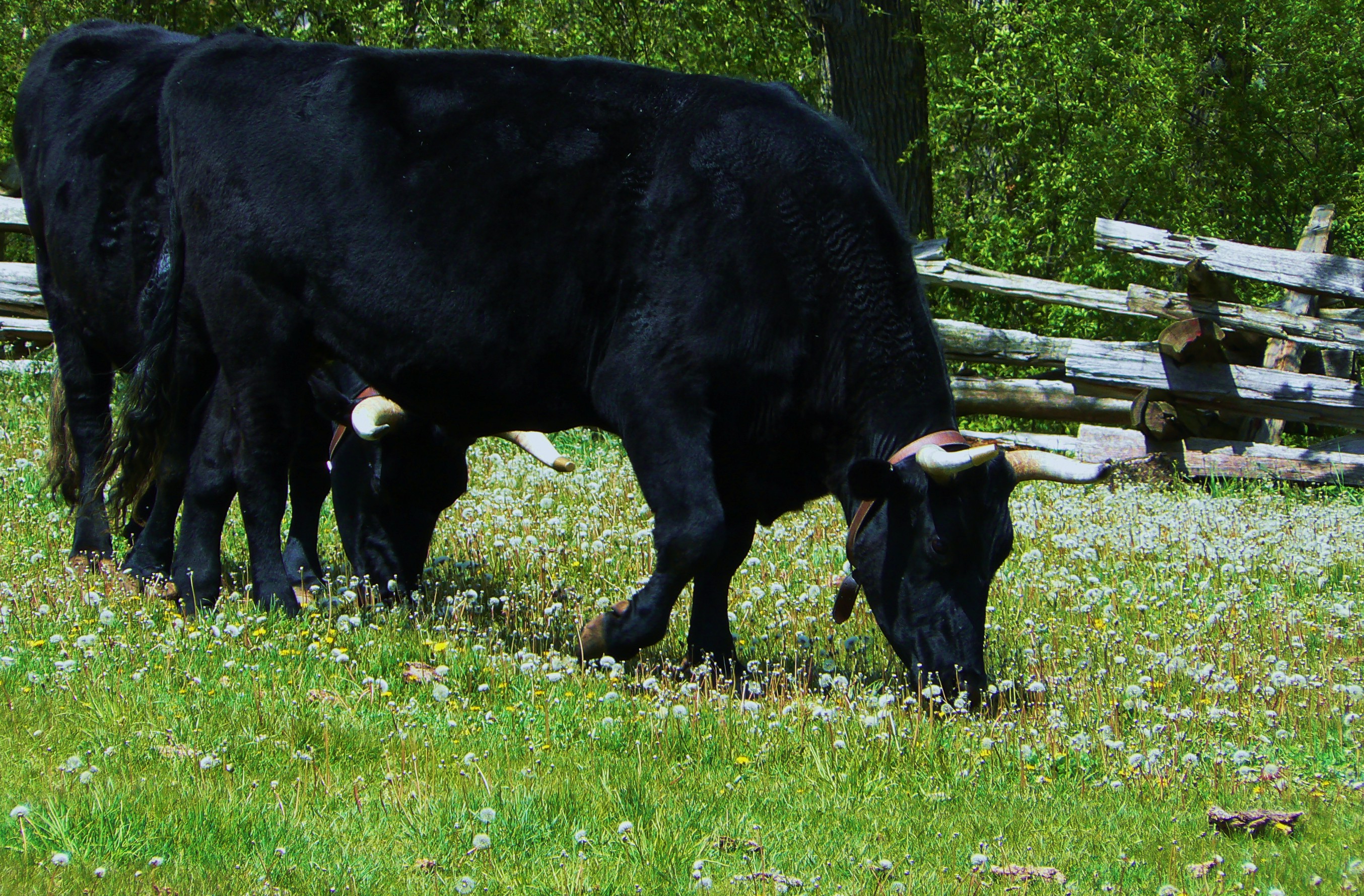
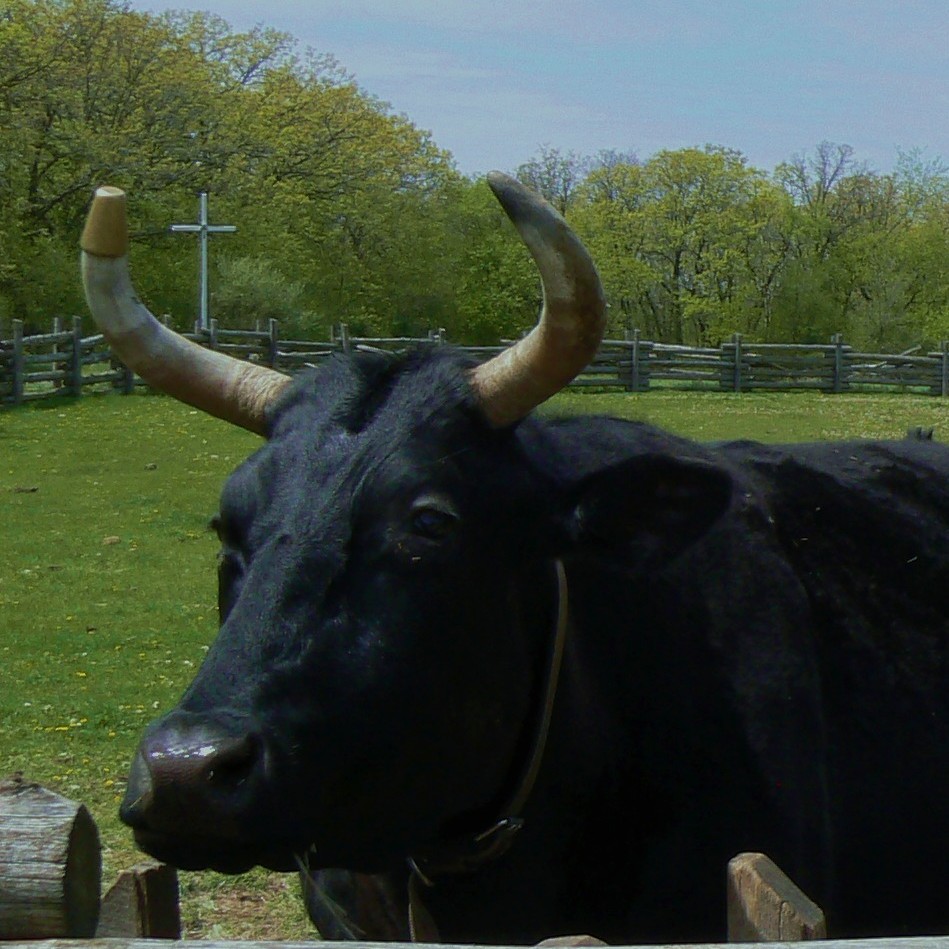
This is Bear and Ted, out in their favorite pasture next to the 1860 Schultz farm.  They are a magnificent team of oxen.  Bear is on the left, with a brass horn cap on his left horn.  (“Bear left” is how I remember which one he is.)  This is so that when he is yoked to his buddy Ted, he doesn’t gore him by accident.  Each of them weighs about a ton (2,000 pounds)They like to be rubbed under their chins, but they will drool on you.  I’ve been told that I will now enjoy good luck because Bear drooled on me.   I like how this photo reminds me of the drawings for the book Ferdinand by Robert Lawson.

This is Ted with Bear behind.  (Okay, I couldn’t stop myself.)  They are clever escape artists, but also well behaved.  They managed to bump up against the logs that cross the fence opening in such a way that they worked them free from their supports.  They carefully stepped over them and went out to the garden in front of the homestead and helped themselves to the red cabbage growing there.  Then, they went back into their pasture.  The next morning, the staff looked at the obviously nibbled produce and the huge hoof prints in the garden and thought, “Oh no!  The oxen are loose!”  But there were Bear and Ted, looking innocent as can be from the pasture enclosure.  But then they checked the gate, which these guys failed to close behind themselves, and their guilt was confirmed.  I give them credit for sticking to the garden paths and returning home by themselves.  


This is a close up of Ted.  He’s a good worker, slow and steady.  He pulls carts and plows and isn’t as skittish as a horse.  You can hook up a cart to the team and go into town, but it’ll take you a while.  They can run as fast as 30 miles an hour, but not for long.   You can’t saddle them up and ride them because their spines form a peaked roof that’s uncomfortable for the rider (and probably for the animal as well).  Sometimes a farmer would put a child on the ox’s back for a short time, just for fun.  They are very docile, and these guys respond to commands like “Gee” and “Haw” and “Whoa” and “Get up” and “Back up” very cooperatively.  They kick to the side instead of straight back, so when you walk beside them, you want to be in front of their back legs.  So, that’s Bear and Ted.  Here’s another team member.  We call her Queen.

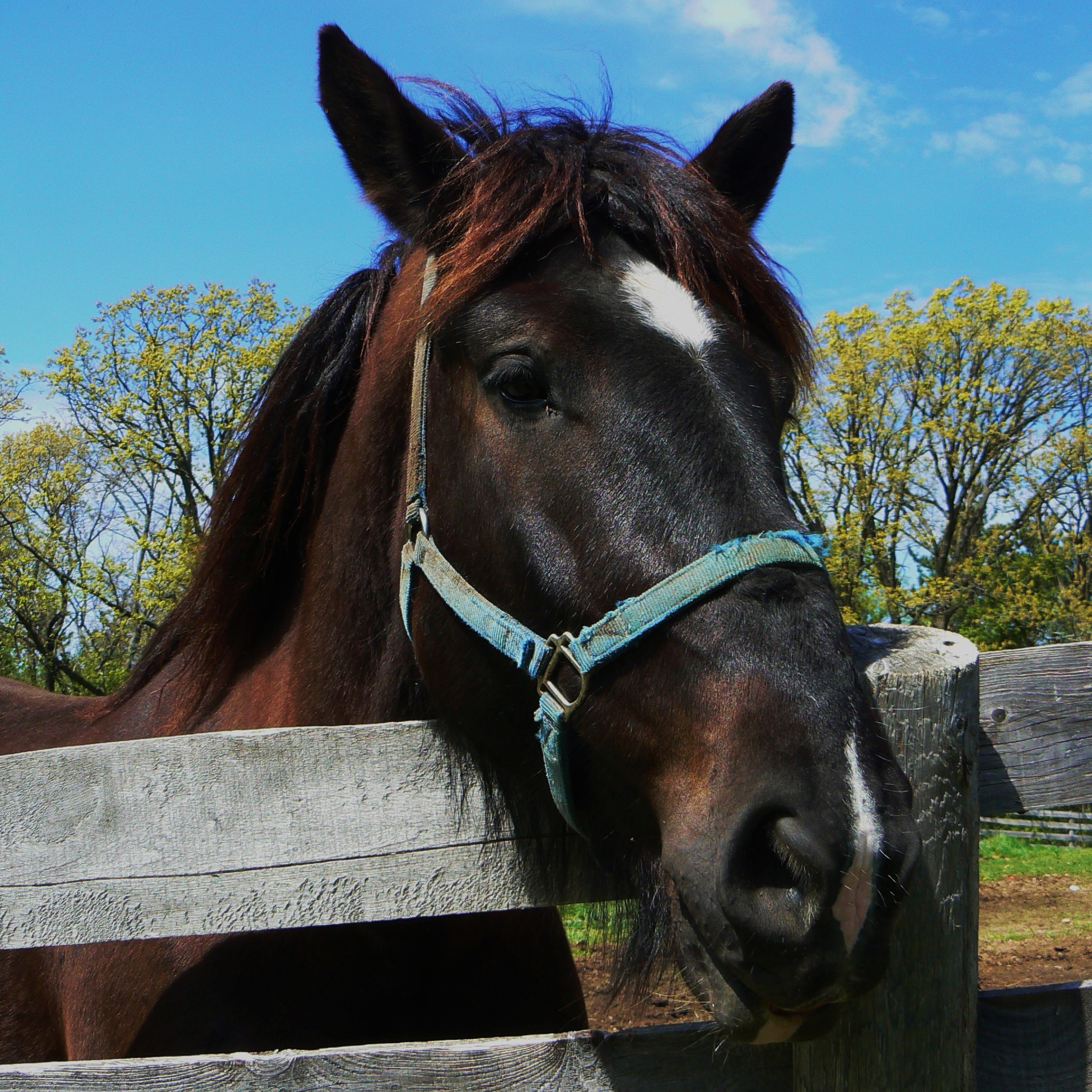
She and Quincy make up our team of Percherons.  Stud horses were brought over from Europe in the mid 19th century and bred with local mares to improve the stock of draft horses for heavy farm work.  I don’t know the pedigree of Queen and Quincy, but I imagine they’re crossbreeds.  What non-profit museum could afford purebreds?  They do a lot of wagon hauling in the harvest season, I think.  Kids love to see them, but they’re massive and a tad dangerous.  We have some quite elderly horses who provide the petting and photo opportunities for visitors with less risk.   Steve put his apple core in Queen’s feed box just about 20 minutes before I snapped this photo.  That may be why she’s giving me such a benevolent look.

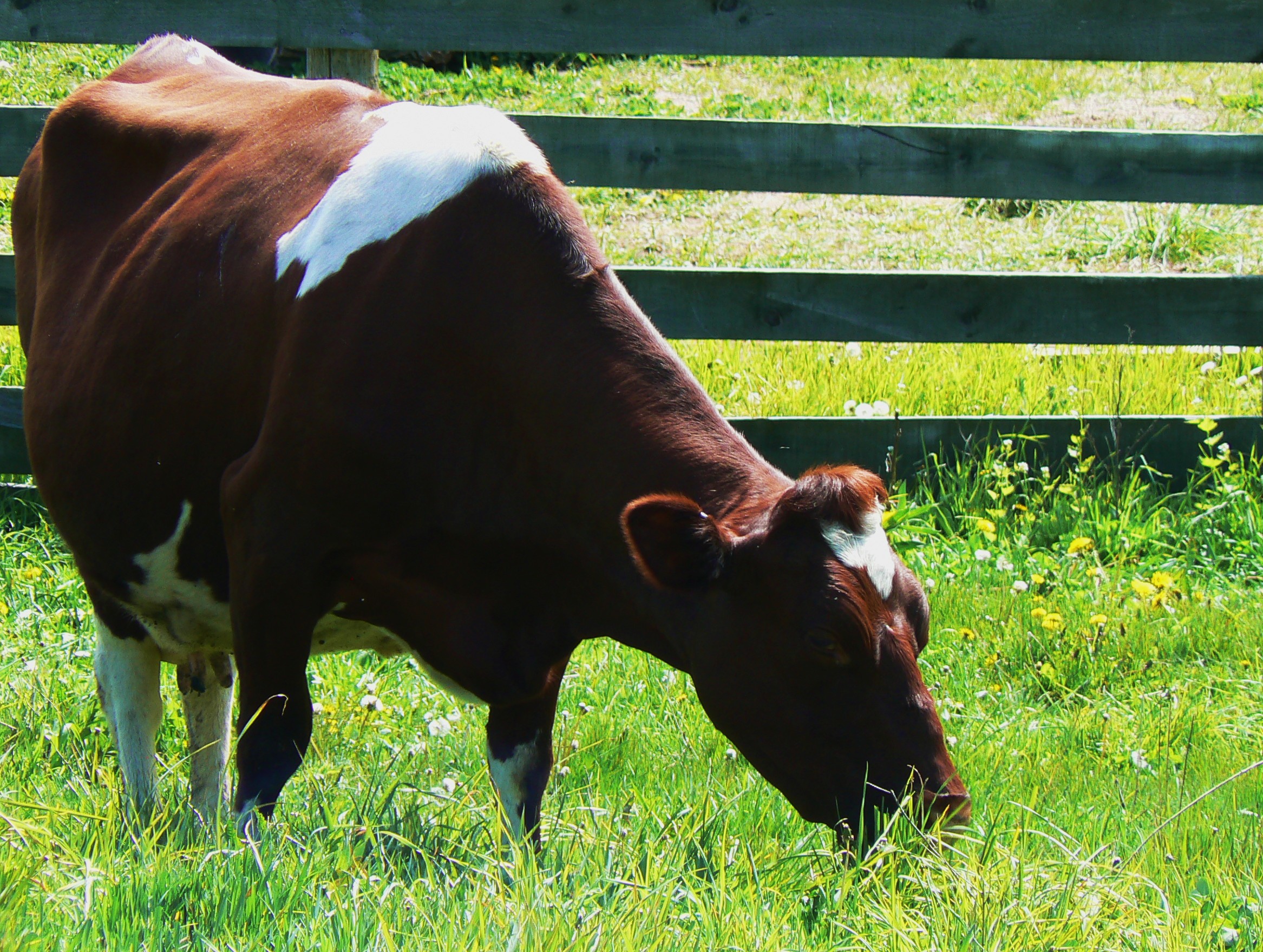
This is Lily.  She and her paddock mate Daisy (who was known last year as Thelma) are over in the Koepsell farm, where they are installing a new exhibit called Life on the Farm.  They’re erecting a petting barn for baby animals, and Lily will be used for milking after she’s calved.  Oh, yes.  She’s pregnant.  Look in her eyes and you can see the fatigue and determination of a heavily laden mother-to-be, can’t you?  She will be producing milk for our dairy demonstrations: cream separation, butter churning, cheese-making and such.  I am hoping to get the opportunity to milk her.  I used to milk goats at a camp when I was in college, and I really enjoyed it.  We milk by hand at OWW, of course.  It seems like a very intimate way to get to know another working mother.  Perhaps it will produce a beautiful friendship.  

  The pigs who will be in the piggery over in my area haven’t been moved onto the site yet.  One sow just gave birth to a litter of 7 about two weeks ago, and another is about to drop her litter any day.  The piglets are still too young and the weather too cool, but I will get a batch in a few weeks, I imagine.  I’ve been instructed to name them things like “Bacon” and “Hammie” if anyone asks.  Hog butchering is one of our autumn events. 

I am very excited about working with these creatures.  I want to be more aware of my anthropocentric mindset and challenge myself to think outside of that box.  I wonder about the relationships we have with animals and the domination that we assume in those relationships.  I expect that there is a lot more to discover than what we are used to or instructed to consider.     

Unknown's avatar

Home and Hearth

I’m anticipating the arrival of my middle daughter for a sleep over visit.  I have done the dishes, swept and mopped the kitchen floor, changed the sheets and made the bed.  My 21st century house is maybe about 75 years old.  The houses I help keep up at my Old World Wisconsin job are about 135 years old.  What remains constant about hospitality?  The desire to provide a degree of comfort out of respect for another person.  The pride of being able to offer, no matter how humble, an invitation to share what you have with another person, be it space, warmth, food, shelter, peace or love.  “For it is in giving that you shall receive.”


I am enjoying a sense of maturity in my ideas about homemaking, a sense of seasoning.  As a young wife and mother, I was extremely anxious about entertaining.  I felt that everyone who walked through my front door was judging me.  I was sure that I wasn’t doing things the “right” way and that everyone could tell that I was faking being a “good” mother.  I hardly ever had the sense that people who visited me were actually interested in enjoying time with me.  I suppose you could just label that “low self-esteem”.  So what does self-esteem have to do with hospitality?  Perhaps it’s simply that until you esteem yourself, it’s hard to know how to esteem someone else, or until you know how to be comfortable in your own skin, it’s hard to know how to help another person be comfortable in his or hers.  That’s what I want to be able to offer my guests: a place where they can be at peace with themselves, with me, and with their surroundings.  A place to experience welcome and contentment —  home and hearth.     

Unknown's avatar

Happy Earth Day, Earthlings!

The first Earth Day was April 22, 1970 and marks what some consider the birth of the Environmental Movement.   Of course, cultures throughout history have celebrated and appreciated the earth according to their particular perspectives.  Harvest festivals, rain rituals, volcano appeasement, fertility festivals, river ceremonies…I can think of many ways that humans have venerated the earth.  Since 1990, when the Earth Day campaign went global, we’ve focused on the planet as a whole.   We are the ones who have seen it (at least in pictures) as a whole from outer space, and I think we are realizing more and more how our relationship to the Earth is effecting that picture.  Large scale weather patterns, extinction rates, pollution and population are just some of the issues that are “going big” in our consciousness.   This is all very well, and at the same time, each of us has a particular and specific and local intimacy with Earth that should never be overlooked.

NaPoWriMo is acknowledging Earth Day with its prompt to write a poem about a plant.  I have so many favorite Earth/Nature/Flower/Animal poems already dear to my heart that I’m having a hard time being original, so I think I’m just going to share a few favorites with you here instead.  The first one is a lullaby that my mother used to sing to me.  I have no idea of its origin.  I just hear Mom sing:

White coral bells upon a slender stalk,

Lilies of the valley deck my garden walk.

Oh! Don’t you wish that you could hear them ring?

That will happen only when the faeries sing!

Here’s one I wrote back in March as I looked at my lilac bush:

When will the buds appear this year?

When will the lilac be full in bloom?

When will that perfume make fair the air?

When will that purple bedeck my room?

Soon, oh, soon; let it be soon!

I’ve been wearing lilac oil from a little vial that Jim bought me when we were on Mackinac Island years ago.  A few drops on my neck assures me that the fragrance of my favorite flower will not fade too quickly from my consciousness. 

I took a walk yesterday to photograph some of my local earth miracles.  May I present:

White tail deer

Bleeding heart

Red Admiral butterfly

Tulips, daffodils, hyacinth

And to represent the hippie protesters and the environmental movement, I have to share one of my favorite earth songs.  Nanci Griffith, “From A Distance” (written by Julie Gold).  Socks with sandals, passion and integrity.  She moves me.

Love our planet, today and every day.  Treat her and all life with respect.  Please.

Unknown's avatar

Cultural Awareness

I am about to venture out into the retail world in search of shoes that might pass as reminiscent of the 1870s.  Having come up empty yesterday at two Goodwill shops, I’m not sure if I will be successful.  It’s interesting taking stock of what’s out there in the resale stores.  This is the stuff that people give away…and other people buy.  It’s not marketed; it’s not about status or brand.  It’s about filling a need with something serviceable.  I would do all my shopping at a resale place if I could.  That’s probably why my kids call me “cheap”.  I don’t get the whole “status and style” idea.  I just want to get the job done.  I’m not trying to fit into a competitive culture of consumerism.  My “work outfit” for my new job will be a reproduction of 19th century pioneer clothing.  My “work outfit” for my last job was jeans and a T-shirt with the latest musical production logo on it.  I guess I have a different idea of dressing for success. 

One of Steve’s favorite fables is The Emperor’s New Clothes.  He often sees himself as the little boy at the side of the parade who looks on in bafflement at what everyone else is celebrating and asks, “Why are we doing this?”  He sometimes talks about it as being the one who points out the elephant in the room, that glaring awkwardness that no one wants to mention.  He’s not judgmental about it, he just wants to discuss it, bring it out into the open, make everyone aware of it.  He’s not cynical or sarcastic, he’s genuinely curious.  We don’t have a TV, but we do watch basketball games online that often include commercials.  Those ads bring up a lot of questions.  Why do we sell what we sell the way that we do?  Why is sex and violence so prevalent?  And stereotypes?  Why do we think having a good time is so important?  What do we really think is important?  And why?  Why?  What is the Big Idea?  Everything comes down to that level, that three year old inside who stands watching and asks, “Why?” 

It’s a really good question, I think, and one that I have been trained not to ask.  “Theirs not to reason why/ theirs but to do and die.” The military motto, President Bush’s command to go out and spend money rather than debate economic policy, my father’s and the Church’s instructions on being obedient…there are so many examples of hushing up that 3-year-old.  I admit that there are times when it’s useful to forgo the philosophical and act decisively and immediately, but shouldn’t we return to the subject eventually and periodically to keep our motivation clear?  There are members of society who are watchdogs to our conscience, in a way, and I very much respect them for their courage and thank them for the questions that I forget to ask.  I am more characteristically concerned with “How?”  I want to do things lovingly, primarily; efficiently, much of the time; and as correctly as possible.   That may say a lot about how effective my indoctrination into Judeo-Christian thought was.  

Intentionally asking both questions and fashioning a life around the answers we find deep in our experience is the focus of our Saturday Summit (what we call our “relationship discussions”).    The poetry prompt I found today on NaPoWriMo’s site challenged me to write a hay(na)ku, which is a recent poetic invention.  It’s simply 6 words in three lines of ascending (or descending) measure.   One word, two words, three words (any number of syllables) or vice versa.  We can link several together as well, we’re told.  So, here is my hay(na)ku series and a few photos. 

Why?

Keeps asking,

What is important?”


How –

Am I

A good person?”


Questions

Are for

Shaping my character.

How now, brown cow?

Why?  Just…why?

Unknown's avatar

Traveling Mercies

Today’s poetry writing prompt is to write a travel poem about getting from Point A to Point B.  I took this with me as I walked with Steve to meet his mom for breakfast at a cafe on North Avenue.  Here’s what I came up with:

Suburban sidewalk, cement sanitation

Fighting blight from untidy dandelions

Writhing, withered stems polluted, poisoned

Preventing spreading superfluous seeds


Muddy raindrop crater-pocked parkway

Mini helicopter maples, twin neon confetti

Mossy black trunks, petal-splashed branches

Tinny worm smell, saturated iris-limp toilet paper


Hiking boots treading asphalt pathways

Longing for the purity beneath.


Yesterday’s rain has left a distinct damp chill over everything.  I miss the golden sunMy mood is slow and overcast as well, but I think I’ve had an epiphany in the recent “relationship talks” we’ve been having.  A serious and positive epiphany, too complicated to explain.  I never knew that shock and denial could last four years and then drop in an instant.  I feel like a snail without her shell.  Perfect for crawling about a rain-soaked environment.