Category Archives: Awareness
Weekly Photo Challenge: Nostalgic
Oh, boy. It’s a dangerous thing to invite a widow and empty-nester to post a blog on the theme Nostalgic! Contemplating the past can lead to maudlin stretches and lots of used Kleenex, even if I don’t have a glass or two of wine first. I don’t think that would be at all edifying to the blogging community, so I’m going to try hard to steer away from that. I hope to write and show something that is true about a time that has come and gone.
Life is characterized by impermanence. Our kids don’t stay little; our loved ones don’t stay alive forever. What we live is present moments. If we try to hang on to them and make them more permanent or attach our happiness to them, we are in for a world of frustration. As we get farther away from present moments, it’s hard to remember what they were really like. We lose perspective. That wonderful family outing…did I yell at the kids that day? I don’t remember. I probably lost patience at least once. Did my kids remember that? How did they feel? How did they heal? Or is it all, as my mother often puts it, ‘a merciful blur’?

Brookfield Zoo dolphin show, August 1991. Jim (RIP), Emily, Josh, Becca and Susan (bride to be in 3 weeks!).
In my current life, I see a lot of families on outings with their children, since I work at two different family museums. Families interact in all sorts of ways. I try to look at them with compassion and tolerance remembering what I can about how challenging it is to raise 4 kids at one time. The important thing is to BE KIND in the present moment. With your kids or someone else’s. If the world is to be a good place to live, it’s important that all 7 billion of us humans remember to BE KIND. And this is not a glib solution. If you think deeply about being kind, you’ll see that it is a profound power in the universe. BE KIND to your fellow humans. BE KIND to every living thing. BE KIND to yourself first, and feel what that is like. It is peace. It is well-being and health. It is life. Don’t settle for feeling nostalgic about a time when you felt the world was a kinder place to live. Make it a kinder place to live this very moment by acting kindly!
Honoring My Father (Reblog)
George William Heigho II — born July 10, 1933, died March 19, 2010.
Today I want to honor my dad and tell you about how I eventually gave him something in return for all he’d given me.
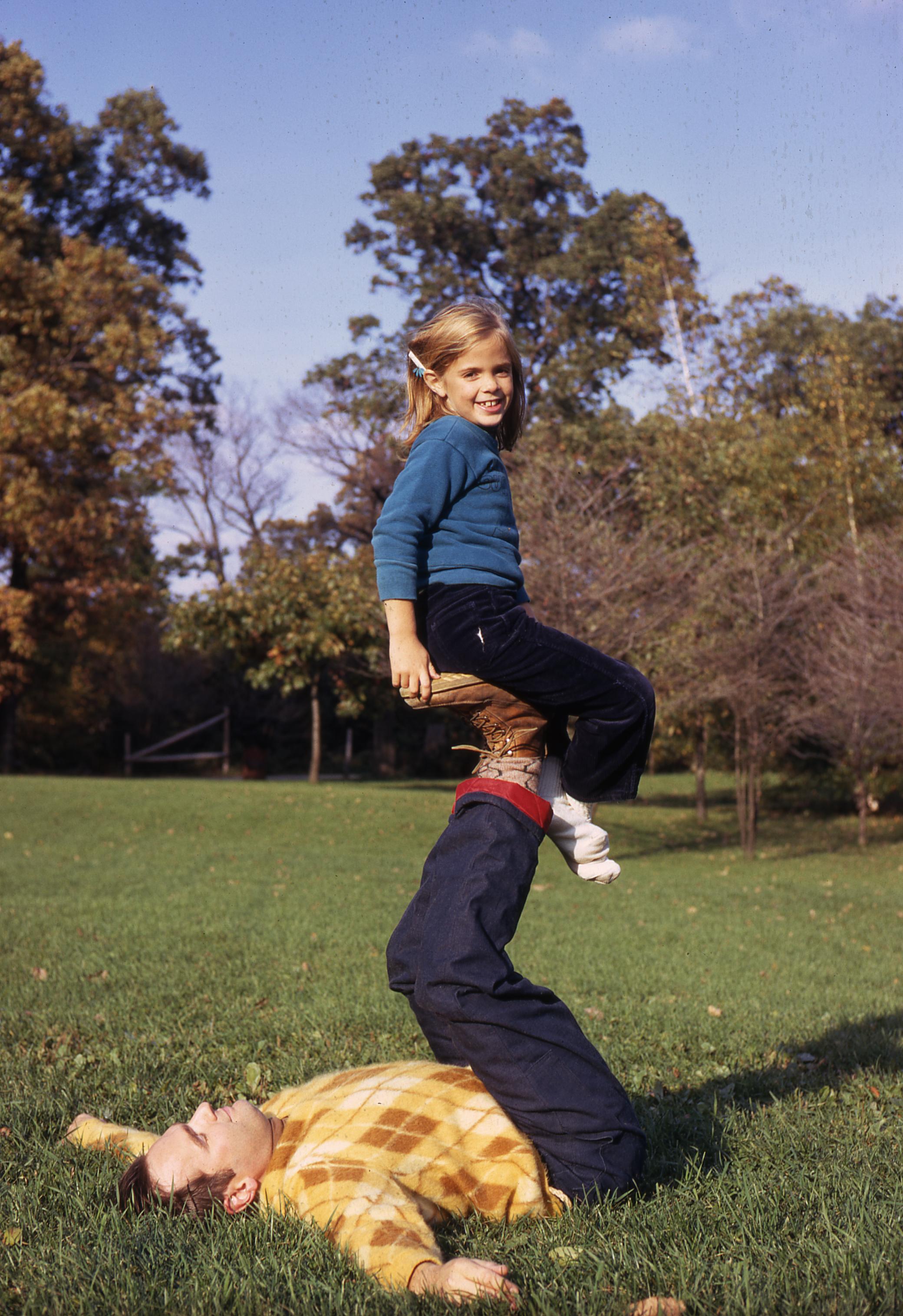
My dad was the most influential person in my life until I was married. He was the obvious authority in the family, very strict and powerful. His power was sometimes expressed in angry outbursts like a deep bellow, more often in calculated punishments encased in logical rationalizations. I knew he was to be obeyed. I also knew he could be playful. He loved to build with wooden blocks or sand. Elaborate structures would spread across the living room floor or the cottage beach front, and my dad would be lying on his side adding finishing touches long after I’d lost interest. He taught me verse after verse of silly songs with the most scholarly look on his face. He took photographs with his Leica and set up slide shows with a projector and tripod screen after dinner when I really begged him. He often grew frustrated with the mechanics of those contraptions, but I would wait hopefully that the show would go on forever. It was magic to see myself and my family from my dad’s perspective. He was such a mystery to me. I thought he was God for a long time. He certainly seemed smart enough to be. He was a very devout Episcopalian, Harvard-educated, a professor and a technical writer for IBM. He was an introvert, and loved the outdoors. When he retired, he would go off for long hikes in the California hills by himself. He also loved fine dining, opera, ballet, and museums. He took us to fabulously educational places — Jamaica, Cozumel, Hawaii, and the National Parks. He kept the dining room bookcase stacked with reference works and told us that it was unnecessary to argue in conversation over facts.
My father was not skilled in communicating about emotions. He was a very private person. Raising four daughters through their teenaged years must have driven him somewhat mad. Tears, insecurities, enthusiasms and the fodder of our adolescent dreams seemed to mystify him. He would help me with my Trigonometry homework instead.
I married a man of whom my father absolutely approved. He walked me down the aisle quite proudly. He feted my family and our guests at 4 baptisms when his grandchildren were born. I finally felt that I had succeeded in gaining his blessing and trust. Gradually, I began to work through the more difficult aspects of our relationship. He scared my young children with his style of discipline. I asked him to refrain and allow me to do it my way. He disowned my older sister for her choice of religion. For 20 years, that was a subject delicately opened and re-opened during my visits. I realized that there was still so much about this central figure in my life that I did not understand at all.
In 2001, after the World Trade Center towers fell, I felt a great urgency to know my father better. I walked into a Christian bookstore and picked up a book called Always Daddy’s Girl: Understanding Your Father’s Impact on Who You Are by H. Norman Wright. One of the chapters contained a Father Interview that listed dozens of questions aimed at bringing out the father’s life history and the meaning he assigned to those events. I decided to ask my father if he would answer some of these questions for me, by e-mail (since he lived more than 2,000 miles away). Being a writer, this was not a difficult proposition for him to accept. He decided how to break up the questions into his own groupings and sometimes re-phrase them completely to be more specific and understandable and dove in, essentially writing his own memoirs. I was amazed, fascinated, deeply touched and profoundly grateful at the correspondence I received. I printed each one and kept them. So did my mother. When I called on the telephone, each time he mentioned how grateful he was for my suggestion. He and my mother shared many hours reminiscing and putting together the connections of events and feelings of years and years of his life. On the phone, his repeated thanks began to be a bit eerie. Gradually, he developed more symptoms of dementia. His final years were spent in that wordless country we later identified as Alzheimer’s disease.
I could never have known at the time that the e-mails we exchanged would be the last record of my dad’s memory. To have it preserved is a gift that is priceless to the entire family. I finally learned something about the many deep wounds of his childhood, the interior life of his character development, his perception of my sister’s death at the age of 20 and his responsibility in the lives of his children. My father is no longer “perfect”, “smart”, “strict” or any other concept or adjective that I could assign him. He is simply the man, my father. I accept him completely and love and respect him more holistically than I did when I knew him as a child. That is the gift I want to give everyone.
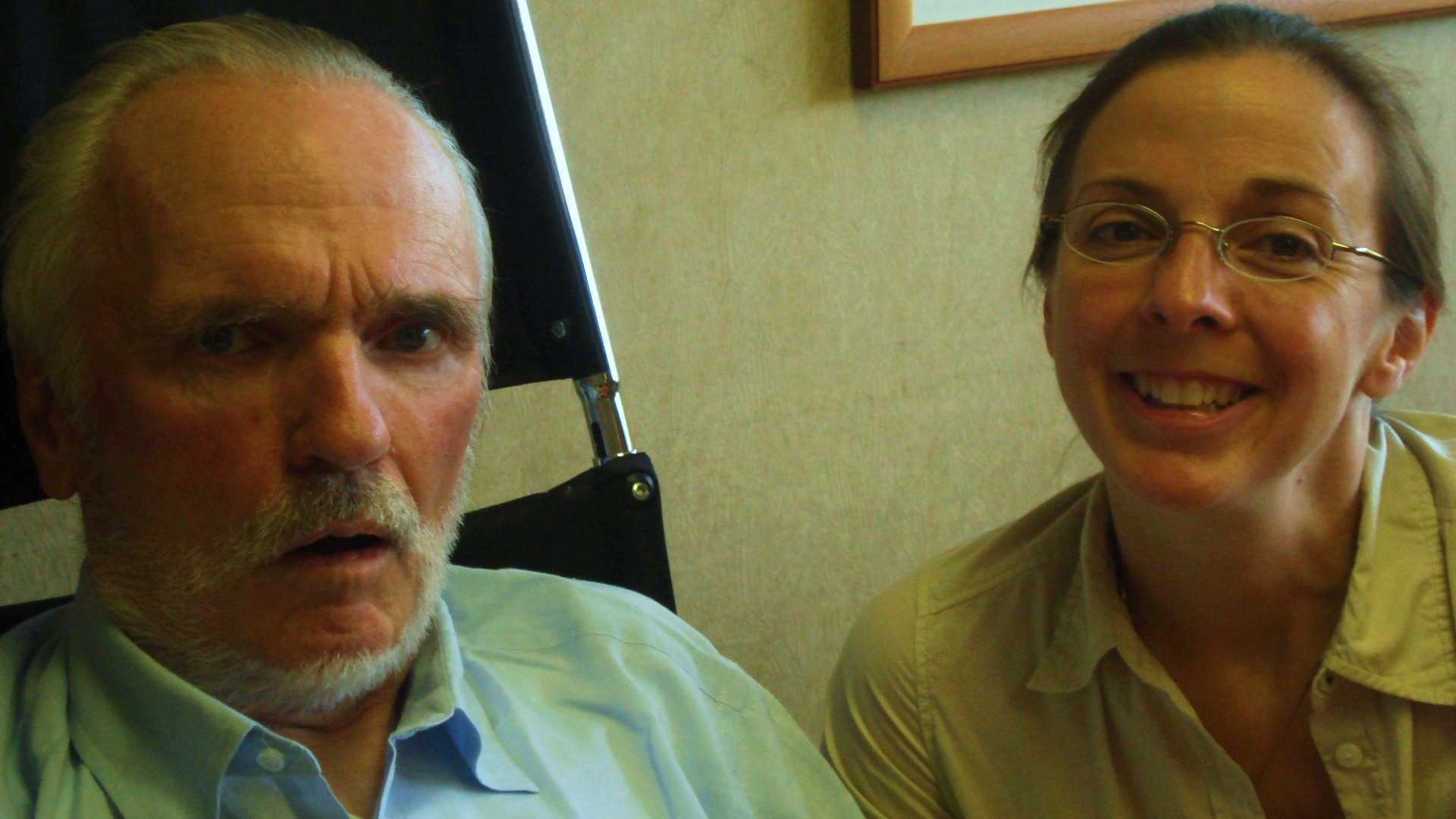
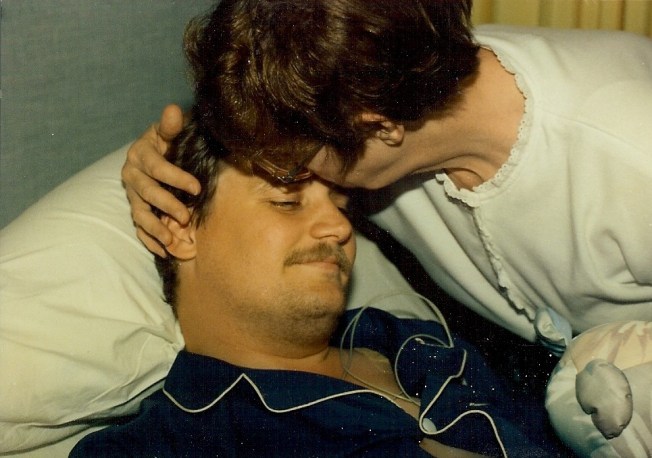
I will close with this photo, taken in the summer of 2008 when my youngest daughter and I visited my father at the nursing home. I had been widowed 6 months, had not yet met Steve, and was anticipating my father’s imminent passing. My frozen smile and averted eyes are fascinating to me. That I feel I must face a camera and record an image is somehow rational and irrational at the same time. To honor life honestly is a difficult assignment. I press on.
Weekly Photo Challenge: Fleeting
I must be sharing some head space with Cheri at Word Press. I’ve been thinking about ephemerals as I photographed the woodland wildflowers a few weeks ago. An entire hillside was covered in trout lily, and I was excited at the prospect of seeing them all bloom at once. I went back two weeks later to discover that I’d missed it.
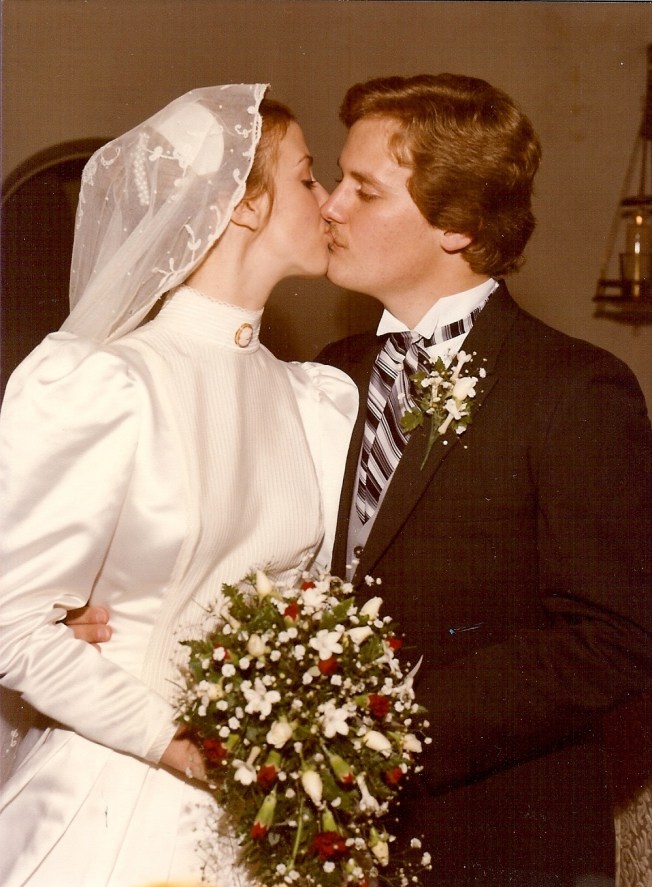
Fleeting. Short life cycles. Tomorrow is the 35th anniversary of the first time I kissed my husband. He died at the age of 47. “It’s not the years in your life, but the life in your years that counts.” That quote is attributed to Abraham Lincoln, and my sister-in-law read it at Jim’s memorial. Living, sentient beings change over time, rapidly or slowly doesn’t matter. We are all impermanent. Is that an aberration? Or is that just the way it is? Rage or accept as you will, the wheel turns, the cycle moves.
Weekly Photo Challenge: In the Background
“Back of the bread is the flour, and back of the flour is the mill, and back of the mill is the sun and the rain and the Father’s will.” So goes a table grace that I learned to sing at Girl Scout camp. Back of the photos that I post here is little ol’ me, with camera in hand, and often my companion on adventures, Steve. The challenge for this week is to Take a picture of yourself or someone else as a shadow, a reflection, or a lesser part of a scene, making the background, or — as in the example above — the foreground, the center of attention. Let’s see what I have in my treasure chest…
Oh, and here’s another one…
Kind of a goofy shot…had no idea my stomach had crept into the photo, and hadn’t really thought much about the composition. I was standing in the middle of an antique/rummage shop, trying to take in all the bizarreness around me, not sure where to look. I am an observer, and often passive. I am actually doing a lot of soul-searching these days, trying to be more intentional about what I do with my life. I have a habit of looking around, appreciating everything and not engaging with much energy in any particular thing. It’s kind of a surrender-based position. Not that it’s bad; it can be useful at times. It can also be very frustrating for Steve who wants to know more about what I really want. I have a tendency to fade into the background: social conditioning? lack of self-confidence? fear of commitment/rejection/judgment? Not that I want to promote my ego, but I do want to attend to values with some assertion. If I don’t stick up for what I think is important, then my days will be incredibly dull and my life energy not very well spent. As I get into my senior years, I want to avoid slipping into the routine of enduring and not enjoying my time here. How do I practice that daily? That’s what I’m hoping to figure out.
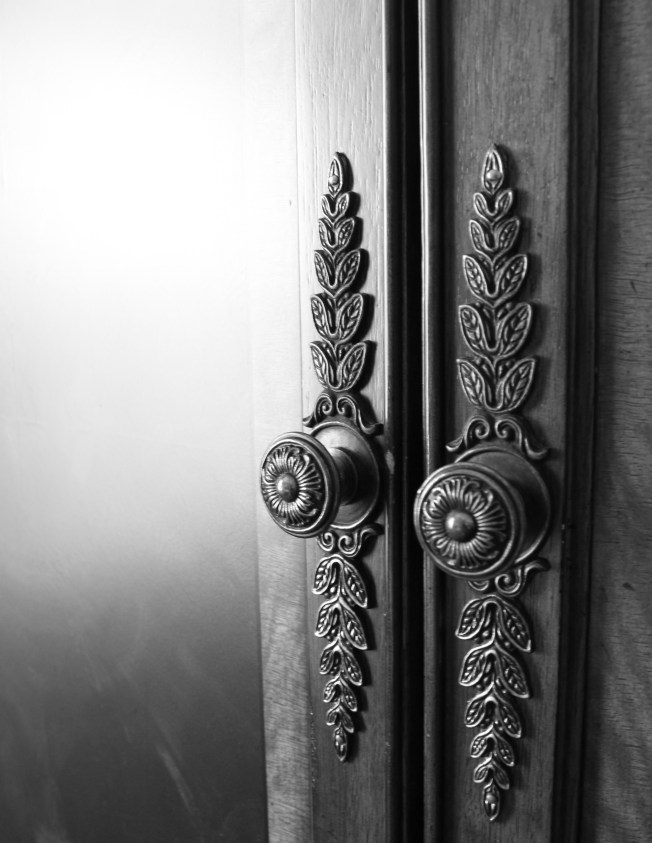
Weekly Photo Challenge: Pattern
This week’s photo challenge theme is Pattern. Visually, this is a very strong subject in photography and has been illustrated in countless dramatic and stunning ways by much more talented artists than I. But what an interesting philosophical theme as well! Are patterns created by humans, or are they natural? Humans have a special knack for identifying and arranging patterns as well as re-creating, extending, and imposing them on all kinds of things. Is that a function of our orderly brains, our consciousness? Of course, there are also examples of patterns in nature….but, again, the concept of ‘pattern’ is something we invented. It wasn’t as if a DNA string said to itself, “I think I’ll create a pattern.” It was a human who saw what was in front of him/her and said, “Eureka! A pattern!” So, pattern…is it a real phenomenon or a construct of our consciousness? Discuss. (or just look at the pictures!)
Weekly Photo Challenge: Change
Pema Chodron writes in a book called “Comfortable With Uncertainty”:
According to the Buddha, the lives of all beings are marked by three characteristics: impermanence, egolessness, and suffering or dissatisfaction. Recognizing these qualities to be real and true in our own experience helps us to relax with things as they are. The first mark is impermanence. That nothing is static or fixed, that all is fleeting and changing, is the first mark of existence. We don’t have to be mystics or physicists to know this. Yet at the level of personal experience, we resist this basic fact. It means that life isn’t always going to go our way. It mean’s there’s loss as well as gain. And we don’t like that. …We experience impermanence at the every day level as frustration. We use our daily activity as a shield against the fundamental ambiguity of our situation, expending tremendous energy trying to ward off impermanence and death. …The Buddhist teachings aspire to set us free from this limited way of relating to impermanence. They encourage us to relax gradually and wholeheartedly into the ordinary and obvious truth of change.”
Much of my life and energy of the past 10 years has been spent trying to cope with change, as I watched my husband’s health deteriorate and my children grow from an innocent childhood into a difficult adulthood. Five years ago, my husband died at the age of 47. In my most agonizing moments of wrestling with impermanence, I would take myself for a walk. Two blocks from my house was a place I liked to call “my prairie”. It was a place where “relaxing gradually and wholeheartedly into the ordinary and obvious truth of change” came naturally. At that time, I’d never heard of Pema Chodron and knew very little about Buddhism. But I could see change all around as leaves turned color, decayed, and returned to the soil where new shoots would eventually spring. Cloud formations came and went, as did the warmth of the sun. Paths mown in the prairie grass grew indistinct and were redirected. Small animal carcases seemed to melt into a puddle of fur and bones until even those were carried off or disappeared. Change was constant and friendly, not the scary beast I was beating from my front door every day.
“My prairie” became a very special sanctuary to me. This is where I went on September 11, 2001 to think. This is where I went when I returned to my old neighborhood after moving in with Steve in 2011. This is where I will wander following the Bridal Shower my daughter’s best friend is throwing for her in June. I bring myself and all my changes into this sanctuary, and I feel immediately embraced by the bigger changes of the Universe in its course. All the impermanence, egolessness and suffering of my life seems to settle down into just What Is when I am here. I feel at peace. It is my pleasure to introduce you to my picture of Change…
Weekly Photo Challenge: Lost in the Details
This week’s photo challenge is hosted by a nature photographer. His shot of an icy falls reminds me of some that I took at Wehr Nature Center…and for that reason, I want to go in a different direction. (Yes, I fear comparison!)
“Lost in the Details” is an interesting posture. Are you forgetting the big picture? Are you so overwhelmed that you are purposely choosing to downscale? Or are you simply appreciating the most minute things in wonder? Details… are they petty? or pretty?
This would be a great theme for macrophotography. Unfortunately, I don’t have the lens. Here’s one detail shot that I’ve posted before that I like:
And here’s one that I took this Wednesday after our latest snow storm:
I enjoy details…and I always want to be reminded to look up! (or as my mother would quote from her Girl Scout leader days, “Look wider still.”)
Weekly Photo Challenge: Kiss

Photo credit: my little brother, aged 7. I set the shot up for him on my Canon AE-1 (a gift from Jim) and asked him to do this favor for me so that I’d have a picture to take away to college in 1980.