Category Archives: Aging
Close Up
There are a million wonders along the path, many of them missed if you’re traveling too fast. You have to slow down to catch life in close up. Our culture resists this vigorously, of course. So I choose to live differently than most. I suppose this difference has been highlighted this week while I’ve been filling out government tax forms, listening to party politics and preparing to step back into the 19th century for my new job at Old World Wisconsin. I am not trying to move “up and to the right” like the business graph. I want to follow a different trajectory.
This morning I’ve been reading some blogs written by women who are caring for their aging mothers through stages of dementia. My father died two years ago from Alzheimer’s, but I was not a care-giver in his life because I live halfway across the country. I was a care-giver to my husband who died 4 years ago from coronary artery disease, kidney failure and diabetes. The perspective of life across different physical, mental and psychological ages intrigues me, and provides the inspiration for today’s poetry and photos. The photos are again from our trip to Wyalusing State Park. The first one was something Steve noticed as we walked. “Look,” he said, “little teenaged Priscillas!” He was looking into a stream where some water striders were sheltering between the rocks. My mother used to refer to me as a water strider when I was in high school. The poetry prompt from NaPoWriMo was to write a sonnet, 14 lines because today’s the 14th. I did not attempt to compose anything with a more formal frame than that. No iambic pentameter or rhyming scheme, just 14 lines. So, here we go with the pictures and poetry!
Skimming the surface, supported by tension
Riding the tide of everyone’s angst
A mere shadow in the depths, a dimple of contrast
Slender legs splayed out, weightless, of no consequence
A teenaged water strider, this youngest daughter.
What rock will plunge her universe,
Reverse the level of her lens and fasten her,
Securely, where the current flows and tugs?
In the wet of things, completely drenched
Attending top and bottom feeders, gasping, flailing,
Always moving, face in the water with wide opened eyes
Until another metamorphosis, an aged knife,
Severs the lines and sets her adrift
Above the ripples once again, that much closer to the sky.
Try a Triolet
Day #2 of NaPoWriMo today! 
I am learning a lot. The prompt for today is to write a “triolet”, which is an 8 line poem where lines 1, 4 & 7 are identical and lines 2 & 8 are identical. The rhyme scheme goes like this: ABaAabAB. Having never studied poetry, this is all new to me and fascinating to engage. What do you do with a structure? Play with it for a while, then take it apart and do something else, like with toy blocks? There’s no “right” way to play, is there? I think not. So I go ahead and see what happens.
I was thinking about the repetitive nature of this particular pattern, and it reminded me of a conversation I had with Steve on a recent neighborhood walk. We were talking about getting old, how older people spend their time until they die, the change in energy and the prelude to death. My husband was technically “working” the day before he died, although by that time, he was working from home at the dining room table, from a laptop equipped with Zoom Text that made each letter on the screen about 4 inches high. My father, in the advanced stages of Alzheimer’s, didn’t move or eat or do anything on his own. He eventually succumbed to pneumonia after he lost the ability to swallow food without aspirating it. My grandmother died in a nursing home rather uneventfully. She had lived with us for several years before moving into a place that could care for her more comprehensively. She spent her days watching TV in her room and would come to the dinner table and try to make conversation, often beginning with “They say….” My father always insisted she cite her sources. “Who says? Where did you hear that?”
Our concepts of dying are so complicated and irrational. What makes “sense” economically often offends morally. Questions, decisions, choices, preferences and emotions arise. What do we do with them? How do we communicate our wishes for life and death? To whom? I don’t have any definite answers. I hope I get to communicate what’s important to me to someone who is listening. I hope my views are respected. What that might look like, I cannot tell. Steve mentioned casually at breakfast that he’d like Schubert’s Octet played at his funeral. I asked him who he thought might be there. He couldn’t even say. I guess what matters is that I heard him when he said it.
Triolet for My Grandmother
There was nothing good on TV that day.
She turned her face toward the wall and died.
The years had slipped by while she wasted away.
There was nothing good on TV that day.
She’d listened and heard what they had to say.
They might have been right, but often they lied.
There was nothing good on TV that day.
She turned her face toward the wall and died.
Seize The Day!
It’s Here!
National Poetry Writing Month
Fun for the whole family! My sister intends to match me, poem for poem, in the comments section of each of my posts. Mind you, this is NOT a competition. I have to be very clear about that and remind myself that this is about playing with words, creative collaboration, cleaning my windshield of mud and fear and stuff that gets in the way of my recognition of the wonderful ideas that I, even I, have shining on the horizon. I remind myself of this several times a day because my older sister is brilliant and has always been better than me at everything. Of course, that’s entirely my own hangup. I admit it, and I’m old enough now to face it head on. Right? Right!
I am using a very inclusive definition of “poetry” here. In other words, I’ve never been a student of poetry, I don’t know form and rules, but as a singer, I like words and rhythm. As a visual person, I like icons and imagery. Any formation of symbols that produce an experience can be called poetry in my definition. Also, it’s understood that any poetry posted here is copyrighted. If it’s not original, I will site the source.
I am tickled that this event is starting on a Sunday. Such creative connotations! And on April Fool’s Day, just so that we don’t take our creativity too seriously. I self-published a book of Poems and Parables back in 1997. This was the first one:
God is a poem
Infinite in meaning
Economical in expression
Clothed in symbol and harmony
A breathing Word
Engaging all perception
Today’s prompt is “Carpe Diem”, with a reference to Andrew Marvell’s To His Coy Mistress. I have to admit that my brain first translated that Latin phrase as something like “Fish Gods”. You know, Carp Deities. ‘Fish gods’ sounds like ‘fish guts’. I was going down that path for a while. But then, I remembered a conversation I had at breakfast with Steve about childhood development. We have often referred to ourselves as 3 and 4 year olds. He’s 3, and I’m 4. I got a chart of early childhood characteristics at my last teacher training session, and we talked about how the descriptions fit us. I often feel like we’re trying to get back to those authentic ideas of ourselves and that maybe, eventually, we’ll become infants again and live as though we were not separate at all from the environment.
So all that musing is background. I began composing my first lines in the bathtub. Here’s what I penciled in my notebook when I dried off:
My three-year-old comes out to play
With ne’er a thought about the day,
For what is ‘think’ or ‘time’ or ‘how’?
The only thing is ‘this right now’.
My three-year-old, with eye and ear
Stays open’d wide to what is here.
Experience is all, you see.
That three-year-old’s inside of me.
Honoring My Father
George William Heigho II — born July 10, 1933, died March 19, 2010.
Today I want to honor my dad and tell you about how I eventually gave him something in return for all he’d given me.
My dad was the most influential person in my life until I was married. He was the obvious authority in the family, very strict and powerful. His power was sometimes expressed in angry outbursts like a deep bellow, more often in calculated punishments encased in logical rationalizations. I knew he was to be obeyed. I also knew he could be playful. He loved to build with wooden blocks or sand. Elaborate structures would spread across the living room floor or the cottage beach front, and my dad would be lying on his side adding finishing touches long after I’d lost interest. He taught me verse after verse of silly songs with the most scholarly look on his face. He took photographs with his Leica and set up slide shows with a projector and tripod screen after dinner when I really begged him. He often grew frustrated with the mechanics of those contraptions, but I would wait hopefully that the show would go on forever. It was magic to see myself and my family from my dad’s perspective. He was such a mystery to me. I thought he was God for a long time. He certainly seemed smart enough to be. He was a very devout Episcopalian, Harvard-educated, a professor and a technical writer for IBM. He was an introvert, and loved the outdoors. When he retired, he would go off for long hikes in the California hills by himself. He also loved fine dining, opera, ballet, and museums. He took us to fabulously educational places — Jamaica, Cozumel, Hawaii, and the National Parks. He kept the dining room bookcase stacked with reference works and told us that it was unnecessary to argue in conversation over facts.
My father was not skilled in communicating about emotions. He was a very private person. Raising four daughters through their teenaged years must have driven him somewhat mad. Tears, insecurities, enthusiasms and the fodder of our adolescent dreams seemed to mystify him. He would help me with my Trigonometry homework instead.
I married a man of whom my father absolutely approved. He walked me down the aisle quite proudly. He feted my family and our guests at 4 baptisms when his grandchildren were born. I finally felt that I had succeeded in gaining his blessing and trust. Gradually, I began to work through the more difficult aspects of our relationship. He scared my young children with his style of discipline. I asked him to refrain and allow me to do it my way. He disowned my older sister for her choice of religion. For 20 years, that was a subject delicately opened and re-opened during my visits. I realized that there was still so much about this central figure in my life that I did not understand at all.
In 2001, after the World Trade Center towers fell, I felt a great urgency to know my father better. I walked into a Christian bookstore and picked up a book called Always Daddy’s Girl: Understanding Your Father’s Impact on Who You Are by H. Norman Wright. One of the chapters contained a Father Interview that listed dozens of questions aimed at bringing out the father’s life history and the meaning he assigned to those events. I decided to ask my father if he would answer some of these questions for me, by e-mail (since he lived more than 2,000 miles away). Being a writer, this was not a difficult proposition for him to accept. He decided how to break up the questions into his own groupings and sometimes re-phrase them completely to be more specific and understandable and dove in, essentially writing his own memoirs. I was amazed, fascinated, deeply touched and profoundly grateful at the correspondence I received. I printed each one and kept them. So did my mother. When I called on the telephone, each time he mentioned how grateful he was for my suggestion. He and my mother shared many hours reminiscing and putting together the connections of events and feelings of years and years of his life. On the phone, his repeated thanks began to be a bit eerie. Gradually, he developed more symptoms of dementia. His final years were spent in that wordless country we later identified as Alzheimer’s disease.
I could never have known at the time that the e-mails we exchanged would be the last record of my dad’s memory. To have it preserved is a gift that is priceless to the entire family. I finally learned something about the many deep wounds of his childhood, the interior life of his character development, his perception of my sister’s death at the age of 20 and his responsibility in the lives of his children. My father is no longer “perfect”, “smart”, “strict” or any other concept or adjective that I could assign him. He is simply the man, my father. I accept him completely and love and respect him more holistically than I did when I knew him as a child. That is the gift I want to give everyone.
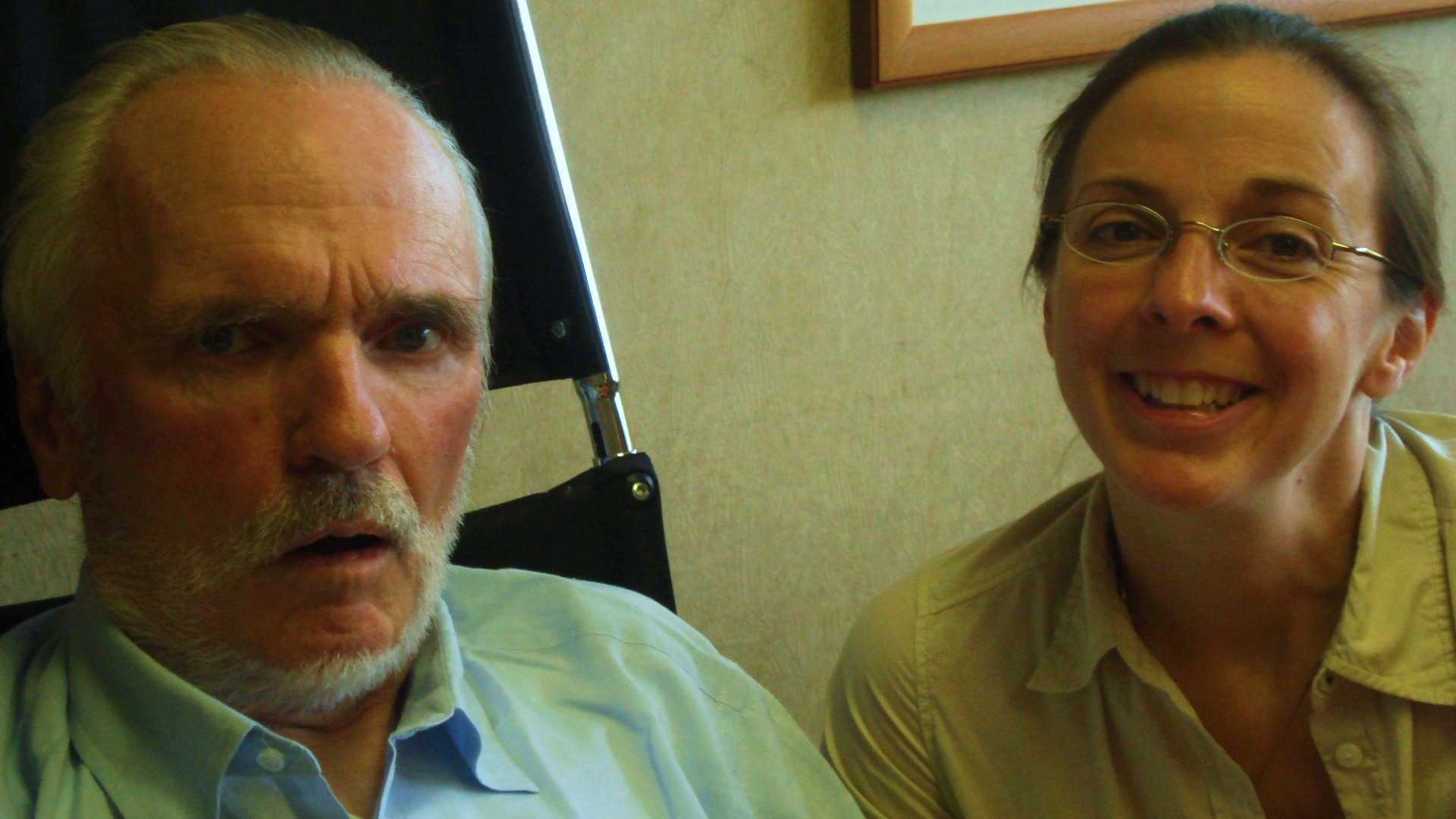
I will close with this photo, taken in the summer of 2008 when my youngest daughter and I visited my father at the nursing home. I had been widowed 6 months, had not yet met Steve, and was anticipating my father’s imminent passing. My frozen smile and averted eyes are fascinating to me. That I feel I must face a camera and record an image is somehow rational and irrational at the same time. To honor life honestly is a difficult assignment. I press on.
Groovin’ on a Sunday Afternoon
*update from yesterday’s post* She Speaks commented:
“I found an online petition from the site “Democrats 2012″ titled “Where are the women?” This petition reads:
‘At a House Oversight Committee hearing, House Republicans convened a panel on denying access to birth control coverage with five men and no women. As Congresswoman Carolyn Maloney asked, “Where are the women?” Join Leader Pelosi in our call to Speaker Boehner, Eric Cantor, Chairman Issa and all House Republicans to demand that women be allowed at the table when discussing women’s health issues. Help us gather 250,000 signatures.’
Here is the link to sign the petition: http://dccc.org/pages/wherearethewomen
I’ve signed. Please help share this information and encourage everyone you know to sign.”
I’ve signed as well. Please forward to any US citizens you think would like to add their names. *thank you*
Okay, on to All About Me.
So, Steve wakes up this morning singing “Tiny Bubbles” (yes, we do this to each other, sharing whatever our brains mumble out first thing upon waking) …Don Ho…Hawaii…and I go back to being 10 years old, which was my age when I actually traveled to Hawaii. My 10-year old self got excited about many things in Hawaii. I thrilled at the choice of coconut or pineapple syrup on my pancakes because I hate maple syrup. I spent a good 30 minutes at a picnic stop trying to open a coconut by stomping on it with my sneakers. I had a camera of my own and could take my own pictures, a Brownie Starmite which yielded snapshots that the drugstore processed with a “bonus snap” of about half the size of the original included on the print and separated by a perforated line. I eagerly tried to pronounce any Hawaiian word just for the fun of letting the syllables bubble out one after another like waves on the beach. “King Kamehameha” “Queen Liliuokalani” “Mele Kalikimaka” “hukilau” “elepani”. I felt daring and adventurous sliding down a lava tube into a lagoon while my mother hyperventilated on the banks. And I got to go swimming every day! One other memory that will always stand out about my trip to Hawaii: I was often mistaken for a boy.
I had a growing out shag haircut in the spring of 1973. My mother had made me get my shoulder-length blonde hair cut VERY short for our trip “Out West” the summer before. She was probably thinking of the convenience and the hot weather. She also insisted that we wear bathing caps whenever we went swimming. I got the idea that the prime consideration in hairstyles was not attractiveness, and at the time, I didn’t care. Much. I do remember the excruciating moment when I debuted the pixie cut at school for the first time. I was at before-school choir practice on the verge of tears because I felt so self-conscious. I was wearing a dress with a Peter Pan collar, my vulnerable neck exposed. I felt whispers behind me. Then the girl behind me leaned forward to say something, and I imagined she was about to make a comment on my haircut. I froze, trembling, with blurry eyes. Turns out she just wanted to ask what page we were on, but the contact ripped me wide open, and I began to cry. After that, I got used to it and so did others. Folks in Colorado couldn’t tell if I were a boy or a girl as I scrambled up rocky mountains with my cousin, Christopher, and it didn’t matter to me. In Hawaii, my hair was a bit longer, but since it was the 70s, boys were also wearing their hair longer. My family went to a luau one night. Each of us was greeted by a hostess with an armful of flowers. My father got a coconut palm hat placed on his head. My mother and my three older sisters received a beautiful lei of fragrant orchids. I couldn’t wait to receive my own exquisite necklace. But what’s this? Hey! Why did you give me just a stupid, green headband! I’m a GIRL, dammit! Same thing happened on a boat trip a few days later. The guide/entertainer picked me out as a model to receive something he was fashioning behind me out of palm leaves. He probably picked me to keep me from getting bored, to amuse my sisters, or just because I was cute and charismatic…in a unisex kind of way. He placed a headband with a palm “feather” sticking up in the back on my head. My sisters howled.
So, before puberty, I didn’t care about being a girl very much. I played with the boy two doors down every day. When I was alone, I crossed the street into the forest preserve and played in the bushes. I enjoyed being physical, roller-skating and jump-roping especially, and I enjoyed “helping” my father at the workbench in the basement. I was not a complete tom-boy, nor was I a girlie-girl. I was just me, and I was fine. Then I hit high school at 14 in a brand new state, California. My mother decided we all should have a lesson on wearing make-up, so we had a Mary Kay consultant visit the house. I began putting on make-up and styling my hair every day before school. I also began flirting and listening to “funky” music. I began to find my groove.
As an adult, I think it would be a revelation to have a conversation with two people from my past especially. One would be the boy I played with every day in grade school, the other would be my first high school boyfriend of more than 2 months. Both of these boys are now homosexual adults, I’ve since learned. I would love to ask them what growing up felt like for them, what our relationship taught them about themselves, but sadly, we lost touch long ago.
Finding my groove in high school led me to two of my greatest expressions of freedom and physicality: dance and jazz. I love to dance. I have taken dance lessons, and I find that I am way too much “in my head” when I’m trying to learn steps and choreography. What I really love is just to free-style to anything with a back beat. Blues, tango, rumba, pop school dances, jazz. I auditioned and got into our high school jazz choir and loved the freedom of improvisation and the soulful feel of the slower pieces we did. From high school, I went on to get a degree in Vocal Performance at a women’s college. I didn’t do any jazz or dancing in those years. I was trying to be more *ahem*, serious about music.
Steve has a very serious music collection, but on Friday, he picked up something from Goodwill’s CD collection with me in mind. It’s “The Fabric of Life” by The Nylons. They’re usually about 4-part a capella vocal jazz, but this CD has percussion and instrumentals as well. He put it on at breakfast, and I had to get out of my chair and dance! It felt great!! My heart rate climbing, my hips swiveling, my shoulders shimmying, my waist stretching and slimming and twisting…I felt alive, physical, ME! Maybe I’m getting closer to understanding how to live in my own skin after all.
I think many women have a long journey to being themselves. It’s easier when you’re 10, I think. It gets pretty complicated through puberty and socialization. Maybe now as I get closer to hitting 50, I can grow into my own groove, be funky and fine and all me. I wish I knew more of my gay friends’ journeys as well. I want to be compassionate to every human and their story of growth.
Fascination
I’ve always believed that I have a great capacity for fascination…until a few days ago when I began to read Annie Dillard’s An American Childhood. She has it in spades, and has always had it, in a way that makes me feel distracted and dull by comparison. Here’s an excerpt from that memoir:
“Our parents and grandparents, and all their friends, seemed insensible to their own prominent defect, their limp, coarse skin.
“We children had, for instance, proper hands; our fluid, pliant fingers joined their skin. Adults had misshapen, knuckly hands loose in their skin like bones in bags; it was a wonder they could open jars. There were loose in their skins all over, except at the wrists and ankles, like rabbits.
“We were whole, we were pleasing to ourselves. Our crystalline eyes shone from firm, smooth sockets; we spoke in pure, piping voices through dark, tidy lips. Adults were coming apart, but they neither noticed nor minded. My revulsion was rude, so I hid it. Besides, we could never rise to the absolute figural splendor they alone could on occasion achieve. Our beauty was a mere absence of decrepitude; their beauty, when they had it, was not passive but earned; it was grandeur; it was a party to power, and to artifice, even, and to knowledge. Our beauty was, in the long run, merely elfin. We could not, finally, discount the fact that in some sense they owned us, and they owned the world.
“Mother let me play with one of her hands. She laid it flat on a living-room end table beside her chair. I picked up a transverse pinch of skin over the knuckle of her index finger and let it drop. The pinch didn’t snap back; it lay dead across her knuckle in a yellowish ridge. I poked it; it slid over intact. I left it there as an experiment and shifted to another finger. Mother was reading Time magazine.
“Carefully, lifting it by the tip, I raised her middle finger an inch and released it. It snapped back to the tabletop. Her insides, at least, were alive. I tried all the fingers. They all worked. Some I could lift higher that others.
“That’s getting boring.” “Sorry, Mama.”
“I refashioned the ridge on her index-finger knuckle; I made the ridge as long as I could, using both my hands. Moving quickly, I made parallel ridges on her other fingers — a real mountain chain, the Alleghenies; Indians crept along just below the ridgetops, eyeing the frozen lakes below them through the trees.”
What rare child in this century, surrounded by electronic stimulators of all descriptions, would spend a half an hour fascinated by her mother’s hand, I wonder? I had the chance to meet 56 kindergarteners at the Wehr Nature Center this morning. This is what we brought out to fascinate them:
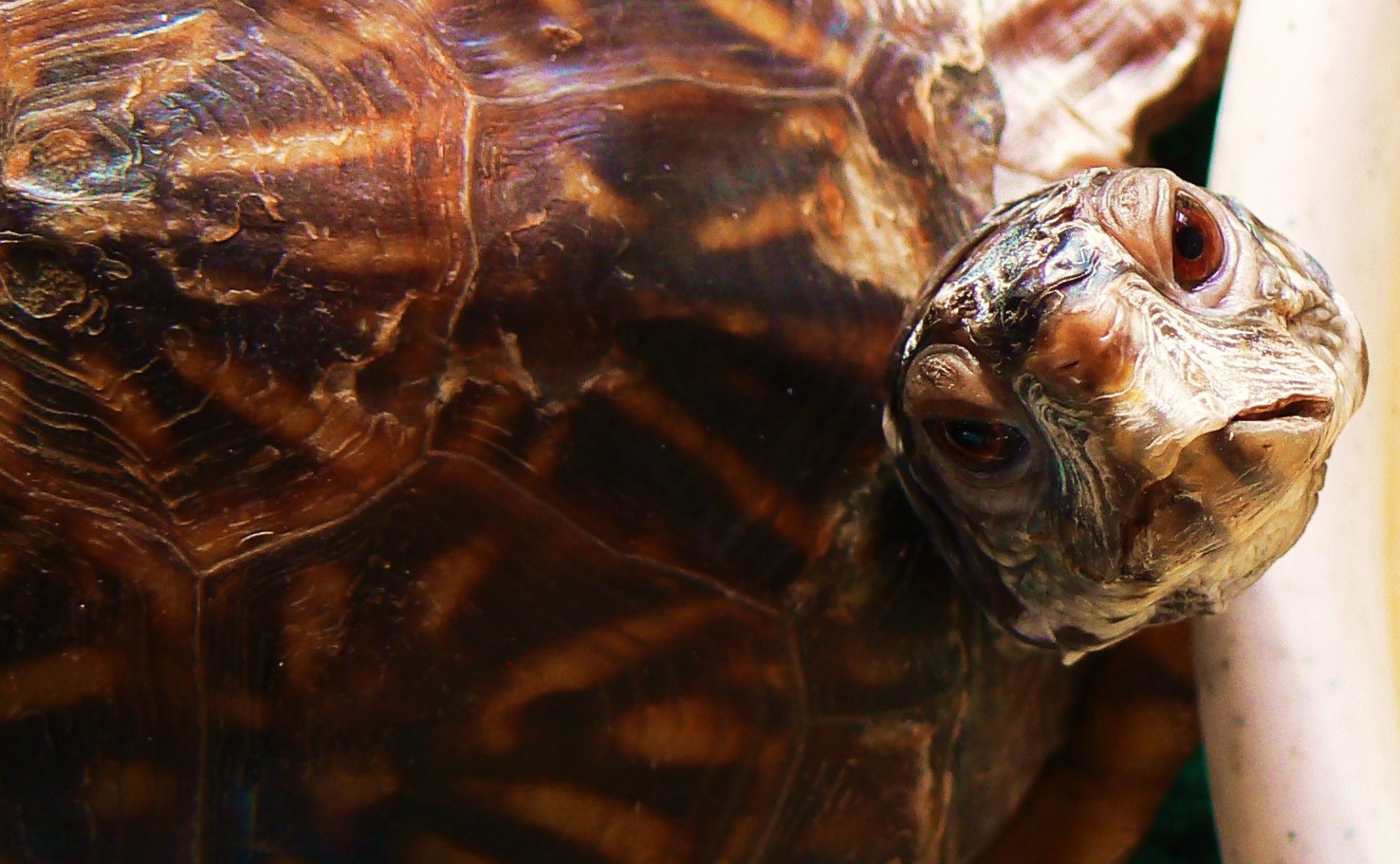
Now that’s an ancient face I could stare at for hours! Meet Boxy, the ornate box turtle. Her species is found primarily in southwestern Wisconsin, where there are sandy prairies and is currently endangered and protected. She came to the nature center about 25 years ago; she may be about 10 years older than that. How do I know to call Boxy ‘she’? Brown eyes. Male box turtles have red eyes. Also, Boxy laid some eggs a few years after she came to the center (not that she had been with a male while she was there). Occasionally, Boxy has her beak trimmed. It can get overgrown because she’s not in the wild digging and wearing it down. I wonder if the vet has ‘styled’ her expression…she looks sad to me. She was quite chipper this morning, though. It’s noticeably warm for this time of year. She and the other reptiles were moving rapidly and eagerly in their cages. We put Boxy down in the middle of the circle of children, and she set out at a brisk pace to examine the perimeter, craning her neck up at the faces around her. She is a bit of a celebrity, as she meets about 10,000 kids every year. She may live to be as many as 70 years old. I wonder if the Nature Center will still be around or if she’ll live out her last days somewhere else.
Boxy has her own beauty, her own fascinating skin. ” The lover of nature is he whose inward and outward senses are still truly adjusted to each other; who has retained the spirit of infancy even into the era of manhood….Standing on the bare ground, –my head bathed by the blithe air, and uplifted into infinite space, — all mean egotism vanishes. I become a transparent eye-ball. I am nothing. I see all. The currents of the Universal Being circulate through me; I am part or particle of God…I am the lover of uncontained and immortal beauty.” (Ralph Waldo Emerson)
What uncontained and immortal beauty will you discover to love today?
Muck and Muddle
I hate hormones. Why anyone would want to replace estrogen once she’s finally lost it is beyond me. The moods and emotions it produces are so murky.
I feel like I haven’t learned a damn thing about who I am, and I’m almost 50 years old. Aren’t I supposed to get this right, eventually?
Annie Dillard writes about awakening to her consciousness when she was about 10 years old. How do you do that at ten? And remember what it felt like decades later? The woman must have a brain six times the size of mine. Here’s a passage I read this morning, from An American Childhood:
“I woke in bits, like all children, piecemeal over the years. I discovered myself and the world, and forgot them, and discovered them again. I woke at intervals until, by that September when Father went down the river, the intervals of waking tipped the scales, and I was more often awake than not. I noticed this process of waking, and predicted with terrifying logic that one of these years not far away I would be awake continuously and never slip back, and never be free of myself again.
“Consciousness converges with the child as a landing tern touches the outspread feet of its shadow on the sand: precisely, toe hits toe. The tern folds its wings to sit; its shadow dips and spreads over the sand to meet and cup its breast.
“Like any child, I slid into myself perfectly fitted, as a diver meets her reflection in a pool. Her fingertips enter the fingertips on the water, her wrists slide up her arms. The diver wraps herself in her reflection wholly, sealing it at the toes, and wears it as she climbs rising from the pool, and ever after.”
Why do I feel like I never achieved this perfect fit, this awakened consciousness, not as a child and that I’m struggling to find it still? The idea of ancient grace that began this blog seems as ethereal and unattainable as ever. The clumsy truce I’ve maintained with myself wears thin.
Time to cocoon under the blankets and let the snow fall. Perhaps I’ll emerge as from a chrysalis and feel differently by supper.
Bridal Wave of Memories
On this day 28 years ago, I was married to my high school sweetheart in my parents’ church in northern California. I was 21 years old. Jim was 23. I wore the veil that my mother and grandmother wore on their wedding days. I wore the hoop petticoat that my mother wore in 1955 under her similarly long-sleeved and high-colored wedding gown. I also wore the wedding present Jim had given me a year before: a beautiful cameo pin that he had purchased on the Ponte Vecchio in Firenze. My dress had been made by a local seamstress using pattern ideas, material and trim that my mother and I had picked out. My mother and I selected the caterer, the photographer, and the florist together. My mother secured the musicians: a flute player she knew to play in the church with our organist, and a jazz trio to play at the reception. My parents issued the Banns of Marriage in the bulletin of the mass the week before my wedding, inviting everyone in the parish to attend. The reception was held in the Parish Hall behind the church.
My bridesmaids included my two older sisters and two friends. Jim’s groomsmen included his half-brother, my brother, and two friends. We selected other friends to participate in reading the Scriptures. Since we knew so many semi-professional singers personally, we decided not to have any soloists. Instead, we included congregation hymns that we could all sing together. The whole affair was pretty simple, but elegant, and definitely traditional. I did not have a manicure or pedicure, I did my own hair and make-up, we did not have a DJ or MC or dancing. I did throw my bouquet, but I gave my garter to my husband…to keep. We did have lots of champagne and loaded the unopened bottles into the station wagon (nothing like a limo) when we took off afterwards for our honeymoon, driving back down to Southern California where I would continue the second semester of my senior year at college.
My grandmother was appalled that Jim and I arranged to meet each other the morning of our wedding day to drive out to a county arboretum and spend some time together. She kept insisting that it was bad luck for the bride to see her future husband before joining him at the altar on her wedding day. She also kept asking if someone was going to sing “I Love You Truly” at the service. These were not the traditions that we were interested in honoring, though. We were not about superstition or sentimentalism, or so we thought. We wanted to be sacramental and sincere. I suppose there are slippery slopes and fine lines involved in those distinctions. What I do remember thinking about is how to conceptualize a lifetime together. I figured that might be 50 years or more. I could barely conceptualize the two decades I had actually experienced. I realized that it had to come down to faith. I couldn’t imagine or predict what our marriage would be like. I could only promise to live it moment by moment as lovingly as I could “until we are parted by death”. I did that to the best of my ability, I believe. That parting occurred almost four years ago, now.
January is often a month of looking into the future, making uncertain plans, vowing to try to live in particular ways. “Pointing your canoe”, as we like to put it. Don’t let it frighten you. Paddling is slow work, with plenty of time to correct, re-align, look around, and get inspired. You can even drift for a while, if you like, without causing harm. Forgiveness can arise. Consequences will arise as well. There’s no need to cast blame. Look lovingly on the scene, on yourself, on your partner, on the world. I enjoy marking the milestones, and I’m finding I even enjoy moving on.
As Time Goes By
My daughter is a certified massage therapist. This makes visiting her an extra special occasion. Not only do I get the pleasure of her company and hospitality, I get a 2 hour massage as well. As I lay there thinking about my body, my cells, and the amazing things going on just under my skin, it occurred to me that the whole process that I call my biological life began exactly half a century ago. Yup, I figure I was conceived Thanksgiving weekend, as my parents celebrated with joy their gratitude for life. Not that they ever divulged so private a story to me, mind you.
I marvel at how life is sustained over time. I mentioned this to my kids as I was sipping my post-therapy water. My youngest piped up, “Yeah, well, half a century is nothing when you think about how mountains grow and change.” Touche. I have to get better at taking a longer view, getting a bigger perspective. I look at my kids bustling around in the kitchen preparing food together, all grown up, and a second later, they are playing a patty-cake game from their childhood.
We are all still so young on this earth; we are such a blink. What kind of impact will we have on the bigger picture? What will be the most lasting legacy of this family whom I love so intensely? The trees that we’ve planted? The children we beget? The words we pen? The votes we cast? The ashes we give back to the soil? I can’t say for sure. It could be the love that we circulate, although it would be impossible to document. I am just grateful to have been a part of it, a crinoid in the limestone, among thousands of others.