Unknown's avatar

What is Sacred?

Today is a good day to ponder the sacred, to feel that aching quiet deep below the surface, to stay with it long enough to taste its bitter and its sweet.  Whatever form that takes.  I have spent years wrapped in one particular expression of that endeavor, but today, I tried a new one.  The NaPoWriMo (National Poetry Writing Month) prompt for the day was a challenge to write a poem about an animal.  I knew immediately what animal that had to be for me: an animal that I’ve admired in different stages of my development, from my earliest memories to the present day.  One of my earliest posts was devoted to this animal, entitled “Nature’s great masterpeece…the only harmlesse great thing – John Donne”.  As I closed my eyes, opened my heart, and began to brainstorm various words and phrases, I realized that I was indeed pondering the sacred.  In order to invite you into that relationship, without influencing you too much, I will end my narrative here and simply share the photo and poem that arose and offer them as icons to stimulate your own thoughts.

Her skin was visible from outer space

     criss-crossed trails in the dry expanse

         seismic sections of caked mud

           pulsing with the rhythm of the magma core.

She walked as continental plates on tip-toe

      shuffling through the sanctuary of time

         in ponderous planetary procession

           chanting sighs that shook the stars.

She raised her tender tip

      a stroking, soothing, searching spirit

         a whisper enfleshed, intuitive, inquisitive

            and opened her sky portals, fringed with boughs

                so heaven could gaze freely down.

Her wisdom reigned in sacred skull,

      the holy archways gleaming

         until her desecration reduced

            to catacombs of dripping blood

                that mammoth cathedral.

The matriarchs lie raped in heaps

      across the countryside.

         No longer shall we place our heads

            on gentle, heaving breasts to feel

                the wide embrace of a universe.

Unknown's avatar

Peace Walk

Yesterday, I blogged several quotes from Thich Nhat Hahn.  Last night, I came across a passage in Living Buddha, Living Christ that illuminated my journey through widowhood, change, and doubt.

“One day when you are plunged into the dark night of doubt, the images and notions that were helpful in the beginning no longer help.  They only cover up the anguish and suffering that have begun to surface.  Thomas Merton wrote, ‘The most crucial aspect of this experience is precisely the temptation to doubt God Himself.’  This is a genuine risk.  If you stick to an idea or an image of God and if you do not touch the reality of God, one day you will be plunged into doubt.  According to Merton, ‘Here we are advancing beyond the stage where God made Himself accessible to our mind in simple and primitive images.’  Simple and primitive images may have been the object of our faith in God in the beginning, but as we advance, He becomes present without any image, beyond any satisfactory mental representation.  We come to a point where any notion we had can no longer represent God.”

“The reality of God”…beyond any notion or representation, there is a reality, an experience.  Returning regularly to this experience is what Thich Nhat Hahn refers to as “deep practice”.  It requires awareness, mindfulness, being awake and paying attention.  What is the experience of being in this living world?

I went for a walk yesterday in a strong wind and looked up to the trees.  They were all swaying in their own way, in different directions, at different levels, different speeds.  They have no notion that is “wind”.  They have an experience.

The river touches the stones and mud in the river bed, it touches the banks, it touches the wind with its surface and reflects the trees that rise high above it.  It inhabits its course without a concept or an image of anything.

I enjoy images.  I become attached to them.  Their primitive simplicity appeals to my limited brain and feels comfortable.  I wonder now if that’s why I often become “stuck”.  It’s as if I become unable to see the forest because I look so constantly at the trees.  The experience of ‘forest’ is so much more.

Every time I take a photo, I put my experience into a frame.  Would a frameless view of reality take me beyond my doubts?  Beyond my fears?

When I was a cantor at my church, I’d sing a refrain during Vespers, framing the prayers that people offered up in the pews: “Shepherd me, O God, beyond my wants, beyond my fears, from death into life.”

Shepherd me, O God, beyond my doubts, wants, fears, images, and notions…from death into Life.

Unknown's avatar

A Bigger World

I’ve been thinking lately about my ego and my mood cycle.   Two days ago, I wrote “I feel that expansive, fecund, open sense bubbling up in me, settling me down, inviting me to nurture and set free.  Then, a while later, I feel a feisty urge to grab hold and wrestle with my circumstances and force them to conform to some idea in my brain.”  Right now, I’m in the restless part of my cycle, and my ego is eager to get to work on something.   It gives me a sort of shimmering sense of dissatisfaction, not like something is “wrong”, but like I’ve been sitting too long and want to stretch.  I don’t want to get into the habit of simply indulging my ego with any old thing whenever it prods me, though.   Steve often talks of feeling like he’s “treading water”, too.  He told me this morning that he wanted to work on “pointing his canoe”, which is his metaphor for re-establishing direction and putting energy into venturing forward, so I asked him if he uses some kind of ego energy to address that.   He said, “It’s not like that.  It’s more like gathering your courage and discipline to step into a bigger world.  I think the ego is a smaller world.”

I immediately got my pencil and notebook and wrote that down.

A bigger world.  A world that is beyond me, beyond my control, beyond prediction.  A bigger concentric circle.  I do think we tend to pull back into our tiny, lower-case universe, the one where we feel safe and comfortable and powerful.  We can’t really help that tendency, but we can acknowledge it and try to point our canoe in a different direction.  I am really inspired by people who do that, and through the network of blogging, I have met a few who I think are paddling away.  Maybe they’re not the people you’re thinking of.  They aren’t the extreme sportsmen.  They aren’t the world travelers.  They aren’t the social superstars.  They are the suffering, the ones who have met their limitations and crossed into the unknown.  They blog about living with their illness, their addiction, their recovery, their brain damage in a way that definitely requires them to gather courage and discipline and step into a bigger world, a world which they don’t master.  And sometimes they whine, and sometimes their posts are incredibly boring, but I keep visiting them because I think they are truly onto something.  I suppose that I am hoping to witness their breakthrough flight, when they will soar high above the rest of us into that bigger world of awareness.  I’m not sure what that will look like, but maybe I’ll recognize it anyway.

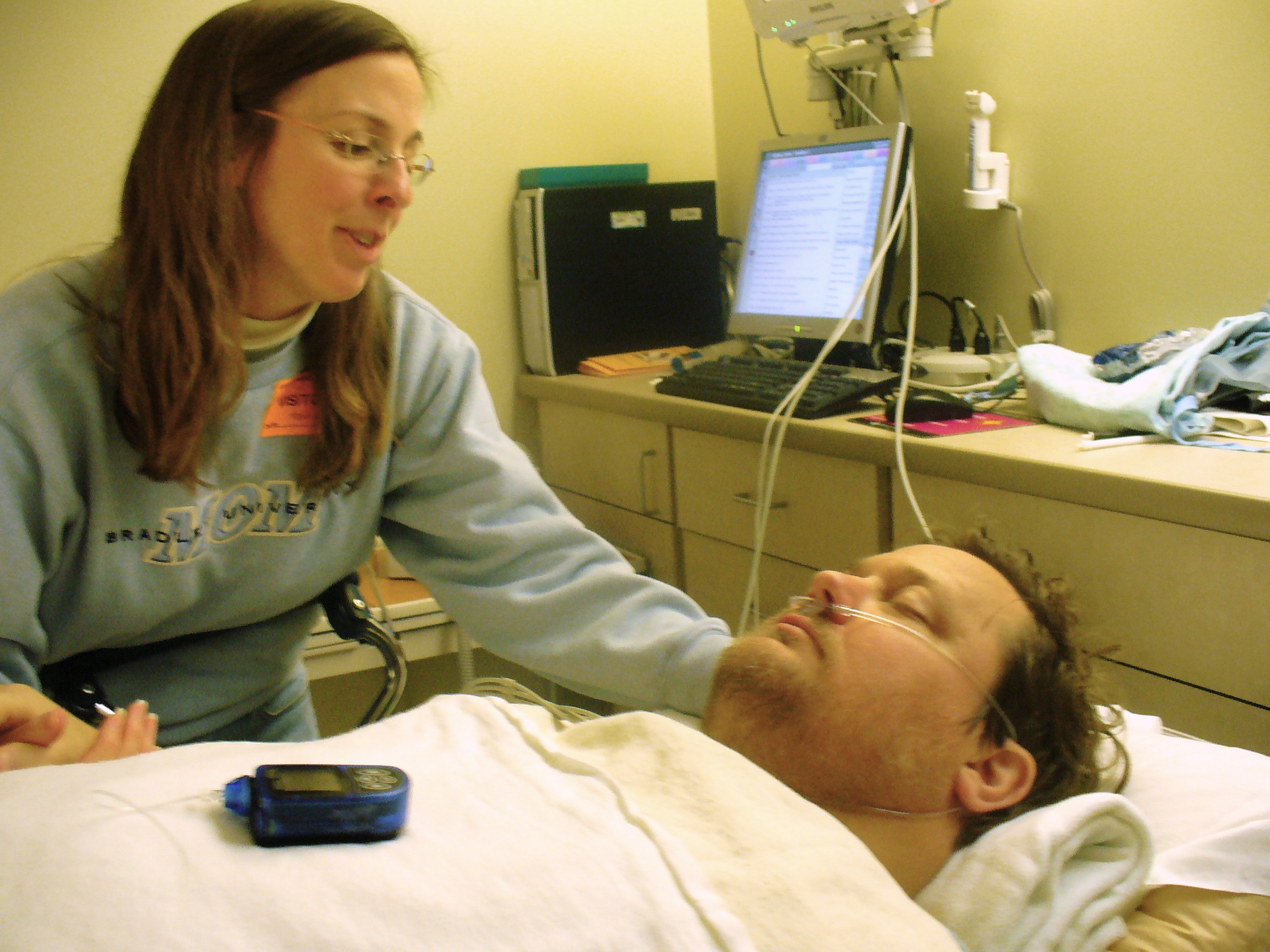
I am working on writing a memoir on my husband’s illness and death.  Four years ago, he had his last surgery.

The story of how he came out of anesthesia is perhaps a glimpse into that bigger world.  My oldest daughter wrote about it in her Live Journal that evening:

“When I saw him after the surgery, painkillers and low blood sugar had rendered him almost completely unresponsive. We tried everything—tickling him, turning his insulin pump off, talking to him, poking him—but the most we could get from him was a groan or a slight shift of position. I told him I was pregnant. Mom said they’d called a rematch of the Super Bowl. I even took a picture of him, threatening, I think, to mock him with it later. Nothing made any difference until I had to leave for work. I squeezed his arm and said “Bye, Dad. I love you,” and in a sleepy, submerged-sounding voice, he said “Love you.” We couldn’t get him to say or do anything else, but every time someone said “I love you,” he would immediately mumble it back.”

So, I think of Jim, hovering somewhere between consciousness and death and knowing only one response: “I love you”.   This is the Universe you don’t control.

Unknown's avatar

Peace On Earth

It is Day #23 in the December countdown.  Today’s gift is Peace.  Ahh, peace.  Take a deep breath.  Relax the muscles around your skull; feel  your ears and eyebrows pull backward; close your eyes and roll your head. Do you feel a sense of well-being?  Julian of Norwich claims that God himself spoke these often quoted words to her, “All shall be well, and all shall be well, and all manner of thing shall be well.”  Do you believe that’s true?  Do you believe that’s possible?  I do, although I don’t always act as though I do. I forget.

Wikipedia uses these phrases to define peace:  “safety, welfare, prosperity, security, fortune,  friendliness… a relationship between any people characterized by respect, justice and goodwill… calm, serenity, a meditative approach”.  Where does peace come from?  Buddha, the Dalai Lama and many others will tell you that peace comes from within, not without.

“The first peace, which is the most important, is that which comes within the souls of people when they realize their relationship, their oneness with the universe and all its powers, and when they realize that at the center of the universe dwells the Great Spirit, and that this center is really everywhere, it is within each of us.” – Black Elk

But perhaps, there are things outside of you that will remind you of the peace which dwells within you.

“Climb the mountains and get their good tidings. Nature’s peace will flow into you as sunshine flows into trees. The winds will blow their own freshness into you, and the storms their energy, while cares will drop away from you like the leaves of Autumn.” – John Muir

Do you feel peace in your mind and body and soul all at once?  Do you descend into peace from your head down?

“I do not want the peace which passeth understanding, I want the understanding which bringeth peace.” – Helen Keller

I suppose each of us must find his/her own journey into peace.  Anxieties and conflicts are particular and personal.  Facing each one head on is not a passive task.  Making peace is not for the weak of heart.  “Blessed are the peacemakers, for they shall be called children of God.”  Is God about making peace?  Is making peace the work of the Universe?  Is it perhaps that joyful effort that gives life meaning?

“Peace is not merely a distant goal that we seek, but a means by which we arrive at that goal.”  – Martin Luther King, Jr.

If we can make peace between ourselves and God, ourselves and Nature, can we then make peace between ourselves and others?

“If we are peaceful, if we are happy, we can smile and blossom like a flower, and everyone in our family, our entire society, will benefit from our peace.” – Thich Nhat Hahn

“What can you do to promote world peace? Go home and love your family.” – Mother Theresa

Steve constantly reminds me that in every situation, especially in those that cause anxiety and conflict to arise, I have 3 choices.  I can hide/run away.  I can try to change the situation.  I can change myself.  The first option doesn’t exactly make peace; it simply avoids confrontation.  You can hide away all day long and still feel the fear of whatever it is that scared you.  So, why do I often employ that choice?  Because I lack courage and I’m lazy.  I sometimes pick that choice first to give me time to screw up my will and motivation.  I don’t want to get stuck there, though.

Trying to change the situation requires engagement.  Making peace with hunger, poverty, sickness, and distress this way requires an understanding of  causes and effects on all different levels.  It requires negotiation, and it requires cooperation.  You don’t always get all that is required to change a situation.  Not all situations can be changed.  Death is the big one that comes to mind here.  You can’t hide or run away from it, and you can’t change the situation so that you don’t have to experience it.  Now what?

Change yourself.  Sometimes the only way to make peace with something is to change your thinking, your belief, your approach, your attachment, your aversion, your ignorance or some other aspect of yourself.  “If you can’t beat ’em, join ’em!” is the simplistic way to say it.  If you’d “rather fight than switch” (old cigarette commercial – pop philosophy at it’s finest), then you have chosen to fight, not to make peace.  Our egos make it really tough to change ourselves.  Sometimes we’d rather fight, sometimes we’d rather die, sometimes we’d rather do anything than change ourselves.  You have to ask yourself very seriously what your ultimate goal is to get past this one.  Is your goal to keep your ego intact or is your goal to make peace?   I’ve come across a lot of phrases that address this ego dilemma: “take up your cross”, “turn the other cheek”, “deny yourself”, “die to self”.  I think that dogma is probably more an ego thing than a peace thing.   If you can’t let go of your religious beliefs in the interest of peace, then your religion is more about yourself than it is about God, in my humble opinion.   I love the part of the movie “Gandhi” where he counsels a Hindu man who is distraught at having murdered a Muslim child.  “Raise a Muslim child and make sure you raise him as a Muslim, not as a Hindu. This is the only way you can purge your sins.”  This is true wisdom about peace.

Give peace a chance. It requires your will, it requires your strength, and it requires you to lay aside will & strength.  I am looking forward to enjoying the peace that my family and I have created.  We are still creating it, and will be our whole lives long.  That’s what children of God do.

Unknown's avatar

Sunday Poetry

Church Going by Philip Larkin (1954)

Once I am sure there's nothing going on
I step inside, letting the door thud shut.
Another church: matting, seats, and stone,
And little books; sprawlings of flowers, cut
For Sunday, brownish now; some brass and stuff
Up at the holy end; the small neat organ;
And a tense, musty, unignorable silence,
Brewed God knows how long. Hatless, I take off
My cycle-clips in awkward reverence.

Move forward, run my hand around the font.
From where I stand, the roof looks almost new -
Cleaned, or restored? Someone would know: I don't.
Mounting the lectern, I peruse a few
Hectoring large-scale verses, and pronounce
'Here endeth' much more loudly than I'd meant.
The echoes snigger briefly. Back at the door
I sign the book, donate an Irish sixpence,
Reflect the place was not worth stopping for.

Yet stop I did: in fact I often do,
And always end much at a loss like this,
Wondering what to look for; wondering, too,
When churches will fall completely out of use
What we shall turn them into, if we shall keep
A few cathedrals chronically on show,
Their parchment, plate and pyx in locked cases,
And let the rest rent-free to rain and sheep.
Shall we avoid them as unlucky places?

Or, after dark, will dubious women come
To make their children touch a particular stone;
Pick simples for a cancer; or on some
Advised night see walking a dead one?
Power of some sort will go on
In games, in riddles, seemingly at random;
But superstition, like belief, must die,
And what remains when disbelief has gone?
Grass, weedy pavement, brambles, buttress, sky,

A shape less recognisable each week,
A purpose more obscure. I wonder who
Will be the last, the very last, to seek
This place for what it was; one of the crew
That tap and jot and know what rood-lofts were?
Some ruin-bibber, randy for antique,
Or Christmas-addict, counting on a whiff
Of gown-and-bands and organ-pipes and myrrh?
Or will he be my representative,

Bored, uninformed, knowing the ghostly silt
Dispersed, yet tending to this cross of ground
Through suburb scrub because it held unspilt
So long and equably what since is found
Only in separation - marriage, and birth,
And death, and thoughts of these - for which was built
This special shell? For, though I've no idea
What this accoutred frowsty barn is worth,
It pleases me to stand in silence here;

A serious house on serious earth it is,
In whose blent air all our compulsions meet,
Are recognized, and robed as destinies.
And that much never can be obsolete,
Since someone will forever be surprising
A hunger in himself to be more serious,
And gravitating with it to this ground,
Which, he once heard, was proper to grow wise in,
If only that so many dead lie round.

I love this poem.  Every time I come to it, I recognize myself – awkward longings and reverential questions, sentimental habits and a hunger to be wise, anachronistic and timeless seriousness.  My spirituality is in transition.   I went to Church every Sunday for 47 years with very few exceptions.  I haven’t been for the last 2 years.  I am working on embodying a more inclusive philosophy, a less social practice, and a less dogmatic and judgmental religious outlook.   I do miss singing in the choir, though I have put lots of good music in my life, and found many holy places in which to look up and many opportunities to practice love outside of the Church.  I feel rather like I’m cutting apron strings and finally growing up.  When I was a child, “Children’s Church” was another place where grown-ups told you how to be and said, “Repeat after me.”  When my children went to church, they had what was called “Catechesis of the Good Shepherd” which was a Montessori-based religious ed approach.  The children explored their own innate spirituality through play, manipulating figures of shepherd and sheep and acting out rituals with candles and vestments and various other items.  I think the idea was to give permission and encouragement for the children to experience their own connection with the stories they were told and express their own emotions about them.  So anyway, I suppose there is an evolution of spirituality within a person’s lifetime.  It’s different for each person, of course.  To stay in the routine of church going without engaging in any new dimension of thought or experience would be a deadening of the dynamic, though.  I want to have a living faith, and I’m experiencing a new kind of life now.  And I suppose that I am also rationalizing in order to give myself permission to be absent from Church.  It’s a complicated relationship.  Maybe more like being a daughter than I imagined.  I’m still trying to mature.