Tag Archives: philosophy
Another Sunday Stroll
Sunday morning, a sunny Spring day. Oatmeal with honey and dried cranberries, orange juice, chai tea. Grab my camera and take a walk. Come along! We got some rain the past two days. Now the colors are so bright!
Steve and I got into another “relationship talk”. The sun was shadowed by a passing cloud, and I saw this lone female duck, head tucked under her wing, standing on one leg. At that moment, my soul was hiding and this seemed like the perfect illustration.
We passed a church where families with well-dressed children crossed from their cars into the open doors. I remember getting myself and four children up and dressed tidily and bundled off to choir and Sunday school week after week. I miss the expectation of meeting people, the habit of seeing and being seen. I don’t miss the bickering between the kids, the passive teenaged resistance. I do miss the bagels and lox and chocolate croissants. I definitely miss the singing.
Junctions. Life paths, habits, structures, changing, evolving, maintained and unkempt.
Useful and interesting, I suppose, but I really want to be graceful, too.
I suppose my biggest fear is that I am neither useful nor graceful.
There’s another way to think of myself, though. Instead of the Western idea of being an artifact, something made by a Maker, I could adopt the Eastern way and imagine myself as something grown and growing.
Thinking, pondering, musing on my self, my vision, my viewpoint, my place in the vast universe. Steve grabs the camera from me and shows me his vision. It’s different from mine. I think it’s kind of Zen, kind of quirky. Very Steve.
I’m back home, sharing my thoughts with a congregation of bloggers. Did anyone bring bagels?
A Flower’s Name and Nature
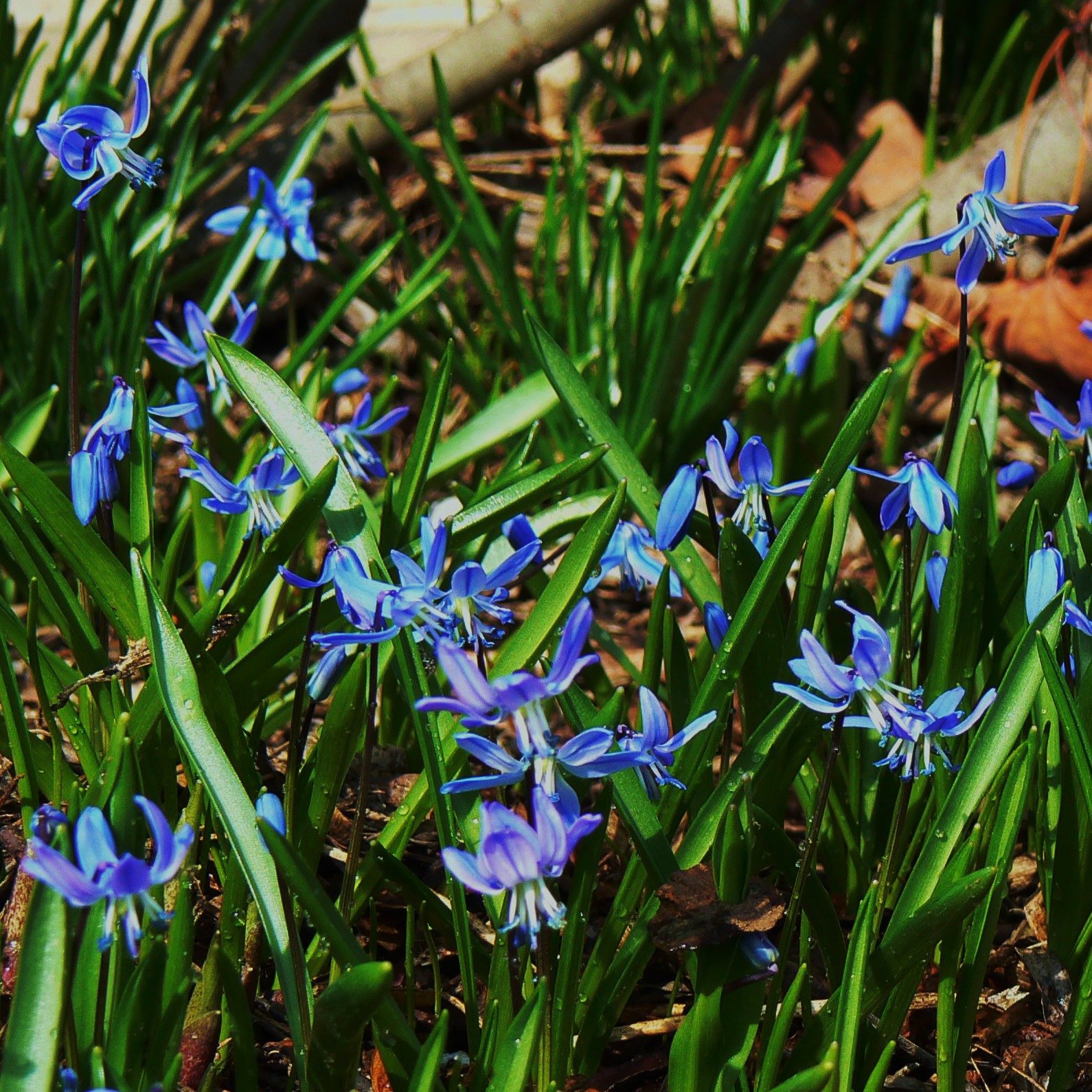
I learned that the blue flower growing in my garden and all over the Wehr Nature Center woods is called scilla siberica (wood squill) and is native to southwestern Russia, the Caucasus and Turkey. I am guessing that settlers brought it over here about a hundred years ago. I’m tickled that we have parts of our name in common! I am thinking more about the settlers and their way of life while I wait to hear about the outcome of my Old World Wisconsin interview. What did they find different about the flora and fauna here? What did they miss from the old country? How does the emotional connection to land, a place, a “mother country” develop, and what did it feel like to venture out from there to an unknown place?
Memories are sweet; what is here right now is also sweet.
I find myself using more energy to be present with what is right in front of me. When I retreat to my memories, I take that energy and shelter it deep within myself. It feels like I’m hiding, in a way. It’s not easy to allow anyone else to inhabit that place. It’s slow and calm and secret.
I have a memory garden. It blooms with the flowers of the old country: my babies, my husband, my house, my youth. I like to visit it and inhale its familiar fragrance. I am alone there.
The world of the present is all around that secret garden. It asks to be acknowledged, appreciated, and invited into my deep consciousness.
I could call this my “settler’s mind”. But there really is no division. Here, there, then, now…it’s all fluid, connected, like the roots and rhizomes of wild flowers.
“One of the illusions of life is that the present hour is not the critical, decisive hour. Write it on your heart that every day is the best day of the year.” – Ralph Waldo Emerson
Every day is the best day, every place you are is the best place.
While You Were Sleeping
As usual, he called me at the office that afternoon while he was working from home. “Hi. How are you doing?” I probably mentioned something about my ordinary frustrations on the job or something about our daughters. Then it was down to business. “What are you doing tonight?” It was Friday night. Our youngest had a rehearsal at a church only a few blocks from our house, starting about a half an hour after I got off work. “Do you want to go out to dinner?” “SURE!” It was cold, the roads were icy. We didn’t want to go far, so we dropped her off and went to a bar & grill that had just opened behind the strip mall in our little town. It was full of activity: TVs were on, people bustled about, artwork from the public schools was displayed on the wall. There was lots to look at and hear. The menu was new to us. Teriyaki green beans sounded good. So did fried artichokes. I ordered a beer; I think he did, too. We had sandwiches as well. Then he got a call on his cell phone. Our daughter was not feeling well and was leaving rehearsal early. We said we’d meet her at home. We all talked in the living room for a little while, as he sat on the couch gathering his strength for the climb upstairs. He seemed pretty tired. He’d come home from the hospital just 10 days earlier with 2 cardiac stents implanted. In the bedroom, he turned on the flat screen TV, took his medications (all 23 of them) and hooked up his dialysis machine and his sleep apnea mask. In our big, squishy bed, we watched an episode of “NUMB3RS”, and then the movie “Regarding Henry” came on. I’d seen it before: Harrison Ford and Annette Bening in a good story about marriage, change and intimacy. It complimented the mood perfectly. We were feeling secure, companionable, close. I fell asleep beside him, holding his hand. I awoke at 6:30 AM. His body was still and cold.
That day was exactly four years ago. What did he dream about that night? Did he feel any pain? Did he try to get up? Did he try to call out or wake me? Did he see a brightness as his neurons flashed for the last time? Was it peaceful? I can only imagine.
I can imagine him firing up feelings of love and bathing in them, floating on a surge of endorphins while images of his babies rushed by. I can imagine him strolling an endless golf course of rolling green fairways, tree-lined and bright. I can imagine him soaring with the tenor section in an angel choir, his energy trembling and resonating with clouds and stars. I can imagine him satisfied and proud and smart and good and kind. I can imagine him wrapped in the embrace of the Universe…forever.
I can imagine him, but can I know him any better, any more? I still feel open to him, and as I continue to try to expand my awareness, I wonder about that. I know that I don’t know what I might be able to know. What is memory? What is sleep? What is consciousness? What is death? Are they ‘real’? I don’t know. What is ‘real’? What I know is that I don’t know. What I feel is that he mattered and still matters. I feel that he is.
Sentimental, Sacramental or Cynical
Valentine’s Day. A Hallmark holiday. Is it even connected to anything in history? The Roman Catholic Church removed St. Valentines’ Day from its calendar in 1969 because there was nothing known about the 3 St. Valentines that had been venerated except that one of them was martyred on February 14th. Chaucer had started the whole romantic connection by writing this verse in 1382 as part of a poem to honor the first anniversary of the engagement of Richard II to Anne of Bohemia:
For this was on seynt Volantynys day
Whan euery bryd comyth there to chese his make.
“For this was on Saint Valentine’s Day, when every bird cometh there to choose his mate.”
Okay. So what?
Eventually socialization takes over. We establish a day on the calendar to honor Love and allow traditions to flourish. It’s good for the economy. See also Mother’s Day and Sweetest Day. We grow increasingly attached to our traditions and habits and compartmentalize the celebration of Love to coincide with the day. That’s what I would call sentimental. It’s about the past and nostalgia.
But why not forget February 14, the calendar, and time itself, since they are merely social constructs, and instead try to honor every moment as we live it? The Bell of Mindfulness rings for this moment only. What are you feeling? What is happening around you? Are you fully aware of the miracle of living right now? If in your awareness, you choose to employ an “outward and visible sign of the inward and spiritual grace” of being mindful, then that’s what I would call a sacrament.
And if the whole thing just strikes you as absurd and unrealistic, then you might be what I would call cynical. You might connect the day with massacres and treat your loved ones to:
Whatever your particular taste tends to on Valentine’s Day, I hope you enjoy the flavor!!
Looking at Life: The Photography Metaphor
So, my son’s visit has come to an end. It was good to offer him a retreat from his everyday routine, a chance to slow down and reflect, the reassurance of support and the challenge of articulating his thoughts, feelings, and desires. Making your way in the world as a young adult is hard work; there’s so much to process and so many options. As I mess around with photos, sliding tint and color saturation and cropping and brightness tools around, I think of all the different ways there are to look at the world. How do you land on the one you want to “apply”? What is the result you’re looking for? How do you recognize that result or closer approximations of it?
I keep asking myself those questions, and the answers do change.
My son remembered some of my “dragon lady” moments as his mom, those angry “This is not the result I want!” rejections of his behavior. I had forgotten the specific events, but I remember the frustration. As always, I had (at least) three options: run/hide, change the situation, change yourself. I spent a lot of energy trying to change situations. “I wouldn’t be this frustrated if I could get these kids to obey me!” I tweaked and cajoled, but I never managed to break their spirits and get them to comply completely. They had their own will, just like a photograph whose focus is already determined. The one thing I can’t do with my photos in post processing is sharpen the focus. So what do I do then? Change myself. This is a fuzzy picture and it will never be crisp. But I can learn to understand fuzziness as a quality that represents a true thing in the universe and so makes a valid image.
I think I’ve evolved to be a closer approximation of the person I want to be. Less of a “dragon lady” or control freak or perfectionist. More tolerant and compassionate. More honest and willing to look at things as they are and drop the tyranny of looking at things in comparison to how I wish them to be. Kinder, more open, less anxious. Oh, but I still have some more adjustments to try. I may get closer still. Meanwhile, here are some examples of the results I got with pictures from yesterday.
A Bigger World
I’ve been thinking lately about my ego and my mood cycle. Two days ago, I wrote “I feel that expansive, fecund, open sense bubbling up in me, settling me down, inviting me to nurture and set free. Then, a while later, I feel a feisty urge to grab hold and wrestle with my circumstances and force them to conform to some idea in my brain.” Right now, I’m in the restless part of my cycle, and my ego is eager to get to work on something. It gives me a sort of shimmering sense of dissatisfaction, not like something is “wrong”, but like I’ve been sitting too long and want to stretch. I don’t want to get into the habit of simply indulging my ego with any old thing whenever it prods me, though. Steve often talks of feeling like he’s “treading water”, too. He told me this morning that he wanted to work on “pointing his canoe”, which is his metaphor for re-establishing direction and putting energy into venturing forward, so I asked him if he uses some kind of ego energy to address that. He said, “It’s not like that. It’s more like gathering your courage and discipline to step into a bigger world. I think the ego is a smaller world.”
I immediately got my pencil and notebook and wrote that down.
A bigger world. A world that is beyond me, beyond my control, beyond prediction. A bigger concentric circle. I do think we tend to pull back into our tiny, lower-case universe, the one where we feel safe and comfortable and powerful. We can’t really help that tendency, but we can acknowledge it and try to point our canoe in a different direction. I am really inspired by people who do that, and through the network of blogging, I have met a few who I think are paddling away. Maybe they’re not the people you’re thinking of. They aren’t the extreme sportsmen. They aren’t the world travelers. They aren’t the social superstars. They are the suffering, the ones who have met their limitations and crossed into the unknown. They blog about living with their illness, their addiction, their recovery, their brain damage in a way that definitely requires them to gather courage and discipline and step into a bigger world, a world which they don’t master. And sometimes they whine, and sometimes their posts are incredibly boring, but I keep visiting them because I think they are truly onto something. I suppose that I am hoping to witness their breakthrough flight, when they will soar high above the rest of us into that bigger world of awareness. I’m not sure what that will look like, but maybe I’ll recognize it anyway.
I am working on writing a memoir on my husband’s illness and death. Four years ago, he had his last surgery.
The story of how he came out of anesthesia is perhaps a glimpse into that bigger world. My oldest daughter wrote about it in her Live Journal that evening:
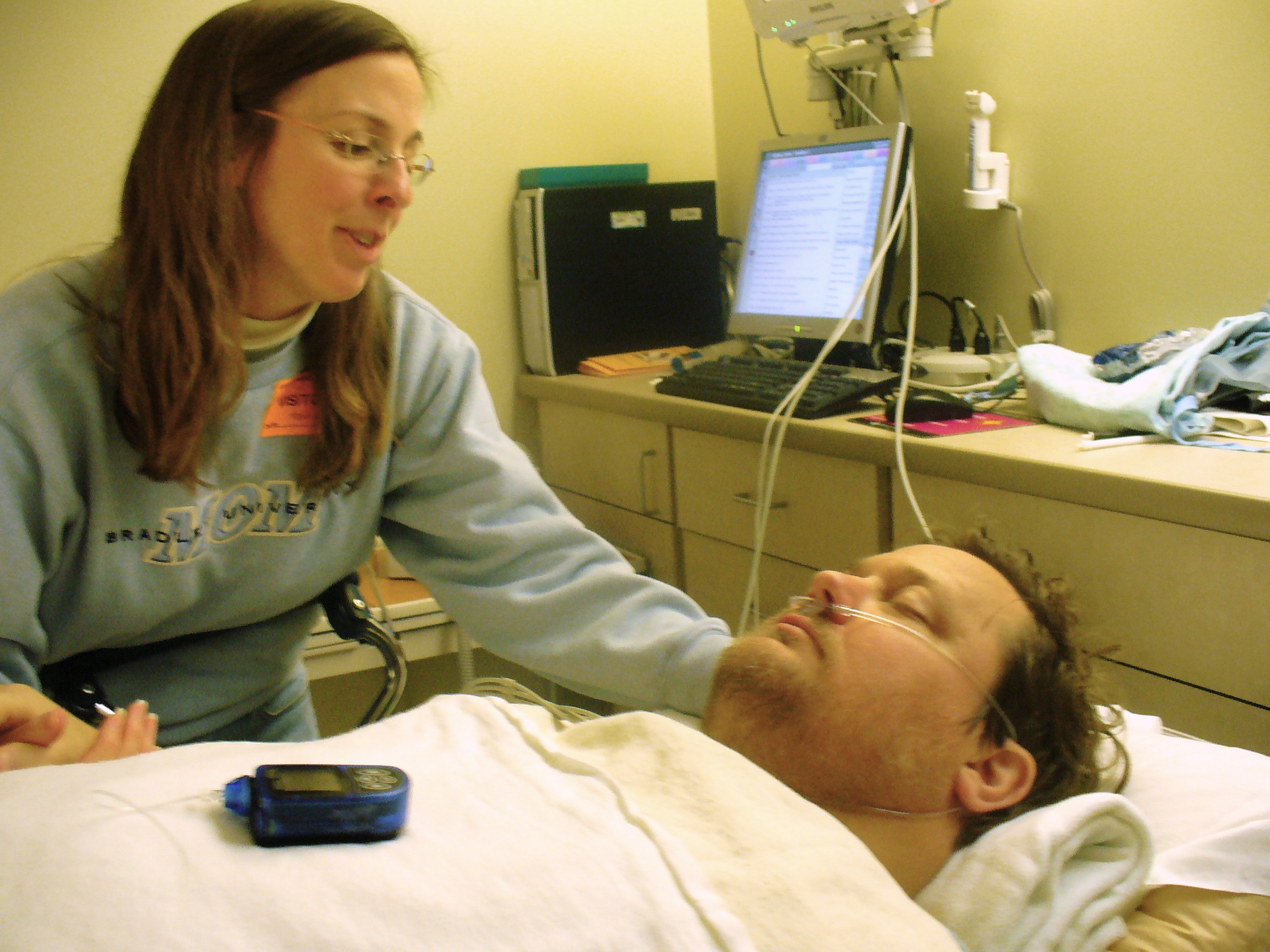
“When I saw him after the surgery, painkillers and low blood sugar had rendered him almost completely unresponsive. We tried everything—tickling him, turning his insulin pump off, talking to him, poking him—but the most we could get from him was a groan or a slight shift of position. I told him I was pregnant. Mom said they’d called a rematch of the Super Bowl. I even took a picture of him, threatening, I think, to mock him with it later. Nothing made any difference until I had to leave for work. I squeezed his arm and said “Bye, Dad. I love you,” and in a sleepy, submerged-sounding voice, he said “Love you.” We couldn’t get him to say or do anything else, but every time someone said “I love you,” he would immediately mumble it back.”
So, I think of Jim, hovering somewhere between consciousness and death and knowing only one response: “I love you”. This is the Universe you don’t control.
What is Love?
Yesterday, I read a travel post about a European romantic trend called Love Locks. Apparently, an Italian novel whose title translates to “I Need You” has spawned the custom of lovers affixing padlocks to public fences, bridges, gates and whatnot as a sign of their everlasting love. This idea really rubs me the wrong way, so I’m sorting out my thoughts to figure out why. Of course, this is about me, not about judging any of the couples who have participated in this ritual nor about anyone else who thinks it’s romantic. So, what do I know about me?
First of all, I worry about the accumulation of stuff. Seeing all those padlocks encrusting a surface reminds me of the proliferation of manufactured gadgets and things that we humans often allow to run unchecked. Apparently, many city officials also consider them “an eyesore”. It occurs to me that if they were something natural or biodegradable (like flower petals or garlands?), I would probably not feel this instant repulsion. This may be just the surface of the aesthetic mismatch, however.
Second, I think a lot about symbolism. What does a padlock say about love? In all fairness, I have not read the novel, so I am probably missing the finer points. I understand the desire for security in a relationship. I was married for 24 years, “until death”, and I positively flourished under the safety of that bond. But now that Jim has slipped all surly bonds, I think that anything everlasting must be a bit more mutable than metal, more plastic than any tangible material. The words of a song by John Denver keep floating to the surface of my consciousness. The title of the song is “Perhaps Love”. Here’s a bit of the chorus: “Some say love is holding on and some say letting go; and some say love is everything and some say they don’t know”. I guess I have to say that lately I’ve been sitting in the “letting go” camp. Out of necessity, obviously. I did the struggle of holding on. I found it to be an ego thing, ultimately unsustainable. Letting go, opening up, imagining expansiveness is a way to include a lot more without confining it to an embrace. I believe love wants to include a lot more by nature.
Two nights before my love died was Valentine’s Day. We celebrated at home with champagne and salmon in the company of two of our daughters. My oldest brought out a book of Pablo Neruda’s poetry and read this one (Love Sonnet #92):
My love, should I die and you don’t,
let us give grief no more ground:
my love, should you die and I don’t,
there is no piece of land like this on which we’ve lived.
Dust in the wheat, sand in the desert sands,
time, errant water, the wandering wind
carried us away like a navigator seed.
In such times, we may well not have met.
The meadow in which we did meet,
oh tiny infinity, we give back.
But this love, Love, has had no end,
and so, as it had no birth,
it has no death. It is like a long river
that changes only its shores and its banks.
Translation: Terence Clarke
I cannot imagine trying to put a padlock on a wheat field or on the desert sands, on the wind or on a river. I cannot imagine putting a padlock on time, even though that’s a concept we made up, just like the padlock, as a way to try to control things. I do know that the impulse to lock down an experience is very human and very old. The ancient story of the Transfiguration of Jesus comes to mind. Jesus and three of his disciples (Peter, James and John) climb a mountain, and there the disciples have an experience of seeing Jesus in glowing white raiment talking to Moses and Elijah. Good old impetuous Peter gets all excited and bursts out with an idea. “Let’s build three booths (or tabernacles)! We can put each of you in one and hang on to this experience for a while longer, perhaps invite others….” He is silenced by a booming voice from the clouds. “Listen!” When the cloud lifts, Jesus stands alone, and they decide to keep quiet instead.
I am beginning to recognize a kind of flow, a yin and yang of contrasting energies, in myself. I think it has something to do with my biological cycle, but it also manifests in a mood cycle. I feel that expansive, fecund, open sense bubbling up in me, settling me down, inviting me to nurture and set free. Then, a while later, I feel a feisty urge to grab hold and wrestle with my circumstances and force them to conform to some idea in my brain. I could say that I am still loving with both energies. I used to tell my children that I disciplined them because I loved them, and I believe that’s true, but I think there’s an ego love and a non-ego love. They are both part of me. One is not “right” and the other “wrong”, but I think that the non-ego kind is more beneficial in the universe.
Valentine’s Day is a few weeks away. It’s a time when many people are thinking about love, romantic love. I keep challenging myself to think bigger, to open up. I hear the voice booming from the clouds, from the trees, from the water and the air. It asks me to Listen. So I guess it’s time to shut up.
Parenting On the Dotted Line and Over the Rainbow
Steve & I borrowed a DVD from the library called “Between the Folds”. It’s a documentary about origami, but not just the decorative, brightly-colored little figures that school kids make. It’s about science and mathematics and art and exploring the fusion of all those disciplines. To learn more, click here. One of the fascinating paper-folders interviewed is Erik Demaine, “an associate professor of electrical engineering and computer science at the Massachusetts Institute of Technology. Called one of the most brilliant scientists in America by Popular Science, he received a MacArthur Genius Fellowship at the age of 22. Demaine’s work combines science and art, geometry, paper folding and computational origami.” The interview also includes footage of him with his dad, who apparently home-schooled him as a single parent and prepared him to enter college at the age of 12. These two bear a touching family resemblance of soft-spoken, constantly smiling Geekdom, complete with pony-tails, facial hair and glasses. It is obvious that they have enjoyed sharing a couple of decades exploring the world with bright-eyed curiosity.
I also happened upon a Mom Blog called RaisingMyRainbow. Its blurb reads: “Adventures in raising a slightly effeminate, possibly gay, totally fabulous son.” Her son is 4 years old. She writes with wit and whimsy and a very open attitude, chronicling how their family navigates what seems to be a mainstream suburban life with an emerging non-mainstream human being. It seems very honest to me, no agenda, no axe to grind, no added drama, just very loving and willing to engage with what arises.
I am inspired by this kind of parenting, and I want this to be what I pass on to my children. My own kids are already in their 20s, though. But I figure it’s never too late to model something positive. After all, they may be parents themselves some day. My parenting models were quite limited. Growing up in the 60s & 70s, I didn’t know one kid whose parents were divorced until I got to High School. My dad’s own parents were divorced, but he never talked about that. My best friend’s parents had been divorced from previous marriages, but that didn’t seem to impact their family life when I knew him. I got the strong impression that there was a ‘right way’ and a ‘wrong way’ to do everything, and the ‘wrong way’ was to be avoided at all costs. Consequently, I complied and conformed and walked the narrow way. It wasn’t a bad response, but it wasn’t necessarily the right response or the only reasonable response. The difficulties with my response became apparent as my circle of awareness widened. Other people were living other responses. Do I tolerate, embrace, include or exclude those people? What if some of those people are my own children?
“There are as many different ways to be a Christian as there are Christians”, my spiritual adviser told me one day. He was a former Jesuit priest, born in India, married to a former nun, both still very active in the Catholic Church. I couldn’t have been more astonished. My father would never have said that. There are as many different ways to be a parent as there are parents. Those ways may be judged according to certain values. To make any kind of distinctions, you really have to look at those values. Do you value conformity? Okay, then call it ‘conformity’. Do you value love? Okay, then look very closely at what you think ‘love’ is. Does love punish? Does love shame? Does love reject? Do you value certain beliefs that you respect? Why do you respect them? Because someone told you to? Because they support something you’ve experienced? There are so many good questions to consider, but it’s hard to find a safe place to consider them. As a parent, I felt attacked, judged and defensive. Competition crept into my parenting way too much. I own those as my issues, but I also believe the suburban environment supported that. Parental support groups I was in may have effectively reinforced the competition rather than offered support.
Hindsight. I was 22 when I became a parent. I didn’t think about a lot of this stuff beforehand. However, I have four totally fabulous children nevertheless. I give them credit; I give me and my husband credit; I give the Universe credit. In general, if I lighten up on my ego, I can avoid creating stuff that’s FUBAR. Instill wonder, curiosity, creativity. Play alongside the kids, and step back. We are all learning and growing up together, folding rainbows into the process.
Existential Sunday
I mentioned yesterday that I was moody. I come around periodically to a place of existential crisis, and I’ve come to believe it’s good for me. When I was raising children and nursing a sick husband, I rarely got this privilege. I always had someone to pour my heart and soul into and frequently felt that my existence was thoroughly used up on a daily basis. Trouble is, this way of living was often an unexamined habit that I could go through sleep-walking. I kept my head down and convinced myself that everything I was doing was noble and important. It may have been, or it may not have been. I wasn’t really paying attention that closely.
Living with Steve is different. It’s challenging. He doesn’t want me to pour my heart and soul into caring for him. He wants me to fly on my own. I blink, open-mouthed. Fly? On my own? What the heck does that look like? He redirects my attention from outside of me to inside…all the time…and I keep imagining an empty room. What if I don’t have any inner life?
So I sit with that. Emptiness isn’t a judgment. It can be the beginning of openness.
I went poking around on the internet, looking for an answer (from outside, again…old habits die hard) to “what is important in life”. I actually found something kinda cool: this community project. An abandoned building in New Orleans is covered with chalkboard paint and stenciled with the prompt “Before I die, I want to ___”. Chalk is provided. People approach. Existential assessment goes on, and the sentence is answered. I imagine myself standing there…clouds gather, rain falls, people pass, children grow up…and I’m still scratching my head.
I thought of re-phrasing the question, changing “What is important in life?” to “What are two things you cannot live without?” They’re not exactly interchangeable, I discovered. I also discovered a great irony: I lost the two things I thought I couldn’t live without, and I’m still living. So, either they weren’t that important, or I’m not really living. Or I didn’t answer that truthfully. I thought I could not live without my husband. I thought I could not live without my Christian faith. I was wrong.
Okay, dammit, what IS important in life? What about the obvious answer…’life’? As in, “Before I die, I want to Live.” I want to live, be alive, be awake, be aware, spend myself, give my love, explore my autonomy, visit that inner room and see what’s there. But not in an ego-driven way. In an open way. The Western way prompts me, “Yes, but what will that look like when it’s all finished?” as if there’s a finish. It wants a goal, a check list with little boxes to tick, just to keep track so that it can say, “Good…I’ve done it!” That’s ego talk. The Eastern way says, “Forget the goal, the check list. You don’t need to keep track; keep open. Engage with life and have a relationship.”
That’s where I’ve gotten to so far today. How about you? What is important in your life?