This month, I was honored to be the Associate Editor of The Be Zine, and the theme of the issue is “The Joys of Nature: Wilderness, Gardens and Green Spaces”. Browse the entire blogazine here.
What exactly is our relationship with Earth, its wilderness, its gardens and its green spaces?
Of course we all value this place in some way. I won’t call it our home, although we all live here; we can live nowhere else. To me, the idea of ownership seems inappropriate at least and inaccurate at best. This place may be closer to owning me, in fact. And ‘home’ makes it seem so domesticated. Is that what it is? Or is it unapologetically wild and autonomous? I have decided to approach this place as I would an equal: with humility and respect for both of us. That seems to be the best moral decision I can make.
Others don’t agree. They consider this place a servant in need of stewardship. They talk of ‘eco-system services’ and measure the value of this place by the benefits it provides to one species, a single leaf on the great Tree of Life – Humans. They extract the elements that serve them, but they are not producers, like plants; they are consumers. They talk in economic terms, like ‘board feet’, but the only thing they truly produce is waste, of which only a minimal amount can be absorbed and re-used. They concern themselves with ‘management’, imagining a parental responsibility for the growth and training of this place. It’s ironic to me that the child they attend is billions of years their senior.
This place is often valued for its beauty, prized for delicate and powerful sensual elements that fill the soul and spark the imagination. Many who praise it lift it far up on a pedestal of mysticism but decline to offer it their understanding or their presence. To them, it can become remote, surreal and alien, a romantic fantasy on an epic canvas.
Some view this place with disinterest, perturbation, or downright disgust. Standing on it just means that it’s beneath them; they will not allow themselves to be grounded. It takes a great expenditure of energy to maintain this separation, but they achieve this distance by employing every distraction and applying every veneer currently available.
This has been called the “Athropocene Era”, the geological epoch of Humans. We are the dominant species at the moment and the major force impacting the Earth. We’re no longer a hunter-gatherer society, and our advancing technology is always at the expense of natural resources, even if our intention is to use it for conservation efforts. For example, the ‘progress’ we have made in recycling plastic still uses tremendous energy to break down the material and still results in the production of waste and toxins. The unchecked growth of our species has effected the climate of the entire planet and threatens a mass extinction.
It stands to reason that the only way to lessen our impact is to become less numerous, consume less, and produce less waste. We must slow down and live simpler, more sustainable lifestyles in order to stop this growth mentality that has become a global menace. Then we can begin to nurture an equal relationship to this place and its inhabitants.
Let us spend time with this place, pay a lover’s attention to its moods, its responses. Let’s be careful what we take and what we leave behind. Let’s respect this place in every detail and not dismiss the nuances in its character. Let us champion its autonomy and dignity, seeking to understand but not using that understanding for our own advancement and growth. Let’s explore to gain wisdom, not to invade. And let us celebrate our love for this place! Teach it! Demonstrate it in song, story, art and work!
I hope we will not grow weary or discouraged in this love. There will certainly come a new age of geography yet, whether our species is included or not. In our own lifetimes, though, living a loving relationship to this place is its own reward. It is a love to fill the heart, soul, mind and body and bless the world.
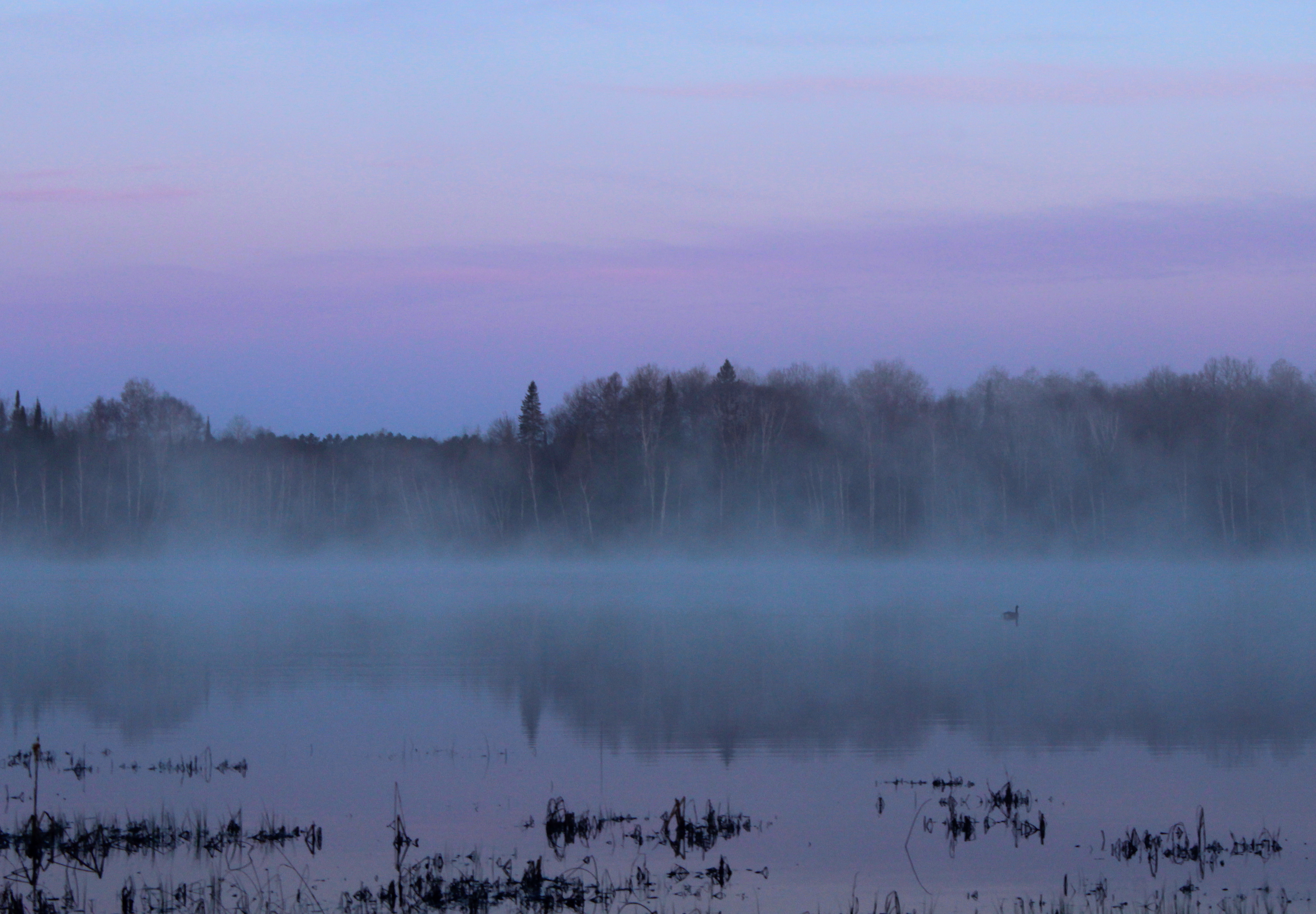
Usually, I reserve Friday mornings for Word Press and open the Daily Post promptly at 11:00 to see what the photo challenge is for the week. Yesterday, however, I was camping in the Whisker Lake Wilderness area in northern Wisconsin. I was up just before dawn, roused by a chorus of woodpeckers and swans, red-winged blackbirds and Canada geese. The early ecophony (a great term Steve recently ran across in an environmental essay: a portmanteau of ecology and cacophony) was only slightly less raucous than the previous moonlit night’s melee of frog song.
Have you ever wondered at the intricacy of co-habitation in an eco-system? Around Perch Lake there were mammals, birds, amphibians, insects and reptiles all doing their interconnected dance with time and space in the most amazingly complex overlapping of rhythms. The full moon, the night frost, the dawn mist, the swelling heat of day: the ebb of one activity and the flow of another as time marches forward spins a never-ending tapestry of living.
On a single rock on the side of the hiking trail, I found another intricate web of life, a microcosm of mosses.
And in a single catkin about to burst into bloom, the green fire of life glows in a delicate pattern of possibility.
The Earth is a multi-layered, intricate web of pattern, design, and interconnection. How marvelous to look at even one tiny corner!
Each separate tune a secret speech upon Creation’s ear,
an intimate awakening of love. What expression can I give you
to welcome your affection,
to place myself within your waiting arms?
The murmur of my scattered dreams,
the sigh of lonely longing,
a wish for lasting closeness on my lips.
Hear in my stuttering, open heart,
Oh, lover and companion,
the grateful, private music of the dawn.
Happy Earth Day (one day late) and Happy Poetry Month! I am also happy to report that I am now employed in my first environmental job – as the office manager for the Cedar Lakes Conservation Foundation. I feel very fortunate to be able to use my time and energy toward preserving habitat, safe-guarding watersheds from pollution, and halting development and building in Washington County, Wisconsin. It was Wisconsin senator Gaylord Nelson who founded Earth Day 45 years ago; the natural beauty of this state has been an inspiration to a number of prominent environmentalists: Aldo Leopold, John Muir and Sigurd Olson, to name just a few. I celebrate the spirit of the land and the people who love it, and I invite you to join in! Write me a comment and let me know how you spent Earth Day!
Where were you in 1970 when Earth Day was first celebrated? I was 7 years old. My particular corner of Earth was a suburb of Chicago where I played in a Forest Preserve across the street from my house. I learned to recognize wild flowers like violets and Jack-in-the Pulpit and animals like squirrels and blue jays. I picked up litter that motorists had thrown out their windows or that picnickers had left in the woods. I’d often find broken beer or Boones Farm Strawberry Hill bottles near the concrete structure off the trail, within the circle of the remains of a campfire. I could never understand why people would just leave their trash behind. My parents would not tolerate that kind of disrespectful behavior in me, and I was incredulous that adults could get away with it. I would come home and tell my mother (a Girl Scout leader) that I’d found evidence of people not “leaving the place cleaner than they found it”. I can still feel my girlish outrage. When I was in 6th grade, I joined an Eco Club and volunteered to help pick up trash in the playground after school. I think I was the only one. I remember being alone with a big trash bag, meandering the grounds and talking to myself. I was very happy feeling that I was contributing to the Ecology Movement. Now that I’m 50, the scope of my awareness has outgrown the patch of land I call my neighborhood. I still feel outrage; I still hope to be part of the solution but on a more grown-up scale. How to do that as an individual is perplexing. There is not one easy button to push to do it. It is a network of decisions, with threads crisscrossing from recycling to teaching to voting. To stay engaged, to keep up the effort, to put energy into learning and practicing responsibility is the way of Earth friendliness. How is your friendship with Earth going today?
The first Earth Day was April 22, 1970 and marks what some consider the birth of the Environmental Movement. Of course, cultures throughout history have celebrated and appreciated the earth according to their particular perspectives. Harvest festivals, rain rituals, volcano appeasement, fertility festivals, river ceremonies…I can think of many ways that humans have venerated the earth. Since 1990, when the Earth Day campaign went global, we’ve focused on the planet as a whole. We are the ones who have seen it (at least in pictures) as a whole from outer space, and I think we are realizing more and more how our relationship to the Earth is effecting that picture. Large scale weather patterns, extinction rates, pollution and population are just some of the issues that are “going big” in our consciousness. This is all very well, and at the same time, each of us has a particular and specific and local intimacy with Earth that should never be overlooked.
NaPoWriMo is acknowledging Earth Day with its prompt to write a poem about a plant. I have so many favorite Earth/Nature/Flower/Animal poems already dear to my heart that I’m having a hard time being original, so I think I’m just going to share a few favorites with you here instead. The first one is a lullaby that my mother used to sing to me. I have no idea of its origin. I just hear Mom sing:
White coral bells upon a slender stalk,
Lilies of the valley deck my garden walk.
Oh! Don’t you wish that you could hear them ring?
That will happen only when the faeries sing!
Here’s one I wrote back in March as I looked at my lilac bush:
When will the buds appear this year?
When will the lilac be full in bloom?
When will that perfume make fair the air?
When will that purple bedeck my room?
Soon, oh, soon; let it be soon!
I’ve been wearing lilac oil from a little vial that Jim bought me when we were on Mackinac Island years ago. A few drops on my neck assures me that the fragrance of my favorite flower will not fade too quickly from my consciousness.
I took a walk yesterday to photograph some of my local earth miracles. May I present:
White tail deer
Bleeding heart
Red Admiral butterfly
Tulips, daffodils, hyacinth
And to represent the hippie protesters and the environmental movement, I have to share one of my favorite earth songs. Nanci Griffith, “From A Distance” (written by Julie Gold). Socks with sandals, passion and integrity. She moves me.
Love our planet, today and every day. Treat her and all life with respect. Please.







 scillagrace