Unknown's avatar

Parenting On the Dotted Line and Over the Rainbow

Steve & I borrowed a DVD from the library called “Between the Folds”.  It’s a documentary about origami, but not just the decorative, brightly-colored little figures that school kids make.   It’s about science and mathematics and art and exploring the fusion of all those disciplines.  To learn more, click here.  One of the fascinating paper-folders interviewed is Erik Demaine, “an associate professor of electrical engineering and computer science at the Massachusetts Institute of Technology. Called one of the most brilliant scientists in America by Popular Science, he received a MacArthur Genius Fellowship at the age of 22. Demaine’s work combines science and art, geometry, paper folding and computational origami.”  The interview also includes footage of him with his dad, who apparently home-schooled him as a single parent and prepared him to enter college at the age of 12.  These two bear a touching family resemblance of soft-spoken, constantly smiling Geekdom, complete with pony-tails, facial hair and glasses.  It is obvious that they have enjoyed sharing a couple of decades exploring the world with bright-eyed curiosity.

I also happened upon a Mom Blog called RaisingMyRainbow.  Its blurb reads: “Adventures in raising a slightly effeminate, possibly gay, totally fabulous son.”  Her son is 4 years old.  She writes with wit and whimsy and a very open attitude, chronicling how their family navigates what seems to be a mainstream suburban life with an emerging non-mainstream human being.  It seems very honest to me, no agenda, no axe to grind, no added drama, just very loving and willing to engage with what arises.
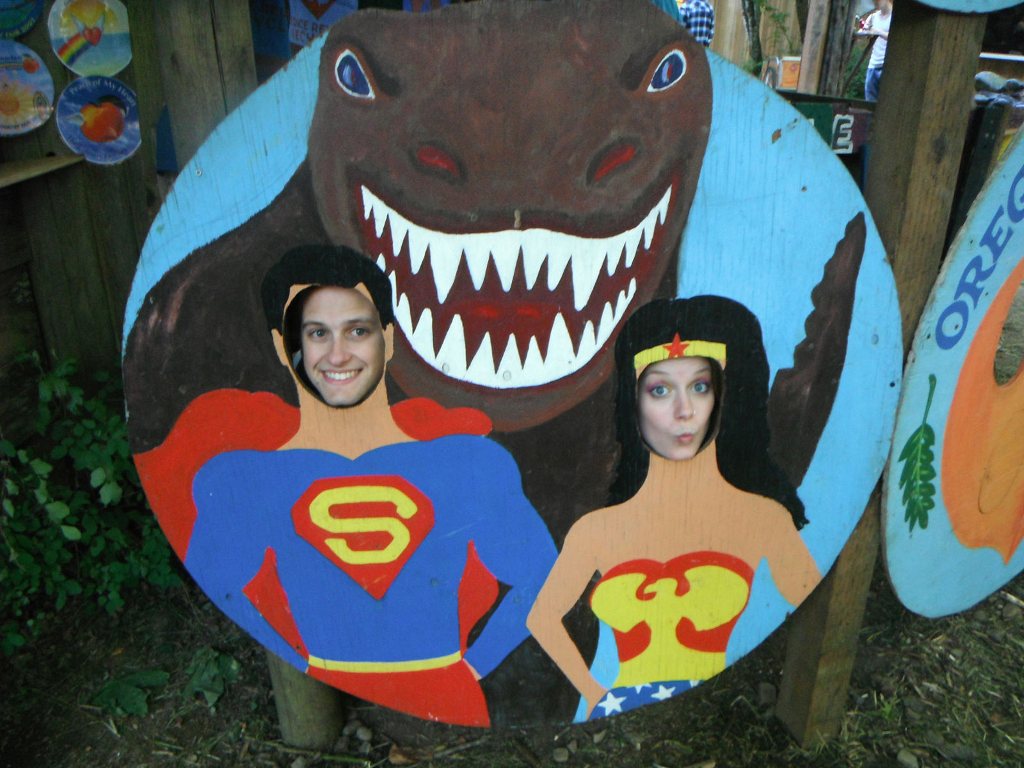
Super Kids (photo by Joe Griessler)

I am inspired by this kind of parenting, and I want this to be what I pass on to my children.  My own kids are already in their 20s, though.  But I figure it’s never too late to model something positive.  After all, they may be parents themselves some day.  My parenting models were quite limited.  Growing up in the 60s & 70s, I didn’t know one kid whose parents were divorced until I got to High School.  My dad’s own parents were divorced, but he never talked about that.  My best friend’s parents had been divorced from previous marriages, but that didn’t seem to impact their family life when I knew him.  I got the strong impression that there was a ‘right way’ and a ‘wrong way’ to do everything, and the ‘wrong way’ was to be avoided at all costs.  Consequently, I complied and conformed and walked the narrow way.  It wasn’t a bad response, but it wasn’t necessarily the right response or the only reasonable response.  The difficulties with my response became apparent as my circle of awareness widened.  Other people were living other responses.  Do I tolerate, embrace, include or exclude those people?  What if some of those people are my own children?

“There are as many different ways to be a Christian as there are Christians”, my spiritual adviser told me one day.  He was a former Jesuit priest, born in India, married to a former nun, both still very active in the Catholic Church.  I couldn’t have been more astonished.  My father would never have said that.  There are as many different ways to be a parent as there are parents.  Those ways may be judged according to certain values.  To make any kind of distinctions, you really have to look at those values.  Do you value conformity?  Okay, then call it ‘conformity’.  Do you value love?  Okay, then look very closely at what you think ‘love’ is.  Does love punish?  Does love shame?  Does love reject?  Do you value certain beliefs that you respect?  Why do you respect them?  Because someone told you to?  Because they support something you’ve experienced?  There are so many good questions to consider, but it’s hard to find a safe place to consider them.  As a parent, I felt attacked, judged and defensive.  Competition crept into my parenting way too much.  I own those as my issues, but I also believe the suburban environment supported that.  Parental support groups I was in may have effectively reinforced the competition rather than offered support.

Hindsight.  I was 22 when I became a parent.  I didn’t think about a lot of this stuff beforehand.  However, I have four totally fabulous children nevertheless.   I give them credit; I give me and my husband credit; I give the Universe credit.   In general, if I lighten up on my ego, I can avoid creating stuff that’s FUBAR.  Instill wonder, curiosity, creativity.  Play alongside the kids, and step back.  We are all learning and growing up together, folding rainbows into the process.

Unknown's avatar

Amusements

It’s bitter cold and sunny outside today.  A crisp, bright world, intensely interesting.  Here are some things that have captured my attention:

frost on my bedroom window

I doctored these shots a bit, which I rarely do.  There’s so much to explore in photography, even when you don’t have the latest equipment.

My mother sent me this last night.  It evoked those happy tears I told you about.

Steve brought a book to breakfast that my mother and father would love.  It’s called The Superior Person’s Book of Words by Peter Bowler and includes such delightful entries as:

“CALEFACIENT — a.  A medicinal agent producing a feeling of warmth.  ‘Calefacient, anyone?’ you inquire as you pass around the cognac.”

I am creating, with Steve, an Art Trivia Game to be debuted at a dinner party at Steve’s sister’s house celebrating Chinese New Year.  I will also be baking almond cookies to bring to the affair.  The first effort is challenging me to be humorous and inventive.  The second will require that I follow instructions precisely.  I’ll let you know if I succeed at either of those.  I do know that I’m succeeding in keeping myself entertained!

Be warmed and be well, my friends.  It’s a wonderful world we live in!

Unknown's avatar

Stressed for Success?

My very astute sister once pointed out to me that all stress is not created equal.  There’s daily stress, the normal result of a body functioning without rest for 16 hours or so, which is alleviated after 8 hours of sleep.  There’s distress, which gives us the feeling of being overwhelmed or upset by the amount of stress we experience, and then there’s eustress, which according to Wikipedia is “a term coined by endocrinologist Hans Selye which is defined…as stress that is healthy, or gives one a feeling of fulfillment or other positive feeling. Eustress is a process of exploring potential gains.”  Examples of eustress could include climbing a mountain, running a marathon or sky-diving.  Or surviving a nautical disaster.

I was intrigued by a comment I read from one of the survivors of the cruise ship, Costa Concordia, that sank in the Mediterranean this past week.   ABC News reported:

‘Australian miner Rob Elcombe and his wife, Tracey Gunn, told Melbourne’s Herald Sun Newspaper they booked a spot on the Concordia as a last ditch effort to save their marriage.  Instead, the couple found themselves trying to save their lives when they boarded the very last lifeboat to leave the ship with survivors. “This has made our bond much, much stronger,” Elcombe told the paper. “Who needs couples counseling, when you survive a Titanic experience?” ‘

An adventure.   Stress worked into a feeling of gain.  Is it possible to turn your distress into eustress?

Peace like a river

Another news story I ran across came under this headline: Wife Slips Into Madness As Husband Dies of Brain Tumor. (ABC News)  Catherine Graves wrote a book called Checking Out: An In Depth Look At Losing Your Mind describing the distress of caring for her husband.  The headline rather sensationalizes an experience of overwhelming stress that is shared by a lot of people who find themselves in the role of caregiver.  I can relate.  I went through depression and Post Traumatic Stress Syndrome during my husband’s illness and after his death.  Like Mrs. Graves, I was widowed at 45.  But did I lose my mind?  Not irretrievably, I don’t think.  Maybe what I’m doing now, being unemployed, slowing down, is my way of turning that distress into eustress.

There’s an old hymn that I’ve affectionately heard referred to as “The Playtex Hymn” (after the girdle).  The first line is “How firm a foundation, ye saints of the Lord, is laid for your faith in His excellent Word”.   It was written by John Keith in 1787.  My favorite verse goes like this:

“When through the deep waters I cause thee to go,
The rivers of woe shall not thee overflow;
For I will be with thee thy trouble to bless,
And sanctify to thee thy deepest distress.”

For some reason, singing that verse always causes me to choke up with emotion.  I know how it is to feel like I’m drowning.  I have a gasp reflex that reminds me of this almost daily.  It shows up lightning fast in moments when my reptilian brain senses danger.  It first became noticeable when I was trying to teach my kids to drive.  I would gasp and grab the handle above the passenger side door at the slightest correction of the steering wheel or touch of the brake.  It happened to me again just this morning.  I was stacking packages on the table and the tower toppled over.  I gasped.  “I must be drowning!” I laughed.  It’s probably a rather annoying habit for those who live with me.   I appreciate their patience.

There’s another hymn that follows this theme.  “It Is Well With My Soul” was written by Horatio Spafford in 1873.  The story behind it is quite amazing.  In brief, according to Wikipedia:

“This hymn was written after several traumatic events in Spafford’s life. The first was the death of his only son in 1871 at the age of four, shortly followed by the Great Chicago Fire which ruined him financially (he had been a successful lawyer). Then in 1873, he had planned to travel to Europe with his family on the SS Ville du Havre, but sent the family ahead while he was delayed on business concerning zoning problems following the Great Chicago Fire. While crossing the Atlantic, the ship sank rapidly after a collision with a sailing ship, and all four of Spafford’s daughters died. His wife Anna survived and sent him the now famous telegram, “Saved alone . . .”. Shortly afterwards, as Spafford traveled to meet his grieving wife, he was inspired to write these words as his ship passed near where his daughters had died.”

And here’s the lyric:

When peace like a river, attendeth my way,
When sorrows like sea billows roll;
Whatever my lot, Thou hast taught me to say,
It is well, it is well, with my soul.

I am trying to re-train my brain to believe that my deepest distress can be sanctified.  I don’t think this is an exclusively Christian perspective at all.  The Noble Truths of Buddhism are all about addressing the suffering (distress) of this world and how we think about it.   I hope that as I “explore potential gains”, my drowning will become floating, and all will be well with my soul.

Unknown's avatar

Chickadee vs. Chicken

I love black-capped chickadees.  Their distinctive songs are the two-note descending major second and “chick-a-dee-dee-dee-dee-dee”.  They fly around in happy little groups in the dead of winter, impervious to gloom and cold.

In another corner of my neighborhood, there is a robust icon of Milwaukee: Champion Chicken.

Reflection and interior images

The delivery van

I’m not sure there’s a point to this post.  Sometimes I just like to look at the juxtaposition of human stuff and non-human stuff on this planet because it brings up some questions and some emotions.   Yeah, we ate their food.  It’s very close to Steve’s mom’s house, so she treated us to lunch after we shoveled for her.  It was tasty and greasy.  I hadn’t had fried chicken in a long time.  Steve remembers frequenting this place throughout his childhood.  He has an appreciation of American kitsch and collects/recycles/sells it online. Is it history?  Is it eyesore?  Is it embarrassing?

What do you think?

Unknown's avatar

Existential Sunday

I mentioned yesterday that I was moody.  I come around periodically to a place of existential crisis, and I’ve come to believe it’s good for me.  When I was raising children and nursing a sick husband, I rarely got this privilege.  I always had someone to pour my heart and soul into and frequently felt that my existence was thoroughly used up on a daily basis.  Trouble is, this way of living was often an unexamined habit that I could go through sleep-walking.  I kept my head down and convinced myself that everything I was doing was noble and important.  It may have been, or it may not have been.  I wasn’t really paying attention that closely.

Living with Steve is different.  It’s challenging.  He doesn’t want me to pour my heart and soul into caring for him.  He wants me to fly on my own.  I blink, open-mouthed.  Fly?  On my own?  What the heck does that look like?  He redirects my attention from outside of me to inside…all the time…and I keep imagining an empty room.  What if I don’t have any inner life?

So I sit with that.  Emptiness isn’t a judgment.  It can be the beginning of openness.

I went poking around on the internet, looking for an answer (from outside, again…old habits die hard) to “what is important in life”.  I actually found something kinda cool:  this community project.  An abandoned building in New Orleans is covered with chalkboard paint and stenciled with the prompt “Before I die, I want to ___”.  Chalk is provided.  People approach.  Existential assessment goes on, and the sentence is answered.  I imagine myself standing there…clouds gather, rain falls, people pass, children grow up…and I’m still scratching my head.

I thought of re-phrasing the question, changing “What is important in life?”  to “What are two things you cannot live without?”  They’re not exactly interchangeable, I discovered.  I also discovered a great irony: I lost the two things I thought I couldn’t live without, and I’m still living.  So, either they weren’t that important, or I’m not really living.  Or I didn’t answer that truthfully.  I thought I could not live without my husband.  I thought I could not live without my Christian faith.  I was wrong.

Okay, dammit, what IS important in life?  What about the obvious answer…’life’?  As in, “Before I die, I want to Live.”  I want to live, be alive, be awake, be aware, spend myself, give my love, explore my autonomy, visit that inner room and see what’s there.  But not in an ego-driven way.  In an open way. The Western way prompts me, “Yes, but what will that look like when it’s all finished?” as if there’s a finish.  It wants a goal, a check list with little boxes to tick, just to keep track so that it can say, “Good…I’ve done it!”  That’s ego talk.  The Eastern way says, “Forget the goal, the check list.  You don’t need to keep track; keep open.  Engage with life and have a relationship.”

That’s where I’ve gotten to so far today.  How about you?  What is important in your life?

Unknown's avatar

Winter in the Neighborhood

“Now is the winter of our discontent/ made glorious summer by this sun of York…”   – first line of Shakespeare’s play Richard III

The Winter of Our Discontent by John Steinbeck

Why is winter associated with Macchiavellian plots?  (I have no answer.)

What do you call an icicle with two prongs?  A bicicle.

What do you get when you photograph a bicicle from inside a screened window?

Can you tell my mind is unfocused today?  Wander with me, if you like…

I’m not the type to rush outdoors and start shoveling in a snowfall.  I stay inside until it stops, and then I wait to see how much will melt off the driveway and sidewalks all by itself.  Often, someone else has already shoveled by the time I get out.  Not very Macchiavellian of me at all.

Squirrel tracks on the garage roof

Stone-faced, pondering, feeling the weight drip slowly down the back of my neck, one cold drop at a time. I’m moody today.


Unknown's avatar

Friday the 13th – Rats!

My daughter added a tidbit of info to my post a few days ago, stating that rats giggle and tickle each other.  I had to check that out and share it with you.  I found that the video at the bottom of that article didn’t work for me, so here’s a youtube clip of Dr. Jaak Panksepp playing with rats.  This is quite a happy little video of some well-behaved rates having a frolic in a nice, clean glass cage lined with AstroTurf.  I had quite a different picture of rats in my head this week.  I grabbed a book to bring to the laundromat on Monday; it happened to be a volume of selected short fiction by Charles Dickens.  I flipped to an entry called “Nurse’s Stories”.  These are not hospital accounts or memorials to field workers bringing medical aid, as I had imagined.  These are the nightmare-inducing tales that young Charles’ nanny told him!  He writes:

“The young woman who brought me acquainted with Captain Murderer had a fiendish enjoyment of my terrors, and used to begin, I remember–as a sort of introductory overture–by clawing the air with both hands, and uttering a long low hollow groan. So acutely did I suffer from this ceremony in combination with this infernal Captain, that I sometimes used to plead I thought I was hardly strong enough and old enough to hear the story again just yet. But, she never spared me one word of it, and indeed commanded the awful chalice to my lips as the only preservative known to science against ‘The Black Cat’–a weird and glaring-eyed supernatural Tom, who was reputed to prowl about the world by night, sucking the breath of infancy, and who was endowed with a special thirst (as I was given to understand) for mine.

This female bard–may she have been repaid my debt of obligation to her in the matter of nightmares and perspirations!–reappears in my memory as the daughter of a shipwright. Her name was Mercy, though she had none on me.”

He then relates the tale of a family of shipwrights, all named Chips, who sold their souls to the Devil “for an iron pot and a bushel of tenpenny nails and half a ton of copper and a rat that could speak”.   This speaking rat, and a cohort of his friends, bedevils poor Chips, at last sinking the ship he crews.  In the end,

“And what the rats–being water-rats– left of Chips, at last floated to shore, and sitting on him was an immense overgrown rat, laughing, that dived when the corpse touched the beach and never came up. And there was a deal of seaweed on the remains. And if you get thirteen bits of seaweed, and dry them and burn them in the fire, they will go off like in these thirteen words as plain as plain can be:

‘A Lemon has pips,
And a Yard has ships,
And I‘ve got Chips!’

So that’s what I was thinking of when I heard about giggling rats.  And then Steve played a selection from a Schubert CD that’s made my blood run cold since I first heard it in college: Der Erlkönig.  The combination of narrative song and piano accompaniment is genius, as you’d expect with Schubert (who is Steve’s absolute favorite composer).  Dietrich Fischer-Dieskau is a master at putting this German ghost story across.  You’ve gotta see this.

So, if you’re not creeped out by now and looking over your shoulder for rats and elves, then enjoy the rest of your Friday the 13th in blissful peace!

Unknown's avatar

Give Us This Day

The temperature is finally dropping and the snow is falling.  I’m rather in the mood to be snowed in; it’s been a long time coming.  The anticipation of winter without the actual characteristics is a little unsettling.  What would you think if your region just “skipped” a season?  What do the animals think?  “Do we fly north now, or not?”  “Is it time to wake up?”  Migratory animals get confused by light pollution.  I’m sure a host of species are getting confused about climate change.  But then again, they probably don’t worry like us humans.  They adapt.  Or they don’t.  They take it one day at a time, looking for warmth and shelter and food just like every day.

Daily living, daily choices, daily bread.  What do you learn from now?

In the eclectic jumble of my brain, a song is emerging.  “For Now” from the musical, Avenue Q (Robert Lopez, Jeff Marx).

PRINCETON: Why does everything have to be so hard?
GARY COLEMAN: Maybe you’ll never find your purpose.
CHRISTMAS EVE: Lots of people don’t.
PRINCETON: But then- I don’t know why I’m even alive!
KATE MONSTER: Well, who does, really? Everyone’s a little bit unsatisfied.
BRIAN: Everyone goes ’round a little empty inside.
GARY COLEMAN: Take a breath, Look around,
BRIAN: Swallow your pride,
KATE MONSTER: For now…
NICKY: Nothing lasts,
ROD: Life goes on,
NICKY: Full of surprises.
ROD: You’ll be faced with problems of all shapes and sizes.
CHRISTMAS EVE: You’re going to have to make a few compromises…For now…
LUCY: For now we’re healthy.
BRIAN: For now we’re employed.
BAD IDEA BEARS: For now we’re happy…
KATE MONSTER: If not overjoyed.
PRINCETON: And we’ll accept the things we cannot avoid, for now…
ALL: But only for now! (For now)…
Only for now! (For now there’s life!)
Only for now! (For now there’s love!)
Only for now! (For now there’s work!)
For now there’s happiness! But only for now!
(For now discomfort!) Only for now!
(For now there’s friendship!) Only for now!

(Sex!) Is only for now!

(Your hair!) Is only for now!

(George Bush!) Is only for now!
Don’t stress, Relax,
Let life roll off your backs
Except for death and paying taxes,
Everything in life is only for now!
NICKY: Each time you smile…
ALL:…Only for now
KATE MONSTER: It’ll only last a while.
ALL:…Only for now
PRINCETON: Life may be scary…
ALL:…Only for now. But it’s only temporary
PRINCETON: Everything in life is only for now.

I saw Buddhists discoursing in a documentary by Werner Herzog once.  Periodically, they would clap their hands together like crashing cymbals.  I was told that was a symbolic gesture aimed at bringing the speaker and listener into the present moment, no matter where the conversation was going.  For NOW!…..and NOW!

This breath…is only for now.  These words…are only for now.  I appreciate now, right now.


Unknown's avatar

Art, Music & Myth: The Deeper Story of Being Human

Are human beings the only animals that weep?

Charles Darwin noted that Indian elephants weep.  There have been many books written on the subject of animals’ emotions, and I haven’t read any of them, so I’m not going to venture an answer.  What I do know is that I weep.  And Steve weeps.   When we weep —  not cry, but weep — it seems to come from a sacred place in our soul, a place that has been stirred by something far greater than our selves.  Of course, we can make efforts to wall off that place, if we want to.  Bombarding ourselves with distractions often works to activate those shields.  We can also choose to be curious and try to understand that feeling better.

“I’m interested only in expressing basic human emotions — tragedy, ecstasy, doom, and so on. And the fact that a lot of people break down and cry when confronted with my pictures shows that I can communicate those basic human emotions . . . The people who weep before my pictures are having the same religious experience I had when I painted them. And if you, as you say, are moved only by their color relationship, then you miss the point.” – Mark Rothko

Tears can be a sign of “religious experience”, then.  Fair enough.  Something spiritual is going on there.  What?

“When I was a younger man, art was a lonely thing. No galleries, no collectors, no critics, no money. Yet, it was a golden age, for we all had nothing to lose and a vision to gain. Today it is not quite the same. It is a time of tons of verbiage, activity, consumption. Which condition is better for the world at large I shall not venture to discuss. But I do know, that many of those who are driven to this life are desperately searching for those pockets of silence where we can root and grow. We must all hope we find them.” – Mark Rothko

That loneliness, that “pocket of silence where we can root and grow” resonates deeply with my partner, Steve.  He calls it being moody or refers to his “Slavic melancholy”.  It’s not a sorrowful thing only; it is just as brightly tinted with joy, like some of Rothko’s paintings.  The combination, the totality is what hits home with him.  He says, “The deeper story is to face all of life.  Jesus and the Buddha are heroes of that story.”   They are not conquering wartime heroes interested solely in winning.  They do not struggle and strive.  They embrace all dimensions of life equally: the suffering, the love, the sacrifice, the elation.

Rothko - Untitled Red and Black

In the book The Power of Myth based on Billy Moyers’ interviews with Joseph Campbell, I read:

Campbell:  “The images of myth are reflections of the spiritual potentialities of every one of us. Through contemplating these, we evoke their powers in our own lives.”

Moyers: “Who interprets the divinity inherent in nature for us today? Who are our shamans?”

Campbell: “It is the function of the artist to do this. The artist is the one who communicates myth for today.….”

Steve weeps when listening to Mahler.  And “Puff the Magic Dragon”.  Slipping into his cave, searching for that place to root and grow, he feels the poignant essence of life, the crescendo and decrescendo, and resists exerting his will against the flow.  I think that I have a different sensibility.  Maybe not so expansive, maybe more interior and visceral.  I identify with a lonely pocket of silence for rooting and growing…the womb.  I feel womb-love, the ache, the swoon, the exchange of life blood.  I see colors inside my eyelids, sunshine through membrane, the tragedy and ecstasy and doom of flesh.  Okay, I am in the grip of my biology this week, so this makes a lot of sense.  I have given birth four times and dream of my grown up children regularly.   The story that trips my tear ducts is “Homeward Bound”, anything with a reunion.  The deeper story for me has something to do with connection.  Maybe that’s the Gaia story.  I think she’s like Jesus and Buddha in that she also embraces all of life without struggling or striving, but in her own way.  Perhaps I feel more in my Sacral Chakra,  Steve in his Heart Chakra.

The deeper story of being human is told from inside this skin.  It is not the only story in the universe, however.  There is the elephant’s story, the asteroid’s story, more stories than we can imagine.  I would hope to know many more, and to weep at all of them.

Unknown's avatar

Home Economics

It’s ALIIIIVE!!!   It’s in the kitchen, and it’s growing!  I’m waiting for it to double in size, then I’ll screw up all my courage and give it a good punch!  I’m gonna break it in half, then I’ll let it alone for about an hour while the two halves grow again.  It sounds kind of like an amoeba, but actually it’s whole wheat dough.  Yup, I’m making bread.  By the time I get it baking, I’ll be making split pea soup as well, but I have to take a walk to the grocery store to get some dried mushrooms for that.

We have about 4 cubic feet of cookbooks in the dining room.  I often just look up a recipe online, but that makes Steve cringe.  He thanked me this morning for asking him to direct me to one of his books.  So I am celebrating my participation in lower-tech food preparation.  I will not get into my car and drive to Panera for bread and soup.  I will make it myself.  And I don’t want to pat myself on the back for this.  This is not a revolutionary step.  This is what almost every woman was able to do 100 years ago.

I’m not exactly sure what the comparative benefits are to this approach.  I haven’t researched the whole economic picture of Panera restaurant vs. homemade.  I just know that I’m not making an income (aside from being paid for giving one private voice lesson a week), and so I don’t want to spend much.  Is it possible in this day and age to live without spending?  Well, just yesterday, I ran across this news article about a grandmother in Germany who hasn’t used money for 16 years. http://wakeup-world.com/2011/07/18/happy-69-year-old-lady-has-not-used-money-for-15-years/     I really like that idea.  Capitalism isn’t my best friend.  WalMart makes me shudder.  I read about theft in my town paper every week.  What would happen if more of us were able to get off that treadmill somehow and live without using money or coveting goods?  Would we be able to scale back on damage to the environment?  Would we be able to scale back our population?  I know all these issues are intertwined, and I’m still wondering how they effect each other in the big picture and in my personal life.

Steve & I have been thinking about going to a conference on Population that will be held in Telluride, Colorado over Memorial Day weekend.  It’s called Moving Mountains Symposium: Population.  It’s a film festival as well, and features Dave Foreman (of The Rewilding Institute) as one of its keynote speakers.

So all this is just rising in my consciousness as the bread is rising downstairs.  I’m not quite ready to present it all sliced and buttered for this blog, but I like to think that IT’S ALIIIIVE in me in some way.  Stay tuned!