Unknown's avatar

Homework

So here’s my assignment for the week: write a description of one of the characters who will be in your memoir.  Here’s what I have written.

“When I met Jim, he was a warm, charismatic 17-year old. Everything about him was golden and good. He was an A student parented by professional educators, a member of the Mormon Church who spent an hour in seminary every day before school, an athlete competitive in tennis, a baritone soloist with the school choir, a blue-eyed blonde with thick, curly surfer locks and a regular California dream. And the crowning touch? His grandfather was an Italian immigrant. I was introduced to him at our high school’s International Talk-In, where locals were given the opportunity to mingle with exchange students. I was then the Vice President of the Italian Club, a thorough Anglo hopelessly enamored of all things italiano. My best friend at the time, the President of the Club, Lynn Panighetti, introduced us. Jim enclosed my right hand in a bear paw and then wouldn’t let go. His long lashes fluttered in befuddlement as he pretended our hands were magically glued together. He was a flirt, a funny one, and I was instantly flattered and powerfully attracted.

His right hand was broad with short, stubby fingers. He would later lament how often he “fat fingered” the keys of his computer. He had a scar on his fourth finger from a machine accident he had while working in a cannery at age 15. He told me after we’d been dating for a few years that I could have all of him except the thumb and two middle fingers of his right hand – he needed them for bowling. Eventually, he qualified for PBA membership; he always pushed himself to achieve the highest level possible in any of his pursuits. His hands matched the rest of his mesomorphic frame. At 5 feet 8 inches tall, with a massive barrel chest, he resembled a friendly teddy bear, especially to my 15-year old eyes. I nicknamed him Winnie the Pooh.

Thirty years later, that stocky body was swollen with toxins and dialysis solution as a result of his failing kidneys. His barrel chest sported a 6-inch scar where they had split his sternum to perform double bypass surgery on his 31-year old heart. A longer scar down his right calf marked the place where they had harvested a vein for the graft. The kids called his lower legs “cankles” because they looked like calves and ankles combined after neuropathy and edema developed. His polar bear feet with the sideways little toes were in pretty good shape for a diabetic. He had lost only one toenail to ulcerating infection. His hair was still thick, too short to be very curly, and just barely graying at the temples. His beautiful Italian mouth fringed by the ginger mustache looked about to smile, but it wouldn’t. His ears were blue with what our daughter identified as ‘circumaural cyanosis’. (“See, Daddy, I’m really smart,” she sobbed.) He was dead.”

I have become rather moody while taking this course.  Finished Joan Didion’s memoir about her husband’s death (The Year of Magical Thinking) last night and did a little research.  Her only child died at the age of 39 just a month before it was published.  Recent images of her are gaunt and haunted.  Interesting that she was an Episcopalian, like me.  Her New York life reminds me a little of Madeleine L’Engle’s (another Episcopalian), but she is more neurotic, less serenely spiritual.   L’Engle’s memoir of her marriage to actor Hugh Franklin was a favorite of mine about 20 years ago.  (Two-Part Invention)  I feel rather like I’m swimming in the shallow end of their private pool.

Unknown's avatar

Affairs of the Heart

“Sudden massive coronary events” are dominating my thinking lately.  I am reading Joan Didion’s account of her husband’s death in The Year of Magical Thinking and recently browsed the pertinent pages of Ekaterina Gordeeva’s book My Sergei while waiting for Steve to glean salable items from Good Will on Tuesday.   I am also writing my own memoirs of my husband Jim in a Continuing Ed course.  What struck me this morning was the role of the grieving person’s best friend as hero.  Not the knight-in-shining-armor type hero, but the simple, calming presence modelling a way to be.  In a moment when shock obscures all notions of how to act, having a trusted person exhibit some caring, helpful behavior is a distinct grace.

My mother was that hero to me when my sister was killed in a car crash.  She and I were traveling across country together, enjoying the freedom of being 20 and (almost) 17 when it happened.  My mother cobbled together connecting flights to reach me in Nebraska the next morning.   She got me discharged from the hospital and set up in a hotel with her while she went through all the details of bringing Alice’s ashes back to California.  We went to the mortuary the next day.  I was still rather zombie-like while my mother handled the business.  Then the director asked us if we would like to see the body.  “Absolutely,” was my mother’s reply.  For some reason, I hadn’t realized that was why we were there.  I hesitated.  Mom led me into the room while the director closed the door.  “Oh, honey,” she sighed as she approached the table.  “No, she’s not there.  She’s gone.  Look here…” she began to comment on Alice’s wounds, on her swollen face and how old she looked, as if she were a battered wife decades in the future.  My mom said something about all the suffering her daughter had been spared.  Then she tenderly bend down and kissed that pale, waxy forehead.  My mother has never looked more beautiful to me in all my life than she did at that moment.  Strong, compassionate, wise and incredibly beautiful.  I wanted to be like her, so I kissed my sister’s forehead, too.

My mom (photo credit DKK)

Gordeeva writes about her coach, Marina, prompting her to go into the ICU room where her husband lay.  “Don’t be afraid.  Go talk to him.  He can still hear you.”  She goes in and begins to unlace his skates, a normal gesture that helps loosen her words, her tears, her emotions.  I remember our priest asking me and two of my daughters if we’d like to anoint Jim with some olive oil, bathe his face, and prepare his body to be taken away.  It was a relief to excuse ourselves from the people downstairs in the living room and go up to him together, to say our goodbyes together, to touch him one more time.  I am so grateful someone thought of allowing us that right then.  We had another opportunity to say goodbye to his body at the funeral home later when my two other children came home.  By then, I could take the lead with them and encourage them to approach.  I can’t remember who started humming “Amazing Grace”, but we all joined in, musical family that we are, and swayed together, arms and bodies entwined.

In the aftermath of Jim’s death, my youngest daughter and I fought frequently.  I didn’t know how to talk to her, to listen to her anger directed at me and recognize that she wasn’t hateful, only grieving.  Steve was the one who suggested that she was hurt, not hurtful and agreed to sit by me while we attempted an honest conversation.  My instinct was to run away.  I was grateful to observe someone who could be calm and present, reasonable and compassionate in the face of powerful emotions that frightened me.  He is adamant about not rescuing me, but equally determined to be the best friend he can be.

I hope that I will have opportunities to be a great friend to someone in grief.  I would like to be a conduit of such grace.

Unknown's avatar

Morning Pages

With the time change, morning daylight becomes precious.  It’s dark by 5pm now, so I like to get up and get going early.  My partner, however, stays up working late into the wee hours and sleeps in.  I woke up at 7, but decided to stay in bed.  Early morning brain work is often my most productive, so I just lay there and thought about my Memoirs assignment.  How would I describe my late husband in detail?  As I pictured him from toe to head, each part brought back associations and memories spanning the 30 years we were together.  Doing this in the quiet, safe, wordless place where I sleep was a great indulgence.  I didn’t feel the need to come up with verbiage or sentence structure or decide what might be better left unsaid.  My brain wandered through different decades and moments without the need to assign chronology.  In this floating place, I felt more connected with his entire person, without delineation.  When Steve rolled over, I put a hand on his shoulder and suddenly began to weep.  Why just then?  Perhaps the absence of tangibility in my relationship with Jim just would not be denied at the moment I became aware of touch.

We are still one.

He sat at the edge of the bed, his naked back to me.  He was working up to rising, about to stand on his unsteady, swollen, deadened feet and shuffle off to the bathroom.  Something prompted me to scoot forward and wrap my legs around his waist and lay my cheek between his shoulder blades.  “You will always be the love of my life,” I whispered.  “You know that, don’t you?”

He did.  He does.

Unknown's avatar

Ordinary Business with a side of grief

My finger is bleeding; I’m cold and frustrated, and now I’m crying.  Time to go inside and figure out what’s going on with me.

I still have occasional melt downs.  I am still grieving.

Today I went to the Wisconsin DMV to get a new driver’s license, car registration, title and license plates.  I am not exactly timely in getting this bit of business done, and I still have to figure out what to do with the other car that is in Chicago with my daughter.  I don’t relish going into “the system”.  I often feel stupid, pushed around, ripped off and helpless.  I try to do my homework and come prepared.  I cannot tell a lie and haven’t figured out how to find justifiable loop holes to save myself some money.  Steve says that I think in black and white, which is why the system loves me.  Fine.  I suppose that’s my personality, and I don’t think it’s so bad.  I will never be a shrewd iconoclast.  I’ll leave that to someone else.  I figure I did okay getting out in 30 minutes with new plates, a new title, and a new (temp) driver’s license.  I was kind of proud of myself for a moment for jumping through this hurdle.  I got home and updated my insurance info online and then went out with a screwdriver and the plates to do the swap.  The back plates are held on by a hexagonal bolt.  Fine.  I went to get pliers.  Back outside.  I couldn’t budge the thing, and the pliers kept slipping.  Fine.  I’ll go find a socket wrench or something.  I do have a handy array of tools, and I rather like solving problems.  I found a set of wrenches and selected one the right size.  It fit on the bolt, but I still couldn’t move it.  I needed more force, so I went back inside to find a hammer.  With the hammer, I decided to be more aggressive.  I wanted to move this stubborn bolt, but the rust resisted.  My knuckle scraped against the plate and started bleeding.  Fine.  I’ll go inside and wash my hand and find some gloves.  Back outside.  Final attempt, nothing’s budging, I’m cold and ILLINOIS is staring me in the face.  “This is Jim’s car,” pops into my head, my nose starts burning and suddenly, everything is blurry.

If this little operation had gone smoothly, I wouldn’t have thought much about it.  I still play the games inside my head that swing me from “This is no big deal” to “This is something important” and back again.  Denying emotion, repressing the thoughts and feelings that spring unbidden in an ordinary moment. Where is that Middle Way?

This isn’t an emergency.  There’s no need to be anxious, but something notable is happening.  I want to slow down and pay attention.  I am thinking of Jim, and I am sad.  I miss the way he took care of all kinds of “system business” smoothly and happily.  Knocking away at his plates with my hammer makes me feel like I’m dismantling something precious, and I don’t want it to be taken apart.  I can’t preserve everything, of course.  What can I keep?  I don’t need the plates.  I appreciate the car.  I want always to have the love.  I wish I could hang on to the security.

And that’s what it is all about.

I am grateful to have a partner who provides a safe, warm place for me to talk about this and arms to encircle me and fingers that can open a package of Band-Aids when I’m trembling.

Unknown's avatar

Solitary, Connected, Attached

Letters to a Young Poet by Rainer Maria Rilke

Letter Six

Rome
December 23, 1903
My dear Mr. Kappus,

I don’t want you to be without a greeting from me when Christmas comes and when you, in the midst of the holiday, are bearing your solitude more heavily than usual. But when you notice that it is vast, you should be happy; for what (you should ask yourself) would a solitude be that was not vast; there is only one solitude, and it is vast, heavy, difficult to bear, and almost everyone has hours when he would gladly exchange it for any kind of sociability, however trivial or cheap, for the tiniest outward agreement with the first person who comes along, the most unworthy. . . . But perhaps these are the very hours during which solitude grows; for its growing is painful as the growing of boys and sad as the beginning of spring. But that must not confuse you. What is necessary, after all, is only this: solitude, vast inner solitude. To walk inside yourself and meet no one for hours – that is what you must be able to attain. To be solitary as you were when you were a child, when the grown-ups walked around involved with matters that seemed large and important because they looked so busy and because you didn’t understand a thing about what they were doing.

And when you realize that their activities are shabby, that their vocations are petrified and no longer connected with life, why not then continue to look upon it all as a child would, as if you were looking at something unfamiliar, out of the depths of your own solitude, which is itself work and status and vocation? Why should you want to give up a child’s wise not-understanding in exchange for defensiveness and scorn, since not-understanding is, after all, a way of being alone, whereas defensiveness and scorn are participation in precisely what, by these means, you want to separate yourself from.

Think, dear Sir, of the world that you carry inside you, and call this thinking whatever you want to: a remembering of your own childhood or a yearning toward a future of your own – only be attentive to what is arising within you, and place that above everything you perceive around you. What is happening in your innermost self is worthy of your entire love; somehow you must find a way to work at it, and not lose too much time or too much courage in clarifying your attitude toward people. Who says that you have any attitude at all? – I know, your profession is hard and full of things that contradict you, and I foresaw your lament and knew that it would come. Now that it has come, there is nothing I can say to reassure you, I can only suggest that perhaps all professions are like that, filled with demands, filled with hostility toward the individual, saturated as it were with the hatred of those who find themselves mute and sullen in an insipid duty. The situation you must live in now is not more heavily burdened with conventions, prejudices, and false ideas than all the other situations, and if there are some that pretend to offer a greater freedom, there is nevertheless none that is, in itself, vast and spacious and connected to the important Things that the truest kind of life consists of. Only the individual who is solitary is placed under the deepest laws like a Thing, and when he walks out into the rising dawn or looks out into the event-filled evening and when he feels what is happening there, all situations drop from him as if from a dead man, though he stands in the midst of pure life. What you, dear Mr. Kappus, now have to experience as an officer, you would have felt in just the same way in any of the established professions; yes, even if, outside any position, you had simply tried to find some easy and independent contact with society, this feeling of being hemmed in would not have been spared you. – It is like this everywhere; but that is no cause for anxiety or sadness; if there is nothing you can share with other people, try to be close to Things; they will not abandon you; and the nights are still there, and the winds that move through the trees and across many lands; everything in the world of Things and animals is still filled with happening, which you can take part in; and children are still the way you were as a child, sad and happy in just the same way – and if you think of your childhood, you once again live among them, and the grown-ups are nothing, and their dignity has no value….”

photo by miguel ugalde

“What is happening in your innermost self is worthy of your entire love.”

Steve dozed beside me until a few minutes past noon this morning, my fingers lightly stroking his arm, his temple, his chest; he felt so warm.  My mind wandered to the last time I touched my husband’s body, deathly cold and precious.  Time evaporated as a tear wet my cheek.  The experience of focused touch would perhaps be a Thing in Rilke’s mind, an action of solitude.  I find myself capable of hours of tactile exploration reminiscent of early motherhood, caressing the skin of my newborn.  I wonder if I am building attachment, an edifice of suffering that will darken my future.  Perhaps I am merely demonstrating connection, an awareness of the reality of the universe.  I contemplate the possibility that I am in a holy state – “with my body I thee worship” – enacting the ritual of Lover and Beloved all by myself.  I feel supremely womanly in this posture and suppose it is something born of biology rather than will, but the mystery of it transcends a scientific framework.  I sense the vastness of solitude in the midst of intimacy.  This paradox is a place of love and vocation to the poet, and I want to know it better.

Unknown's avatar

All Saints and Scorpios

Today is All Saints’ Day, a major feast in the Christian tradition.  It’s also Dia de los Muertos.  And it’s also the birthday of two of my favorite people in the world: Steve and my sister.  It’s a fitting festival for fall, colorful and reeking with death and ghosts.  I think that Steve and DKK also have a marvelous blend of color and passion and darkness in them.  And to tell the truth, this scared me about them.  I am a sunny Leo, all bright smiles and pleasing, if a bit manipulative and ego-driven.  Their seething power is something that I can not control or influence, and that used to bug me.

As a kid, I shared a room with my older sister for 9 years.  I used to be frightened of her insistent non-compliance under our very strict father, and so I would nag her and repeat his instructions and try to get her to do what would keep her out of trouble.  I don’t know why I thought my two cents would make an impact when my father’s words were disobeyed.  What do you do with a pestering younger sister?  You beat her up occasionally.  That kept me afraid and convinced that she really hated me.  I did not understand her at all.  She was power and mystery and goddamn smart to boot.  Then we moved and finally got separate rooms.  And we went to the same High School and had some friends in common.  Still, there was a kind of power struggle and competition going on.  She dated older guys I was crushing on.  She was better than me at Italian and spent a summer in Italy — and that was supposed to be MY language.  She was supposed to stick to Latin!  She did me the favor of passing my first love note to a boy in her Senior English class…who became my husband for 24 years until his death.  And I tattled on her and brought the wrath of my father down upon her.  I didn’t see her much for a long time, but I wrote to her, and I prayed for her.

I remember one All Saint’s Day sitting in a church in southern California, thinking about her birthday.  I decided that she was a saint, too, and that I would write to her again.  It was a holy moment, one that I knew might change me, and I was willing.  I think the thing that made me see how much we have in common, how much we really care about each other, was motherhood.  When we both had babies, I had three to her one, and we had lots to talk about.  I began to see her hopes and values and fierce love writ large on her parenting style, and her dynamic became more understandable to me.  She had the same parenting model to work with as I, and we were both fashioning our response to it in our individual styles.  I began to recognize her and appreciate her in a way I never had.  I wish we could spend more time together as we grow older.  We keep growing closer, even though we live half a continent apart.

So that’s today’s version of Favorite Memories of (My Sister), my family’s traditional birthday game.

And now, favorite memories of the birthday boy, still dozing beside me.

I’ve known Steve for 3 years.  Three very important, reformative years.  When we met, I had been a widow for only 7.5 months.  Although sane, I was rather raw and fragile.  So was my family of 4 children.  He’s never been married and has no children.  In the pool of dating possibilities, he was advised against choosing the widow.  But he loves a dark, complex, engaging challenge.  And apparently, he loves me.  So when my youngest daughter, grieving the loss of her father, contemplated the presence of this new man in my life, she became passionately angry.  It terrified me, and I ran away.  My new friend wasn’t scared of her at all.  In fact, he stood up for her saying that her emotions were completely justified.  He cared about her and understood her in a way I hadn’t.  He sat down with both of us and listened as we struggled to repair our relationship.  He offered his observations calmly and honestly and maintained a safe place for both of us.  He made a huge difference in a very critical time, and for that, I will always be grateful…and a bit awed.

Passion is a marvelous hallmark of life.  It is scary in many ways, but adds so much.  I am learning to be open to it more and more.  And I thank DKK and Steve for helping me learn how.  Happy Birthdays, youse guys!

Unknown's avatar

Suffering Attachment

Today was a cottage industry day.  Mondays are good days to get all the book orders from the weekend off to the Post Office.  It’s always interesting to peruse the stack and see who’s buying what and where it’s going.  Today there was a book on mourning going out.  I couldn’t help myself, I had to look into the table of contents and see what helpful and insightful pearls of grief I may have missed.  Philosophical or practical nuggets on this subject still pertain, right?  So there I was, reading about identity and widowhood, and it still struck a chord.  How am I almost 50 years old and still not sure who I am?  I have been working really hard on this for 3 and a half years now.  I am working on updating relationships, working on being as honest as I possibly can in order to face myself and my changes directly.  I am working on my memories a bit more slowly, I suspect, because I don’t live with my kids who share those memories, and I don’t mention all the ones that occur to me when I’m with Steve (not that he’d object in any way).  What do I mean by “working on my memories” anyway?  Well, I guess I mean identifying the emotions associated with them.  Maybe the primary work is the identification of attachment and expectation and the acknowledgement of the suffering that produces.

Jim was my first love, my high school sweetheart, my only husband, and my best friend for 30 years.  I expected to be reminded of that head-over-heels falling in love stage on a daily basis for the rest of my life.  It’s starting to fade.  I see my daughter and her boyfriend together, and I am reminded of that youthful, giddy feeling…and I realize that I don’t feel it anymore.  It’s an attachment I developed.  It’s not necessary in any way.  Many people don’t feel that way and never did.  Why can’t I just get over it already?  Jim was a singer.  He sang to me frequently.  I expected to be serenaded throughout my life, I suppose.  It’s not happening.  I miss it.  The fourth finger of my left hand feels occasionally naked, and I will twirl the phantom ring that is no longer there with the surrounding fingers every once in a while.  I wish I could just stop doing that.  In brainstorming with my kids about possible homestead arrangements, it feels weird that Jim isn’t part of that family meeting.  I suspect that I have a million small expectations and maybe a couple of dozen rather large ones that I have not been able to exorcize.

Grief seems to be the gift that just keeps on giving.  My identity was very much associated with being Jim’s wife, and I am working on getting to know myself as just myself.  And I keep on working.  Here are a few things I know about me:  I am a visual person; I like pictures.  I like figuring out how to do stuff.  How do you treat deer skin after you’ve field dressed your kill, and turn it into leather? (I wake up in the middle of the night wondering about stuff like that.  No kidding.)  I am an introvert.  I managed to live without “partying” and “dating” for my entire life so far.  I am a “natural woman”.  What do you mean by that?  I liked getting pregnant and having babies.  I like taking care of people.  I like preparing food.  I also like being silly and childlike and entertaining.  I like sensual experiences: fragrance, textures, tastes, sounds, sights, juxtapositions.  I like enjoying them unhurried.  I have a million insecurities and anxieties and a huge desire to be a good person.  I have fantasies of being really good at something and recognized for it.  I am a bit on the “dreamy” side and rather afraid of meeting the world head on, but I work hard at being practical.  Relationships are really important to me.  I want to be loved, and I want to be loving.

I like camping and building fires.

And all of this might change.  What happens if I get to know me and get attached to me and then develop Alzheimer’s like my dad did?  Best to stay light on my feet and light in my thinking, not get dogmatic about it.

Life is suffering and life is wonderful.  And sometimes I just feel sad about the attachments I’ve developed.  And that’s the truth.

Unknown's avatar

Friendship

I woke from a dream this morning feeling the hostility of people whom I thought were my friends.  It made me wonder about myself and about friendship.  My late husband, Jim, was a very popular person.  About 300 people came to his memorial service.  Collecting friends was as easy as collecting dust for him.  Everyone liked him.  He was easy-going, out-going, always going.  He had friends from the P.B.A. (bowling buddies), friends from church, friends from music groups he was in, friends to golf with, friends he worked with, friends from Junior High School he still played cards with on occasion, friends he met through me, even, who probably liked him better.  He was gifted in the social dance and spun like a well-balanced top.  I admire that, and I’m not like that.  Does that mean there’s something wrong with me?

Before I got too heavily into my little pity party, Steve woke up and asked me what I was thinking.  Then he asked, “So, what is a friend?”

With my friends the sun and the prairie

I have never really had more than one good friend at a time.  Neither has Steve.  We’re both introverted, which is one way to label us.  What does that mean?  We go inward, downward.  We get introspective and deep.  We challenge ourselves, and we challenge others. Often, this makes other people uncomfortable.  Steve has no problem being uncomfortable; he’s just that confident and always has been.  When I feel uncomfortable or that I’ve made someone else uncomfortable, I get very judgmental of myself.  I hide from the discomfort.  That can make me seem aloof, I suppose.  When I am with my one friend whom I trust, I can risk being uncomfortable and be honest.  This is what I want most in a friendship.  I have a lot of questions that I want to ask, but I’m afraid to ask most of them.  It takes me a long time to feel that I’m in a safe enough space to be my questioning, challenging, unsure self.  Providing that space is a wonderful gift.  Really interacting with me in that space is a rare and holy experience, and one that I think I have sought out throughout my life.  I have been in prayer groups, Bible study groups, leadership groups, workshop groups, meditation groups, and interactive groups of all kinds ever since my teenaged years looking for that.  I thought I was just looking for acceptance, but now I think I was looking for much more.  I don’t crave being social.  I crave the mystery and vulnerability of authenticity.  I want to feel free to go into dangerous inner territory, and I’d like a companion to help me feel safe.

Years ago, my spiritual director asked me if I thought Jim was my “soul mate”.  I replied, “Sometimes.”  We’d get to places of depth, and then he’d pull up.  I accepted that.  Then I’d go to another prayer group or walk alone in the prairie or write some poetry.  It worked.  We were very good companions, but different.  There is no “right” way to be a friend.  We aren’t guaranteed a soul-mate.  Although, if you look at Yahoo news items, they will give you a list of how many friends you’re “supposed” to have and what kind and then give you 6 tips on how to make more friends.  I imagine that is fear-based, and that’s what I want to avoid.  “I’m afraid that no one likes me” “I’m afraid there’s something wrong with me” “I’m afraid I’ll die alone and unloved”.   I am who I am.  I will be who I will be.  We all die on our own.  I will go down to the depths with myself, if no one else, and that will be fine.  God is within me, at the depths, around me, everywhere.  That space that allows me to be how I am is God.  There is nothing to be afraid of.

After breakfast, Steve played his favorite song.  It always makes him (and now me) cry.  The last verse goes like this:

His head was bent in sorrow/ green scales fell like rain/ Puff no longer went to play along the cherry lane.

Without his life-long friend, Puff could not be brave/ So Puff that magic dragon sadly slipped into his cave.


Life changes.  Sometimes we slip into a cave and become our own best friend.  We can still explore the depths there and thrill to that dangerous territory.

Unknown's avatar

Autumn Sentiments

The autumn years of life.  The harvest of a lifetime.  Gathering together the products of work and character.  There’s something nostalgic and lonesome about autumn, sweet and melancholic.  Glossy photos of food and family and warm colors seem so appetizing.  I am planning to host Thanksgiving dinner for Steve’s family, and I keep daydreaming about how the table will look.  I want my home to be filled with warmth and love, good smells, earthy colors, sparkles of glass, silver, and candlelight.  Of course, this will be on a modest scale.  Martha Stewart does not live anywhere near here.  I have song lyrics stuck in my head from Barry Manilow’s “Paradise Cafe 2:00am” CD… “Oh, how I hate to see October go.”  How will I get my Thanksgiving vegetables now that the farmer’s market is closed?  The acorn squash and broccoli we had last night were delicious, dressed only in butter, salt & pepper.  The earth is so good to us and autumn is the applause before a winter curtain.  How do you feel when you’re giving a standing ovation, damp-faced and shining, heart bursting, swallowing hard, delaying your exodus into the next moment?  I feel that way about autumn.  I remember driving home from dropping one of my children off at preschool one cloudy November day and bursting into tears.  I tried to figure out what that was about and ended up writing this poem:

Change

In autumn, the trees start to sing once again

of the bittersweet mystery of change.

Is it beauty or pain now attached to my soul?

Is it grief…or relief…or nostalgia?

In the scarlet and gold,

the blood-red of life’s hold…on my heart

and the warmth of its love

mingles memories and years

into afternoon tears

falling softly…as leaves…to the ground.

Unknown's avatar

Cats and the Philosophy of Health Care

At our Socrates Cafe meeting on Saturday, we discussed the ethics of rationing health care.  How are decisions made about administering medical care?  Should health care be awarded to the wealthiest, the most fit, the least at-risk or the most at-risk?  Is health care a commodity that can be administered according to social and economic guidelines?  Is health care distinct from “illness care”?  And so on.  Our group is rather small and not especially representative of any particular demographic.  I don’t think we’re “solving” anything, we’re just enjoying discussion and engagement and some brain activity.  I’m exploring the results of allowing other people to comment on the products of my own bizarre thinking.  Which is kind of what blogging is about as well.

As I put in my own perspective on this issue, I realize that I speak from experiences that have centered mostly around my husband’s illness and death and from observances of non-human beings.  Jim used to chalk up a lot of his medical interventions as “better living through technology”.  He was the recipient of some very technical and somewhat heroic (although now pretty standard) procedures.  It was a complicated arena of insurance issues, multiple specializing doctors, drug interactions and availability, and the donor list system.  There were layers of decision-making involved and a fabric of responsibility that was pretty nebulous.  When his pulmonologist found out that he’d died, he asked me, “What are you doing about it?”  I wasn’t sure what he was talking about.  “I’m grieving!” I answered.  “I mean legally,” he explained.

Who is responsible for my health?

As for the observance of non-humans and their health, I look to the pets I have known.  Specifically cats.  I learned a lot from Pinkle, who somehow got injured up in the attic one day.  She simply stopped using her back legs until they had healed.  She slept.  She ate.  She tried out putting weight on them gradually, and eventually got back to doing all the things she had been doing.  She didn’t complain.  She didn’t seem miserable.  She didn’t worry or push herself or engage in any neurotic behavior that we could detect.  She took responsibility for herself, for the most part, and we provided food and shelter and quiet.  Phantom is another cat I have observed.  She is 16 years old now, and not living with me any more.  She had some urinary tract issues in the past when I did care for her.  I gave her antibiotics in pill and liquid form (which was an ordeal she did not welcome) and changed her food.  She had a bladder stone removed surgically as well.  That was maybe 10 years ago.  Her litter mate died of cancer a couple of years ago.  Cats don’t complain about pain much, and they don’t complain about death.  My kids tell me that Tabitha was purring as she died of the injection that ended her suffering.  Cats (and many other animals) have a tendency to seek out a quiet place to die.  They don’t make a big fuss.  We’re the ones who fuss.

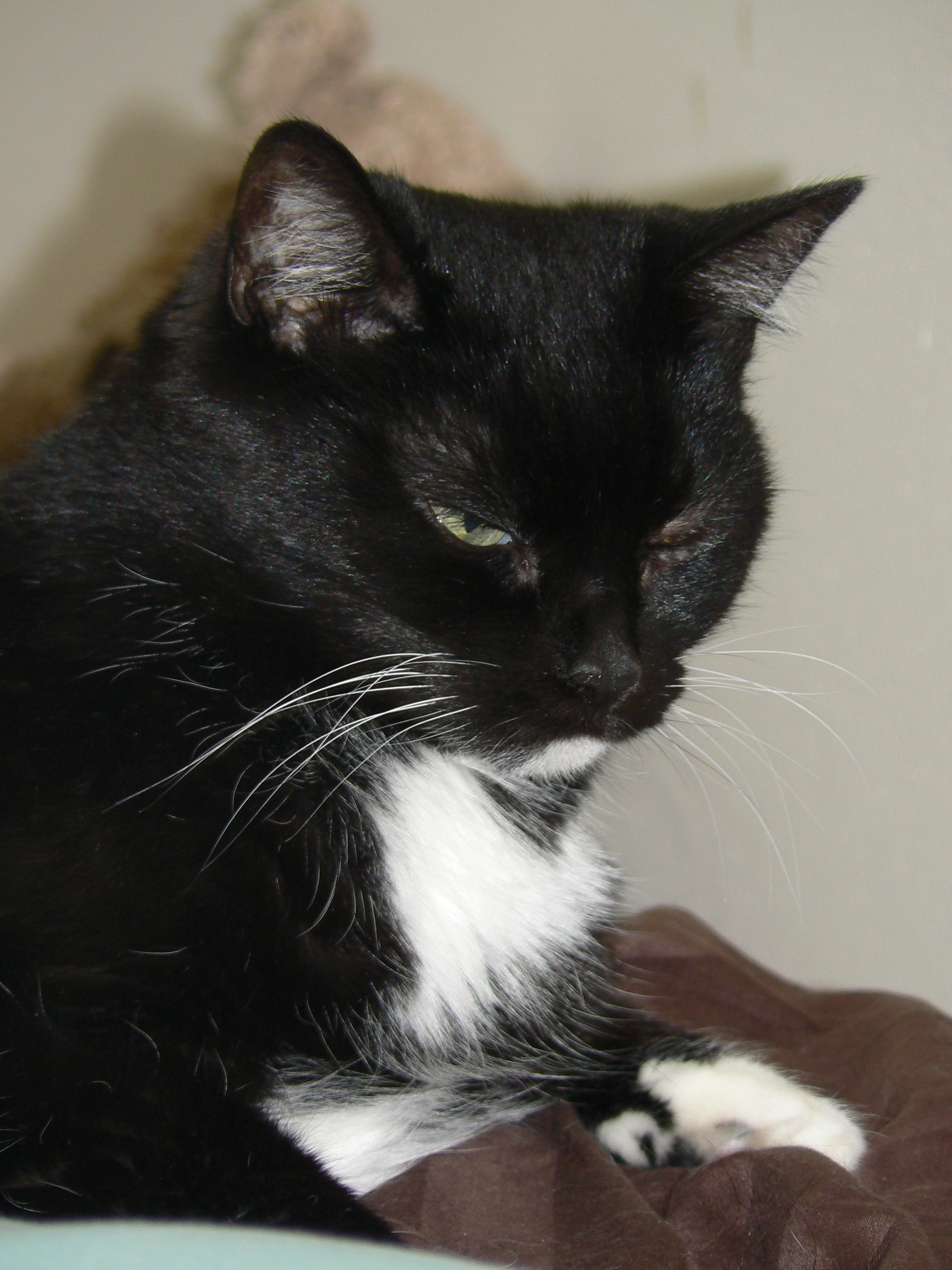
Phantom del'Opera

Pinkle Purr (see poem by A.A. Milne)

What if we focused on healthy living and didn’t sweat so much about “illness care”?  What if we made it our social/economic/political responsibility to work hard to provide clean water, clean air, healthy food, shelter, education about health, and quiet (less stress) for as many of us as we can, and let illness play out as it would naturally?  What if we as a community took responsibility for supporting health but abstained from taking responsibility for preventing death?  It’s not like we’d be successful in that effort ultimately anyway, right?  We’d do our best to give you the basic needs, and the rest is up to you and nature.  That’s how human life went before technology kicked in, and plenty of people lived to reproduce (or we wouldn’t be here today).   Is there anything wrong with that model?

That’s my two cents for the health care debate.