Unknown's avatar

Looking at Life: The Photography Metaphor

So, my son’s visit has come to an end.  It was good to offer him a retreat from his everyday routine, a chance to slow down and reflect, the reassurance of support and the challenge of articulating his thoughts, feelings, and desires.  Making your way in the world as a young adult is hard work; there’s so much to process and so many options.  As I mess around with photos, sliding tint and color saturation and cropping and brightness tools around, I think of all the different ways there are to look at the world.  How do you land on the one you want to “apply”?  What is the result you’re looking for?  How do you recognize that result or closer approximations of it?

I keep asking myself those questions, and the answers do change.

My son remembered some of my “dragon lady” moments as his mom, those angry “This is not the result I want!” rejections of his behavior.  I had forgotten the specific events, but I remember the frustration.  As always, I had (at least) three options: run/hide, change the situation, change yourself.  I spent a lot of energy trying to change situations.  “I wouldn’t be this frustrated if I could get these kids to obey me!”  I tweaked and cajoled, but I never managed to break their spirits and get them to comply completely.  They had their own will, just like a photograph whose focus is already determined.  The one thing I can’t do with my photos in post processing is sharpen the focus.   So what do I do then?   Change myself.  This is a fuzzy picture and it will never be crisp.  But I can learn to understand fuzziness as a quality that represents a true thing in the universe and so makes a valid image.

I think I’ve evolved to be a closer approximation of the person I want to be.  Less of a “dragon lady” or control freak or perfectionist.  More tolerant and compassionate.  More honest and willing to look at things as they are and drop the tyranny of looking at things in comparison to how I wish them to be.  Kinder, more open, less anxious.  Oh, but I still have some more adjustments to try.  I may get closer still.  Meanwhile, here are some examples of the results I got with pictures from yesterday.

"Canyonland" in a decaying willow


Slimy tendrils of ice


Blue lagoon, Wisconsin style

Unknown's avatar

Soaring Hopes

What is it in the air?  That scent of wet earth, that change in light and warmth, that lengthening of days, that springtime feeling that quickens the pulse, that vitality?  Dare I call it ‘hope’?

My definition: n. A kind of trust or confidence…but not necessarily about a specific future outcome.  It points to a relationship and carries a sense of intimacy.

Why today?  Because my son is coming to visit me for a few days.  My only son.  He’s about half my age now.  I remember writing a poem about this kind of surging feeling when he was about 7 years old.  “A brilliant day in April…” it began.  I saw him walking home from school, baseball glove on hand, tossing a ball in the air and lazily catching it while his white-blond hair sucked a sunbeam into his entire being.  What was I feeling?  Pride?  Joy?  Awe?  That womb-love from the Hebrew scriptures?  Yes.  Absolom, my son, my son.  Coming home to me.

Ah, progeny.  How we load that concept with cultural baggage.  What is the reality of this young man’s life?  That’s what I want to learn.  The economy sucks.  Student loans suck.  Losing your father sucks.  Growing up is difficult.  And the world is a wonderful place.

What can we make of this visit?  While I wait for it to unfold, I will make chili and a clean place for him to sleep.  And I know he’s bringing his fabulous camera.  It’s a place to start.

Unknown's avatar

A Bigger World

I’ve been thinking lately about my ego and my mood cycle.   Two days ago, I wrote “I feel that expansive, fecund, open sense bubbling up in me, settling me down, inviting me to nurture and set free.  Then, a while later, I feel a feisty urge to grab hold and wrestle with my circumstances and force them to conform to some idea in my brain.”  Right now, I’m in the restless part of my cycle, and my ego is eager to get to work on something.   It gives me a sort of shimmering sense of dissatisfaction, not like something is “wrong”, but like I’ve been sitting too long and want to stretch.  I don’t want to get into the habit of simply indulging my ego with any old thing whenever it prods me, though.   Steve often talks of feeling like he’s “treading water”, too.  He told me this morning that he wanted to work on “pointing his canoe”, which is his metaphor for re-establishing direction and putting energy into venturing forward, so I asked him if he uses some kind of ego energy to address that.   He said, “It’s not like that.  It’s more like gathering your courage and discipline to step into a bigger world.  I think the ego is a smaller world.”

I immediately got my pencil and notebook and wrote that down.

A bigger world.  A world that is beyond me, beyond my control, beyond prediction.  A bigger concentric circle.  I do think we tend to pull back into our tiny, lower-case universe, the one where we feel safe and comfortable and powerful.  We can’t really help that tendency, but we can acknowledge it and try to point our canoe in a different direction.  I am really inspired by people who do that, and through the network of blogging, I have met a few who I think are paddling away.  Maybe they’re not the people you’re thinking of.  They aren’t the extreme sportsmen.  They aren’t the world travelers.  They aren’t the social superstars.  They are the suffering, the ones who have met their limitations and crossed into the unknown.  They blog about living with their illness, their addiction, their recovery, their brain damage in a way that definitely requires them to gather courage and discipline and step into a bigger world, a world which they don’t master.  And sometimes they whine, and sometimes their posts are incredibly boring, but I keep visiting them because I think they are truly onto something.  I suppose that I am hoping to witness their breakthrough flight, when they will soar high above the rest of us into that bigger world of awareness.  I’m not sure what that will look like, but maybe I’ll recognize it anyway.

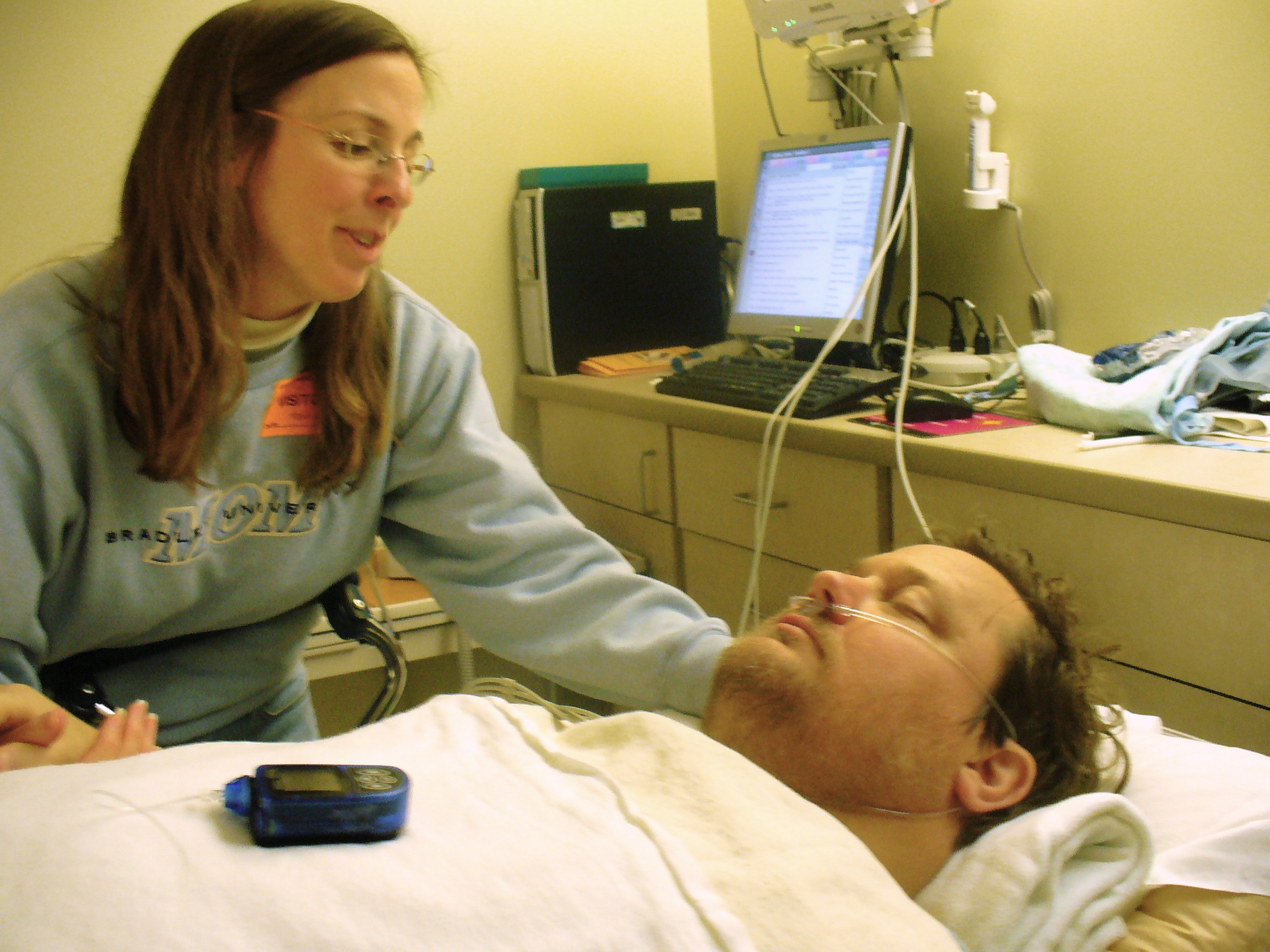
I am working on writing a memoir on my husband’s illness and death.  Four years ago, he had his last surgery.

The story of how he came out of anesthesia is perhaps a glimpse into that bigger world.  My oldest daughter wrote about it in her Live Journal that evening:

“When I saw him after the surgery, painkillers and low blood sugar had rendered him almost completely unresponsive. We tried everything—tickling him, turning his insulin pump off, talking to him, poking him—but the most we could get from him was a groan or a slight shift of position. I told him I was pregnant. Mom said they’d called a rematch of the Super Bowl. I even took a picture of him, threatening, I think, to mock him with it later. Nothing made any difference until I had to leave for work. I squeezed his arm and said “Bye, Dad. I love you,” and in a sleepy, submerged-sounding voice, he said “Love you.” We couldn’t get him to say or do anything else, but every time someone said “I love you,” he would immediately mumble it back.”

So, I think of Jim, hovering somewhere between consciousness and death and knowing only one response: “I love you”.   This is the Universe you don’t control.

Unknown's avatar

What is Love?

Yesterday, I read a travel post about a European romantic trend called Love Locks.  Apparently, an Italian novel whose title translates to “I Need You” has spawned the custom of lovers affixing padlocks to public fences, bridges, gates and whatnot as a sign of their everlasting love.  This idea really rubs me the wrong way, so I’m sorting out my thoughts to figure out why.  Of course, this is about me, not about judging any of the couples who have participated in this ritual nor about anyone else who thinks it’s romantic.  So, what do I know about me?

First of all, I worry about the accumulation of stuff.  Seeing all those padlocks encrusting a surface reminds me of the proliferation of manufactured gadgets and things that we humans often allow to run unchecked.  Apparently, many city officials also consider them “an eyesore”.  It occurs to me that if they were something natural or biodegradable (like flower petals or garlands?), I would probably not feel this instant repulsion.  This may be just the surface of the aesthetic mismatch, however.

Second, I think a lot about symbolism.  What does a padlock say about love?  In all fairness, I have not read the novel, so I am probably missing the finer points.  I understand the desire for security in a relationship.  I was married for 24 years, “until death”, and I positively flourished under the safety of that bond.  But now that Jim has slipped all surly bonds, I think that anything everlasting must be a bit more mutable than metal, more plastic than any tangible material.  The words of a song by John Denver keep floating to the surface of my consciousness.  The title of the song is “Perhaps Love”.  Here’s a bit of the chorus: “Some say love is holding on and some say letting go; and some say love is everything and some say they don’t know”.   I guess I have to say that lately I’ve been sitting in the “letting go” camp.  Out of necessity, obviously.  I did the struggle of holding on.  I found it to be an ego thing, ultimately unsustainable.  Letting go, opening up, imagining expansiveness is a way to include a lot more without confining it to an embrace.  I believe love wants to include a lot more by nature.

Two nights before my love died was Valentine’s Day.  We celebrated at home with champagne and salmon in the company of two of our daughters.  My oldest brought out a book of Pablo Neruda’s poetry and read this one (Love Sonnet #92):

My love, should I die and you don’t,
let us give grief no more ground:
my love, should you die and I don’t,
there is no piece of land like this on which we’ve lived.

Dust in the wheat, sand in the desert sands,
time, errant water, the wandering wind
carried us away like a navigator seed.
In such times, we may well not have met.

The meadow in which we did meet,
oh tiny infinity, we give back.
But this love, Love, has had no end,

and so, as it had no birth,
it has no death. It is like a long river
that changes only its shores and its banks.

Translation: Terence Clarke

I cannot imagine trying to put a padlock on a wheat field or on the desert sands, on the wind or on a river.  I cannot imagine putting a padlock on time, even though that’s a concept we made up, just like the padlock, as a way to try to control things.  I do know that the impulse to lock down an experience is very human and very old.  The ancient story of the Transfiguration of Jesus comes to mind.   Jesus and three of his disciples (Peter, James and John) climb a mountain, and there the disciples have an experience of seeing Jesus in glowing white raiment talking to Moses and Elijah.  Good old impetuous Peter gets all excited and bursts out with an idea.  “Let’s build three booths (or tabernacles)!  We can put each of you in one and hang on to this experience for a while longer, perhaps invite others….”   He is silenced by a booming voice from the clouds. “Listen!”  When the cloud lifts, Jesus stands alone, and they decide to keep quiet instead.

I am beginning to recognize a kind of flow, a yin and yang of contrasting energies, in myself.  I think it has something to do with my biological cycle, but it also manifests in a mood cycle.  I feel that expansive, fecund, open sense bubbling up in me, settling me down, inviting me to nurture and set free.  Then, a while later, I feel a feisty urge to grab hold and wrestle with my circumstances and force them to conform to some idea in my brain.   I could say that I am still loving with both energies.  I used to tell my children that I disciplined them because I loved them, and I believe that’s true, but I think there’s an ego love and a non-ego love.   They are both part of me.  One is not “right” and the other “wrong”, but I think that the non-ego kind is more beneficial in the universe.

Valentine’s Day is a few weeks away.  It’s a time when many people are thinking about love, romantic love.  I keep challenging myself to think bigger, to open up.  I hear the voice booming from the clouds, from the trees, from the water and the air.  It asks me to Listen.  So I guess it’s time to shut up.

Unknown's avatar

Parenting On the Dotted Line and Over the Rainbow

Steve & I borrowed a DVD from the library called “Between the Folds”.  It’s a documentary about origami, but not just the decorative, brightly-colored little figures that school kids make.   It’s about science and mathematics and art and exploring the fusion of all those disciplines.  To learn more, click here.  One of the fascinating paper-folders interviewed is Erik Demaine, “an associate professor of electrical engineering and computer science at the Massachusetts Institute of Technology. Called one of the most brilliant scientists in America by Popular Science, he received a MacArthur Genius Fellowship at the age of 22. Demaine’s work combines science and art, geometry, paper folding and computational origami.”  The interview also includes footage of him with his dad, who apparently home-schooled him as a single parent and prepared him to enter college at the age of 12.  These two bear a touching family resemblance of soft-spoken, constantly smiling Geekdom, complete with pony-tails, facial hair and glasses.  It is obvious that they have enjoyed sharing a couple of decades exploring the world with bright-eyed curiosity.

I also happened upon a Mom Blog called RaisingMyRainbow.  Its blurb reads: “Adventures in raising a slightly effeminate, possibly gay, totally fabulous son.”  Her son is 4 years old.  She writes with wit and whimsy and a very open attitude, chronicling how their family navigates what seems to be a mainstream suburban life with an emerging non-mainstream human being.  It seems very honest to me, no agenda, no axe to grind, no added drama, just very loving and willing to engage with what arises.

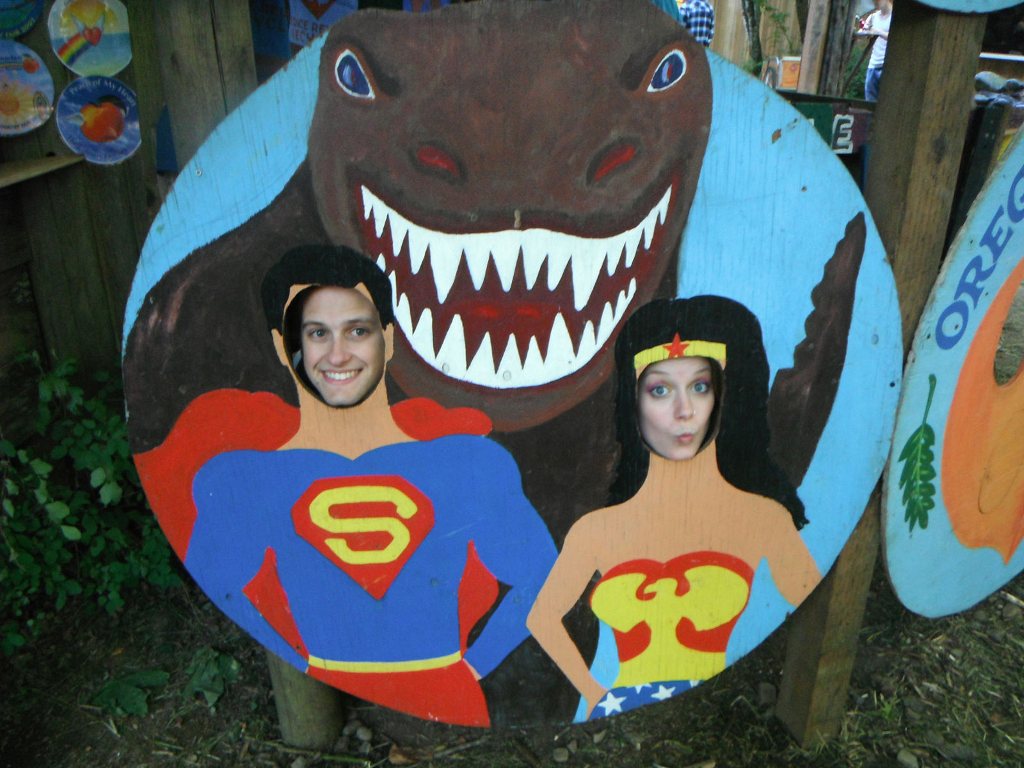
Super Kids (photo by Joe Griessler)

I am inspired by this kind of parenting, and I want this to be what I pass on to my children.  My own kids are already in their 20s, though.  But I figure it’s never too late to model something positive.  After all, they may be parents themselves some day.  My parenting models were quite limited.  Growing up in the 60s & 70s, I didn’t know one kid whose parents were divorced until I got to High School.  My dad’s own parents were divorced, but he never talked about that.  My best friend’s parents had been divorced from previous marriages, but that didn’t seem to impact their family life when I knew him.  I got the strong impression that there was a ‘right way’ and a ‘wrong way’ to do everything, and the ‘wrong way’ was to be avoided at all costs.  Consequently, I complied and conformed and walked the narrow way.  It wasn’t a bad response, but it wasn’t necessarily the right response or the only reasonable response.  The difficulties with my response became apparent as my circle of awareness widened.  Other people were living other responses.  Do I tolerate, embrace, include or exclude those people?  What if some of those people are my own children?

“There are as many different ways to be a Christian as there are Christians”, my spiritual adviser told me one day.  He was a former Jesuit priest, born in India, married to a former nun, both still very active in the Catholic Church.  I couldn’t have been more astonished.  My father would never have said that.  There are as many different ways to be a parent as there are parents.  Those ways may be judged according to certain values.  To make any kind of distinctions, you really have to look at those values.  Do you value conformity?  Okay, then call it ‘conformity’.  Do you value love?  Okay, then look very closely at what you think ‘love’ is.  Does love punish?  Does love shame?  Does love reject?  Do you value certain beliefs that you respect?  Why do you respect them?  Because someone told you to?  Because they support something you’ve experienced?  There are so many good questions to consider, but it’s hard to find a safe place to consider them.  As a parent, I felt attacked, judged and defensive.  Competition crept into my parenting way too much.  I own those as my issues, but I also believe the suburban environment supported that.  Parental support groups I was in may have effectively reinforced the competition rather than offered support.

Hindsight.  I was 22 when I became a parent.  I didn’t think about a lot of this stuff beforehand.  However, I have four totally fabulous children nevertheless.   I give them credit; I give me and my husband credit; I give the Universe credit.   In general, if I lighten up on my ego, I can avoid creating stuff that’s FUBAR.  Instill wonder, curiosity, creativity.  Play alongside the kids, and step back.  We are all learning and growing up together, folding rainbows into the process.

Unknown's avatar

Stressed for Success?

My very astute sister once pointed out to me that all stress is not created equal.  There’s daily stress, the normal result of a body functioning without rest for 16 hours or so, which is alleviated after 8 hours of sleep.  There’s distress, which gives us the feeling of being overwhelmed or upset by the amount of stress we experience, and then there’s eustress, which according to Wikipedia is “a term coined by endocrinologist Hans Selye which is defined…as stress that is healthy, or gives one a feeling of fulfillment or other positive feeling. Eustress is a process of exploring potential gains.”  Examples of eustress could include climbing a mountain, running a marathon or sky-diving.  Or surviving a nautical disaster.

I was intrigued by a comment I read from one of the survivors of the cruise ship, Costa Concordia, that sank in the Mediterranean this past week.   ABC News reported:

‘Australian miner Rob Elcombe and his wife, Tracey Gunn, told Melbourne’s Herald Sun Newspaper they booked a spot on the Concordia as a last ditch effort to save their marriage.  Instead, the couple found themselves trying to save their lives when they boarded the very last lifeboat to leave the ship with survivors. “This has made our bond much, much stronger,” Elcombe told the paper. “Who needs couples counseling, when you survive a Titanic experience?” ‘

An adventure.   Stress worked into a feeling of gain.  Is it possible to turn your distress into eustress?

Peace like a river

Another news story I ran across came under this headline: Wife Slips Into Madness As Husband Dies of Brain Tumor. (ABC News)  Catherine Graves wrote a book called Checking Out: An In Depth Look At Losing Your Mind describing the distress of caring for her husband.  The headline rather sensationalizes an experience of overwhelming stress that is shared by a lot of people who find themselves in the role of caregiver.  I can relate.  I went through depression and Post Traumatic Stress Syndrome during my husband’s illness and after his death.  Like Mrs. Graves, I was widowed at 45.  But did I lose my mind?  Not irretrievably, I don’t think.  Maybe what I’m doing now, being unemployed, slowing down, is my way of turning that distress into eustress.

There’s an old hymn that I’ve affectionately heard referred to as “The Playtex Hymn” (after the girdle).  The first line is “How firm a foundation, ye saints of the Lord, is laid for your faith in His excellent Word”.   It was written by John Keith in 1787.  My favorite verse goes like this:

“When through the deep waters I cause thee to go,
The rivers of woe shall not thee overflow;
For I will be with thee thy trouble to bless,
And sanctify to thee thy deepest distress.”

For some reason, singing that verse always causes me to choke up with emotion.  I know how it is to feel like I’m drowning.  I have a gasp reflex that reminds me of this almost daily.  It shows up lightning fast in moments when my reptilian brain senses danger.  It first became noticeable when I was trying to teach my kids to drive.  I would gasp and grab the handle above the passenger side door at the slightest correction of the steering wheel or touch of the brake.  It happened to me again just this morning.  I was stacking packages on the table and the tower toppled over.  I gasped.  “I must be drowning!” I laughed.  It’s probably a rather annoying habit for those who live with me.   I appreciate their patience.

There’s another hymn that follows this theme.  “It Is Well With My Soul” was written by Horatio Spafford in 1873.  The story behind it is quite amazing.  In brief, according to Wikipedia:

“This hymn was written after several traumatic events in Spafford’s life. The first was the death of his only son in 1871 at the age of four, shortly followed by the Great Chicago Fire which ruined him financially (he had been a successful lawyer). Then in 1873, he had planned to travel to Europe with his family on the SS Ville du Havre, but sent the family ahead while he was delayed on business concerning zoning problems following the Great Chicago Fire. While crossing the Atlantic, the ship sank rapidly after a collision with a sailing ship, and all four of Spafford’s daughters died. His wife Anna survived and sent him the now famous telegram, “Saved alone . . .”. Shortly afterwards, as Spafford traveled to meet his grieving wife, he was inspired to write these words as his ship passed near where his daughters had died.”

And here’s the lyric:

When peace like a river, attendeth my way,
When sorrows like sea billows roll;
Whatever my lot, Thou hast taught me to say,
It is well, it is well, with my soul.

I am trying to re-train my brain to believe that my deepest distress can be sanctified.  I don’t think this is an exclusively Christian perspective at all.  The Noble Truths of Buddhism are all about addressing the suffering (distress) of this world and how we think about it.   I hope that as I “explore potential gains”, my drowning will become floating, and all will be well with my soul.

Unknown's avatar

Art, Music & Myth: The Deeper Story of Being Human

Are human beings the only animals that weep?

Charles Darwin noted that Indian elephants weep.  There have been many books written on the subject of animals’ emotions, and I haven’t read any of them, so I’m not going to venture an answer.  What I do know is that I weep.  And Steve weeps.   When we weep —  not cry, but weep — it seems to come from a sacred place in our soul, a place that has been stirred by something far greater than our selves.  Of course, we can make efforts to wall off that place, if we want to.  Bombarding ourselves with distractions often works to activate those shields.  We can also choose to be curious and try to understand that feeling better.

“I’m interested only in expressing basic human emotions — tragedy, ecstasy, doom, and so on. And the fact that a lot of people break down and cry when confronted with my pictures shows that I can communicate those basic human emotions . . . The people who weep before my pictures are having the same religious experience I had when I painted them. And if you, as you say, are moved only by their color relationship, then you miss the point.” – Mark Rothko

Tears can be a sign of “religious experience”, then.  Fair enough.  Something spiritual is going on there.  What?

“When I was a younger man, art was a lonely thing. No galleries, no collectors, no critics, no money. Yet, it was a golden age, for we all had nothing to lose and a vision to gain. Today it is not quite the same. It is a time of tons of verbiage, activity, consumption. Which condition is better for the world at large I shall not venture to discuss. But I do know, that many of those who are driven to this life are desperately searching for those pockets of silence where we can root and grow. We must all hope we find them.” – Mark Rothko

That loneliness, that “pocket of silence where we can root and grow” resonates deeply with my partner, Steve.  He calls it being moody or refers to his “Slavic melancholy”.  It’s not a sorrowful thing only; it is just as brightly tinted with joy, like some of Rothko’s paintings.  The combination, the totality is what hits home with him.  He says, “The deeper story is to face all of life.  Jesus and the Buddha are heroes of that story.”   They are not conquering wartime heroes interested solely in winning.  They do not struggle and strive.  They embrace all dimensions of life equally: the suffering, the love, the sacrifice, the elation.

Rothko - Untitled Red and Black

In the book The Power of Myth based on Billy Moyers’ interviews with Joseph Campbell, I read:

Campbell:  “The images of myth are reflections of the spiritual potentialities of every one of us. Through contemplating these, we evoke their powers in our own lives.”

Moyers: “Who interprets the divinity inherent in nature for us today? Who are our shamans?”

Campbell: “It is the function of the artist to do this. The artist is the one who communicates myth for today.….”

Steve weeps when listening to Mahler.  And “Puff the Magic Dragon”.  Slipping into his cave, searching for that place to root and grow, he feels the poignant essence of life, the crescendo and decrescendo, and resists exerting his will against the flow.  I think that I have a different sensibility.  Maybe not so expansive, maybe more interior and visceral.  I identify with a lonely pocket of silence for rooting and growing…the womb.  I feel womb-love, the ache, the swoon, the exchange of life blood.  I see colors inside my eyelids, sunshine through membrane, the tragedy and ecstasy and doom of flesh.  Okay, I am in the grip of my biology this week, so this makes a lot of sense.  I have given birth four times and dream of my grown up children regularly.   The story that trips my tear ducts is “Homeward Bound”, anything with a reunion.  The deeper story for me has something to do with connection.  Maybe that’s the Gaia story.  I think she’s like Jesus and Buddha in that she also embraces all of life without struggling or striving, but in her own way.  Perhaps I feel more in my Sacral Chakra,  Steve in his Heart Chakra.

The deeper story of being human is told from inside this skin.  It is not the only story in the universe, however.  There is the elephant’s story, the asteroid’s story, more stories than we can imagine.  I would hope to know many more, and to weep at all of them.

Unknown's avatar

The Rose

I think I have a pretty active dream life.  I usually remember something of my sleeping hours upon awakening.  Perhaps that indicates the level of my anxieties and neuroses; I’m not sure.  Steve says he hardly ever dreams, and he thinks it’s because he is so aware of his conscious mind while he’s awake.  Well, fine for you, then.  I blink my eyes open and forget where I am.  I need decompression time every morning.  My dreams almost always include my late husband, who has been dead almost 4 years.  It gives me a rather fluid sense of reality.  Jim is real and Steve is real, they’re just never real at the same time, in the same place.  Is that weird?  Oh, probably.  I’m getting used to it.

The other thing I do in dreamland is sing.  I wake up singing a song, or with a song stuck in my head.  This morning, it was “The Rose”, a song Bette Midler recorded some years back.  I think I learned it from one of my kid’s elementary school music programs. The line I was stuck on went like this: “Some say love, it is a river, that drowns the tender reed.  Some say love, it is a razor, that leaves your soul to bleed.  Some say love, it is a hunger, an endless aching need.  I say love, it is a flower, and you, its only seed.”

Now why in the world would something like that be dominating my waking transition?  I thought about that for a while.  Then I began to cry.  This is how I know when I’ve hit on some repressed emotion, some way that I think about myself that I don’t like to admit.  For some reason, I was associating with that tender reed, drowned in a river of love.  I was 15 when I met my husband, 21 when we married, 45 when I was widowed.  My youth was engulfed in loving him.  I don’t feel a great resonance with the bleeding soul bit.  Ah, but the hunger, the aching need; yeah, that gets to me, too.  I feel that for my kids as well.  I call it “yearning”.  I yearn for my kids all the time, no matter where they are.  It’s a visceral thing.  I once learned in a Bible study that there is a Hebrew word for God’s loving-kindness that translates to a verb form of the same word that’s used for a mother’s womb.  Womb-love.  God “wombs” us.  I “womb” my kids.  I also “womb” my dead husband.

Now the last line of that first verse, I will take exception to.  “You, its only seed” just sounds too exclusive and attached.  It doesn’t fit the scope of the rest of the song, either, in my opinion.  Second verse: “It’s the heart afraid of breaking that never learns to dance; and it’s the dream afraid of waking that never takes a chance.  It’s the one who won’t be broken, who cannot learn to give; and the soul afraid of dying who never learns to live.”  Okay, you could probably guess that verse gets to me all over (see yesterday’s post).  Although, in my case, it’s the heart that once danced, the dream that once dared, the one who gave everything already who is afraid to live again and invest all that…again.  So, here’s the key change and the big finish: “When the night has been too lonely and the road has been too long, and you think that love is only for the lucky and the strong, just remember in the winter, far beneath the bitter snows, lies the seed that with the sun’s love, in the spring becomes the rose.”   At this point, I want to give credit to Amanda McBroom who wrote these lyrics.  Good job.  I love the idea of seeds beneath the snow.  It appeals to the naturalist in me, even though we STILL don’t have any snow this winter in Wisconsin.  I love the idea of hope and new life.  And this is where I get to re-write that last line in the first verse.  The seed of love isn’t a person.  It’s LIFE, life itself.

Steve and I were talking about this yesterday as we drove out to hike the Ice Age trail.  He was urging me, again, to talk about what I want in life, how I want to live, why I want the things I might want.  “Why do you want to have land and grow food?”  I want to nurture living things; I loved raising kids.  I loved because they lived.  I want to live life loving.  Whatever I do.  It’s a cyclical thing, the flower that comes from a seed and begets more seeds that become more flowers.  Life begets love which nourishes life…and so on.  Okay, maybe this is sounding like drivel to you.  There is something going on here, though, and it’s about a flow of energy passing from living thing to living thing, and some of us call it love.  I don’t like the idea of that energy being confined to one “beloved”.  That’s where I think I’m getting stuck.  I say love, it is a flower and all of life can be its seed.

There.  Sorry Amanda, but I have re-worked your song so that it fits my dreaming and waking life a little better.  Hope you don’t mind.

Unknown's avatar

Bridal Wave of Memories

On this day 28 years ago, I was married to my high school sweetheart in my parents’ church in northern California.  I was 21 years old.  Jim was 23.  I wore the veil that my mother and grandmother wore on their wedding days.  I wore the hoop petticoat that my mother wore in 1955 under her similarly long-sleeved and high-colored wedding gown.  I also wore the wedding present Jim had given me a year before: a beautiful cameo pin that he had purchased on the Ponte Vecchio in Firenze.  My dress had been made by a local seamstress using pattern ideas, material and trim that my mother and I had picked out.  My mother and I selected the caterer, the photographer, and the florist together.  My mother secured the musicians: a flute player she knew to play in the church with our organist, and a jazz trio to play at the reception.  My parents issued the Banns of Marriage in the bulletin of the mass the week before my wedding, inviting everyone in the parish to attend.  The reception was held in the Parish Hall behind the church.

My bridesmaids included my two older sisters and two friends.  Jim’s groomsmen included his half-brother, my brother, and two friends.  We selected other friends to participate in reading the Scriptures.  Since we knew so many semi-professional singers personally, we decided not to have any soloists.  Instead, we included congregation hymns that we could all sing together.  The whole affair was pretty simple, but elegant, and definitely traditional.  I did not have a manicure or pedicure, I did my own hair and make-up, we did not have a DJ or MC or dancing.  I did throw my bouquet, but I gave my garter to my husband…to keep.  We did have lots of champagne and loaded the unopened bottles into the station wagon (nothing like a limo) when we took off afterwards for our honeymoon, driving back down to Southern California where I would continue the second semester of my senior year at college.

My grandmother was appalled that Jim and I arranged to meet each other the morning of our wedding day to drive out to a county arboretum and spend some time together.  She kept insisting that it was bad luck for the bride to see her future husband before joining him at the altar on her wedding day.  She also kept asking if someone was going to sing “I Love You Truly” at the service.  These were not the traditions that we were interested in honoring, though.  We were not about superstition or sentimentalism, or so we thought.  We wanted to be sacramental and sincere.  I suppose there are slippery slopes and fine lines involved in those distinctions.  What I do remember thinking about is how to conceptualize a lifetime together.  I figured that might be 50 years or more.  I could barely conceptualize the two decades I had actually experienced.  I realized that it had to come down to faith.  I couldn’t imagine or predict what our marriage would be like.  I could only promise  to live it moment by moment as lovingly as I could “until we are parted by death”.  I did that to the best of my ability, I believe.  That parting occurred almost four years ago, now.

January is often a month of looking into the future, making uncertain plans, vowing to try to live in particular ways.  “Pointing your canoe”, as we like to put it.  Don’t let it frighten you.  Paddling is slow work, with plenty of time to correct, re-align, look around, and get inspired.  You can even drift for a while, if you like, without causing harm.  Forgiveness can arise.  Consequences will arise as well.  There’s no need to cast blame.  Look lovingly on the scene, on yourself, on your partner, on the world.  I enjoy marking the milestones, and I’m finding I even enjoy moving on.

Unknown's avatar

Zeal for Thy House

We watched another installment of Simon Schama’s “Power of Art”; this one was on Van Gogh.  I didn’t know that he attempted a career as a missionary and was released for his “over-zealousness”.  That zeal, that fervor exploded in color and paint a few years later.  Perhaps the misfiring of his neurological circuits added to the visions he experienced, but that doesn’t make them any less real, does it?  For the film, an actor portrays him eating an entire tube of chrome yellow.  It is an intensely sensuous clip.  It makes me want to feel the passion myself, love and zeal and lust in an explosion of warm color and bright hope.  I wish I had art sliding around like finger paint beneath my skin.

Making chocolate truffles with my daughter; good gooey creativity

I feel the need to make something.  It’s going to end up being a pot of chili and some yeasty corn bread from scratch.  I wish I had some clay or acrylics lying around to play with, but I suppose it’s just as well I don’t.  I’d feel bad about wasting expensive materials just for the tactile exploration.  Still, I feel a tension within me longing for creative release.  Perhaps that’s because I haven’t been singing regularly for a while, or playing the piano.  I miss getting caught up in the joy of expression.  Do you suppose that our society suffers from creative repression on a massive scale?  With all the technology we have to take creativity out of our hands, are we fueling a psychotic collapse?  What if we staged a revolutionary return to physical creativity, set up mud pie and garden therapy stations, bread dough and needlework,  improvisational dance and percussion…would we see a decline in depression, suicide and domestic violence?

My fingertips get a mild work out typing every day, but it doesn’t feel like enough.  I used to do 8 hours of typing, telephoning, and staring at a screen in a cubicle every day.  It got very old.  I’m lucky to be done with that.  I hope that we don’t press people into that kind of thing more exclusively as our society “progresses”.  It seems pretty soul-killing.  I’d like to set them all free in a wheat field with a box of squishy colors and a canvas and let them stay out all day until the sun sets.  Then invite them to share a bottle of wine with me, some good crusty bread, and listen to them describe their experiences while they show me their work.  I want to hear their zeal and watch it float free into the world…with mine.