Unknown's avatar

Happy Earth Day, Earthlings!

The first Earth Day was April 22, 1970 and marks what some consider the birth of the Environmental Movement.   Of course, cultures throughout history have celebrated and appreciated the earth according to their particular perspectives.  Harvest festivals, rain rituals, volcano appeasement, fertility festivals, river ceremonies…I can think of many ways that humans have venerated the earth.  Since 1990, when the Earth Day campaign went global, we’ve focused on the planet as a whole.   We are the ones who have seen it (at least in pictures) as a whole from outer space, and I think we are realizing more and more how our relationship to the Earth is effecting that picture.  Large scale weather patterns, extinction rates, pollution and population are just some of the issues that are “going big” in our consciousness.   This is all very well, and at the same time, each of us has a particular and specific and local intimacy with Earth that should never be overlooked.

NaPoWriMo is acknowledging Earth Day with its prompt to write a poem about a plant.  I have so many favorite Earth/Nature/Flower/Animal poems already dear to my heart that I’m having a hard time being original, so I think I’m just going to share a few favorites with you here instead.  The first one is a lullaby that my mother used to sing to me.  I have no idea of its origin.  I just hear Mom sing:

White coral bells upon a slender stalk,

Lilies of the valley deck my garden walk.

Oh! Don’t you wish that you could hear them ring?

That will happen only when the faeries sing!

Here’s one I wrote back in March as I looked at my lilac bush:

When will the buds appear this year?

When will the lilac be full in bloom?

When will that perfume make fair the air?

When will that purple bedeck my room?

Soon, oh, soon; let it be soon!

I’ve been wearing lilac oil from a little vial that Jim bought me when we were on Mackinac Island years ago.  A few drops on my neck assures me that the fragrance of my favorite flower will not fade too quickly from my consciousness. 

I took a walk yesterday to photograph some of my local earth miracles.  May I present:

White tail deer

Bleeding heart

Red Admiral butterfly

Tulips, daffodils, hyacinth

And to represent the hippie protesters and the environmental movement, I have to share one of my favorite earth songs.  Nanci Griffith, “From A Distance” (written by Julie Gold).  Socks with sandals, passion and integrity.  She moves me.

Love our planet, today and every day.  Treat her and all life with respect.  Please.

Unknown's avatar

Process, Procedure, Product, and Practice OR Fail Before You Bail

I’m in the midst of a baking day.  Steve’s Aunt asked me to bake two different kinds of cookies to mail to her nephew out of state.  I was happy to participate in producing a care package.  I like caring, even if I don’t know the person.  The first recipe was written out on an index card with rather sketchy instructions.  For instance, nowhere did it suggest how long to cook them!  These are rolled and filled cookies.  I’ve never attempted anything like that before in my life, nor have I witnessed anyone else’s attempt, nor had I seen a representation of the final product.   But for some reason, I decided to plow ahead and do my best using my intuition.  Only after they were out of the oven did I look around online for images.  I wasn’t too far off, I guess, but I know I’d make some changes next time.   “But what have you learned, Dorothy?”

Edible, I suppose

I’ve learned that this kind of thing teaches me a lot about myself.  There was one point in the procedure when my brain did actually shoot off an almost audible “F*** this!” and I felt like quitting.   I have a perfectionist streak in me that easily loses patience.  I suppose that things should go smoothly if I’m doing them right.  When things stop going smoothly, I’m in danger of failing, and this is where the perfectionist wants to bail.  I often go to this conclusion even before I’ve begun a job.  I see this tendency dangling from various branches  in my family tree.  But I figure that if I continue to live this way, I am going to eliminate a lot of experiences prematurely and end up not doing much with the time I have left.   So I might as well just roll up my sleeves and dive in.

I think we live in a culture of “professionalism” and “experts” that contributes to this kind of self-elimination.  How often are we told that we can’t do something because we’re not qualified, we don’t have the skills, we don’t have the right background, or we don’t have the resources and we simply give up on the idea?  Only a charlatan would continue to try to do something he hasn’t been trained for!  But how do you get experience?  By trying something you’ve never done!  We get caught in the Catch-22 all the time, beginning as children, probably now more than ever.  If you haven’t had the 2-yr-old class on foreign languages, you’re not going to get into the right pre-school, and if you don’t get into the right pre-school…(usw)…you won’t get into Harvard!  Gone are the days when a self-taught person could go from a log cabin to the White House.   Now we think we’re not qualified to make improvements in our lives, in our communities, in our government, in our international relations, and we can’t solve global problems.   Well, maybe we actually can but we’ve eliminated the possibility prematurely because the feeling that things aren’t going smoothly is tempting us to bail before we fail.   If you’re going to bail, why not fail first so that you have an experience to learn from?  Or why not fail frequently and refuse to bail?

My kids are in their 20s now.  I hope they have the courage to fail many times.  I hope they don’t bail before they try something that interests them.  I hope I still have some of that left in my future as well.


Unknown's avatar

To Ad or Not To Ad

That is the question: whether it is nobler to support the hosting web manager directly or to suffer the slings and arrows of outrageous advertisements that defray his costs.  Or to take up arms against capitalism and occupy cyberspace, thereby ending it.

My apologies to the honorable Bard.  I woke to a dilemma this morning when my sister noticed a “goofy” ad showing up on my blog that was totally incongruous to the serious, graceful tone that I’m trying to achieve.  I found out that through the Terms of Service that I agreed to when I started this blog, I had given my permission for WordPress to run ads on my page to defray their costs.  If I want to ensure that there will be no ads on my blog page, I can pay a yearly fee of about $30.  So much for the idea of truly “free” hosting.   To be fair, though, this is only the second time since August I have seen an ad on ANY blog that I’ve visited.  I suppose I harbor a vain hope that there is a way to avoid capitalism in my daily life, and unfortunately, that is just not possible.  What I do have is choices about how I will interact with this system.

What kind of choices do I get to make?  Well, I can choose to avoid advertising by paying the fee, like I would do with Public Television (if I had a TV).  I can choose to support local small businesses, like the family operations that fixed my car this week.  I can choose “no ad” products at the market and avoid mega-stores and franchises.   I can unsubscribe to all the junk mail I get online or through the Postal Service.  Come to think of it, I need to find a better way of doing that.  I am still getting junk mail in my late husband’s name at my current boyfriend’s address, which is kind of creepy in an absurd sort of way.  It will be four years in February since he died.  How do you turn that sewage off??

The fact that advertising is so ubiquitous is one of the things that makes it so objectionable.  We are bombarded to the point that we stop paying attention.  Our awareness is compromised, and that goes against the very thing I am trying to develop in my life.   How many advertisements do you see in your average day?  If someone came up with statistics about how many you encounter, how much time you spend reading them or viewing them in video, how much time you spend trying to dispose of them or avoid them, how much money you spend funding them (whether directly or indirectly), and how much noise and visual pollution they add to the environment, don’t you suppose you’d be surprised?  Possibly appalled?  Angry? Or wouldn’t you care?

I think that the sheer volume of advertising and the phoniness of it creates an atmosphere that is potentially damaging to the human spirit.  I want to point my canoe in another direction entirely.  My relationship with my blog host is not one that will allow me to get away from using currency, but I can get away from using advertising.  I wish I could trade singing lessons or a home cooked meal for the use of cyberspace. … Yeah, that would be neat.

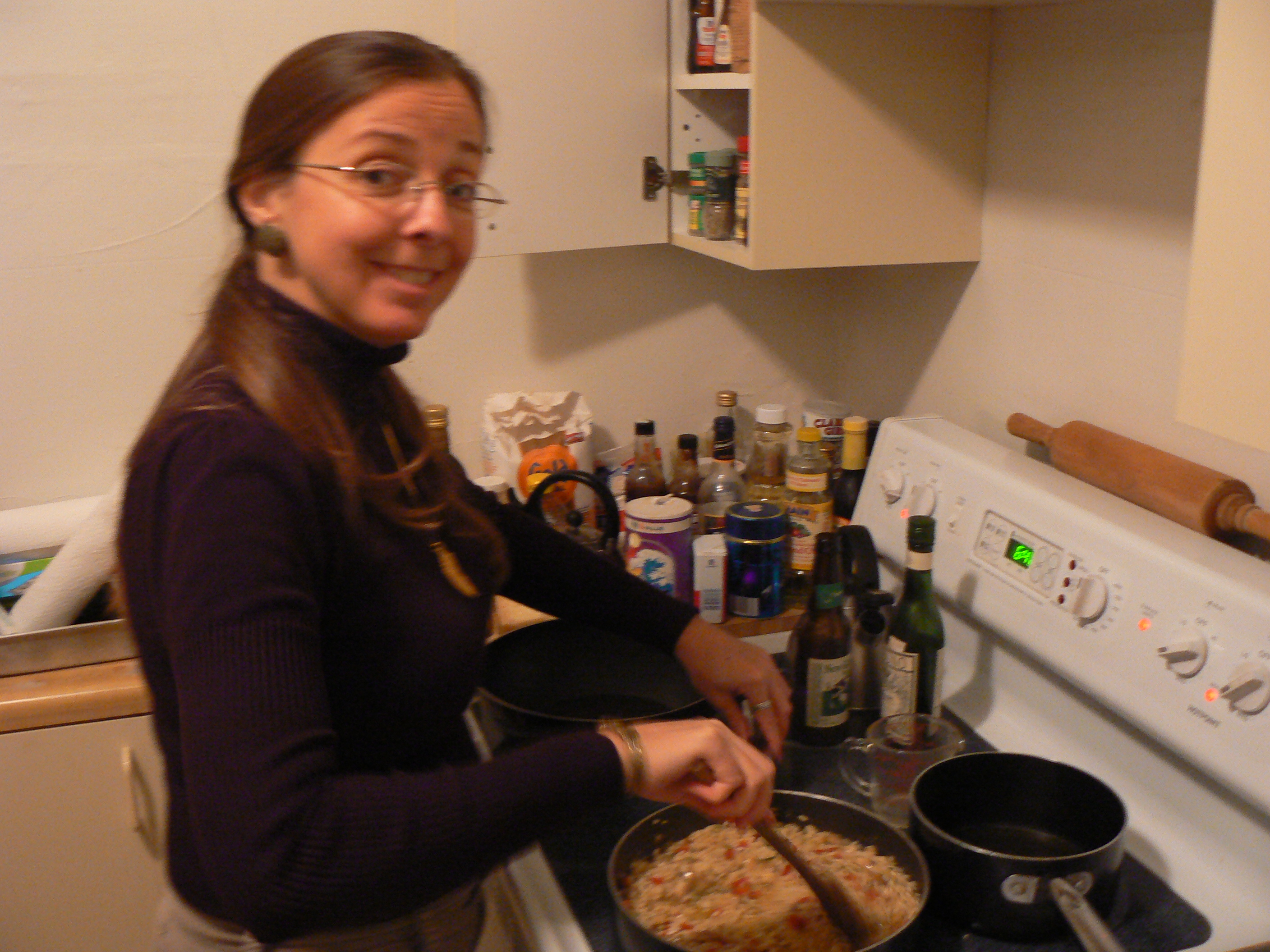
Hey, WordPress! I'm making risotto tonight!

Unknown's avatar

“I’m sorry; we can’t do that.”

You know how once you get pregnant, all you see around you is pregnant women?  I want to trigger that phenomenon in this post and bring awareness to something I feel is pretty common in our fast-paced American life.  I want to see how often people come up with the “I’m sorry; we can’t do that” line when what they really mean is something else.  Something like, “I’m sorry; I haven’t been trained to do that” or “I’m sorry; my computer can’t do that, and I don’t know how to do anything without the computer” or “I’m sorry; we aren’t willing to do that.  Your request is not as important as other things.”  The real answer is absolutely valid and a fine place to begin negotiations.  The problem is, we don’t often get the real answer.

I worked in customer service for a few years, and I remember the nervousness that accompanied requests to depart from policy.  I didn’t know if I had the authority to make exceptions.  I often didn’t want to be in the position of the middle man going back and forth from the customer to my superior.  It made me feel caught in a conflict that wasn’t mine, especially if it dragged on and on.  Eventually, I got to the point where I rather enjoyed listening to people and trying to come up with creative compromises.  But then I was told that I was spending too much time on these discussions and I should simply state the policy and get off the phone.

Dealing with people is tricky.  They require your time, and time is money.  To be an efficient society, we must streamline our systems.  Any person who does not comply with procedure is throwing a monkey wrench into the works.  So what do we value more, the “works”, the people, or some other ideal?  Once you become aware that you’re getting an “I’m sorry; we can’t do that” response, what do you do?

Here are a few examples of this kind of exchange in real life.  The first one is “How do you want your coffee?”  Steve does not like the prevalent custom of serving coffee in disposable containers.  He likes to drink his latte from a mug.  He rarely orders anything “to go”.  He values conservation of resources and energy and is not too concerned with “convenience”.  We have breakfast often at a local cafe that has recently been hiring new staff.  Young staff.  I am patient and cheerful and as helpful as I can be when I’m placing our order.  I got to ordering Steve’s latte and said, “With that breakfast, I want a latte in a mug with 2% milk.”  “Um, okay.  What size?”  “In a mug.”  “I’m sorry; we can’t do that.”  We happened to have had breakfast there just the day before.  “Well, yesterday you could.”  A more veteran server came up behind him and whispered, “Yes we can.  It’s served in a soup mug.”

I’m not saying this young person did anything wrong.  It was probably about his third day on the job.  The point is that we often get streamlined into making concessions in our decision-making and forget that there are other options.  We don’t have to take the disposable option.  We don’t have to take the profitable option if profit is not our highest goal.   We don’t have to have a lawn or rake our leaves or live in the city or send our kids to public schools or give birth in a hospital.  We don’t have to go “up and to the right” and continue to support a growth economy.  But we’ll probably be told when we suggest an alternative, “I’m sorry; we can’t do that.”

Here’s another example.  I am following a discussion on a blog about an architectural idea coming out of Italy.  The title of the article is “Milan’s Vertical Forest”.  http://pensci.wordpress.com/2011/11/07/milans-vertical-forest   The premise of the idea is to create a “less crowded, less polluted, less inhumane” city by erecting high-rise buildings with open balcony space on all four sides to accommodate trees and greenery that would help clean the air and provide a natural aesthetic.  It sounds great, but it makes me wonder whether it’s assuming “we can’t” do something else instead.  If what Milan wants is forest, why not tear down the high-rises and convert the land into open green space?  If what Milan wants is urban housing, why are they calling it a forest when in reality, it’s just apartments with more balcony space?  Are potted trees really going to thrive there?  And will people actually use all that space for vegetation instead of storing their bicycles and grills and laundry there?  If we really want the city to be less crowded and polluted, why not encourage people to move out and work the small farms in France that are being abandoned, for example?  No, “we can’t do that”, we have to think of solutions that keep people in the city and promote more construction and more growth.  Well, we don’t have to.  Let’s just be honest about what our goals are and discuss from there.

So what happens when you “throw a monkey wrench” into the system and ask for a different option?  Do you get an honest negotiation?  I would like to gum up the works of the political machine and ask for a candidate who would admit that s/he is not perfect in character, is not superior in knowledge about every facet of American life and doesn’t necessarily have to be the prime ideologue, but who would be a skilled administrator willing to represent the people and carry out their ideas.

I don’t want a cardboard cup with the shiny logo and a snappy lid.  I just need a teacup to hold some tea long enough to get it to my mouth.  Any Buddhist will tell you, it’s not about the teacup, it’s about the tea.