Unknown's avatar

The Daily Planet

Awareness, Appreciation, and Action.   I have an idea about awareness.  Here’s the issue: our culture has gotten so technical and anthropocentric that we are no longer aware of the changes and events of the planet.  We live mostly in cities, far removed from wilderness or even farmland and our connection to the earth.  We are more aware of Lindsay Lohan’s activity in the fashion world than we are of the seasonal changes happening in the natural world.   I get “news” items popping up on my browser all the time about some celebrity and her latest beau or who was seen wearing the same red dress and who wore it better.  OMG!  Is this news?  I don’t think so.  What if I could replace all those items with some news about the natural world?  What is happening in monarch migration, for example.   Or how are various species preparing for the winter?  Who hibernates, who sleeps, who migrates, who stays put?  And I would want local news for each area.  We know so little about our local ecology.  What if we had a daily conservation report similar to the Dow Jones?  How are soils doing in my area?  How is the water and the air?  What species became extinct today across the nation?   Which species are making a comeback?   The Old Farmer’s Almanac is still being published; it covers weather patterns, moon cycles and gardening advice.  How many people still read even this much information about the earth?  We just had a gorgeous harvest moon last night.  How many people in my city know what a “harvest moon” is, and how many do you suppose looked up and noticed it?   More to the point: how many care?

An American goldfinch takes his daily echinacea

Caring for our planet is our responsibility.  The Bible talks about stewardship, Buddhism talks about respecting all of life.  As technology advances, it seems that we develop new and more elaborate ways to abuse and exploit the planet faster than we come up with ways to protect it and safeguard its resources.  How backwards is that?  Carl Sagan wonders in his Cosmos series if the reason we haven’t been contacted by other intelligent life forms is that once a civilization develops to the point of having the technology necessary for galactic space travel, they have destroyed themselves and their planet in the process.  A sobering thought.

I care.  I want to be more aware.  I appreciate lots and want to know more.  Most of all, I want to know what actions I can take to really do something about the care of our planet.  I figured education would be a good place to start.  Tomorrow I’m off to the Wehr Nature Center to help run a field trip program about insects.  What do you know about creatures who “Fly, Flutter and Crawl”?   Would that kind of information be more important to you than knowing which celebrity pasta sauces scored highest in a taste test?  Just wondering, not judging.
Unknown's avatar

In Other News…..

Today is September 11, 2011.  It is National Grandparents’ Day and the 105th anniversary of the beginning of Ghandi’s non-violent protest campaign in South Africa.  It is also a sunny, bright, warm fall day in the Midwest, just as it was 10 years ago.  The 4 U.S. plane crashes on this day a decade ago have almost completely commandeered the date and the collective memory.   Pivotal days have a way of doing that…or not.  What I remember of September 11, 2001 is similar to what I remember of August 18, 1978.  Many people died on the first date, none of whom I knew personally.  My sister died on the second date, while I sat beside her in her overturned car.   What I remember is how blue the sky looked behind a stalk of prairie grass on the side of the interstate.   I went to the prairie on 9/11, and the sky was a brilliant blue that day, too.   Life as I knew it changed forever, and didn’t change.  It’s peculiar how our minds perceive things and how we turn the world on our own anthropocentric axis, meanwhile the universe keeps “unfolding as it should”.

Please don’t misunderstand my musing.  I don’t mean to say that the plane crashes were something that “should” have happened or that my sister’s crash “should” have happened.  I also don’t mean to say that they “shouldn’t” have happened.  They did happen, and other stuff happened.  Where I attach importance, though, is exactly that – me attaching importance, and I want to keep that in mind.

In Buddhism, there are 3 described causes of suffering: attachment, aversion and ignorance.  Attaching importance to something can cause suffering.  My daughter remembers an early crushing loss: we were driving home from a church event, and she had a balloon animal in her hand that was whisked out of the car window by a gust of fast air.   She was so surprised to be so suddenly bereft of her “mousie” and cried all the way home.  I was curious how she got so attached to something she’d only had for an hour.   I can’t quite imagine how to live without any attachments, but I am becoming more aware of the nature and consequences of attachments.  I still choose to be attached to some things, knowing that I may have to suffer their loss one day.

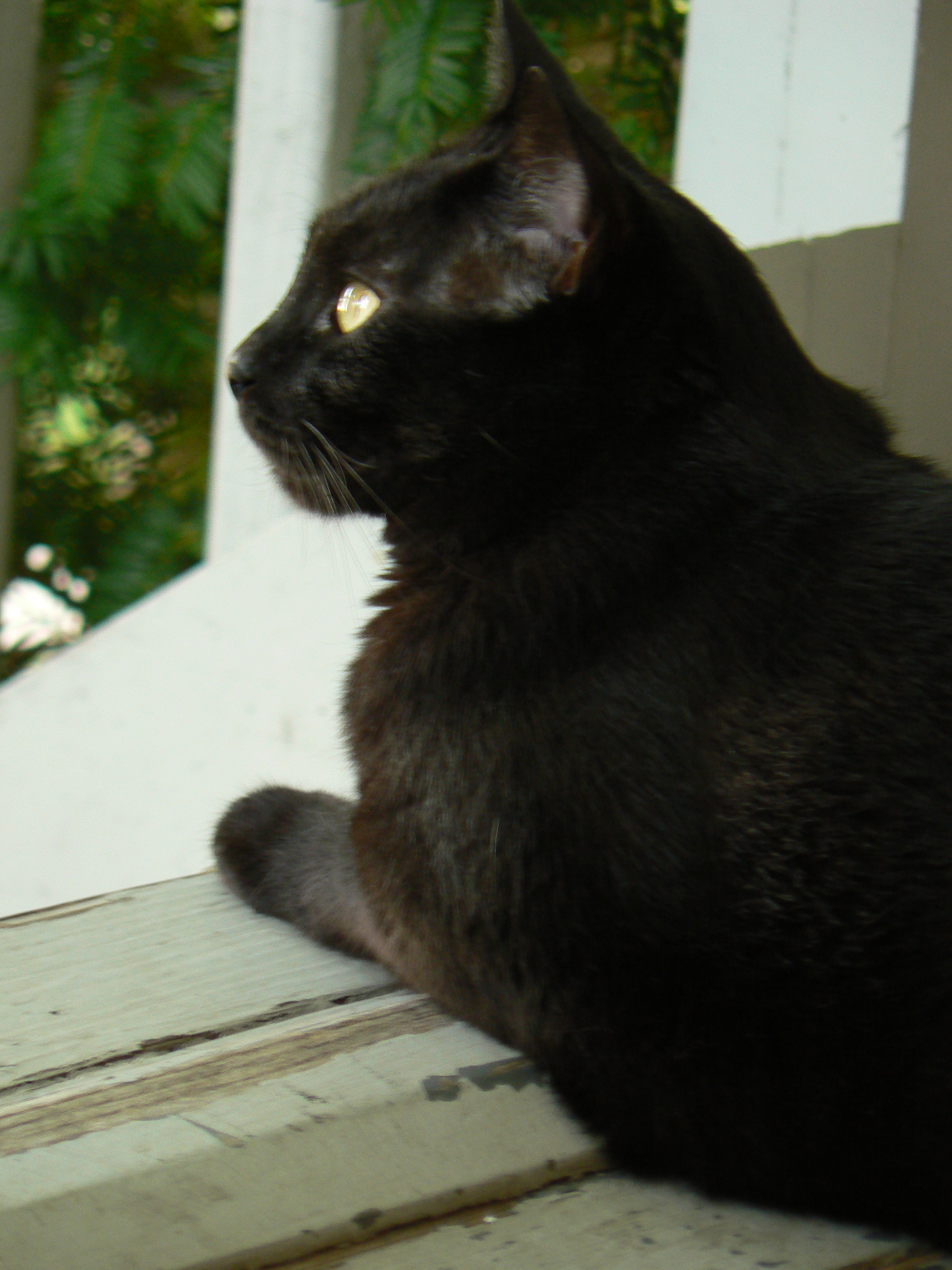
We got attached to Pinkle. She doesn't seem to miss us at all. Cats are very Zen.

What do we teach our children about attachment?  What do we teach ourselves?  When do we say, “Get over it” and when do we say, “That’s terrible!”  What do we do with a cultivated love for impermanent things?   I have a cultivated love of summer: warm temperatures, sunny skies, green things all around.  I feel the changes in the air, the shortening of the daylight hours and begin to suffer from my attachment a little.   I remind myself that I love Fall as well.  My very favorite colors in the universe show themselves wherever I look.   Rich red burgundies, intense golden yellow, muted soft green.  Then the branches are bare, and I begin to despair until the first gentle snowflakes against a night sky drop magic all around.  When it’s piled up 18 inches here in Wisconsin for the 8th week in a row,  I get SAD (S. A. D.) until a crocus peeks out bright green in the mud.   The cycle keeps turning.   Steve did an identity exercise some years ago that brought him to this conclusion: I am the joy in change and movement.  That has been his touchstone ever since.  I am beginning to relax and enjoy the change and movement in life and fight against it a little less each day.   Every day is pivotal and beautiful, just like that morning ten years ago.

Unknown's avatar

Taking Action, Stepping Out, Making Meaning

My husband was diagnosed with diabetes after his first heart attack when he was 31 years old.  He died 16 years later from coronary artery disease, kidney failure, and other complications of diabetes.  He was sleeping in bed next to me and never woke up.  I unplugged his dialysis machine, his CPAP machine, and his insulin pump that morning and set him free.  That was 3 and a half years ago.  My eldest child got the idea the next year that she wanted to do something to honor her father and take action to support diabetes research.  She and 2 of her siblings participated in a fundraiser called StepOut Walk to Stop Diabetes.  I was really impressed by her initiative and her civic action.  I joined her the next year with Steve; the siblings had moved west by then.  This year, we are all going to participate together.  All 4 siblings and mom with a few significant others alongside.   Our goal is to raise some money, to honor Jim, and to be involved in positive action as a grieving family.   (If you want to donate money on behalf of our team, go to http://main.diabetes.org/goto/pgalasso)

Team Galasso 2010

Do I expect that our participation will cause this disease to be eradicated?  Well, not really.  Do I imagine that Jim will feel honored and bring some good fortune to us from the spirit world?  Not exactly.  Do I hope that our sorrow will abate and our self-esteem will soar as we pat ourselves on the back for “giving back” to the community and “fighting” for a cause?  Actually, I don’t.  All of those things are ego-based and not very realistic.  What am I really doing, then?  Well, I think of it as “pointing the canoe” again.  I see that people suffer from this disease.  I see that certain kinds of medical technology and education have been used to ease that suffering.   I want to paddle my canoe, make some effort, toward helping those who suffer, not because I believe that I can rescue someone, but because it is how I want to live.  I want to honor Jim and remember him because that’s how I want to live.  I want to work with my family’s grief because that’s how I want to live.  I don’t know if any particular thing will result; I don’t expect to become noble or perfect or anything.  I do know that paddling in that way lets me choose a purpose and work toward it.  I suppose it helps my mind to be directed toward meaning.

So, why are we humans always looking for meaning?  Inquiring minds want to know…

That Steven Colbert report clip from the Approximate Chef suggests that we want to feel safe about the ending of the story.  We tell ourselves, “It’s okay, because it turns out this way; I know it does”.  That gives us, what, control?  Last night I had a dream about  meeting “the woman who owned the house” of the estate sale I went to yesterday.  I don’t even know that a woman lived there.  In fact, it was quite a masculine log cabin, with a boat and a mounted moose head dominating the decor.  What was my subconscious trying to figure out?  Well, I was trying to assure myself that this family was okay.  They were selling all their stuff.  They were letting strangers into their house to buy their belongings.  There has to be a story there.  I just went through the sale of my family home.  I had emotions about it.  I had a story.  I imagine that there are people behind these things with an emotional story, and I want to be told that they are okay.  I want to be satisfied that there is some meaning to the sale of these possessions.   Ultimately, I want to know that I’m okay, that my story has a happy ending.  (Steve always tells me that everyone in your dream is really you.)

Man’s Search for Meaning by Victor Frankl comes to mind.  I read parts of it.  Is this how we keep ourselves sane in “stressful” circumstances?  Is it just a game?  If it works, does it matter?  If I am not dogmatically asserting that my actions are ultimately meaningful, just saying that I find meaning in them and that is useful to me, does that make my position more authentic?  Can I make up a satisfying story about the family in the cabin and then say, “I know it’s not ‘true’, but I like to tell myself this story to calm my neuroses” and still be considered ‘sane’?  Do most of us do this anyway?  Does that make it ‘normal’ then?  I suppose I could give that up and face the fact that I won’t know every story.  Perhaps I would be far more sane to learn to live with ambiguity and uncertainty and meaninglessness.   What do you think?

Unknown's avatar

The Final Frontier

Today was the final day of my volunteer training.  We did lesson plans about the Moon, Mars, and spent the last 20 minutes in the SkyLab.    As I lay on my back on the floor under that dome of plastic sheeting, I remembered trips to the Adler Planetarium when I was a kid.  Oh, those comfy seats!  I sometimes fell asleep as the narrator talked softly about constellations and Greek mythology, as I’m sure did many young visitors.  Today wasn’t a just a trip down memory lane, though, because science is constantly changing.  Robots are patrolling space right now and taking pictures of stuff we’ve never seen before.  I didn’t know there was a Kuiper belt before this morning.  I didn’t know that there is now a dwarf planet that isn’t named after something in Greek mythology.  It’s called Makemake, and it’s named after the god of creation in the culture of the Canary Islands.

Last night, we watched a Russian film by Andrei Tarkovsky, one of Steve’s favorite directors.  Solaris was adopted from the novel by a Polish writer, originally written in French.  We’ve also been borrowing the Cosmos series with Carl Sagan from the library.   I feel like I’m finally homeschooling myself in astro-physics because I never took Physics in high school.  Aside from trying to wrap my brain around conceptual numbers and the nature of sub-atomic particles, I’m wondering about moral and philosophical questions about what it means to be human and what part we may play in any larger community of intelligent life forms.

And then, today, we found ourselves at an estate sale in Lake Geneva where a VERY wealthy family is selling off furniture, antiques, and toys of rather astronomical proportions.  A horse-drawn sleigh and a mounted buffalo head, for instance.  Who has these things in their garage?!

So, now I feel like I’m in the synthesis stage of learning.  Pulling these bits of information and experience together, what meaning emerges?  Who are we and what are we doing here?  We live in a world that is much more vast than our consciousness can grasp, and yet we have this ability to be aware of our conscious mind and how we choose to live with it.  The Approximate Chef sent me a video clip she called “unexpected existentialism of Stephen Colbert” where he jokes about our penchant for knowing the end of the story and being comforted by that expected “happy ending”.  What is the best we can do with consciousness?  Use it to feel happy?  Use it to be compassionate?  Use it to reach toward expanding our awareness and capability?  Use it to gather the most impressive bits of this world into a collection we defend as our own?

I suppose we each have to answer that question for ourselves.  What do you want to do with your consciousness?  I do want to use it to be happy.  I want to use it to learn how to be less neurotic, anyway.  I do want to use it to be compassionate.  I do want to expand my awareness and capability, but I often wonder how much I can learn before I’ll just be forgetting most of it anyway.  I want to use it to make a positive impact in the world, but I’m not sure what that will be.  I want to use it to touch the Divine, if I can.

“To go into solitude, a man needs to retire as much from his chamber as from society.  I am not solitary whilst I read and write, though nobody is with me.  But if a man would be alone, let him look at the stars.  The rays that come from those heavenly worlds, will separate between him and vulgar things.  One might think the atmosphere was made transparent with this design, to give man, in the heavenly bodies, the perpetual presence of the sublime.”  Ralph Waldo Emerson

Perseid meteors over a castle in Hungary

Try the “Astronomy Picture of the Day” from NASA.  http://apod.nasa.gov/apod/

Unknown's avatar

Awareness, Appreciation, Action

Today was Day 2 of volunteer training.  Insects and Soil were the topics.  Howard, the second staff naturalist, began the day.  We went through some background information about the Animal kingdom and where Insects fit in, targeting the 1st grade through 3rd grade audience.  Then he sort of stepped outside of the topic to comment on why we teach this stuff.  He said that he likes to keep AAA in mind: awareness, appreciation, and action.  I understand completely that there is a dearth of awareness about the natural world in our urban youngsters, especially as technology advances and funding for enrichment education is continually cut.  They spend more and more time on the computer and less time outside, then they look under a log for the first time and are amazed to find critters living there.   Ta-dah!  First step.  Then comes appreciation.  They wonder and want to know more and are fascinated by what there is to learn.  Animals, plants, rocks, the solar system, cycles, etc., all inter-dependent and inter-active, details and marvels in abundance.  I recognize that my appreciation increases every day and that I have a voracious appetite for more.  I want to spend more and more time outdoors, more and more time learning.  This is a pretty cool place to be, but it’s not the end.  The final step is action.  What do we hope for these young people who come to learn about the natural world?  What do we hope for the next generation?  Well, I raised my hand and ventured, “Responsibility?” because that’s what I hope for myself.  I want to take all this awe and love and turn it into decisions that will make a positive impact.  This is indeed the toughest part of the trilogy to grasp and embody, and it’s where Steve and I are currently stuck.  It’s fine to recycle, buy local food, and support environmental legislation, but is that really going to make a difference?  In order to reverse trends and live sustainably, we need to make more progressive and radical life decisions, and we need to implement them in community with others.  But where do we begin?   How do we find others who are committed to that progress?

How will I respond to this awesome world?

We have a lot of reading material (as you would expect), and Steve is planning to write to some of the authors he’s following: Derrick Jensen, David Orr, David Foreman, etc.  He’s looking to start or join a forum or study group of people with similar action goals.  I know that often, when I sit and think about how to solve a problem, I end up going nowhere because I’m too much in my head.  I find it useful to just get out and do something in that direction, anything, and see if that reveals the next step.  That’s why I’m happy to be meeting naturalists and educators.  It feels like I’m tracking down a clue.  When Howard began talking about action, I got excited.  That’s it!  That’s where I want to go!  I’m hoping that more clues will open up.

Unknown's avatar

Blissing Out

We were having lunch today at a Mexican restaurant, and Steve asked me,”Where are you, emotionally?  You seem like you’re not all here.”  He often asks me this because I somehow got adept at hiding my feelings, for various reasons.  I ran through the list – mad, sad, glad or afraid – but nothing jumped out at me.  I thought harder.  “I feel glad, but guilty.”  Have you ever been ashamed for being happy or content?  Did you ever think that feeling happy could not possibly be genuine?  That if you were glad, you must be missing something?  The first noble truth of Buddhism is that life is suffering.  I do think there’s truth in that, but I don’t think that means you must always feel sad.  I don’t think that if you feel happy, you must be Pollyana with her head in the sand.  Yet somehow, in this world, in this economy, when people are going back to work after Labor Day and kids are getting roused out of bed to go to school, I feel a bit guilty for having a blissful day.  Steve used to say he was amazed at my capacity to “bliss out” – this was when we were dating, and my weekend with him, away from work, away from my lonely home, would be one of indulgent relaxation.  I suppose that I am reluctant to put obvious energy into this stolen pleasure; it would be like gloating.  That’s why it’s hard for me to say what I feel.  But, dammit, I am happy!  I’m having a wonderful day.  I have a wonderful life.  It’s September, and the clarity of the air without the summer humidity dazzles me.  The sunshine is crisp, the colors are bright.  I remember feeling this way out in the prairie one day about 15 years ago and writing this poem:

In September’s Ease

Prairie grasses, butterflies,

Queen Anne’s lace, Black-eyed Susans

Cacophony of winged things

A  chipmunk scurry-stops and sings

Invisible mid-distance of a spider’s web

Or inchworm’s thread

Fur-stemmed sumac’s reddened hue

Feather-wisps in sunny blue

Summer’s heat slowed by a breeze

Reclining in September’s ease

Prostrate between the Earth and Sun

The Artist and the art made one.

Am I able to feel this joy and also be aware of the suffering that is always around?  I am aware of the impermanence of everything, but I am enjoying this moment.  I don’t want to get too attached to it, so I’m not jumping up and down, but I am smiling.  Thich Nhat Hahn writes about smiling in a lovely way; I am reminded of smiling Buddhas I’ve seen.  I hope you smiled today, too.

Unknown's avatar

Home

My son and daughter are moving back to Illinois from Oregon.  Today, they’re staying at my mother’s house.  My daughter is probably sleeping in my old room.  They are probably going to church with my mother and then to the Farmer’s Market.  I close my eyes and see them perfectly.  I see my mother’s house in detail.  I can close my eyes and see each house I grew up in with the sharpest clarity…except maybe the one I lived in first and moved out of when I was 4.  I know the smells of “home”…my mother sauteing onions in butter and vermouth at suppertime, the rosemary in the front yard and the lemon tree out back, and star jasmine.   I remember the faint mildew smell of the basement of the old house, and the smell of the dirt in the crawl space beneath her California home.  “Home” has always been accessible to me through my senses and memories, even when I felt very far away.  I knew what I longed for and where it was.  Today, my youngest will escape her city apartment and come visit us.  She has had a rough few weeks and feels the need for “home”.    I wonder how to provide “home” now that I’ve sold the house they all grew up in.  I wonder how and where we will gather as an entire family.  I am so excited that we will be all in the Midwest soon!  I’m hoping for a Team Galasso outing on October 2 for the Step Out Walk for Diabetes.  (more about that later)  I’m hoping for a Christmas gathering.  It is up to us to redefine “home”.  What are the essentials?

I think of the elements of my home visits,  like looking at photographs.   The snapshots and albums I have are in storage.   The accessible photos I have are on a thumb drive I can plug into this laptop.  How about singing around the piano?  Marni’s piano, which is now Susan’s, is in the home of one of her college friends.   The big family bed?  That’s in Emily’s apartment.  Well, dang.  Ah, but here’s the very thing.  The dining room table.  My grandmother’s cherry table is here, waiting.  Being together at table is one of the most essential “home” activities.  The chance to nourish our bodies with food, our minds with conversation, and our souls with love and acceptance is what wanting to come home is about to me.  I was invited to Emily’s home for Mother’s Day this year.  She had just moved into her apartment and didn’t have a table yet.  You know what?  We don’t even need the table.  The meal, the talk, the physical connection, maybe that’s all “home” is.  The stuff in our lives keeps changing.  I have given up trying to keep that together.  I want always to provide the experience of being “home” nevertheless.  Maybe it’s just being present with each other.  Being as aware as we can of ourselves and the “thou” across from us, being honest and authentic and paying attention, and holding space for each other, respectfully and lovingly.

Dining sans table

So, what is “home” to you?  Is there meaning in that word?  Is it one of those “values” we made up so that we can find ways to be guilty or judgmental or isolated or needy or consumers?  Is planet Earth a “home”?  What would that mean?

Unknown's avatar

That Bwessed Awwangement

Today is my parents’ wedding anniversary.  They were married in 1955, and my dad died in 2010.   My mother was 20 when she got married, not even legally allowed to drink the champagne cocktails they served.  I was 21.  We wore the same veil and the same hooped petticoat when we walked down the aisle.  We said the same words from the Episcopal nuptial mass.  We are both widows now.  Time and society have changed Marriage quite a bit, and I’m sure that will continue.   We redefine our social institutions, and why not?  We made them up.  Kind of like the bowling game Steve invented (see my post “Hope for a recovering perfectionist”), your experience grows outward into broader concentric circles.  If you’re a linear person, you may not see it this way at first, but imagine an aerial view of the game as it progresses, and that may help.  So, what is marriage for?  When I was 21, I was absolutely thrilled to be getting married.  It had been a goal of ours for 5 and a half years!  Jim and I wanted to marry and “have lots of sex and babies” (best Alan Rickman voice there).  We wanted to merge our lives, our fortunes, our fate, our names, the whole bit.  And we wanted to do it in the context of a social community that we had become invested in: our families and our church.   This commitment to our relationship, the larger circle of people supporting us, and to our belief in a personal God who was also invested in us, was a very spiritual thing.  It was central to our lives and how we lived them out.  I didn’t think very much about the legal arrangement; it was rather swallowed up and incorporated in the religious ritual.  I enjoyed a very successful, loving marriage for 24 years.  And I don’t want another one.  My experience has shifted into another circle.

I have always and will always value relationships very highly.  I have a wonderful relationship with Steve.   We started talking about getting married in December of 2008.  My previous experience was that when you talk about marriage with a boy, you’re engaged and then you get married.  Well, when Steve talks about something, he really explores it deeply.  We now laugh and recall that what he really meant to communicate back then was that he was not afraid of marriage.  He is willing to marry.  But what kind of marriage would it be?  How would we define it?  How would we want to live it out?  What is the purpose of a legal marriage?   How is our personal ‘contract’ with each other different than a social contract?  What part do we want ‘society’ to play in our life, including family, the state, the country, the world?  At this stage of my life, I’m not about setting up a family that will interact with society.  I am about developing a committed, working partnership that will support our growth into deeper living on many levels.  We may encounter some legal situations that would give us good reasons to get married…like if we travel internationally and find that married couples navigate the system more easily, or if we start filing taxes as a family business or something…and we may decide to marry then.   I definitely wouldn’t want to change my name.  I want to have the same last name as my children.  Besides, I would rather die than give up the only thing that may possibly give me an Italian identity!

What about the giddiness of being in love, of beginning something special that you share with your friends and family, of having a big party with presents?  Well, we’ve talked about that, too.  Speaking of “Don’t Super-size Me” (my last post), have you ever been to a wedding that wasn’t out of scale in some way?  There is so much going on in weddings.  Traditions upon traditions upon social customs upon personal expression, etc.  Steve and I are often confused by those layers of social business, and we prefer to communicate one-on-one.  So maybe, when we have a place that we feel will be our settling place for some time, we will want to invite people who are part of our social contract to hear more about our partnership in that place and celebrate it with us.  Actually, we are doing that anyway every time we invite people over for dinner.

Committed partners

And then there’s dancing.  I didn’t have dancing at my wedding.  I don’t think my mother did, either.  Steve and I are going dancing tonight…at Old World Wisconsin in a barn with a bunch of strangers and their children.  This will be our third time.   I love dancing there.  I feel connected to my body, to people, to music, to my thoughts, my emotions, to the prairie and nature and the wooden floor, to history and to life.  For me, that’s a blessed arrangement indeed.  So, like the song says, “I hope you dance.”

Unknown's avatar

Don’t Super-size Me

I attended a leadership conference at a famously successful mega-church in Northern Illinois a few years ago.  This church always astounded my small-town Episcopal sensibilities.  I remember growing up and going through Sunday school with only one other classmate – the rector’s son.  This church has a youth program that has more high-schoolers than a city high school.  The “sanctuary” was actually a stage with jumbo screens all around it, two balconies, and seating for, oh, 15,000.  Definitely not an Anglican atmosphere.   Also, they have a food court and cafeteria.  It’s quite a production.  During this conference, one of the speakers (who was a missionary to an Asian country that I can’t recall) talked about the American Church’s view of success.  He pointed out that it is basically the same as our economic model.  On a grid or graph of production over time, our goal is always to go “up and to the right”.   Think of your classic board meeting cartoon with a graph on an easel.  Sales, attendance, production, whatever, we want to see that arrow climbing up and to the right.  That’s progress.  And we want it always to go in that direction, with no cap or end point.  His point was that in building churches, you build relationships, and there is no “up and to the right” measurement or trend necessary to success.  Success can be in another direction entirely, like deeper.  I got to thinking that we have adopted that “up and to the right” philosophy across so many categories, and failed to think critically about whether that trend is beneficial or not.

The movie “Zeitgeist Going Forward” addresses the global economy and makes the same point.  We keep inflating supply and demand at the peril of our planet, and we make no moves to slow down or stop.  Why do we do this?  What ever happened to the concept of scale?  Who said that ‘bigger’ or ‘more’ is a better value for everything?  Think of all the restaurants that you know that serve much more food than you can comfortably eat at one sitting.  Think of all the super-stores that you have walked that have more brands of cereal than can be shelved in a 10-foot rack.   Think of the buildings and monuments that we erect that are larger than any of the previous decade.  Think of the businesses you know that have merged and of the mom-and-pop places of your childhood that have folded.   Where do you buy your coffee?  Where do you go when you want to buy a toilet plunger?  How many TVs did your family have when you were growing up?  How many TVs did the next generation of your family have?  Or cars?  Think of food availability and population.  They are always linked in the natural world.  When there’s more food for a certain species available, that species always experiences a population boom.  Think of mice in a granary.  Mice don’t plant and harvest grain, but think if they could.  Their population would boom and then they’d work to make more food, and then their population would boom again, etc.  A never-ending cycle, if nothing interrupts it.  Eventually, the resources are exhausted and the population corrects itself.  Wouldn’t the same thing apply to humans?  How do we feel when populations in Somalia are dying because of resource scarcity?  Is that a tragedy or is that nature correcting an unsustainable trend going “up and to the right”?

I’m not about to say that I have a “correct” approach to any of these issues.   I do want to think deeply about the scale of my life, and to adjust it according to changes in my situation in order to achieve balance.  For one thing, I now shop and cook for a household of 2 instead of 6.  That took me a while to adjust to.  I don’t have any closet space here, so I’ve stopped buying clothes.  I like that I can walk to an Ace Hardware store that has been in the village for 90 years in the same old building.  I don’t even know where the StuffMart is.  Steve & I don’t own a TV.  Downsizing is really satisfying to me.  It feels like a relief.  There’s less that I feel I “need” to do and have, and I find myself more involved in things I want to do and have.   I feel like my home economy is something that I can sustain, not something that is going to overwhelm me.  Right now, I have no debt at all.  That’s something I really like.

How do you feel when you see something that is outrageously out of scale?  Do you laugh?  Do you judge it and get mad?  How do you feel about waste?  Do you think that you have those reactions because of the way you were raised?  What kind of messages did you internalize?  Did your mother ever mention starving children in China when she wanted you to eat your vegetables?  Did that make sense to you?  Where do you see life as abundant?  Where do you see life in terms of scarcity?  (we’re probably mixed in these attitudes; I don’t want to set up a duality)  I like to be frugal in lots of things, but I also buy opera tickets.  I like having the responsibility to make these choices.  And I’m glad they don’t kick you out of the Lyric if you show up in an outfit from Goodwill.

Dressed up to see "Hair"

P.S.  I just logged in to Yahoo news and read that President Obama has stopped the EPA’s proposed regulations on ground-level ozone…in order to allow American industries to go further “up and to the right”.  People!  Can’t we come up with a less destructive way to live?


Unknown's avatar

Follow Your Bliss

“Do you care what’s happening around you?  Do your senses know the changes when they come? Can you see yourself reflected in the seasons?  Do you understand the need to carry on.”  I was humming this John Denver song yesterday as I walked around the neighborhood with my camera, looking for signs of autumn.

I noticed something peculiar about some of the maple trees.  I had seen this from my bedroom window a few days before.  Black spots on the leaves, as if the rain we had the other day had pelted them with something corrosive.  I took these down by the city pool.

And this is my “treehouse” tree, the one outside my bedroom window.

I wanted an answer to what made those mysterious spots, so I took my camera with me to the Wehr Nature Center where I had volunteered to sort fliers for school groups.  I went to one of the staff naturalists, who referred me to another, Mark, who knew something about plant diseases.  Mark said that it was probably a fungal disease and mentioned one, verticillium wilt, that is deadly to trees.  He told me that I should look up a plant pathologist from UW Madison, Brian Hudelson, on the internet who diagnoses plant diseases from samples, for a fee.  With visions from my childhood of elm trees felled all up and down the street for carrying Dutch Elm disease, I went to my computer looking for this tree specialist.

I found out that Dr. Brian Hudelson is the plant pathologist on the NPR show “Garden Talk”.   His website contains instructions for taking samples and a fee chart for services from the diagnostic clinic he runs.  Since these are city trees, I wondered if he’d answer my question based on just photos.  I pulled my best Nature Center Volunteer card and wrote to him as a good citizen concerned about the health of our village trees.  He responded immediately with a pdf information page on Tar Spot fungus.  Fortunately, it’s not fatal to the tree and can be treated.  I was so relieved that I sent back an immediate “thank you”.  This was his reply:

Priscilla:

Glad to help, and please don’t worry about misspelling my name.  I really didn’t notice.  I tell everyone that I respond to pretty much anything (including expletives).  Everyone really just calls me Brian.  If you want to call me Dr. something, call me Dr. Death.  That’s been a nickname and radio handle for years (and DOES tickle the evil little boy in me).

Definitely let me know if you need information in the future.  Happy to help.

Brian (:))

I am so excited to be working with people who are passionate about what they do!  Susan called me from her orientation day at UW Madison that afternoon.  She was wondering if she should have her head examined for paying for a master’s program in linguistics by working full time.  I told her that she was finally doing something about which she had always dreamed, that she was doing exactly what Joseph Campbell (author of The Power of Myth and professor at Sarah Lawrence for years) had advised all his students to do:  Follow Your Bliss.   This is the way to true happiness.  I want to see myself, my children, everybody get to fly.  What is life for, anyway, if not to live it passionately?

This morning at breakfast, Steve read me this poem.  We both had tears in our eyes afterwards.

The Writer — Richard Wilbur

In her room at the prow of the house
Where light breaks, and the windows are tossed with linden,
My daughter is writing a story.
I pause in the stairwell, hearing
From her shut door a commotion of typewriter-keys
Like a chain hauled over a gunwale.
Young as she is, the stuff
Of her life is a great cargo, and some of it heavy:
I wish her a lucky passage.
But now it is she who pauses,
As if to reject my thought and its easy figure.
A stillness greatens, in which
The whole house seems to be thinking,
And then she is at it again with a bunched clamor
Of strokes, and again is silent.
I remember the dazed starling
Which was trapped in that very room, two years ago;
How we stole in, lifted a sash
And retreated, not to affright it;
And how for a helpless hour, through the crack of the door,
We watched the sleek, wild, dark
And iridescent creature
Batter against the brilliance, drop like a glove
To the hard floor, or the desk-top,
And wait then, humped and bloody,
For the wits to try it again; and how our spirits
Rose when, suddenly sure,
It lifted off from a chair-back,
Beating a smooth course for the right window
And clearing the sill of the world.
It is always a matter, my darling,
Of life or death, as I had forgotten. I wish
What I wished you before, but harder.

I am thinking of my kids; Josh and Becca will be driving back to Illinois from Oregon beginning tomorrow.  I wish them a lucky passage.  I wish all of us a flight that follows our bliss.