Unknown's avatar

Think Big

How often do you think big….sooooo big!?

How do you keep the bigger picture in mind in a culture so enamored of minutiae?  What reminds you to “look up from your life”?  What words do you use to communicate the unknowable edges of the universe?  How do you maintain a posture of humility in an egocentric nation?  How often do you forsake the light of a screen to seek the light of the stars?

After traveling for 4 weeks to the west coast and back, my favorite memory became the night sky over Bandolier National Monument in New Mexico.  The heavens came down to the horizon without tall trees to push them back.  The stars spoke to me of vast possibilities, of fates and predictions thrown to the night winds.  I had the feeling that anything could happen.  I was far away from home, far away from my past.  I looked up and felt that it was time for me to dream new things.  I felt that my younger ambitions had already played their hand — I had been married to my teenage sweetheart until we were parted by death, I had raised 4 children to the age of majority, I had dabbled in the entertainment of various interests — and that greater things still revolved untouched before me.  I cried tears of relief and felt rested in the engulfing spaciousness.

My former spiritual director used to talk about “the MORE” of life.   The MORE is the mystery, the vastness, the infinity of which we can be aware without ever grasping.  The trick is to be aware of that while living out a particular life of responsibility.  Loving the whole universe can be done by practicing love for a specific part.  Here are some ways that has been illustrated: Mother Theresa used to say, “We can do no great things only small things with great love.”  My husband and I used to lead workshops for engaged and married couples for our church.  I told the couples that “my marriage informs my image of God and my image of God informs my marriage”.  Wendell Berry writes (in The Body and the Earth) “To live in marriage is a responsible way to live in sexuality, as to live in a household is a responsible way to live in the world.  One cannot enact or fulfill one’s love for womankind or mankind, or even for all the women or men to whom one is attracted.  If one is to have the power and delight of one’s sexuality, then the generality of instinct must be resolved in a responsible relationship to ta particular person.  Similarly, one cannot live in the world: that is, one cannot become, in the easy, generalizing sense with which the phrase is commonly used, a ‘world citizen.’  There can be no such thing as a ‘global village.’  No matter how much one may love the world as a whole, one can live fully in it only by living responsibly in some small part of it.  Where we live and who we live there with define the terms of our relationship to the world and to humanity.  We thus come again to the paradox that one can become whole only by the responsible acceptance of one’s partiality.”  So, think universally, act locally.

Living between mountains and grains of sand

What is thinking universally?  How do you keep the MORE of life in mind?  And how do you act on this mindset?

Wendell Berry, again, from Home Economics:

“To call the unknown by its right name, ‘mystery’, is to suggest that we had better respect the possibility of a larger, unseen pattern that can be damaged or destroyed and, with it, the smaller patterns.  This respecting of mystery obviously has something or other to do with religion, and we moderns have defended ourselves against it by turning it over to religion specialists, who take advantage of our indifference by claiming to know a lot about it.  What impresses me about it, however, is the insistent practicality implicit in it.  If we are up against mystery, then we dare act only on the most modest assumptions.  The modern scientific program has held that we must act on the basis of knowledge, which, because its effects are so manifestly large, we have assumed to be ample.  But if we are up against mystery, then knowledge is relatively small, and the ancient program is the right one.  Act on the basis of ignorance.  Acting on the basis of ignorance, paradoxically, requires one to know things, remember things — for instance, that failure is possible, that error is possible, that second changes are desirable (so don’t risk everything on the first chance), and so on.”

Remembering that we act on the basis of ignorance (because we really have no choice) should keep us humble.  Allowing that every seemingly random thing, like the way the rain falls from the sky, might be a pattern that we are just too myopic to recognize should keep us looking to the bigger picture.  Practicing love without the will to power (as Jung defines it) in particular relationships should keep us honest.  That is the way I want to point my canoe.

Unknown's avatar

“I”, Myself, and Ego

Who am I, anyway?

My mother suggested that I may be becoming a “Buddapalian”, blending Buddhism and Episcopalian traditions.  The point of divergence between the two is a critical juncture, then.  The Christian tradition supposes a Creator God who is superior in every way to the created human and source of everything in the universe.  Humans are morally inferior and have been instructed that obedience and subservience is the correct posture to take in relationship with God.  We need to be saved and cannot do that for ourselves.  God gets credit and blame for everything in this world view, really.  Humans fall and fail but aren’t ultimately responsible for that, as God set the whole thing up in the first place as author and initiator of the salvation story.  Throughout my life, this story dominated my thinking.

Then someone asked the question, “Why does there have to be a Source of life?  What if that’s just a human construct?”  We humans are used to doing and making things and finding cause and effect.  We see ourselves as agents, and so we assume agency is the way the world began.  Maybe it isn’t.  Buddhism talks about conditions “arising” so that something is manifest, and then conditions change and the thing is not manifest.  There is no agent.  Humans aren’t a Creator’s creature, we are a life form that arose out of certain conditions.  We can be aware of conditions and grateful for them.  Steve once looked around on a sunny day, spread his arms wide and said, “Who do I thank?”  It seemed a very natural question, and being the human I am, I wanted to give him an answer.  I couldn’t prove that answer was true, however.  He also asked me about being separated from God and needing salvation.  “What if you’re not?”  I had to begin to look to experience to answer that.  I don’t feel separated from Life.  I don’t see Life being separated from anything, even Death.  They seem more like two sides of the same coin.  I see this more and more as I study the natural world.

A humble smile

So what is a sentient being’s responsibility and position in life?  That’s what I am working out.  I don’t know that I need to feel superior or inferior to any other being that lives.  I am not the Source of most of the wonderful things in life, so I don’t thank myself for them, but I do want to take responsibility for my decisions, my actions, my thoughts and my attitudes.  Both Christianity and Buddhism have a lot to teach about responsibility and ego.  Their teaching comes from very different basic suppositions about the world, but both come to a place of humility.  I am a life form with a pretty complex brain that enables me to be aware of quite a bit…including the fact that this brain dominates my world view but not the world.  So I take it with a grain of salt and try to be open and do my best to respect everything.

Unknown's avatar

Going Deeper

‘There is something rich and alive in these people. They want to be able to breathe the Great Breath. They are like children, helpless. And then they’re like demons. But somewhere, I believe, they want the breath of life and the communion of the brave, more than anything.’

She was surprised at herself, suddenly using this language. But her weariness and her sense of devastation had been so complete, that the Other Breath in the air, and the bluish dark power in the earth had become, almost suddenly, more real to her than so-called reality. Concrete, jarring, exasperating reality had melted away, and a soft world of potency stood in its place, the velvety dark flux from the earth, the delicate yet supreme life-breath in the inner air. Behind the fierce sun the dark eyes of a deeper sun were watching, and between the bluish ribs of the mountains a powerful heart was secretly beating, the heart of the earth.  — from The Plumed Serpent by D. H. Lawrence

Steve and I are reading this novel aloud.  The chapter that follows this quote describes a sensual ritual inspired by the god Quetzalcoatl.  D.H. writes with a rhythmic repetition that is especially enhanced in the hearing of it.  The protagonist, Kate, is an Irish woman opening herself to the experience of Mexico in the 1920s; the political and racial and sexual tensions pulsate under the glaring sun and a dark softness broods beneath them.  Last night, we listened to some selections of Richard Strauss (Four Last Songs), Shostakovich (Movements III and IV of the 5th symphony), and Wagner (prelude and Liebestod from “Tristan und Isolde”) and talked about sinking into deeper places in the soul.  Obsession, ego, openness, control.  And under-girding it all, the space for life and love to unfold, which I might call “God”.  It’s like moving from a caress to a deep-tissue massage.  How much can you stand?  Does it feel dangerous?  I feel a “safety valve” kick in when I am in that dark night which always brings me back to the light.  I don’t know if that’s my ego wrestling control out of the situation or an intrinsic optimism that says that the space where everything takes place is basically safe.  When I am seized by grief or anxiety, I can only cry so much…and then I stop.  Steve seems to have a Slavic tolerance for brooding that far exceeds mine.

And today, Steve is dizzy and nauseated.  He took an antihistamine yesterday for his allergies, and he never takes drugs.  So he is sleeping it off beside me, breathing deeply and regularly.  A squirrel hangs upside down outside the window eating maple seeds amid the green and golden foliage.  The body, bodies, the earth: we move in and out of shadow and sunshine and time.  Nothing lasts, not brooding or joy, cohesion or disbursement.  The universe is in motion.  No wonder we feel dizzy sometimes.

Sky and water on a moving planet

Unknown's avatar

Discoveries

In 14 hundred and ninety-two, Columbus sailed the ocean blue…

Happy Columbus Day.  In my family, the tradition is to play selections from Stan Freeburg’s “The United States of America” on this day.  Especially the song “It’s a Round, Round World”.  Just because it’s silly and we’ve memorized the whole record.  Yes, record.  As in vinyl.  It was from Jim’s collection.

“You have a dream?”  “Yes, I do.”   “Would you like to talk about it?”

Yes, I would.  My dream is to live a life of discovery, to open my eyes and ears and arms and senses to the vast experiences of this round, round world.  To open my mind to possibilities for living, to find ways of peace, of tolerance and acceptance.  To learn from the earth, from the other living things around me, what it is to be in harmony with my surroundings.  I want to discover how to live in grace.

To look far off

and close up

to notice relationships

and contrasts

Awareness, appreciation, attitude, action, activism and education.  Discovery, embodiment, and teaching.  The way of the bodhisattva, actually.

Yes, that’s my dream.

Unknown's avatar

Squirrely Business

A whole lot of chattering is going on in the trees outside my bedroom window.  A whole lot of rustling is going on below.  Animals are harvesting and gathering and hiding food away for the winter.  We have a special friend whom I call Itchy Twitchy.  He sits on the fence above our landlord’s garbage can and munches on whatever he’s gleaned from inside it.  He has (or his friends have) chewed a couple of holes in the plastic can big enough to fit through, so he has easy access to the people food in the bottom.  I have found him working on Eggo waffles and chicken legs before.  When he’s not eating, he’s itching and scratching.  He probably has some kind of insect parasite problem.  He has to do some pretty nifty acrobatics to clean thoroughly while still perched on the fence.


Sometimes it looks as if he has a belly ache from something he ate.

I really appreciate his visits.  He reminds me that despite my suburban surroundings, there are other critters making a living here besides the human neighbors.  Steve and I were talking about hubris and anthropocentricism at dinner again, and we keep coming back to a desire to be open to the wider world.  I think my landlord considers Itchy a pest, and he keeps saying, “Yeah, I need to get a new can.”  But he hasn’t done it yet.  I’m not sure waffles are the best squirrel food, though.  Maybe it would be better to fix the can and put out the occasional corn cob or plant sunflowers and echinacea?

I have grand ideas about saving the planet, but maybe I should start in my own back yard and figure out how to have a good relationship with the squirrels first.  In other words, address my own hubris.

Unknown's avatar

Harvest and Hunting

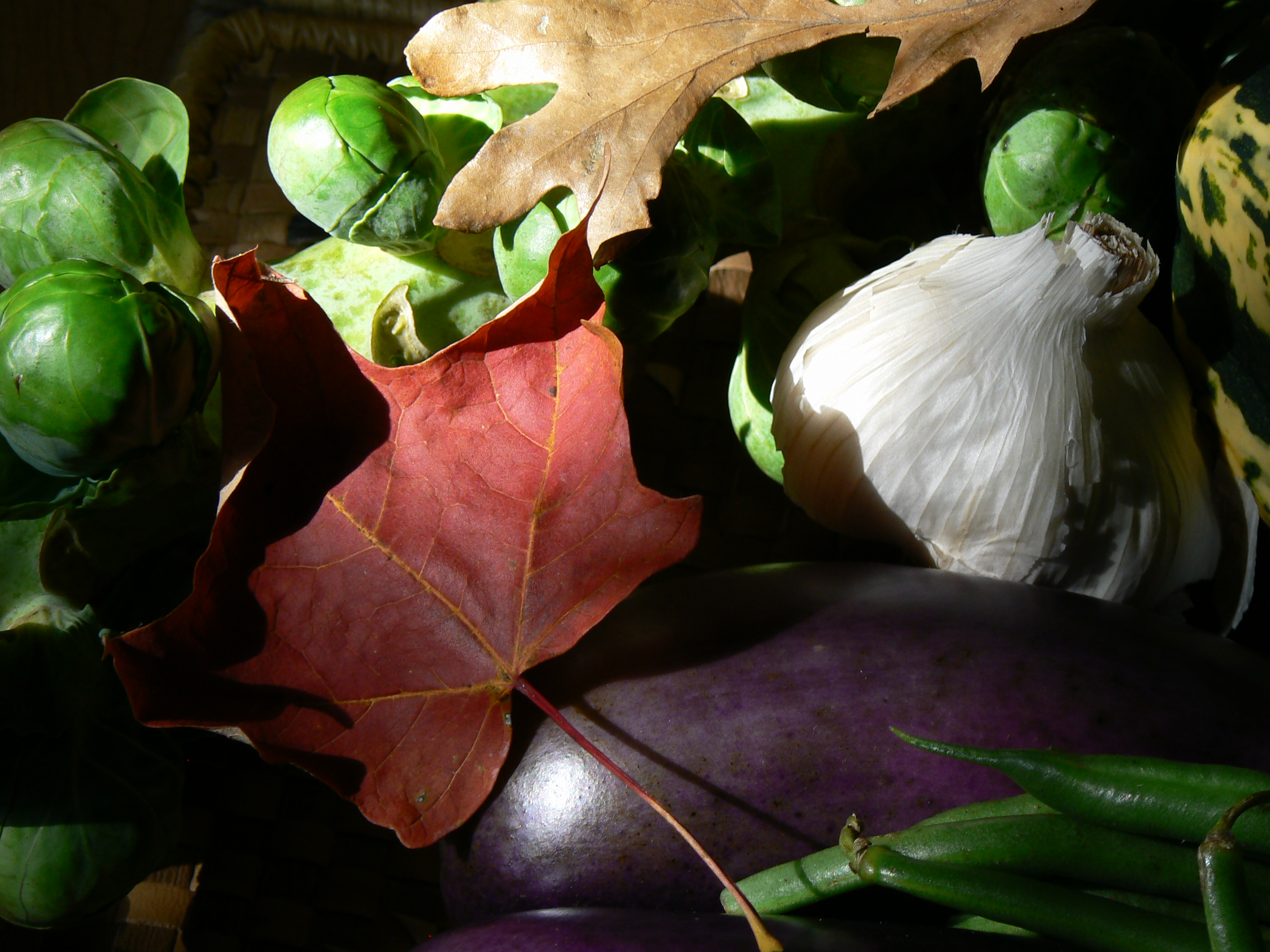
Next Saturday will be the last Farmer’s Market day for ‘Tosa.  Today’s was spectacular, though.  Here’s a picture of my morning harvest.

Oh, it’s so beautiful, I have to show you another:

As we walked to the market place in the village, we noticed a deer on someone’s front lawn grazing on fallen crabapples as the leaves blew around her.  Such a picturesque view of Fall, but unfortunately, I didn’t have my camera with me.  This evening,  I made a risotto using the Japanese eggplant, green beans, garlic, onion, and red pepper.  Supplemented with a couple of unfinished bottles of red wine plus a loaf of Kalamata rosemary bread, also from the Farmer’s Market.  Dessert was Amaretto and brownies.

In the afternoon, Steve and I went walking in the Vernon State Wildlife Area.  Emily will remember this place.   Oh, and we took the D.H. Lawrence novel we’re reading with us.

Our reading spot

Our reading was punctuated by the sound of rifle fire not far away.  Also, up the river was a duck blind and a bunch of decoys.

Not the real thing

We had a lot of questions.  Are there supposed to be people hunting waterfowl in a wildlife refuge?  The signs that were posted were confusing.  There’s no waterfowl hunting whatever beyond certain signs.  No one is allowed in the refuge area from Sept. 1 to November 30 except for gun deer hunters.  You can’t hunt on the dikes between the signs.  We took the long way around the perimeter of the area, and ended up on the railroad tracks for a while to avoid the marshy path.

Taking a higher road out of the marsh

We finally got back to the parking lot at about 4:30pm and noted more cars and people in camouflage gear with guns taking to the trails.  What was going on?  The sign in the parking lot did indicate that Hunting was one of the features of this wildlife area.  But is it deer hunting season already?  As concerned citizens, we wanted to know.  Steve jumped online when we returned home and learned that this weekend is Youth Deer Hunt weekend.  The Wildlife Area is a public hunting area, and only a portion of it is a refuge.  From the Department of Natural Resources website: “Youth hunting events give hunters ages 10 to 15 an opportunity to hunt and gain valuable experience without competing against adult hunters. Special seasons for a variety of species allow only youngsters to hunt during these days under the supervision of their mentor.”  Here is a picture:

From the DNR website

This morning, we were talking about children taking responsibility and how there ought to be a way to give kids a more meaningful role in society – somewhere between child labor and “playing” at adult roles while mom or dad do all the real stuff because adults are more efficient.  So I’m asking myself, is “hunter” a meaningful role in today’s society?  Are these kids helping the family to eat for the winter?  Are they participating in a traditional family role?  Do they partake in any ritual of acknowledging the deer’s part in this event, as many hunting cultures do?  I don’t want to be dogmatic, and I don’t like killing for sport.  I wonder what these kids are taught by their “mentors” about hunting.  I suppose I would have to speak to a hunter to find out.  I have questions.

Unknown's avatar

Reinventing Environmental Education

This morning we had a group of 1st graders participate in the Soil Secrets program.  They gathered “ingredients” for soil and cooked up a great batch…except that it will take 100 years for their ingredients to decompose and become one inch of soil.  At least that’s what they were told.  I told Howard the naturalist that I’ve been taking his teachings on Change and the 3 As (Awareness, Appreciation and Action) and blogging about them.  I told him I added “Attitude” to the list.  Just then, another staff member chimed in and said, “Oh, those are the 4 pillars of Environmental Education: Awareness, Appreciation, Attitude and Action”.  So intuitively, I’ve been piecing together a way of learning that’s already been codified and stamped with a Presidential approval…by Richard Nixon, no less.   I looked it up on Wikipedia.

Environmental education (EE) refers to organized efforts to teach about how natural environments function and, particularly, how human beings can manage their behavior and ecosystems in order to live sustainably. The term is often used to imply education within the school system, from primary to post-secondary. However, it is sometimes used more broadly to include all efforts to educate the public and other audiences, including print materials, websites, media campaigns, etc. Related disciplines include outdoor education and experiental education.  EE focuses on:

  • Awareness and sensitivity about the environment and environmental challenges
  • Knowledge and understanding about the environment and environmental challenges
  • Attitude concern for the environment and help to maintain environmental quality
  • Skills to mitigate the environmental problems
  • Participation for exercising existing knowledge and environmental related programs.

There’s a history section that notes that thinking about the environment was at first a more philosophical endeavor, engaging writers and ‘naturalists’ like Rousseau and Agassiz and became a more “scientific” issue after the Depression and dust bowl days when Conservation Education became “a major scientific management and planning tool that helped solve social, economic, and environmental problems.”

On Thursday, I learned that the CCC had built the dam at the Wehr Nature Center in 1935.  I also learned that they planted pine forests on top of the glacial kames because reforestation was generally considered good management.  Howard told me that it introduced a monoculture that wasn’t really typical of the native vegetation of the area.

So I’m beginning to realize that I’m stepping into the middle of a long-term drama.  The dialogue isn’t new, I’m just new.  But I notice that the dialogue has become more clinical and less poetic.  I like the aspect of grace.  I like the aspect of wonder.  I met a student on our program today who is getting her certification in early childhood education, K-3.  Environmental education represents 8 hours of her total degree requirements.  She will check it off her list and be that much closer to becoming a teacher. What will she impart to her students?  She laments the fact that most city kids don’t get the opportunity to go on a field trip to a park.  They simply can’t afford it.  Sometimes one parent will foot the bill for the entire class to go, and that helps.  When they can’t leave the school, they try to do a nature unit in the classroom.  One class did a seed experiment that failed because their class was in a basement room that didn’t get enough sunlight to grow the seeds in their little plastic bags.  They all rotted instead of sprouting.  What happens when you put in your required curriculum hours on environmental education but the students don’t actually get to experience a natural environment?  I suppose they learn that environments can be very different.  Wendell Berry hates the term, actually.  He says, “I don’t live in an environment.  I live in a place.”

Man, I wish I could take every kid in Milwaukee out one at a time and show them the Wehr Nature Center or Havenwoods at least once every year of their school career.

Green space at the heart of the city at Havenwoods State Forest, Milwaukee

That would be a good beginning.  How do you develop love for the world in yourself?  How do you help develop it in another person?


Unknown's avatar

Change

Today I tagged along with a group of 4-6th graders as they participated in a program called “Let’s Go Climb a Moraine”.  The staff naturalist gathered them all at the beginning of the hike and said that he hoped they would remember one important word from the day’s experience.  “Glacier?” they guessed.  No.  CHANGE.  Everything on the planet is changing.  Even the land.  For example, Wisconsin was once underwater at about the equator, back in the days of Pangaea.  The glaciers shaped landforms.  A beaver changes the landscape by chewing down trees and creating dams.  People are making all kinds of changes to the earth as well.  Naturalist Howard also asked the kids, “Why do we bother to study and learn about the earth?  The more we know about the earth, the better we’re able to do what?”  Protect it.  Take care of it.

And change?  Why do we bother to look at change and be aware of it?

So we won’t be so afraid of it, perhaps.

Change is inevitable.  Eventually, everything changes.  Some changes take a long, long time and are not even noticed in a few lifetimes.  Other changes happen in an instant.  Does change make you feel unsettled, anxious, frightened, panicked?  Are you comfortable with change?  Do you delight in change?  “Depends on what the change is.”  Sure.  That’s a fair question, but would you be able to accept every change eventually?  Are there some changes that you would never accept?  What do we teach about change?

New colors on the trees

My children are going to be living quite differently from the way I did.  There is change in the air.  Our economic situation seems like a popcorn kernel about to burst.  Something’s gotta give.  And I think that will be a very good thing.  I think that the older I get, the more open I am to change.  You might say the opposite would be more typical, and perhaps it is, but the longer I live, the more changes I see and the more I get used to change.

Steve really enjoyed our hike and remarked, “My life’s been good to me.”  It made me think of John Denver’s song, “Poems, Prayers and Promises”.

The days they pass so quickly now
Nights are seldom long
And time around me whispers when it's cold
The changes somehow frighten me
Still I have to smile
It turns me on to think of growing old
For though my life's been good to me
There's still so much to do
So many things my mind has never known
I'd like to raise a family
I'd like to sail away
And dance across the mountains on the moon

I have to say it now
It’s been a good life all in all
It’s really fine
To have the chance to hang around
And lie there by the fire
And watch the evening tire
While all my friends and my old lady
Sit and watch the sun go down

And talk of poems and prayers and promises
And things that we believe in
How sweet it is to love someone
How right it is to care
How long it’s been since yesterday
What about tomorrow
What about our dreams
And all the memories we share

I’ll always have a place in my heart for Henry John Deutschendorf, Jr.

Unknown's avatar

Righteous Depression

Ya know, in general, I think I’m a pretty happy, positive person.  I want to be like that.  Also peaceful, calm and occasionally insanely silly.  I did have a wicked period of postpartum depression after my first child was born and a bout with post-traumatic stress syndrome when Jim had heart surgery at 31. Okay, but I’m a pretty happy person, I think.  I’ve noticed now that since I’m a widow, if I get started crying about something, I can go on leaking for hours.  Now, could this be due to my new agenda of trying to face the reality of the world honestly?  The truth is the truth hurts.  Suffering exists in the world.  Various coping strategies and religions exist primarily to soften the blow of that blunt piece of honesty.  I am trying to be open, and it leaves me vulnerable.  Ouch.  It felt better to be Polyanna.

What to do about the responsibility and challenge to look deeply into the suffering of the planet, to become aware of the failures of systems and cultures, of relationships and communication from the large-scale to the intimate?  I feel sad about the truth.  Can I call this righteous depression?  Is this deep or simply pathological?

I am suddenly reminded of one of my life stories.  My sister and I were in a car accident when I was 17 and she was 20.  She was driving, and flipped the car at 80 miles per hour on the Interstate.  We were transported in an ambulance together to the Lincoln, NE hospital.  I was aware that they had been doing CPR on her the whole time with no response.  I had seen her covered in blood slumped next to me in the car before I was extricated from it.  I was in shock, but I was able to comprehend what was going on.  The hospital has policies about who can release information to patients, though, and everything must be done according to protocol.  So I found myself in an examining room with a nurse.  I had been checked out and aside from a bump on the head and some cuts, I am fine.  I know that my sister is not fine.   A nurse comes in and sits in the chair in the corner and says something about how they’re also examining my sister.  “It’s very bad,” she says, looking worried and vague, but directly at me.  “It’s just very bad.”  I felt like she was trying to talk to me in code or something.  She wanted to say something specific, but she couldn’t.  Instead, she just kept repeating how bad it was.  Was this supposed to prepare me for something?  Or was it supposed to fill me with a sense of doom and dread?  I realize she was probably a very sympathetic woman who felt terrible at being in the position of not having more comforting things to say or even more authority to speak the truth.  The result was just….awkward.  What do I do with this?  I suppose I could put her out of her misery and say, “It’s okay.  I’ve guessed that she’s dead.  I will deal with it.  I have a plan.”  Honestly, this is what I want to do in these situations.  I want to take responsibility and make everyone around me feel better.  Then I suppose I can feel righteously depressed.  It’s bad; it’s very bad, but I am going to try to do the right thing.

There are some very seriously bad things happening around us.  Global climate change, deforestation, greenhouse gases, ozone depletion, drought, famine, economic devastation, war, oppression and domination, political atrocities, nuclear poisoning, chemical poisoning, racial hatred, bullying, on and on and on.  How much of this can I be open to?  What if I bit off just a tiny portion and tried to chew on that only, to save myself from being overwhelmed?  What if I tried to absorb the totality and sank into a dark depression?  What do we do with deep sadness?  Share it?  Ignore it?  Fight it?  Meditate?  I’m open to suggestions.

Unknown's avatar

You’re Grounded!

I have this thing about wanting to do things “right”.  I grew up with a strict father who had a clear sense of what he thought was right, and I was always trying to please him.  I find myself feeling anxious about whether or not I’ve made the right decisions or acted in the best possible way or been “good” in every way I can.  The more interactions I have, the more I have to feel anxious about.  So, in a busy week, I feel more stress.  Yesterday, I spent 7 hours making pea soup.  It turned out fine, although I had to do some re-direction and repair in the middle (turns out that whole dried peas don’t cook the same way as split peas).  Not a big deal, but I felt like I had “failed” to be super-efficient and triumphant in that endeavor.  My relationship with my cooking contained some anxiety and thus drained energy from me rather than invigorating me.  We have a relationship to everything on the planet, and this is living.  Living can be a drain, or it can be energizing, or anywhere in between.  It depends on whether you’re blocking energy or “surfing” on it.  In other words, you can be at war with life, or you can be at peace with it.  Our relationship with food is a good example of this.  Did you know that the use of pesticides and herbicides came out of the technology of WWI?  The chemicals that were developed for warfare were applied to food production.  Agribusiness declared war on the earth in order to use its technology and generate a wartime economy.  Conflict, manipulation, “strong-arming” the earth in order to wrestle food from it is a particular kind of relationship.  Organic farming uses a more peaceful relationship to obtain food, working with nature and not against it.

I have been trained, in a way, to think that doing things in a prescribed “right” way is the least stressful.  I have been a pretty compliant person.  But this anxiety of compliance also produces stress.  Is there another way?  Yes.  Being grounded and open.  I’m never going to know the “right” way to do everything because there isn’t a right way.  There are a million ways.  And that’s okay.  Steve and my sister share a birthday.  They both have a way of reminding me that the way I am is wonderful, but it’s not the only way.  They both play “devil’s advocate” and bring up something that I hadn’t thought about without saying I’m wrong.  It took me some time to take this as a gift and not as a chastisement.  I was used to taking everything short of complete praise as chastisement.  I used to be somewhat afraid of both of these important people whom I love so much.  They are challenging (and they are smarter than I am).  I have a relationship with them that can be conflictual or peaceful depending on my posture of defensiveness or openness.

So, I’m still thinking about all my relationships to the residents of earth, from the dominant one I have with Steve (three year anniversary today of our very first date) to the invisible ones I have with the bacteria in my own body.   My sister points out that “What are you feeling?” is perhaps a better question than “How are you feeling?”  What am I feeling in these relationships?  Am I feeling energized?  Drained?  Peaceful?  Afraid? Stiff? Open? Anxious?  Sad? Mad? Glad?  Being open to what I’m feeling allows discussion and movement and flow and change.

Letting go of the anxiety of having “right” relationships and exploring what I feel is what I mean by being grounded and open.  What surfaces in our relationships to other species when we do this?  Here’s one thing that came to mind: the euthanizing of animals who have attacked humans.  I have read several news articles lately about grizzly bear attacks, wild cat attacks and even a deer attack (a buck with antlers that inflicted some serious wounds) that ended with the report that these animals “had to be euthanized”.  I always thought that euthanasia was “mercy killing”, like putting a wounded animal out of its misery.  These stories don’t indicate that the animals were in misery, they were simply protecting territory or defending themselves from a perceived threat.  It seems that they were killed as a punishment for attacking a human.  Some of the articles mention that the possibility of rabies warrants “mercy”, but the animal is killed before any diagnosis of rabies is made.   What is the feeling?  Do these animals need to be punished because they’ve injured a human?  Is this about anger and a preference for humans?  Are we at war with animals?  If we end up in the same place at the same time, is it kill or be killed because you are my enemy?   Why shouldn’t an animal take out a human who has shot at it or who represents a food source in a depleted environment?  Are we somehow exempt from being in that kind of relationship?  Why?  For that matter, are we supposed to be exempt from being on the “losing” side of a relationship with listeria bacteria?  Are we “better” or “more valuable”?  Why? (or why not?)

How much can we be open to in our relationships with the world?

What do you feel about buzzards?

What about lotus flowers?