Unknown's avatar

A Magical Bond

Last night we watched Werner Herzog’s film “Grizzly Man”, an amazing documentary featuring Timothy Treadwell’s video footage of grizzly bears in Alaska.  He spent 13 summers among them, mostly alone, and eventually he and his girlfriend were attacked and eaten by one.   This man was quite a character — often childlike, flamboyant, furious, arrogant, gentle, fearless and completely whacked.  At the core, though, he seemed to be straining toward a connection he deeply valued.  He wanted to bond with the bears, he may have even imagined he could become a bear.  It approximates a desperately unrequited love.  His affection for them (and for the foxes that follow him around and play with him like puppies) is palpable, although sometimes articulated in a corny, self-help guru fashion.  “Thank you, Mr. Chocolate, for being my friend…”  Okay, Fred Rogers he’s not; more like Richard Simmons.  It’s kinda weird.  But, still, he loves them; he would rather die with them than be anywhere else.  The pristine wilderness shots convey the aching beauty of the ideal.  The close ups reveal more reality: flies cover the lens and buzz around the speaker without ceasing.  Then there’s the inherent danger.  Treadwell is aware of the risks he’s taking; he talks about them quite theatrically to the camera, but they do not seem important.

Is he nuts?  Is he an idealist?  Is he wrong?  Is he inspiring?  What do we tell our kids about such passions?

I led 4 small groups of Boy Scouts on nature hikes this morning.  They were earning their Webelos Naturalist merit badge.  I had one directive: teach them about decomposers, producers, and consumers.  I added a goal of my own — introduce the Four As: awareness, appreciation, attitude, action.   For 10-year-olds, I thought this might fly.  I suppose I secretly hoped to see some of that childlike enthusiasm, the wonder and joy that can be ignited by spending a half hour on the trail.  Well, there weren’t many ‘Eureka!’ moments.  I forgot that boys can get more interested in hitting things with sticks and calling each other names than looking at mushrooms and picking up litter.   ‘Awareness’ to them meant “look out for things that could hurt you” instead of “look out for everything because the world is awesome!”  I think I may have impressed some of them by leading them to a decomposing deer carcass.  That may have provoked a “Cool!” from a few.  I wish I could do a one-on-one hike, take more time to slow down and eliminate some of the group social pressures, but these kids come with a program, so I only get one shot with a group of 8 for 30 minutes.   I wish I had taken more time to do this with my own 4 kids.

One thing to be aware of at Wehr

How do we bond with nature?  Will we ever fit in?  Are our brains just too big to allow us play nicely in the sandbox with the rest of the world?  Will we always be too distracted, too confused, too technological, too exploitative, too manipulative, too dominant, or too tasty?  I have to admit that to survive for 13 summers in Alaska among grizzlies is probably about the best record on that front.  Jane Goodall’s 45 years spent among chimpanzees is another monolithic example.   Will there be anyone like that in this next generation?  I can only hope…and volunteer to take as many as I can out on the trails.
Unknown's avatar

To Ad or Not To Ad

That is the question: whether it is nobler to support the hosting web manager directly or to suffer the slings and arrows of outrageous advertisements that defray his costs.  Or to take up arms against capitalism and occupy cyberspace, thereby ending it.

My apologies to the honorable Bard.  I woke to a dilemma this morning when my sister noticed a “goofy” ad showing up on my blog that was totally incongruous to the serious, graceful tone that I’m trying to achieve.  I found out that through the Terms of Service that I agreed to when I started this blog, I had given my permission for WordPress to run ads on my page to defray their costs.  If I want to ensure that there will be no ads on my blog page, I can pay a yearly fee of about $30.  So much for the idea of truly “free” hosting.   To be fair, though, this is only the second time since August I have seen an ad on ANY blog that I’ve visited.  I suppose I harbor a vain hope that there is a way to avoid capitalism in my daily life, and unfortunately, that is just not possible.  What I do have is choices about how I will interact with this system.

What kind of choices do I get to make?  Well, I can choose to avoid advertising by paying the fee, like I would do with Public Television (if I had a TV).  I can choose to support local small businesses, like the family operations that fixed my car this week.  I can choose “no ad” products at the market and avoid mega-stores and franchises.   I can unsubscribe to all the junk mail I get online or through the Postal Service.  Come to think of it, I need to find a better way of doing that.  I am still getting junk mail in my late husband’s name at my current boyfriend’s address, which is kind of creepy in an absurd sort of way.  It will be four years in February since he died.  How do you turn that sewage off??

The fact that advertising is so ubiquitous is one of the things that makes it so objectionable.  We are bombarded to the point that we stop paying attention.  Our awareness is compromised, and that goes against the very thing I am trying to develop in my life.   How many advertisements do you see in your average day?  If someone came up with statistics about how many you encounter, how much time you spend reading them or viewing them in video, how much time you spend trying to dispose of them or avoid them, how much money you spend funding them (whether directly or indirectly), and how much noise and visual pollution they add to the environment, don’t you suppose you’d be surprised?  Possibly appalled?  Angry? Or wouldn’t you care?

I think that the sheer volume of advertising and the phoniness of it creates an atmosphere that is potentially damaging to the human spirit.  I want to point my canoe in another direction entirely.  My relationship with my blog host is not one that will allow me to get away from using currency, but I can get away from using advertising.  I wish I could trade singing lessons or a home cooked meal for the use of cyberspace. … Yeah, that would be neat.

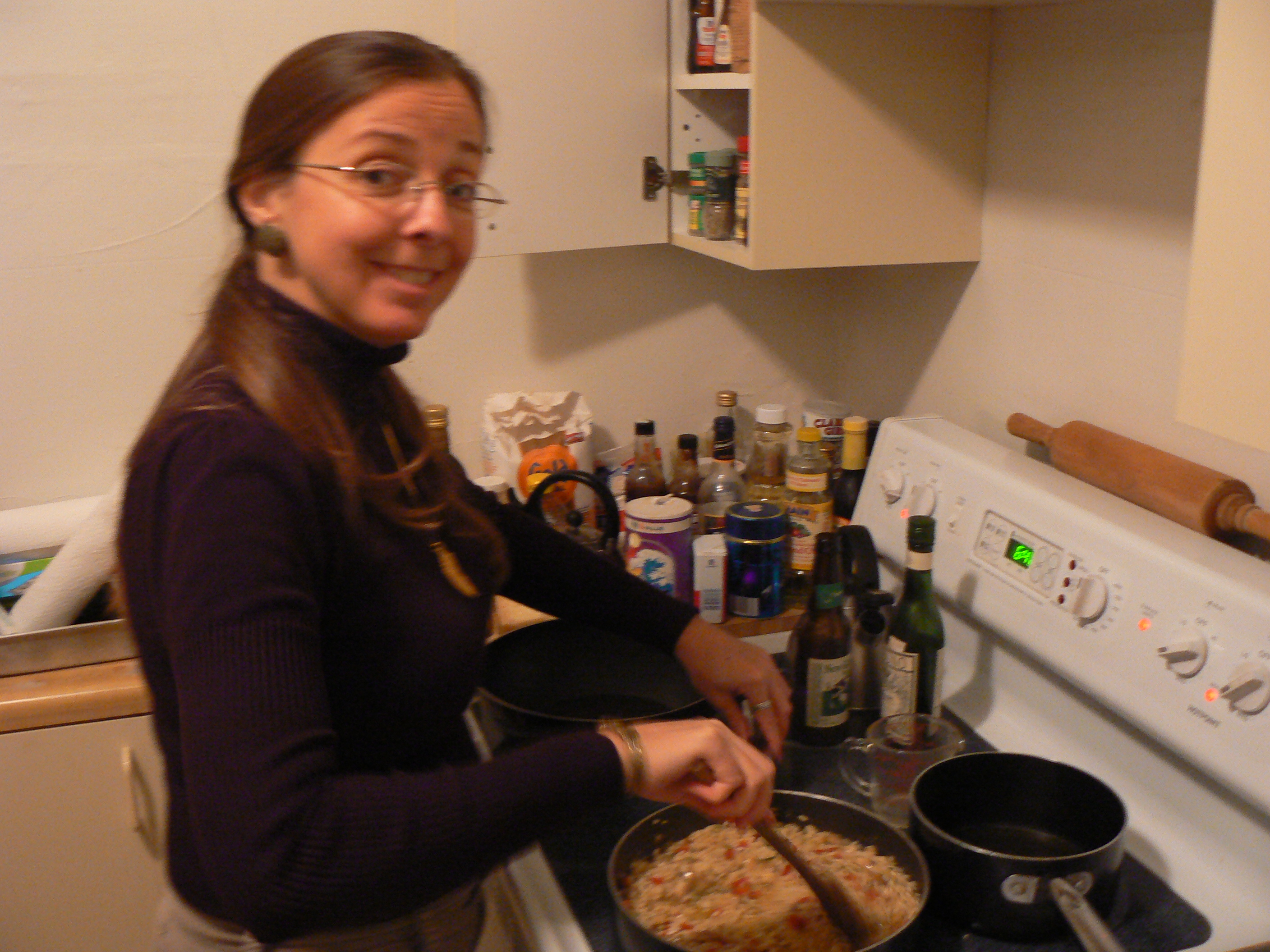
Hey, WordPress! I'm making risotto tonight!

Unknown's avatar

Getting Along

Sundays will always prompt me to meditate.  How should I behave?  How can I walk in a good and gracious and loving and peaceful path today?  Contentiousness makes me squirm uncomfortably.  Much of it is social, but it can lead me to deeper awareness.  For example, who cares if you rake the leaves off your lawn and why?  I have had conversations about this topic with Steve, his mother, and my neighbors.  Each of them has a perspective on this, and they are not all in agreement.  Which of these are important to me?  What rationales am I giving for my behavior in this situation?  Well, finally I decided to rake the leaves up this morning while Steve was sleeping.  I had a dream last night that some teenagers were assigned by community service sentences to rake the leaves on our property.  I saw that they had done it, and I was relieved.  If I feel this relief in my dream, I figured I should just relieve myself.  So I raked and encountered my landlord during the process.  I feel I have a better relationship with myself and my neighbors now.  The leaf relationship with Steve and his mother is still a work in progress.

Our reading time with D.H. Lawrence’s The Plumed Serpent reached a rather dramatic point.  Ramon, who is ushering in the age of Quetzlcoatl, removes the images and statuary from the local Catholic church and burns them in a big bonfire.  He exclaims through a hymn that Jesus and Mary have left Mexico and gone back to heaven.  Adios, they sing.  Quetzlcoatl is returning.  I can tell there’s going to be a religious war in the upcoming chapters.  Somewhere deep in my psyche a little voice is saying, “Uh-oh.  That’s really bad.  You are going to be in SOOOO much trouble for reading this book about de-throning Jesus!  It’s bad enough that you stopped going to church, etc.”  Wow.  So what is a gracious and peaceful path in the midst of a religious war?  How do we engage in philosophical exploration and practice peaceful co-existence when we’ve been taught to have red flags and warning lights go off whenever we venture into this dangerous territory?  Is it real danger or is the danger manufactured to scare us into our corners?

I feel estranged from my former church friends, and I’m still trying to figure out how to deal with that gracefully.  I was very active there for 20 years.  I haven’t been in communication with any of them much for the last 3 years, and I wonder about that a lot.  Were those true friendships?  It was a very social church.  Was it just about acquaintance and pleasantries?  Was the intimacy that sometimes arose merely circumstantial?  Today I got an e-mail from my dearest friend from there.  She is suffering.  I feel so moved that she included me in her update that I keep tearing up as I write this.

I have changed so much over the last few years.  I have stripped off a lot of familiar ways of being in order to try some newer, more open, more aware versions.  I still feel very tentative and emotional about it sometimes.   But I am really grateful to be in a place where I examine my motivations and actions more closely than ever.   It is a lively place, and I think I will see grace here.

Unknown's avatar

Winter Metaphysics

Winter is setting in.  We had some flurries yesterday.  I spent a lot of time writing online, concentrating on ideas, thoughts, feelings, and other stuff in my head.  It made me feel restless and a bit dyspeptic.  I wanted to walk; I needed to walk.  The harvest moon rose full at sunset, and we walked around the wetlands of the county grounds.  The cold was sharp and stung my nose and ears.  I felt my thighs and feet going numb.  It was a welcome discomfort, inviting me to feel my body and feel alive, real and physical.

Winter can be a time of cabin fever when things feel insular and unreal.  There are so many ways to distract myself from the basics, ways I can move from one bubble to the next without popping up for clear air.  So today, I felt like working with my hands.  I took my tools out to the backyard and broke apart the CD cabinet that’s been sitting there for 11 months.  It was good to observe rot and rust and decomposition.   I put the flat boards back down on the ground to make a home for insects and their relatives.  Come spring, I know where I can find some specimens for my nature walks.  I took a few other boards to make a bird feeder station on the old wicker chair.  Later, I’m going to make some broccoli cheddar soup.

Work, things, tools.  How do you see your relationship to the world?  Are things merely static objects?   Are things actually doings or beings as Alan Watts would suggest (e.g.  this isn’t a ‘tree’, it’s a ‘treeing’ – a dynamic process)?  If I pick up a dishrag and begin to clean, I am entering a relationship with the rag, the dishes, the water, the soap.  I want to know more about each of these things, pay attention and appreciate their qualities and how I experience them.

Is it living?

Sometimes, this seems like an unnecessary complication.  I learned from Sesame Street that certain things are alive and others aren’t.   Does that mean that I can control those inanimate objects and do whatever I want with them?  Great.  That sounds simple.  But what if that’s just one way of looking at things and not The One Correct Way?  What would I learn or experience about life if I looked at everything as a being?

These might be good questions for next week’s Socrates Cafe meeting.   Meanwhile, there are some pots and pans in the kitchen sink longing for a relationship with me.

Unknown's avatar

“I’m sorry; we can’t do that.”

You know how once you get pregnant, all you see around you is pregnant women?  I want to trigger that phenomenon in this post and bring awareness to something I feel is pretty common in our fast-paced American life.  I want to see how often people come up with the “I’m sorry; we can’t do that” line when what they really mean is something else.  Something like, “I’m sorry; I haven’t been trained to do that” or “I’m sorry; my computer can’t do that, and I don’t know how to do anything without the computer” or “I’m sorry; we aren’t willing to do that.  Your request is not as important as other things.”  The real answer is absolutely valid and a fine place to begin negotiations.  The problem is, we don’t often get the real answer.

I worked in customer service for a few years, and I remember the nervousness that accompanied requests to depart from policy.  I didn’t know if I had the authority to make exceptions.  I often didn’t want to be in the position of the middle man going back and forth from the customer to my superior.  It made me feel caught in a conflict that wasn’t mine, especially if it dragged on and on.  Eventually, I got to the point where I rather enjoyed listening to people and trying to come up with creative compromises.  But then I was told that I was spending too much time on these discussions and I should simply state the policy and get off the phone.

Dealing with people is tricky.  They require your time, and time is money.  To be an efficient society, we must streamline our systems.  Any person who does not comply with procedure is throwing a monkey wrench into the works.  So what do we value more, the “works”, the people, or some other ideal?  Once you become aware that you’re getting an “I’m sorry; we can’t do that” response, what do you do?

Here are a few examples of this kind of exchange in real life.  The first one is “How do you want your coffee?”  Steve does not like the prevalent custom of serving coffee in disposable containers.  He likes to drink his latte from a mug.  He rarely orders anything “to go”.  He values conservation of resources and energy and is not too concerned with “convenience”.  We have breakfast often at a local cafe that has recently been hiring new staff.  Young staff.  I am patient and cheerful and as helpful as I can be when I’m placing our order.  I got to ordering Steve’s latte and said, “With that breakfast, I want a latte in a mug with 2% milk.”  “Um, okay.  What size?”  “In a mug.”  “I’m sorry; we can’t do that.”  We happened to have had breakfast there just the day before.  “Well, yesterday you could.”  A more veteran server came up behind him and whispered, “Yes we can.  It’s served in a soup mug.”

I’m not saying this young person did anything wrong.  It was probably about his third day on the job.  The point is that we often get streamlined into making concessions in our decision-making and forget that there are other options.  We don’t have to take the disposable option.  We don’t have to take the profitable option if profit is not our highest goal.   We don’t have to have a lawn or rake our leaves or live in the city or send our kids to public schools or give birth in a hospital.  We don’t have to go “up and to the right” and continue to support a growth economy.  But we’ll probably be told when we suggest an alternative, “I’m sorry; we can’t do that.”

Here’s another example.  I am following a discussion on a blog about an architectural idea coming out of Italy.  The title of the article is “Milan’s Vertical Forest”.  http://pensci.wordpress.com/2011/11/07/milans-vertical-forest   The premise of the idea is to create a “less crowded, less polluted, less inhumane” city by erecting high-rise buildings with open balcony space on all four sides to accommodate trees and greenery that would help clean the air and provide a natural aesthetic.  It sounds great, but it makes me wonder whether it’s assuming “we can’t” do something else instead.  If what Milan wants is forest, why not tear down the high-rises and convert the land into open green space?  If what Milan wants is urban housing, why are they calling it a forest when in reality, it’s just apartments with more balcony space?  Are potted trees really going to thrive there?  And will people actually use all that space for vegetation instead of storing their bicycles and grills and laundry there?  If we really want the city to be less crowded and polluted, why not encourage people to move out and work the small farms in France that are being abandoned, for example?  No, “we can’t do that”, we have to think of solutions that keep people in the city and promote more construction and more growth.  Well, we don’t have to.  Let’s just be honest about what our goals are and discuss from there.

So what happens when you “throw a monkey wrench” into the system and ask for a different option?  Do you get an honest negotiation?  I would like to gum up the works of the political machine and ask for a candidate who would admit that s/he is not perfect in character, is not superior in knowledge about every facet of American life and doesn’t necessarily have to be the prime ideologue, but who would be a skilled administrator willing to represent the people and carry out their ideas.

I don’t want a cardboard cup with the shiny logo and a snappy lid.  I just need a teacup to hold some tea long enough to get it to my mouth.  Any Buddhist will tell you, it’s not about the teacup, it’s about the tea.

Unknown's avatar

Ordinary Business with a side of grief

My finger is bleeding; I’m cold and frustrated, and now I’m crying.  Time to go inside and figure out what’s going on with me.

I still have occasional melt downs.  I am still grieving.

Today I went to the Wisconsin DMV to get a new driver’s license, car registration, title and license plates.  I am not exactly timely in getting this bit of business done, and I still have to figure out what to do with the other car that is in Chicago with my daughter.  I don’t relish going into “the system”.  I often feel stupid, pushed around, ripped off and helpless.  I try to do my homework and come prepared.  I cannot tell a lie and haven’t figured out how to find justifiable loop holes to save myself some money.  Steve says that I think in black and white, which is why the system loves me.  Fine.  I suppose that’s my personality, and I don’t think it’s so bad.  I will never be a shrewd iconoclast.  I’ll leave that to someone else.  I figure I did okay getting out in 30 minutes with new plates, a new title, and a new (temp) driver’s license.  I was kind of proud of myself for a moment for jumping through this hurdle.  I got home and updated my insurance info online and then went out with a screwdriver and the plates to do the swap.  The back plates are held on by a hexagonal bolt.  Fine.  I went to get pliers.  Back outside.  I couldn’t budge the thing, and the pliers kept slipping.  Fine.  I’ll go find a socket wrench or something.  I do have a handy array of tools, and I rather like solving problems.  I found a set of wrenches and selected one the right size.  It fit on the bolt, but I still couldn’t move it.  I needed more force, so I went back inside to find a hammer.  With the hammer, I decided to be more aggressive.  I wanted to move this stubborn bolt, but the rust resisted.  My knuckle scraped against the plate and started bleeding.  Fine.  I’ll go inside and wash my hand and find some gloves.  Back outside.  Final attempt, nothing’s budging, I’m cold and ILLINOIS is staring me in the face.  “This is Jim’s car,” pops into my head, my nose starts burning and suddenly, everything is blurry.

If this little operation had gone smoothly, I wouldn’t have thought much about it.  I still play the games inside my head that swing me from “This is no big deal” to “This is something important” and back again.  Denying emotion, repressing the thoughts and feelings that spring unbidden in an ordinary moment. Where is that Middle Way?

This isn’t an emergency.  There’s no need to be anxious, but something notable is happening.  I want to slow down and pay attention.  I am thinking of Jim, and I am sad.  I miss the way he took care of all kinds of “system business” smoothly and happily.  Knocking away at his plates with my hammer makes me feel like I’m dismantling something precious, and I don’t want it to be taken apart.  I can’t preserve everything, of course.  What can I keep?  I don’t need the plates.  I appreciate the car.  I want always to have the love.  I wish I could hang on to the security.

And that’s what it is all about.

I am grateful to have a partner who provides a safe, warm place for me to talk about this and arms to encircle me and fingers that can open a package of Band-Aids when I’m trembling.

Unknown's avatar

Memories

What is a “legitimate memory”?  Does it have to be factual?  Is the emotional memory as valid and important as anything else?  If you polled the people effected by an event, would any two have the same memory of it?  I think that highly unlikely.  Everyone has his own perspective.  There must be thousands of different stories about the holocaust of WWII or about Sept. 11, 2001 in New York City.  What do we gain from a memory?  What is achieved by illustrating and sharing it?  With whom should we share our memories?  If you enjoy engaging in someone else’s memories, does that make you somewhat voyeuristic?  Does the sharing of memories help us to become more emotionally intelligent, more empathic?  Does that make it Art?

Andrew Lloyd Weber imagines cats have memories.

We didn’t really talk about these questions in class last night, but Steve asked me sleepily as he came to bed in the wee hours this morning, “So, why do you want to write memoirs?”  He is supportive, but he is much more interested in research and synthesis.  Also, he doesn’t remember much.  Names, anniversaries, directions and details get lost in a blur.  He will remember a holistic sense of something, an emotional reading.   I go the other way; I’m heavy on detail and can’t articulate an emotion.  Perhaps I am trying to teach myself to become more compassionate and empathic.  I typically repress a lot of emotion.  I am afraid of getting in trouble for acting out my passions.  Especially anger.  I completely deny anger.  I like to think this makes me a more pleasant person, but it probably just makes me more neurotic.

Theater, music, literature, art: they’re about communicating emotion, right?  They make us feel human.  We get connected to others and to ourselves through them.  They are marks of culture and civilization. They help us explore a kind of intelligence and understanding about the human condition.  The emotions in art can be immediate and raw or they can be seeds from the past grown into a living reality.  My son tells me that our brains also make memories when we dream and thereby prepare us to have some experience to draw on in a new situation.

So I’m working on remembering repressed emotions, pulling up experiences from the past in detail.  And I’m also trying to be present in the moment, in now.  Going back and forth is kind of a test of sanity.  One of the things Steve said he liked about me when we started dating was that I was “sane”.  There’s a short cut to sanity, which is to remain shallow and functional.  Then there’s the long route, which is to attempt to feel in depth and yet refrain from wallowing.  I want to take that long and winding road and share what I find on the journey.  I hope that results in a learning experience for me and a few others.

Unknown's avatar

Continuing My Education

I’m rather innocent in the ways of the world, even though I’ve lived almost 50 years in it.  I married my high school sweetheart before I’d even graduated from college and left my parents’ care completely.  My husband was a fabulous provider and only urged me to seek full time employment after my 4 kids had reached their teenaged years.  So really, I’ve never supported myself entirely.   Well, come to think of it, probably nobody “supports himself entirely”.  Let’s just say that I still have much to learn.

So today, I’m starting a class in Memoir Writing through the UW – Milwaukee extension program.  I am so excited to be going back to school!  I have a BA already, so I’m not embarking on a long term degree program, but I am trying to get closer to a goal I’ve had for about 20 years.  I’d like to be a published writer.  When I was 30, I started writing poetry.  I self-published one booklet, and had one poem published in a magazine.  I didn’t receive any pay for these efforts.  I’d like to see if I can actually earn money with this proclivity to write.  Aside from a few curriculum guides commissioned by my former employer, I haven’t had any paying work since last December.  And now, my car needs repairs and registration plates.  It’s time to go out into the world and seek some income.

You have no idea how neurotic I could be about this.  My kids have much more work experience than I.  I have urged them out into the job market on many occasions with peppy confidence talks, and they’ve always had some measure of success.  It’s part of their skill set.  I kind of freeze up inside and whine, “But I don’t know how to do this!  I wasn’t brought up to do this!”  I’m sure some of you are incredulous.  Let me explain: my mother hasn’t had a paying job since she graduated and married in 1955.  She is a brilliant and accomplished woman with a BA from our nation’s most prestigious institute of higher learning (yes, that one, but the women’s version from the pre-co-ed days).  She’s worked on countless volunteer committees and made important contributions to many communities.  But she hasn’t had a paying job.  It’s actually possible to live without one.  I grew up thinking that employment was optional, not mandatory.  And I’m glad that I did.  I think it allows me to think outside a very pernicious box.  It also gnaws at my sense of security at times.

Many people believe that education is primarily a pre-requisite for being more competitive in the job market.  A smaller percentage believe that education is simply engaging with life; it needs no framework from society and no economic impetus.  It’s the joyful occupation of people with brains.  (That would be all of us.)  A Buddhist might look for a Middle Way between the practical and the ideological posture of learning.  That’s where I want to be.  I don’t want to be defined by my wage-earning potential.  I don’t want to be so high in an ivory tower that I can’t find a way to feed myself, either.   I am sure that I can use the skills I have, and new skills that I can acquire, to secure my basic needs.  And I’m pretty sure I can do it in a way that doesn’t enslave me to something I resent.

Maybe this is the meaning behind the statement made by the founder of my Alma Mater: “The paramount obligation of a college is to develop in its students the ability to think clearly and independently, and the ability to live confidently, courageously, and hopefully.”

All that, and they give you a coffee mug, too.

Corny?  Elitist? Profound?  What has your education developed in you?

Unknown's avatar

Living Heroically

Discipline without coercion.  Is it possible for individuals?  For communities?  Dare we believe that without obligation, people will make efforts to do their best and work toward the common good?  Are people who do that “heroes”?

We dangle punitive measures and capitalistic rewards in front of the masses and hope that will encourage us to be model citizens, and then we have to deal with the greedy monsters that evolve wondering “What’s in it for me?”  If I am of the 1% and super-wealthy, what incentive do I have to share?  And what is the percentage of the 99% who hope that one day, they will become super-wealthy also and so feel no inclination to put restrictions on the rich?  How many people are likely to come to a sense that they have “enough” all on their own and turn their surplus over to others?  And when will that sense of “enough” kick in?  What standard of living do we feel entitled to?  What would it feel like to say, “This is all I need.  I am not afraid to trust that I have enough”?  Would it feel like freedom?

How do you discipline yourself without feeling a sense of obligation?  Do you eat healthy foods because you want to?  Or because some outside influence is holding up a consequence or reward?  Do you make music because some authority is telling you to practice or for the sheer joy of it?  Do you do what you do out of passion or fear?

On our first date, Steve played a kind of “twenty questions” game with me.  I was trying to guess his three heroes in order to get to know him better.  He maintains that each of these inspirational figures have a passion for something and demonstrate it joyfully.  The first one is David Attenborough of the BBC Natural History Unit, groundbreaking writer and presenter of nature programs.  The second is Julia Child, The French Chef.  I was in total accord to this point, and also loved that they are easy to imitate in voice and mannerism to add levity to any undertaking (and we do this frequently).  The third one was rather tough to guess, mostly because he wasn’t human.  “An athlete” was about as close as I got.  Finally, Steve led me to thinking about equestrian athletes, and I immediately thought of Secretariat.  I found that rather a head-scratcher, though.  How could a horse be a hero?  And then he showed me the youtube clip of the final race in the1973 Triple Crown.  It still makes him cry.

A horse cannot be coerced by the promise of fame and fortune, can it?  There was no whipping, no carrot on a stick.  Secretariat ran for the pure joy of running, it would seem.  Feeling the power of his legs, the wind in his mane, the freedom of doing what he was born and bred and loved to do that day.  Did he have a reward afterward?  Did he develop a taste for winning?  I suppose you could debate the emotions of a horse forever and never learn anything conclusive.  You could also debate whether or not his race was something that created “good”.  Many people were undoubtedly uplifted; just listen to the audio on the tape.  His grace and beauty are captivating.  And maybe a bunch of people were making money off of it, but the horse wasn’t.  For that reason, it seems rather pure to me.

So what would it mean for you and me to be the heroes of our own lives?  To be the best we could be not out of obligation or fear of reprisal or for monetary gain, but just for the joy of living out our own passion and interest, for the love of it?  What would it be like to allow that to be our reward, our life work, and not ask fame or fortune from it?  Would we share any surplus of our efforts?  What if we all lived like that?  Would we be able to balance the table top, enjoy sustainability and equality, as a community and perhaps as a planet?  Is this a utopian ideal and totally unrealistic?

Probably.  But I would love to feel the wind in my hair, too…

...like her. (My daughter, in France, living her passion.)

Unknown's avatar

Bravi!

I just returned from watching the HD live simulcast of the Metropolitan Opera’s matinee performance of Wagner’s Siegfried.  After five and half hours in another world, I’m not really sure what day it is.  But it doesn’t matter.  I’ve been convening with the gods and had a ringside (oh, pun appreciated!) seat at a resurrection which left me breathless and sobbing.  Brunhilde (two dots over the ‘u’) is wakened from her 18 year slumber by a kiss from Siegfried.  It may sound like Sleeping Beauty, but with Wagner’s incredible score underneath instead of Disney, it is a much more transcendent moment.  Deborah Voigt is an amazing actress as well as a singer.  In due time, she rises and greets the sun with a smile that lights the stage and a melody that thrills you to gooseflesh and tears.  Have you ever felt dead?  Hopeless?  Trapped?  Futureless? Depressed?  “There’s got to be a morning after….” is the same sentiment with inferior music. Her salutation of the day and the realization that she is alive reminds me of the Suryanamaskar in yoga, not that she does the position, but the joy of it shows in her entire being.  The passion behind the resurrection in this story is her banishment by Wotan, her father, god of Valhalla and enforcer of all the rules.  That scene as well struck me in the heart and gut as I pictured my own stern father turning his back on his daughter.  Their parting was a wrenching and painful death, again reducing me to tears in the darkness of the theater…last June.  She doesn’t awake until Act III of the next opera, which is what I saw today.

Oh, life!  Light in your eyes, the touch of your own warm flesh, breath in your lungs.  What compares with realizing the richness of being alive?  We can barely endure a moment of this stunning gift.  Something of sentience crashes in on the sparkle like a sledgehammer on an icicle.  Now that I’m alive, there’s so much to fear!  Brunhilde quickly realizes she’s lost her immortality, her armor and shield, and her autonomy.  I know the place where my morning turns on a dime from sunny dawn to mental lists of obligations and anxieties.  It’s like the Easter let down after the trumpet recessional when you know you have to leave the church and the music and go back to your business.  Listening to Deborah sing those first phrases, I hitch my entire being to her joy and long to go with her into that rapture and never come back.

A human emotion, pure and powerful, captured in Art.  It seems simple enough but somehow requires genius…or open innocence…or both.  I feel compelled to become attached, to grab this jewel and hang on, to build a booth around this transfiguration, but that would be a strangle hold.  I let it go, grateful for its presence and passing, and hopeful that another day the sun will rise and I with it.