Unknown's avatar

Parenting On the Dotted Line and Over the Rainbow

Steve & I borrowed a DVD from the library called “Between the Folds”.  It’s a documentary about origami, but not just the decorative, brightly-colored little figures that school kids make.   It’s about science and mathematics and art and exploring the fusion of all those disciplines.  To learn more, click here.  One of the fascinating paper-folders interviewed is Erik Demaine, “an associate professor of electrical engineering and computer science at the Massachusetts Institute of Technology. Called one of the most brilliant scientists in America by Popular Science, he received a MacArthur Genius Fellowship at the age of 22. Demaine’s work combines science and art, geometry, paper folding and computational origami.”  The interview also includes footage of him with his dad, who apparently home-schooled him as a single parent and prepared him to enter college at the age of 12.  These two bear a touching family resemblance of soft-spoken, constantly smiling Geekdom, complete with pony-tails, facial hair and glasses.  It is obvious that they have enjoyed sharing a couple of decades exploring the world with bright-eyed curiosity.

I also happened upon a Mom Blog called RaisingMyRainbow.  Its blurb reads: “Adventures in raising a slightly effeminate, possibly gay, totally fabulous son.”  Her son is 4 years old.  She writes with wit and whimsy and a very open attitude, chronicling how their family navigates what seems to be a mainstream suburban life with an emerging non-mainstream human being.  It seems very honest to me, no agenda, no axe to grind, no added drama, just very loving and willing to engage with what arises.
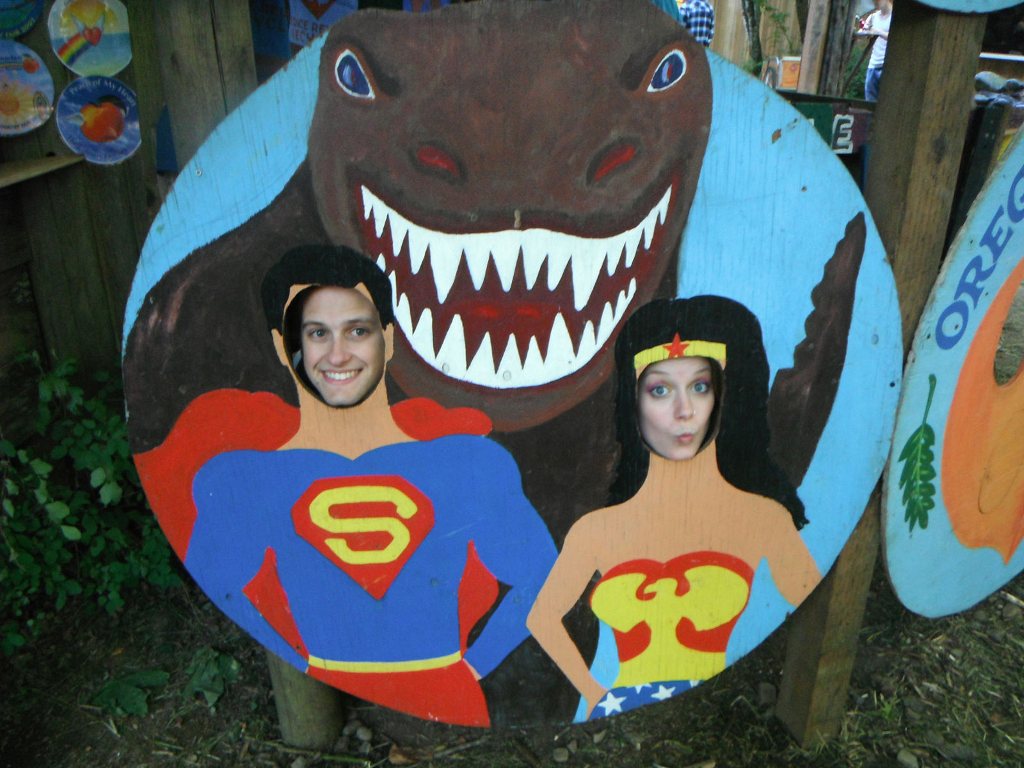
Super Kids (photo by Joe Griessler)

I am inspired by this kind of parenting, and I want this to be what I pass on to my children.  My own kids are already in their 20s, though.  But I figure it’s never too late to model something positive.  After all, they may be parents themselves some day.  My parenting models were quite limited.  Growing up in the 60s & 70s, I didn’t know one kid whose parents were divorced until I got to High School.  My dad’s own parents were divorced, but he never talked about that.  My best friend’s parents had been divorced from previous marriages, but that didn’t seem to impact their family life when I knew him.  I got the strong impression that there was a ‘right way’ and a ‘wrong way’ to do everything, and the ‘wrong way’ was to be avoided at all costs.  Consequently, I complied and conformed and walked the narrow way.  It wasn’t a bad response, but it wasn’t necessarily the right response or the only reasonable response.  The difficulties with my response became apparent as my circle of awareness widened.  Other people were living other responses.  Do I tolerate, embrace, include or exclude those people?  What if some of those people are my own children?

“There are as many different ways to be a Christian as there are Christians”, my spiritual adviser told me one day.  He was a former Jesuit priest, born in India, married to a former nun, both still very active in the Catholic Church.  I couldn’t have been more astonished.  My father would never have said that.  There are as many different ways to be a parent as there are parents.  Those ways may be judged according to certain values.  To make any kind of distinctions, you really have to look at those values.  Do you value conformity?  Okay, then call it ‘conformity’.  Do you value love?  Okay, then look very closely at what you think ‘love’ is.  Does love punish?  Does love shame?  Does love reject?  Do you value certain beliefs that you respect?  Why do you respect them?  Because someone told you to?  Because they support something you’ve experienced?  There are so many good questions to consider, but it’s hard to find a safe place to consider them.  As a parent, I felt attacked, judged and defensive.  Competition crept into my parenting way too much.  I own those as my issues, but I also believe the suburban environment supported that.  Parental support groups I was in may have effectively reinforced the competition rather than offered support.

Hindsight.  I was 22 when I became a parent.  I didn’t think about a lot of this stuff beforehand.  However, I have four totally fabulous children nevertheless.   I give them credit; I give me and my husband credit; I give the Universe credit.   In general, if I lighten up on my ego, I can avoid creating stuff that’s FUBAR.  Instill wonder, curiosity, creativity.  Play alongside the kids, and step back.  We are all learning and growing up together, folding rainbows into the process.

Unknown's avatar

Stressed for Success?

My very astute sister once pointed out to me that all stress is not created equal.  There’s daily stress, the normal result of a body functioning without rest for 16 hours or so, which is alleviated after 8 hours of sleep.  There’s distress, which gives us the feeling of being overwhelmed or upset by the amount of stress we experience, and then there’s eustress, which according to Wikipedia is “a term coined by endocrinologist Hans Selye which is defined…as stress that is healthy, or gives one a feeling of fulfillment or other positive feeling. Eustress is a process of exploring potential gains.”  Examples of eustress could include climbing a mountain, running a marathon or sky-diving.  Or surviving a nautical disaster.

I was intrigued by a comment I read from one of the survivors of the cruise ship, Costa Concordia, that sank in the Mediterranean this past week.   ABC News reported:

‘Australian miner Rob Elcombe and his wife, Tracey Gunn, told Melbourne’s Herald Sun Newspaper they booked a spot on the Concordia as a last ditch effort to save their marriage.  Instead, the couple found themselves trying to save their lives when they boarded the very last lifeboat to leave the ship with survivors. “This has made our bond much, much stronger,” Elcombe told the paper. “Who needs couples counseling, when you survive a Titanic experience?” ‘

An adventure.   Stress worked into a feeling of gain.  Is it possible to turn your distress into eustress?

Peace like a river

Another news story I ran across came under this headline: Wife Slips Into Madness As Husband Dies of Brain Tumor. (ABC News)  Catherine Graves wrote a book called Checking Out: An In Depth Look At Losing Your Mind describing the distress of caring for her husband.  The headline rather sensationalizes an experience of overwhelming stress that is shared by a lot of people who find themselves in the role of caregiver.  I can relate.  I went through depression and Post Traumatic Stress Syndrome during my husband’s illness and after his death.  Like Mrs. Graves, I was widowed at 45.  But did I lose my mind?  Not irretrievably, I don’t think.  Maybe what I’m doing now, being unemployed, slowing down, is my way of turning that distress into eustress.

There’s an old hymn that I’ve affectionately heard referred to as “The Playtex Hymn” (after the girdle).  The first line is “How firm a foundation, ye saints of the Lord, is laid for your faith in His excellent Word”.   It was written by John Keith in 1787.  My favorite verse goes like this:

“When through the deep waters I cause thee to go,
The rivers of woe shall not thee overflow;
For I will be with thee thy trouble to bless,
And sanctify to thee thy deepest distress.”

For some reason, singing that verse always causes me to choke up with emotion.  I know how it is to feel like I’m drowning.  I have a gasp reflex that reminds me of this almost daily.  It shows up lightning fast in moments when my reptilian brain senses danger.  It first became noticeable when I was trying to teach my kids to drive.  I would gasp and grab the handle above the passenger side door at the slightest correction of the steering wheel or touch of the brake.  It happened to me again just this morning.  I was stacking packages on the table and the tower toppled over.  I gasped.  “I must be drowning!” I laughed.  It’s probably a rather annoying habit for those who live with me.   I appreciate their patience.

There’s another hymn that follows this theme.  “It Is Well With My Soul” was written by Horatio Spafford in 1873.  The story behind it is quite amazing.  In brief, according to Wikipedia:

“This hymn was written after several traumatic events in Spafford’s life. The first was the death of his only son in 1871 at the age of four, shortly followed by the Great Chicago Fire which ruined him financially (he had been a successful lawyer). Then in 1873, he had planned to travel to Europe with his family on the SS Ville du Havre, but sent the family ahead while he was delayed on business concerning zoning problems following the Great Chicago Fire. While crossing the Atlantic, the ship sank rapidly after a collision with a sailing ship, and all four of Spafford’s daughters died. His wife Anna survived and sent him the now famous telegram, “Saved alone . . .”. Shortly afterwards, as Spafford traveled to meet his grieving wife, he was inspired to write these words as his ship passed near where his daughters had died.”

And here’s the lyric:

When peace like a river, attendeth my way,
When sorrows like sea billows roll;
Whatever my lot, Thou hast taught me to say,
It is well, it is well, with my soul.

I am trying to re-train my brain to believe that my deepest distress can be sanctified.  I don’t think this is an exclusively Christian perspective at all.  The Noble Truths of Buddhism are all about addressing the suffering (distress) of this world and how we think about it.   I hope that as I “explore potential gains”, my drowning will become floating, and all will be well with my soul.

Unknown's avatar

Existential Sunday

I mentioned yesterday that I was moody.  I come around periodically to a place of existential crisis, and I’ve come to believe it’s good for me.  When I was raising children and nursing a sick husband, I rarely got this privilege.  I always had someone to pour my heart and soul into and frequently felt that my existence was thoroughly used up on a daily basis.  Trouble is, this way of living was often an unexamined habit that I could go through sleep-walking.  I kept my head down and convinced myself that everything I was doing was noble and important.  It may have been, or it may not have been.  I wasn’t really paying attention that closely.

Living with Steve is different.  It’s challenging.  He doesn’t want me to pour my heart and soul into caring for him.  He wants me to fly on my own.  I blink, open-mouthed.  Fly?  On my own?  What the heck does that look like?  He redirects my attention from outside of me to inside…all the time…and I keep imagining an empty room.  What if I don’t have any inner life?

So I sit with that.  Emptiness isn’t a judgment.  It can be the beginning of openness.

I went poking around on the internet, looking for an answer (from outside, again…old habits die hard) to “what is important in life”.  I actually found something kinda cool:  this community project.  An abandoned building in New Orleans is covered with chalkboard paint and stenciled with the prompt “Before I die, I want to ___”.  Chalk is provided.  People approach.  Existential assessment goes on, and the sentence is answered.  I imagine myself standing there…clouds gather, rain falls, people pass, children grow up…and I’m still scratching my head.

I thought of re-phrasing the question, changing “What is important in life?”  to “What are two things you cannot live without?”  They’re not exactly interchangeable, I discovered.  I also discovered a great irony: I lost the two things I thought I couldn’t live without, and I’m still living.  So, either they weren’t that important, or I’m not really living.  Or I didn’t answer that truthfully.  I thought I could not live without my husband.  I thought I could not live without my Christian faith.  I was wrong.

Okay, dammit, what IS important in life?  What about the obvious answer…’life’?  As in, “Before I die, I want to Live.”  I want to live, be alive, be awake, be aware, spend myself, give my love, explore my autonomy, visit that inner room and see what’s there.  But not in an ego-driven way.  In an open way. The Western way prompts me, “Yes, but what will that look like when it’s all finished?” as if there’s a finish.  It wants a goal, a check list with little boxes to tick, just to keep track so that it can say, “Good…I’ve done it!”  That’s ego talk.  The Eastern way says, “Forget the goal, the check list.  You don’t need to keep track; keep open.  Engage with life and have a relationship.”

That’s where I’ve gotten to so far today.  How about you?  What is important in your life?

Unknown's avatar

Give Us This Day

The temperature is finally dropping and the snow is falling.  I’m rather in the mood to be snowed in; it’s been a long time coming.  The anticipation of winter without the actual characteristics is a little unsettling.  What would you think if your region just “skipped” a season?  What do the animals think?  “Do we fly north now, or not?”  “Is it time to wake up?”  Migratory animals get confused by light pollution.  I’m sure a host of species are getting confused about climate change.  But then again, they probably don’t worry like us humans.  They adapt.  Or they don’t.  They take it one day at a time, looking for warmth and shelter and food just like every day.

Daily living, daily choices, daily bread.  What do you learn from now?

In the eclectic jumble of my brain, a song is emerging.  “For Now” from the musical, Avenue Q (Robert Lopez, Jeff Marx).

PRINCETON: Why does everything have to be so hard?
GARY COLEMAN: Maybe you’ll never find your purpose.
CHRISTMAS EVE: Lots of people don’t.
PRINCETON: But then- I don’t know why I’m even alive!
KATE MONSTER: Well, who does, really? Everyone’s a little bit unsatisfied.
BRIAN: Everyone goes ’round a little empty inside.
GARY COLEMAN: Take a breath, Look around,
BRIAN: Swallow your pride,
KATE MONSTER: For now…
NICKY: Nothing lasts,
ROD: Life goes on,
NICKY: Full of surprises.
ROD: You’ll be faced with problems of all shapes and sizes.
CHRISTMAS EVE: You’re going to have to make a few compromises…For now…
LUCY: For now we’re healthy.
BRIAN: For now we’re employed.
BAD IDEA BEARS: For now we’re happy…
KATE MONSTER: If not overjoyed.
PRINCETON: And we’ll accept the things we cannot avoid, for now…
ALL: But only for now! (For now)…
Only for now! (For now there’s life!)
Only for now! (For now there’s love!)
Only for now! (For now there’s work!)
For now there’s happiness! But only for now!
(For now discomfort!) Only for now!
(For now there’s friendship!) Only for now!

(Sex!) Is only for now!

(Your hair!) Is only for now!

(George Bush!) Is only for now!
Don’t stress, Relax,
Let life roll off your backs
Except for death and paying taxes,
Everything in life is only for now!
NICKY: Each time you smile…
ALL:…Only for now
KATE MONSTER: It’ll only last a while.
ALL:…Only for now
PRINCETON: Life may be scary…
ALL:…Only for now. But it’s only temporary
PRINCETON: Everything in life is only for now.

I saw Buddhists discoursing in a documentary by Werner Herzog once.  Periodically, they would clap their hands together like crashing cymbals.  I was told that was a symbolic gesture aimed at bringing the speaker and listener into the present moment, no matter where the conversation was going.  For NOW!…..and NOW!

This breath…is only for now.  These words…are only for now.  I appreciate now, right now.


Unknown's avatar

Art, Music & Myth: The Deeper Story of Being Human

Are human beings the only animals that weep?

Charles Darwin noted that Indian elephants weep.  There have been many books written on the subject of animals’ emotions, and I haven’t read any of them, so I’m not going to venture an answer.  What I do know is that I weep.  And Steve weeps.   When we weep —  not cry, but weep — it seems to come from a sacred place in our soul, a place that has been stirred by something far greater than our selves.  Of course, we can make efforts to wall off that place, if we want to.  Bombarding ourselves with distractions often works to activate those shields.  We can also choose to be curious and try to understand that feeling better.

“I’m interested only in expressing basic human emotions — tragedy, ecstasy, doom, and so on. And the fact that a lot of people break down and cry when confronted with my pictures shows that I can communicate those basic human emotions . . . The people who weep before my pictures are having the same religious experience I had when I painted them. And if you, as you say, are moved only by their color relationship, then you miss the point.” – Mark Rothko

Tears can be a sign of “religious experience”, then.  Fair enough.  Something spiritual is going on there.  What?

“When I was a younger man, art was a lonely thing. No galleries, no collectors, no critics, no money. Yet, it was a golden age, for we all had nothing to lose and a vision to gain. Today it is not quite the same. It is a time of tons of verbiage, activity, consumption. Which condition is better for the world at large I shall not venture to discuss. But I do know, that many of those who are driven to this life are desperately searching for those pockets of silence where we can root and grow. We must all hope we find them.” – Mark Rothko

That loneliness, that “pocket of silence where we can root and grow” resonates deeply with my partner, Steve.  He calls it being moody or refers to his “Slavic melancholy”.  It’s not a sorrowful thing only; it is just as brightly tinted with joy, like some of Rothko’s paintings.  The combination, the totality is what hits home with him.  He says, “The deeper story is to face all of life.  Jesus and the Buddha are heroes of that story.”   They are not conquering wartime heroes interested solely in winning.  They do not struggle and strive.  They embrace all dimensions of life equally: the suffering, the love, the sacrifice, the elation.

Rothko - Untitled Red and Black

In the book The Power of Myth based on Billy Moyers’ interviews with Joseph Campbell, I read:

Campbell:  “The images of myth are reflections of the spiritual potentialities of every one of us. Through contemplating these, we evoke their powers in our own lives.”

Moyers: “Who interprets the divinity inherent in nature for us today? Who are our shamans?”

Campbell: “It is the function of the artist to do this. The artist is the one who communicates myth for today.….”

Steve weeps when listening to Mahler.  And “Puff the Magic Dragon”.  Slipping into his cave, searching for that place to root and grow, he feels the poignant essence of life, the crescendo and decrescendo, and resists exerting his will against the flow.  I think that I have a different sensibility.  Maybe not so expansive, maybe more interior and visceral.  I identify with a lonely pocket of silence for rooting and growing…the womb.  I feel womb-love, the ache, the swoon, the exchange of life blood.  I see colors inside my eyelids, sunshine through membrane, the tragedy and ecstasy and doom of flesh.  Okay, I am in the grip of my biology this week, so this makes a lot of sense.  I have given birth four times and dream of my grown up children regularly.   The story that trips my tear ducts is “Homeward Bound”, anything with a reunion.  The deeper story for me has something to do with connection.  Maybe that’s the Gaia story.  I think she’s like Jesus and Buddha in that she also embraces all of life without struggling or striving, but in her own way.  Perhaps I feel more in my Sacral Chakra,  Steve in his Heart Chakra.

The deeper story of being human is told from inside this skin.  It is not the only story in the universe, however.  There is the elephant’s story, the asteroid’s story, more stories than we can imagine.  I would hope to know many more, and to weep at all of them.

Unknown's avatar

The Rose

I think I have a pretty active dream life.  I usually remember something of my sleeping hours upon awakening.  Perhaps that indicates the level of my anxieties and neuroses; I’m not sure.  Steve says he hardly ever dreams, and he thinks it’s because he is so aware of his conscious mind while he’s awake.  Well, fine for you, then.  I blink my eyes open and forget where I am.  I need decompression time every morning.  My dreams almost always include my late husband, who has been dead almost 4 years.  It gives me a rather fluid sense of reality.  Jim is real and Steve is real, they’re just never real at the same time, in the same place.  Is that weird?  Oh, probably.  I’m getting used to it.

The other thing I do in dreamland is sing.  I wake up singing a song, or with a song stuck in my head.  This morning, it was “The Rose”, a song Bette Midler recorded some years back.  I think I learned it from one of my kid’s elementary school music programs. The line I was stuck on went like this: “Some say love, it is a river, that drowns the tender reed.  Some say love, it is a razor, that leaves your soul to bleed.  Some say love, it is a hunger, an endless aching need.  I say love, it is a flower, and you, its only seed.”

Now why in the world would something like that be dominating my waking transition?  I thought about that for a while.  Then I began to cry.  This is how I know when I’ve hit on some repressed emotion, some way that I think about myself that I don’t like to admit.  For some reason, I was associating with that tender reed, drowned in a river of love.  I was 15 when I met my husband, 21 when we married, 45 when I was widowed.  My youth was engulfed in loving him.  I don’t feel a great resonance with the bleeding soul bit.  Ah, but the hunger, the aching need; yeah, that gets to me, too.  I feel that for my kids as well.  I call it “yearning”.  I yearn for my kids all the time, no matter where they are.  It’s a visceral thing.  I once learned in a Bible study that there is a Hebrew word for God’s loving-kindness that translates to a verb form of the same word that’s used for a mother’s womb.  Womb-love.  God “wombs” us.  I “womb” my kids.  I also “womb” my dead husband.

Now the last line of that first verse, I will take exception to.  “You, its only seed” just sounds too exclusive and attached.  It doesn’t fit the scope of the rest of the song, either, in my opinion.  Second verse: “It’s the heart afraid of breaking that never learns to dance; and it’s the dream afraid of waking that never takes a chance.  It’s the one who won’t be broken, who cannot learn to give; and the soul afraid of dying who never learns to live.”  Okay, you could probably guess that verse gets to me all over (see yesterday’s post).  Although, in my case, it’s the heart that once danced, the dream that once dared, the one who gave everything already who is afraid to live again and invest all that…again.  So, here’s the key change and the big finish: “When the night has been too lonely and the road has been too long, and you think that love is only for the lucky and the strong, just remember in the winter, far beneath the bitter snows, lies the seed that with the sun’s love, in the spring becomes the rose.”   At this point, I want to give credit to Amanda McBroom who wrote these lyrics.  Good job.  I love the idea of seeds beneath the snow.  It appeals to the naturalist in me, even though we STILL don’t have any snow this winter in Wisconsin.  I love the idea of hope and new life.  And this is where I get to re-write that last line in the first verse.  The seed of love isn’t a person.  It’s LIFE, life itself.

Steve and I were talking about this yesterday as we drove out to hike the Ice Age trail.  He was urging me, again, to talk about what I want in life, how I want to live, why I want the things I might want.  “Why do you want to have land and grow food?”  I want to nurture living things; I loved raising kids.  I loved because they lived.  I want to live life loving.  Whatever I do.  It’s a cyclical thing, the flower that comes from a seed and begets more seeds that become more flowers.  Life begets love which nourishes life…and so on.  Okay, maybe this is sounding like drivel to you.  There is something going on here, though, and it’s about a flow of energy passing from living thing to living thing, and some of us call it love.  I don’t like the idea of that energy being confined to one “beloved”.  That’s where I think I’m getting stuck.  I say love, it is a flower and all of life can be its seed.

There.  Sorry Amanda, but I have re-worked your song so that it fits my dreaming and waking life a little better.  Hope you don’t mind.

Unknown's avatar

The Power of Concepts

Steve and I have been talking about concepts lately.  We humans think conceptually, like it or not.  Words, thoughts, concepts and the associations they suggest invariably bring with them emotional reactions and suffering.  Trying to leave concepts behind, or to do without them somehow, is what “enlightenment” points to…I think.  Maybe it’s not so much trying to eradicate them as it is to acknowledge their fabrication and refrain from investing them with a lot of meaning or credence.

The most troubling concept for me is death or mortality.  I have huge emotional associations with that concept that do tend to exert a lot of influence on me.  And yes, this causes suffering.  I suppose I can say that I come by this honestly, having had both my sister and my husband die at my side during my lifetime.  Consequently, I often feel the weight of a burden hanging around my head and shoulders, casting a shadow over my footsteps, causing me to be slow and rather plodding instead of eager and light on my feet.  You might call this a certain level of pervasive depression.  I find that, as I get older, I am more circumspect, less enthusiastic, and can easily convince myself out of an adventure.  I can never dismiss the danger of death with a casual “Oh, that’ll never happen to me!”  Instead, I tend to think: Why bother?  What’s the point?  Why start anything now, with the end so near in sight?  That kind of thing.

Let me direct your attention to Exhibit A:  Stephen Hawking.

As many of you know, Dr. Hawking celebrated his 70th birthday today.  When he was 21, and shortly before his first marriage, he was diagnosed with ALS (Lou Gehrig’s disease) and told that his life expectancy was about 2-3 years.  “Why start anything now?” was a question that occupied his thoughts to some extent as he wrestled with the idea of starting his doctorate.  Wikipedia reports that the turning point came with his marriage. “When his wife, Jane, was asked why she decided to marry a man with a three-year life expectancy, she responded, ‘Those were the days of atomic gloom and doom, so we all had a rather short life expectancy.”‘

We all still have a rather short life expectancy.  None of us has a guarantee on the next minute.  What do you do with that concept?  “Refrain from investing (it) with a lot of meaning or credence.”  What do you invest in?  Your passion.  Your bliss.  That’s what Stephen Hawking did.  The speech he would have delivered today in person included this admonition: “Remember to look up at the stars, not down at your feet. Try to make sense of what you see and wonder about what makes the universe exist. Be curious.”

I took a walk along the Ice Age Trail at dusk.  Driving home, I asked Steve to pull over at a cornfield so that I could look up.  Here’s what I saw:

And this is just with my own myopic vision through some vari-focal glasses and a point and shoot digital camera.  I am curious about my experiences.  I am curious about how I think about them.  In the end, though, I think I want to concentrate mostly on being aware of being alive.

Unknown's avatar

Bridal Wave of Memories

On this day 28 years ago, I was married to my high school sweetheart in my parents’ church in northern California.  I was 21 years old.  Jim was 23.  I wore the veil that my mother and grandmother wore on their wedding days.  I wore the hoop petticoat that my mother wore in 1955 under her similarly long-sleeved and high-colored wedding gown.  I also wore the wedding present Jim had given me a year before: a beautiful cameo pin that he had purchased on the Ponte Vecchio in Firenze.  My dress had been made by a local seamstress using pattern ideas, material and trim that my mother and I had picked out.  My mother and I selected the caterer, the photographer, and the florist together.  My mother secured the musicians: a flute player she knew to play in the church with our organist, and a jazz trio to play at the reception.  My parents issued the Banns of Marriage in the bulletin of the mass the week before my wedding, inviting everyone in the parish to attend.  The reception was held in the Parish Hall behind the church.

My bridesmaids included my two older sisters and two friends.  Jim’s groomsmen included his half-brother, my brother, and two friends.  We selected other friends to participate in reading the Scriptures.  Since we knew so many semi-professional singers personally, we decided not to have any soloists.  Instead, we included congregation hymns that we could all sing together.  The whole affair was pretty simple, but elegant, and definitely traditional.  I did not have a manicure or pedicure, I did my own hair and make-up, we did not have a DJ or MC or dancing.  I did throw my bouquet, but I gave my garter to my husband…to keep.  We did have lots of champagne and loaded the unopened bottles into the station wagon (nothing like a limo) when we took off afterwards for our honeymoon, driving back down to Southern California where I would continue the second semester of my senior year at college.

My grandmother was appalled that Jim and I arranged to meet each other the morning of our wedding day to drive out to a county arboretum and spend some time together.  She kept insisting that it was bad luck for the bride to see her future husband before joining him at the altar on her wedding day.  She also kept asking if someone was going to sing “I Love You Truly” at the service.  These were not the traditions that we were interested in honoring, though.  We were not about superstition or sentimentalism, or so we thought.  We wanted to be sacramental and sincere.  I suppose there are slippery slopes and fine lines involved in those distinctions.  What I do remember thinking about is how to conceptualize a lifetime together.  I figured that might be 50 years or more.  I could barely conceptualize the two decades I had actually experienced.  I realized that it had to come down to faith.  I couldn’t imagine or predict what our marriage would be like.  I could only promise  to live it moment by moment as lovingly as I could “until we are parted by death”.  I did that to the best of my ability, I believe.  That parting occurred almost four years ago, now.

January is often a month of looking into the future, making uncertain plans, vowing to try to live in particular ways.  “Pointing your canoe”, as we like to put it.  Don’t let it frighten you.  Paddling is slow work, with plenty of time to correct, re-align, look around, and get inspired.  You can even drift for a while, if you like, without causing harm.  Forgiveness can arise.  Consequences will arise as well.  There’s no need to cast blame.  Look lovingly on the scene, on yourself, on your partner, on the world.  I enjoy marking the milestones, and I’m finding I even enjoy moving on.

Unknown's avatar

New Year, new goals, new reads

Monday morning, back to work.  Orders for Scholar & Poet Books piled up on our dining room table over the weekend.  We’ll be taking more than 35 packages to the Post Office to be mailed today.  Some are self-help books on diet, procrastination, and clutter management.  Some are theology books, some poetry, some fiction, some children’s books, some history.  Words to buttress a new year of aspirations.  Which words will I apply to my year?

I’m not one for making New Year’s resolutions, really.  The sense of obligation and failure tweaks too much of what I’m trying to outgrow.  It struck me as I was flipping through a book of poetry by a Korean writer that we have our cultural and familial flavors stamped on us pretty early.  Guilt, shame, obligation, work ethic, judgment.  If we are aware and astute, we grow to recognize it.  If we are brave, we engage with it and come to a deeper understanding.  My Anglican family leaned toward perfectionism, rationalism, judgment.  There was always a “right” way to do something.  I want to push myself to get past that kind of assessment  and look more kindly at what is in the world.  I’ve noticed a few things that are: I’m getting older and putting on weight more easily.  Without judging myself too much, I want to be aware of my health and support it.  I’m aware of my desire to write my memoirs.  I want to turn that desire into an artifact.   I’m also aware of my desire to live lightly and gently on the planet.  Without nailing goals to the doors of my consciousness, can I make efforts and decisions that will guide me closer to the life I envision?  We’ll see.

Steve & I finished reading D.H. Lawrence’s The Plumed Serpent, so we set up another book selection.  This is kind of a game for us.  Steve picks a box full of likely candidates and numbers them.  I pick two numbers, look at the books, and choose one.  The reject is then out of the running.  I keep doing this until I’ve gotten down to one book.  This is sometimes an agonizing process because I want to read them all!  This is where I have to tell myself that I can’t make a “wrong” choice.  If we get stuck with something we don’t enjoy, we can always abandon it and choose something else.  If we pass up something intriguing, we can always go back to it.  So, out of 24 books, I came away with Italo Calvino’s The Road to San Giovanni.  I feel bad about putting Rilke’s Letters on Cezanne on the reject stack, but I’ve been dipping into it anyway.  No, I’m not “cheating”.  I am living.  No, I’m not “undisciplined”.  I am feeding myself.  I think of Anne Lamott in Traveling Mercies describing the epiphany she had when she broke through her habits and learned to eat.  It’s not about setting up rules so that you can get neurotic about them.  It’s about feeling a hunger and responding to it.  Choosing what to read, choosing what to eat, choosing how to live.  It can be a simple, graceful process.  Why do we often make it torture?

Joyful possibilities set before us. Happy choosing!

Unknown's avatar

New Year’s Eve

The social tradition in this country is to spend New Year’s Eve with the person who is most important to you, someone with whom you’d like to spend your future.  That first kiss of the New Year is supposed to impart good fortune for the year to come.  For many Americans, then, it’s off to parties to drink up and link up in an attempt to avoid the curse of loneliness for the rest of your life.

Yeah, well, I’ve never seen it quite like that.  You see, New Year’s Eve is also my mother’s birthday.  We always spent it at home, having a family celebration.  When I got married and moved out, my new nuclear family did the same thing.  We dressed up in prom gowns and tuxes (and sometimes like pirates) and danced in the living room, sipping champagne and listening to the weirdest music we had.  Kisses were passed between husbands and wives and fathers and daughters and mothers and sons and sometimes siblings.  Our future was with the family; our past was with the family.  The two were intertwined, and we liked it that way.  We watched the ball drop in NYC some years, and sometimes we just let the kids run outdoors with big spoons and pots and pans and make all the noise they liked at midnight.  One year, we were visiting Jim’s best friend’s family, and the kids had a silly string fight in the middle of the street that afternoon.  They made a huge mess.   Which makes me wonder: who cleans up the confetti after New Year’s Eve in NYC?  How much gets recycled?

New Year's Eve 1992 or 1993?

Who do I want to be next year?  My future is rooted in my past and lived in the present.  I will always live with my family legacy coursing through my veins, pulsating in my brain.  I am my father & mother’s daughter, Jim’s lover, my kids’ mother, and that will stay with me year after year.  I am also Steve’s partner, a writer, a budding naturalist.  I hope to become a home economist & ecologist.  I want to keep on practicing awareness, appreciation, attitude and action.  Ultimately, the person with whom I will spend my future is…myself.  At the stroke of midnight, I’ll look myself in the eye and say, “You and me, kid!  It’s gonna be a great year!”  Hopefully, I won’t feel cross-eyed and alone when I do.  And I promise I’ll clean up after myself.