Category Archives: Buddhist
Tower Perspectives
Buddhism teaches me much about the interconnectedness of all things, about perspective in consciousness, about the dangers of dogma and claiming to know the capital T “Truth” about anything. What is this thing in front of you? You can give it a name, describe it with words and symbols, but that is not the reality of that thing. Those words and symbols are useful but limited. The experience of that thing is more, more than you can describe or symbolize, more than you can communicate. Yesterday, I went to Lapham Peak State Park and climbed a tower. Here are three different views of the tower. How do I convey the experience, the wind, the dizzying aspect of ascent, the vast horizon, the humor of humans who visit and the irony of our inability to depict our emotions and our consciousness of grand things? Perhaps these shots will give you a partial idea.
What do you “beleve”?
Too Darn Hot
I have been given the day off from my job at Old World Wisconsin. When the heat index is over 100 degrees, we expect few visitors to the outdoor living history museum. With my time, I imagine accomplishing all kinds of things, but in truth, I am simply sitting in front of a fan in the living room, drinking cold water. I am surrounded by books. “Savor” by Thich Nhat Hahn is right at hand, bringing mindfulness into my view, but what I am mindful of is the sun beating down on the roof next door, angling through the windows despite the mini-blinds, heating the air so that any breeze coming in feels like the blow-dryer set on High. I imagine all the sweet corn that I want to be eating next month shriveling up in the fields. The loss of that treat – roasted in the husk, dripping in fresh butter and seasoned with salt and pepper – is probably not as devastating as the loss of an entire crop to a farmer. Dust Bowl conditions may be just around the corner at this rate. We are all connected to the changes and conditions on this planet. How can we be mindful and act compassionately as a community? How can we become “solid, peaceful, whole, and well” and improve the well-being of the world through collective compassion? And can we cause a sea change on the planet before our brains are so baked that we can’t think at all? I retreat into distraction and immediately think of this song…
Drops of sweat tap dance down my trunk…
Conscientiousness melts into individual survival…
When will the healing rain fall?
Imagine
While investigating a new follower, GYA today, I watched this YouTube clip from his May 17 post. Again, I had to ask myself about the source of my tears. (see my post Why These Tears? from 2 days ago) Watch it and see if you don’t have the same questions.
Okay, I’ll wait while you go get a tissue. Or watch it again. (I did both.)
I love his choice of song. It really puts the focus on the force of consciousness. What does your brain spend time on? Did you catch the comment by the one judge who said that it made her think that the things she worries about are “pathetic”? Pathetic. Sad. Sorrowful. Tearful. That we get stuck in negative and depressive patterns of thought surrounding circumstance is very sad to me. That there are other options, that we do have the capability to change our focus and probably our futures is the great joy. The tears are a double whammy. I am sad that seeing physical deformity and hearing the story of a child’s abandonment brings me to focus on depression by default. I am overjoyed to see that assumption shattered by the reality of a young man who enjoys love, the gift of a beautiful voice, and the opportunity to create a life that is satisfying to himself and an inspiration to others.
I hope that anyone reading this can take the time to IMAGINE today. Imagine the things you worry about dissolving in a broader perspective. Imagine your limitations transformed by the transcendence of judgment. “Handicaps” aren’t handicaps. Reality is neutral. You can make a positive or a negative judgment about them, and that will effect your experience of them. I really believe this is what we do with our enormous brains, but most of our culture thinks that’s metaphysical hocus-pocus and that quality of life is found in the nature of circumstances. “IF” conditions are right, you can be happy. Why not just be happy and never mind “conditions”? This is not my own idea, of course. It stems from centuries of Buddhist thought about suffering. I have only recently begun to see it illustrated in my Western life. So here’s the million dollar question: what is happiness and how can you discover it? My mother used to quote, “Joy is the most infallible sign of the presence of God.” If so, joy is everywhere. Happiness is everywhere. It’s already here, then. It doesn’t need to be discovered; it may simply need to be uncovered. “Cleaning the windshield” is what Steve sometimes calls it. Get rid of the crud that keeps you from seeing the happiness that is all around. Imagine!
Peace Walk
Yesterday, I blogged several quotes from Thich Nhat Hahn. Last night, I came across a passage in Living Buddha, Living Christ that illuminated my journey through widowhood, change, and doubt.
“One day when you are plunged into the dark night of doubt, the images and notions that were helpful in the beginning no longer help. They only cover up the anguish and suffering that have begun to surface. Thomas Merton wrote, ‘The most crucial aspect of this experience is precisely the temptation to doubt God Himself.’ This is a genuine risk. If you stick to an idea or an image of God and if you do not touch the reality of God, one day you will be plunged into doubt. According to Merton, ‘Here we are advancing beyond the stage where God made Himself accessible to our mind in simple and primitive images.’ Simple and primitive images may have been the object of our faith in God in the beginning, but as we advance, He becomes present without any image, beyond any satisfactory mental representation. We come to a point where any notion we had can no longer represent God.”
“The reality of God”…beyond any notion or representation, there is a reality, an experience. Returning regularly to this experience is what Thich Nhat Hahn refers to as “deep practice”. It requires awareness, mindfulness, being awake and paying attention. What is the experience of being in this living world?
I went for a walk yesterday in a strong wind and looked up to the trees. They were all swaying in their own way, in different directions, at different levels, different speeds. They have no notion that is “wind”. They have an experience.
The river touches the stones and mud in the river bed, it touches the banks, it touches the wind with its surface and reflects the trees that rise high above it. It inhabits its course without a concept or an image of anything.
I enjoy images. I become attached to them. Their primitive simplicity appeals to my limited brain and feels comfortable. I wonder now if that’s why I often become “stuck”. It’s as if I become unable to see the forest because I look so constantly at the trees. The experience of ‘forest’ is so much more.
Every time I take a photo, I put my experience into a frame. Would a frameless view of reality take me beyond my doubts? Beyond my fears?
When I was a cantor at my church, I’d sing a refrain during Vespers, framing the prayers that people offered up in the pews: “Shepherd me, O God, beyond my wants, beyond my fears, from death into life.”
Shepherd me, O God, beyond my doubts, wants, fears, images, and notions…from death into Life.
Meditation
I got myself into a mood last night while Steve was gone. We had mailed out job applications earlier that day for Old World Wisconsin, a seasonal living history museum, and gradually my anxieties about my life and work began escalating. I searched the internet like a magic 8 ball, and the best advice I found was a quote from Teddy Roosevelt, “Far and away the best prize that life has to offer is the chance to work hard at work worth doing.”
What is “work worth doing”? How do I want to spend my life’s energy? What is worth it? Am I even worthy of my life if I don’t do something worth doing with it? Steve came home to find me sitting in the dark, staring out the window. “Are you okay?” he asked tentatively. Fortunately, we both have the ability to laugh at our moods, acknowledge them and joke about them and pay attention to them without getting too attached to them. I did some doodling and some stream-of-consciousness writing and played my sopranino recorder a bit to loosen up and allow something to emerge. I fell asleep with this phrase in my head: “Teach peace”.
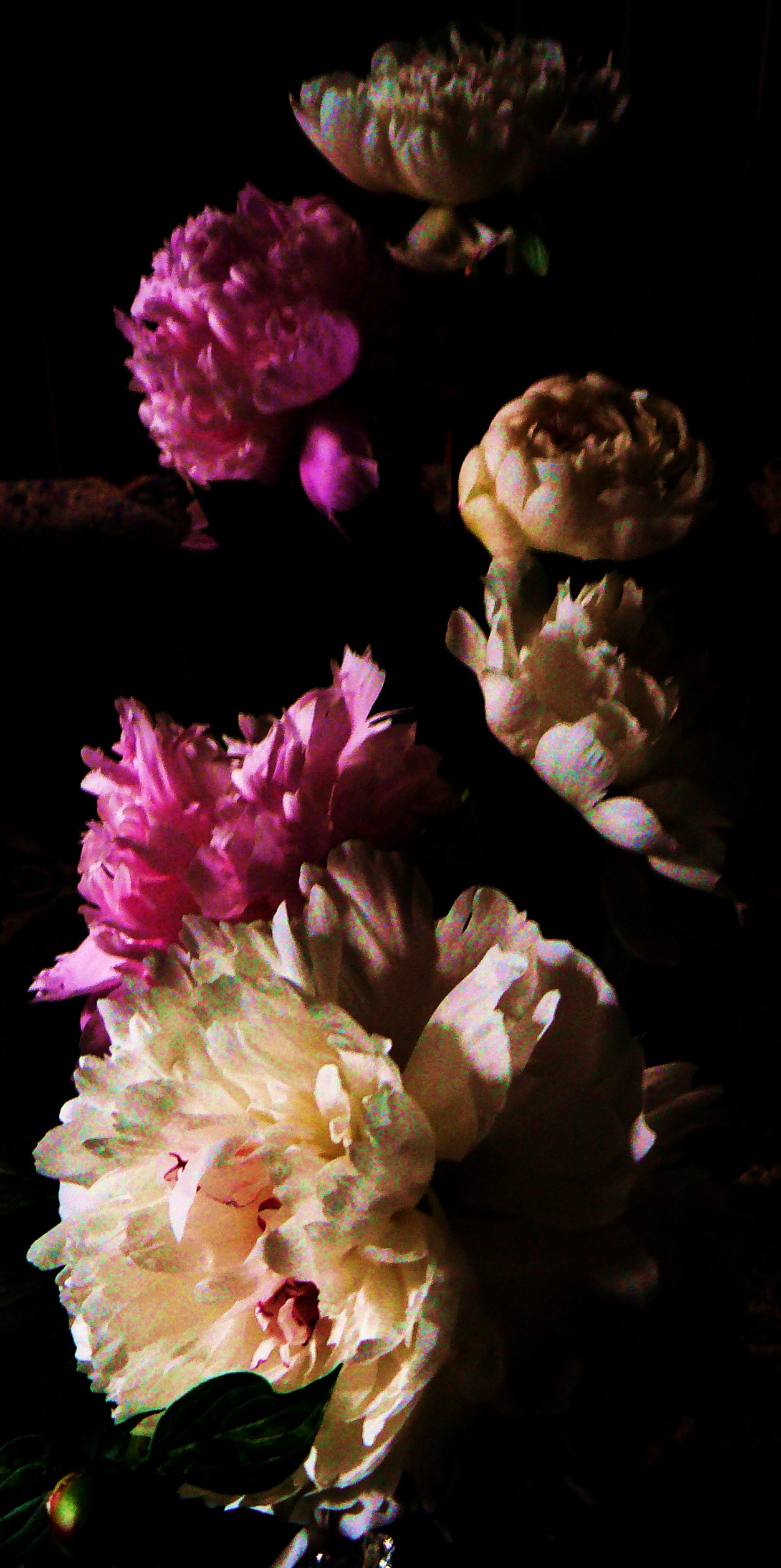
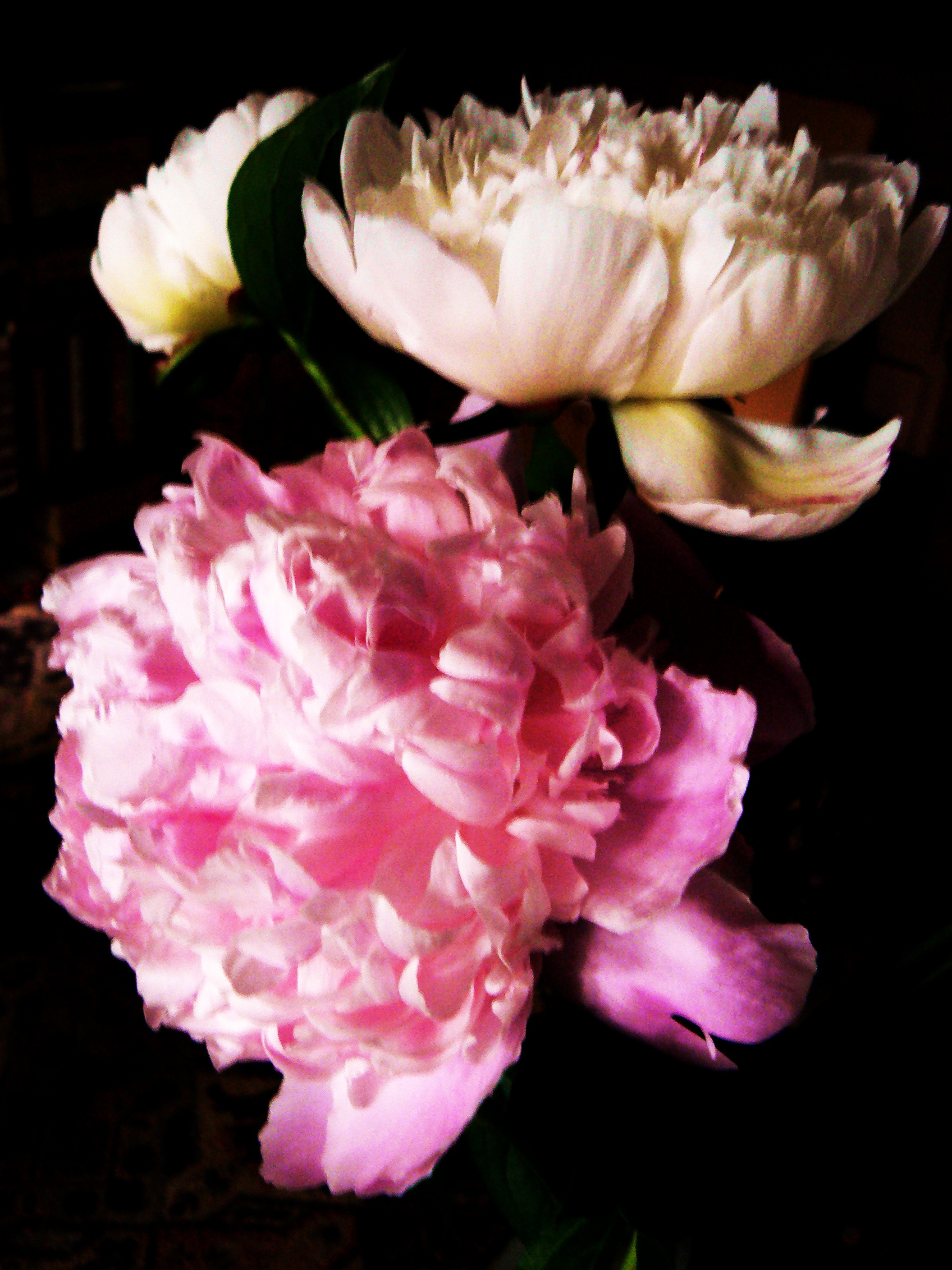
This morning my thoughts turned to flowers and Thich Nhat Hahn. He is one of the greatest teachers of peace, in my opinion. If you’ve never heard of him, I urge you to do a little research. Reading his books helped me through pivotal stages of grief and anger and crises of faith after my husband died. I got a very personal message from his words, but his vision is for the entire world as well. Peace begins internally and has consequences on a global scale. I do believe that. Today, I invite you to a meditation using Thich Nhat Hahn’s words and photos I took last summer of peonies from our garden. I hope it nudges you awake to the happiness in you…as it did for me!
“If we are peaceful, if we are happy, we can smile and blossom like a flower, and everyone in our family, our entire society, will benefit from our peace.”
– Thich Nhat Hahn, Being Peace
“The source of love is deep in us and we can help others realize a lot of happiness. One word, one action, one thought can reduce another person’s suffering and bring that person joy.”
“The most precious gift we can offer anyone is our attention. When mindfulness embraces those we love, they will bloom like flowers.”
“Each moment is a chance for us to make peace with the world, to make peace possible for the world, to make happiness possible for the world.”
― Teachings on Love
“Our notions about happiness entrap us. We forget that they are just ideas. Our idea of happiness can prevent us from actually being happy. We fail to see the opportunity for joy that is right in front of us when we are caught in a belief that happiness should take a particular form.”
”The earth is so beautiful. We are beautiful also. We can allow ourselves to walk mindfully, touching the earth, our wonderful mother, with each step. We don’t need to wish our friends, ‘Peace be with you.’ Peace is already with them. We only need to help them cultivate the habit of touching peace in each moment.”
WALKING MEDITATION
Take my hand.
We will walk.
We will only walk.
We will enjoy our walk
without thinking of arriving anywhere.
Walk peacefully.
Walk happily.
Our walk is a peace walk.
Our walk is a happiness walk.
Then we learn
that there is no peace walk;
that peace is the walk;
that there is no happiness walk;
that happiness is the walk.
We walk for ourselves.
We walk for everyone
always hand in hand.
Walk and touch peace every moment.
Walk and touch happiness every moment.
Each step brings a fresh breeze.
Each step makes a flower bloom under our feet.
Kiss the Earth with your feet.
Print on Earth your love and happiness.
Earth will be safe
when we feel in us enough safety.
– from Call Me by My True Names: The Collected Poems of Thich Nhat Hanh
“Smile, breathe, and go slowly.”
Stressed for Success?
My very astute sister once pointed out to me that all stress is not created equal. There’s daily stress, the normal result of a body functioning without rest for 16 hours or so, which is alleviated after 8 hours of sleep. There’s distress, which gives us the feeling of being overwhelmed or upset by the amount of stress we experience, and then there’s eustress, which according to Wikipedia is “a term coined by endocrinologist Hans Selye which is defined…as stress that is healthy, or gives one a feeling of fulfillment or other positive feeling. Eustress is a process of exploring potential gains.” Examples of eustress could include climbing a mountain, running a marathon or sky-diving. Or surviving a nautical disaster.
I was intrigued by a comment I read from one of the survivors of the cruise ship, Costa Concordia, that sank in the Mediterranean this past week. ABC News reported:
‘Australian miner Rob Elcombe and his wife, Tracey Gunn, told Melbourne’s Herald Sun Newspaper they booked a spot on the Concordia as a last ditch effort to save their marriage. Instead, the couple found themselves trying to save their lives when they boarded the very last lifeboat to leave the ship with survivors. “This has made our bond much, much stronger,” Elcombe told the paper. “Who needs couples counseling, when you survive a Titanic experience?” ‘
An adventure. Stress worked into a feeling of gain. Is it possible to turn your distress into eustress?
Another news story I ran across came under this headline: Wife Slips Into Madness As Husband Dies of Brain Tumor. (ABC News) Catherine Graves wrote a book called Checking Out: An In Depth Look At Losing Your Mind describing the distress of caring for her husband. The headline rather sensationalizes an experience of overwhelming stress that is shared by a lot of people who find themselves in the role of caregiver. I can relate. I went through depression and Post Traumatic Stress Syndrome during my husband’s illness and after his death. Like Mrs. Graves, I was widowed at 45. But did I lose my mind? Not irretrievably, I don’t think. Maybe what I’m doing now, being unemployed, slowing down, is my way of turning that distress into eustress.
There’s an old hymn that I’ve affectionately heard referred to as “The Playtex Hymn” (after the girdle). The first line is “How firm a foundation, ye saints of the Lord, is laid for your faith in His excellent Word”. It was written by John Keith in 1787. My favorite verse goes like this:
“When through the deep waters I cause thee to go,
The rivers of woe shall not thee overflow;
For I will be with thee thy trouble to bless,
And sanctify to thee thy deepest distress.”
For some reason, singing that verse always causes me to choke up with emotion. I know how it is to feel like I’m drowning. I have a gasp reflex that reminds me of this almost daily. It shows up lightning fast in moments when my reptilian brain senses danger. It first became noticeable when I was trying to teach my kids to drive. I would gasp and grab the handle above the passenger side door at the slightest correction of the steering wheel or touch of the brake. It happened to me again just this morning. I was stacking packages on the table and the tower toppled over. I gasped. “I must be drowning!” I laughed. It’s probably a rather annoying habit for those who live with me. I appreciate their patience.
There’s another hymn that follows this theme. “It Is Well With My Soul” was written by Horatio Spafford in 1873. The story behind it is quite amazing. In brief, according to Wikipedia:
“This hymn was written after several traumatic events in Spafford’s life. The first was the death of his only son in 1871 at the age of four, shortly followed by the Great Chicago Fire which ruined him financially (he had been a successful lawyer). Then in 1873, he had planned to travel to Europe with his family on the SS Ville du Havre, but sent the family ahead while he was delayed on business concerning zoning problems following the Great Chicago Fire. While crossing the Atlantic, the ship sank rapidly after a collision with a sailing ship, and all four of Spafford’s daughters died. His wife Anna survived and sent him the now famous telegram, “Saved alone . . .”. Shortly afterwards, as Spafford traveled to meet his grieving wife, he was inspired to write these words as his ship passed near where his daughters had died.”
And here’s the lyric:
When peace like a river, attendeth my way,
When sorrows like sea billows roll;
Whatever my lot, Thou hast taught me to say,
It is well, it is well, with my soul.
I am trying to re-train my brain to believe that my deepest distress can be sanctified. I don’t think this is an exclusively Christian perspective at all. The Noble Truths of Buddhism are all about addressing the suffering (distress) of this world and how we think about it. I hope that as I “explore potential gains”, my drowning will become floating, and all will be well with my soul.
Existential Sunday
I mentioned yesterday that I was moody. I come around periodically to a place of existential crisis, and I’ve come to believe it’s good for me. When I was raising children and nursing a sick husband, I rarely got this privilege. I always had someone to pour my heart and soul into and frequently felt that my existence was thoroughly used up on a daily basis. Trouble is, this way of living was often an unexamined habit that I could go through sleep-walking. I kept my head down and convinced myself that everything I was doing was noble and important. It may have been, or it may not have been. I wasn’t really paying attention that closely.
Living with Steve is different. It’s challenging. He doesn’t want me to pour my heart and soul into caring for him. He wants me to fly on my own. I blink, open-mouthed. Fly? On my own? What the heck does that look like? He redirects my attention from outside of me to inside…all the time…and I keep imagining an empty room. What if I don’t have any inner life?
So I sit with that. Emptiness isn’t a judgment. It can be the beginning of openness.
I went poking around on the internet, looking for an answer (from outside, again…old habits die hard) to “what is important in life”. I actually found something kinda cool: this community project. An abandoned building in New Orleans is covered with chalkboard paint and stenciled with the prompt “Before I die, I want to ___”. Chalk is provided. People approach. Existential assessment goes on, and the sentence is answered. I imagine myself standing there…clouds gather, rain falls, people pass, children grow up…and I’m still scratching my head.
I thought of re-phrasing the question, changing “What is important in life?” to “What are two things you cannot live without?” They’re not exactly interchangeable, I discovered. I also discovered a great irony: I lost the two things I thought I couldn’t live without, and I’m still living. So, either they weren’t that important, or I’m not really living. Or I didn’t answer that truthfully. I thought I could not live without my husband. I thought I could not live without my Christian faith. I was wrong.
Okay, dammit, what IS important in life? What about the obvious answer…’life’? As in, “Before I die, I want to Live.” I want to live, be alive, be awake, be aware, spend myself, give my love, explore my autonomy, visit that inner room and see what’s there. But not in an ego-driven way. In an open way. The Western way prompts me, “Yes, but what will that look like when it’s all finished?” as if there’s a finish. It wants a goal, a check list with little boxes to tick, just to keep track so that it can say, “Good…I’ve done it!” That’s ego talk. The Eastern way says, “Forget the goal, the check list. You don’t need to keep track; keep open. Engage with life and have a relationship.”
That’s where I’ve gotten to so far today. How about you? What is important in your life?
Give Us This Day
The temperature is finally dropping and the snow is falling. I’m rather in the mood to be snowed in; it’s been a long time coming. The anticipation of winter without the actual characteristics is a little unsettling. What would you think if your region just “skipped” a season? What do the animals think? “Do we fly north now, or not?” “Is it time to wake up?” Migratory animals get confused by light pollution. I’m sure a host of species are getting confused about climate change. But then again, they probably don’t worry like us humans. They adapt. Or they don’t. They take it one day at a time, looking for warmth and shelter and food just like every day.
Daily living, daily choices, daily bread. What do you learn from now?
In the eclectic jumble of my brain, a song is emerging. “For Now” from the musical, Avenue Q (Robert Lopez, Jeff Marx).
PRINCETON: Why does everything have to be so hard?
GARY COLEMAN: Maybe you’ll never find your purpose.
CHRISTMAS EVE: Lots of people don’t.
PRINCETON: But then- I don’t know why I’m even alive!
KATE MONSTER: Well, who does, really? Everyone’s a little bit unsatisfied.
BRIAN: Everyone goes ’round a little empty inside.
GARY COLEMAN: Take a breath, Look around,
BRIAN: Swallow your pride,
KATE MONSTER: For now…
NICKY: Nothing lasts,
ROD: Life goes on,
NICKY: Full of surprises.
ROD: You’ll be faced with problems of all shapes and sizes.
CHRISTMAS EVE: You’re going to have to make a few compromises…For now…
LUCY: For now we’re healthy.
BRIAN: For now we’re employed.
BAD IDEA BEARS: For now we’re happy…
KATE MONSTER: If not overjoyed.
PRINCETON: And we’ll accept the things we cannot avoid, for now…
ALL: But only for now! (For now)…
Only for now! (For now there’s life!)
Only for now! (For now there’s love!)
Only for now! (For now there’s work!)
For now there’s happiness! But only for now!
(For now discomfort!) Only for now!
(For now there’s friendship!) Only for now!
(Sex!) Is only for now!
(Your hair!) Is only for now!
(George Bush!) Is only for now!
Don’t stress, Relax,
Let life roll off your backs
Except for death and paying taxes,
Everything in life is only for now!
NICKY: Each time you smile…
ALL:…Only for now
KATE MONSTER: It’ll only last a while.
ALL:…Only for now
PRINCETON: Life may be scary…
ALL:…Only for now. But it’s only temporary
PRINCETON: Everything in life is only for now.
I saw Buddhists discoursing in a documentary by Werner Herzog once. Periodically, they would clap their hands together like crashing cymbals. I was told that was a symbolic gesture aimed at bringing the speaker and listener into the present moment, no matter where the conversation was going. For NOW!…..and NOW!
This breath…is only for now. These words…are only for now. I appreciate now, right now.
Art, Music & Myth: The Deeper Story of Being Human
Are human beings the only animals that weep?
Charles Darwin noted that Indian elephants weep. There have been many books written on the subject of animals’ emotions, and I haven’t read any of them, so I’m not going to venture an answer. What I do know is that I weep. And Steve weeps. When we weep — not cry, but weep — it seems to come from a sacred place in our soul, a place that has been stirred by something far greater than our selves. Of course, we can make efforts to wall off that place, if we want to. Bombarding ourselves with distractions often works to activate those shields. We can also choose to be curious and try to understand that feeling better.
“I’m interested only in expressing basic human emotions — tragedy, ecstasy, doom, and so on. And the fact that a lot of people break down and cry when confronted with my pictures shows that I can communicate those basic human emotions . . . The people who weep before my pictures are having the same religious experience I had when I painted them. And if you, as you say, are moved only by their color relationship, then you miss the point.” – Mark Rothko
Tears can be a sign of “religious experience”, then. Fair enough. Something spiritual is going on there. What?
“When I was a younger man, art was a lonely thing. No galleries, no collectors, no critics, no money. Yet, it was a golden age, for we all had nothing to lose and a vision to gain. Today it is not quite the same. It is a time of tons of verbiage, activity, consumption. Which condition is better for the world at large I shall not venture to discuss. But I do know, that many of those who are driven to this life are desperately searching for those pockets of silence where we can root and grow. We must all hope we find them.” – Mark Rothko
That loneliness, that “pocket of silence where we can root and grow” resonates deeply with my partner, Steve. He calls it being moody or refers to his “Slavic melancholy”. It’s not a sorrowful thing only; it is just as brightly tinted with joy, like some of Rothko’s paintings. The combination, the totality is what hits home with him. He says, “The deeper story is to face all of life. Jesus and the Buddha are heroes of that story.” They are not conquering wartime heroes interested solely in winning. They do not struggle and strive. They embrace all dimensions of life equally: the suffering, the love, the sacrifice, the elation.
In the book The Power of Myth based on Billy Moyers’ interviews with Joseph Campbell, I read:
Campbell: “The images of myth are reflections of the spiritual potentialities of every one of us. Through contemplating these, we evoke their powers in our own lives.”
Moyers: “Who interprets the divinity inherent in nature for us today? Who are our shamans?”
Campbell: “It is the function of the artist to do this. The artist is the one who communicates myth for today.….”
Steve weeps when listening to Mahler. And “Puff the Magic Dragon”. Slipping into his cave, searching for that place to root and grow, he feels the poignant essence of life, the crescendo and decrescendo, and resists exerting his will against the flow. I think that I have a different sensibility. Maybe not so expansive, maybe more interior and visceral. I identify with a lonely pocket of silence for rooting and growing…the womb. I feel womb-love, the ache, the swoon, the exchange of life blood. I see colors inside my eyelids, sunshine through membrane, the tragedy and ecstasy and doom of flesh. Okay, I am in the grip of my biology this week, so this makes a lot of sense. I have given birth four times and dream of my grown up children regularly. The story that trips my tear ducts is “Homeward Bound”, anything with a reunion. The deeper story for me has something to do with connection. Maybe that’s the Gaia story. I think she’s like Jesus and Buddha in that she also embraces all of life without struggling or striving, but in her own way. Perhaps I feel more in my Sacral Chakra, Steve in his Heart Chakra.
The deeper story of being human is told from inside this skin. It is not the only story in the universe, however. There is the elephant’s story, the asteroid’s story, more stories than we can imagine. I would hope to know many more, and to weep at all of them.