Unknown's avatar

Peace Walk

Yesterday, I blogged several quotes from Thich Nhat Hahn.  Last night, I came across a passage in Living Buddha, Living Christ that illuminated my journey through widowhood, change, and doubt.

“One day when you are plunged into the dark night of doubt, the images and notions that were helpful in the beginning no longer help.  They only cover up the anguish and suffering that have begun to surface.  Thomas Merton wrote, ‘The most crucial aspect of this experience is precisely the temptation to doubt God Himself.’  This is a genuine risk.  If you stick to an idea or an image of God and if you do not touch the reality of God, one day you will be plunged into doubt.  According to Merton, ‘Here we are advancing beyond the stage where God made Himself accessible to our mind in simple and primitive images.’  Simple and primitive images may have been the object of our faith in God in the beginning, but as we advance, He becomes present without any image, beyond any satisfactory mental representation.  We come to a point where any notion we had can no longer represent God.”

“The reality of God”…beyond any notion or representation, there is a reality, an experience.  Returning regularly to this experience is what Thich Nhat Hahn refers to as “deep practice”.  It requires awareness, mindfulness, being awake and paying attention.  What is the experience of being in this living world?

I went for a walk yesterday in a strong wind and looked up to the trees.  They were all swaying in their own way, in different directions, at different levels, different speeds.  They have no notion that is “wind”.  They have an experience.

The river touches the stones and mud in the river bed, it touches the banks, it touches the wind with its surface and reflects the trees that rise high above it.  It inhabits its course without a concept or an image of anything.

I enjoy images.  I become attached to them.  Their primitive simplicity appeals to my limited brain and feels comfortable.  I wonder now if that’s why I often become “stuck”.  It’s as if I become unable to see the forest because I look so constantly at the trees.  The experience of ‘forest’ is so much more.

Every time I take a photo, I put my experience into a frame.  Would a frameless view of reality take me beyond my doubts?  Beyond my fears?

When I was a cantor at my church, I’d sing a refrain during Vespers, framing the prayers that people offered up in the pews: “Shepherd me, O God, beyond my wants, beyond my fears, from death into life.”

Shepherd me, O God, beyond my doubts, wants, fears, images, and notions…from death into Life.

Unknown's avatar

Because of Love

“In this vision he showed me a little thing, the size of a hazelnut, and it
was round as a ball. I looked at it with the eye of my understanding and
thought “What may this be?” And it was generally answered thus: “It is all that is
made.” I marveled how it might last, for it seemed it might suddenly have
sunk into nothing because of its littleness. And I was answered in my
understanding: “It lasts and ever shall, because God loves it.”

— Julian of Norwich

Why does evolution continue?  Why does the universe expand?  Why does the sun appear on the horizon every morning?  Why am I here?

Who do I thank?

Unknown's avatar

A Bigger World

I’ve been thinking lately about my ego and my mood cycle.   Two days ago, I wrote “I feel that expansive, fecund, open sense bubbling up in me, settling me down, inviting me to nurture and set free.  Then, a while later, I feel a feisty urge to grab hold and wrestle with my circumstances and force them to conform to some idea in my brain.”  Right now, I’m in the restless part of my cycle, and my ego is eager to get to work on something.   It gives me a sort of shimmering sense of dissatisfaction, not like something is “wrong”, but like I’ve been sitting too long and want to stretch.  I don’t want to get into the habit of simply indulging my ego with any old thing whenever it prods me, though.   Steve often talks of feeling like he’s “treading water”, too.  He told me this morning that he wanted to work on “pointing his canoe”, which is his metaphor for re-establishing direction and putting energy into venturing forward, so I asked him if he uses some kind of ego energy to address that.   He said, “It’s not like that.  It’s more like gathering your courage and discipline to step into a bigger world.  I think the ego is a smaller world.”

I immediately got my pencil and notebook and wrote that down.

A bigger world.  A world that is beyond me, beyond my control, beyond prediction.  A bigger concentric circle.  I do think we tend to pull back into our tiny, lower-case universe, the one where we feel safe and comfortable and powerful.  We can’t really help that tendency, but we can acknowledge it and try to point our canoe in a different direction.  I am really inspired by people who do that, and through the network of blogging, I have met a few who I think are paddling away.  Maybe they’re not the people you’re thinking of.  They aren’t the extreme sportsmen.  They aren’t the world travelers.  They aren’t the social superstars.  They are the suffering, the ones who have met their limitations and crossed into the unknown.  They blog about living with their illness, their addiction, their recovery, their brain damage in a way that definitely requires them to gather courage and discipline and step into a bigger world, a world which they don’t master.  And sometimes they whine, and sometimes their posts are incredibly boring, but I keep visiting them because I think they are truly onto something.  I suppose that I am hoping to witness their breakthrough flight, when they will soar high above the rest of us into that bigger world of awareness.  I’m not sure what that will look like, but maybe I’ll recognize it anyway.

I am working on writing a memoir on my husband’s illness and death.  Four years ago, he had his last surgery.

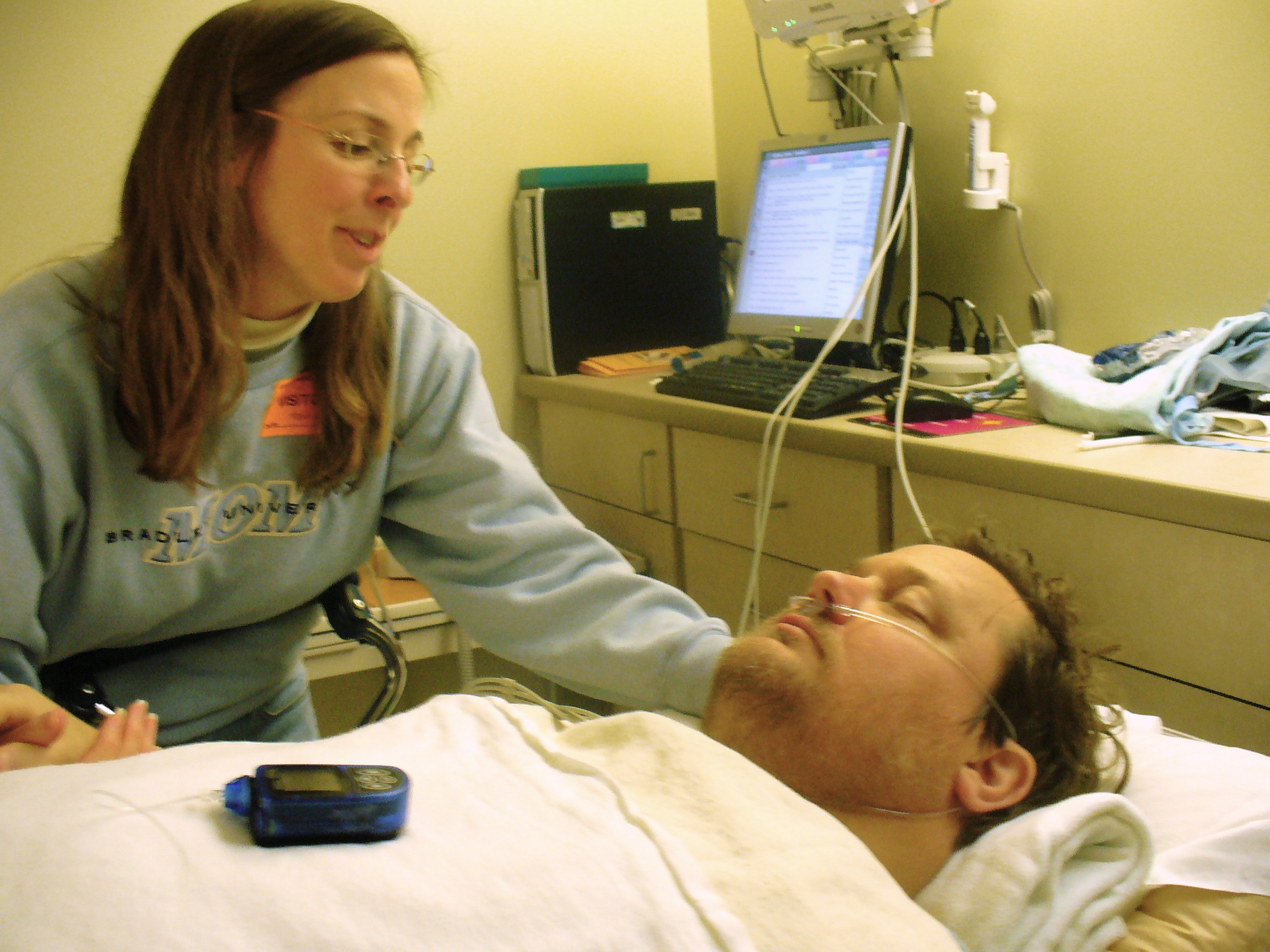
The story of how he came out of anesthesia is perhaps a glimpse into that bigger world.  My oldest daughter wrote about it in her Live Journal that evening:

“When I saw him after the surgery, painkillers and low blood sugar had rendered him almost completely unresponsive. We tried everything—tickling him, turning his insulin pump off, talking to him, poking him—but the most we could get from him was a groan or a slight shift of position. I told him I was pregnant. Mom said they’d called a rematch of the Super Bowl. I even took a picture of him, threatening, I think, to mock him with it later. Nothing made any difference until I had to leave for work. I squeezed his arm and said “Bye, Dad. I love you,” and in a sleepy, submerged-sounding voice, he said “Love you.” We couldn’t get him to say or do anything else, but every time someone said “I love you,” he would immediately mumble it back.”

So, I think of Jim, hovering somewhere between consciousness and death and knowing only one response: “I love you”.   This is the Universe you don’t control.

Unknown's avatar

What is Love?

Yesterday, I read a travel post about a European romantic trend called Love Locks.  Apparently, an Italian novel whose title translates to “I Need You” has spawned the custom of lovers affixing padlocks to public fences, bridges, gates and whatnot as a sign of their everlasting love.  This idea really rubs me the wrong way, so I’m sorting out my thoughts to figure out why.  Of course, this is about me, not about judging any of the couples who have participated in this ritual nor about anyone else who thinks it’s romantic.  So, what do I know about me?

First of all, I worry about the accumulation of stuff.  Seeing all those padlocks encrusting a surface reminds me of the proliferation of manufactured gadgets and things that we humans often allow to run unchecked.  Apparently, many city officials also consider them “an eyesore”.  It occurs to me that if they were something natural or biodegradable (like flower petals or garlands?), I would probably not feel this instant repulsion.  This may be just the surface of the aesthetic mismatch, however.

Second, I think a lot about symbolism.  What does a padlock say about love?  In all fairness, I have not read the novel, so I am probably missing the finer points.  I understand the desire for security in a relationship.  I was married for 24 years, “until death”, and I positively flourished under the safety of that bond.  But now that Jim has slipped all surly bonds, I think that anything everlasting must be a bit more mutable than metal, more plastic than any tangible material.  The words of a song by John Denver keep floating to the surface of my consciousness.  The title of the song is “Perhaps Love”.  Here’s a bit of the chorus: “Some say love is holding on and some say letting go; and some say love is everything and some say they don’t know”.   I guess I have to say that lately I’ve been sitting in the “letting go” camp.  Out of necessity, obviously.  I did the struggle of holding on.  I found it to be an ego thing, ultimately unsustainable.  Letting go, opening up, imagining expansiveness is a way to include a lot more without confining it to an embrace.  I believe love wants to include a lot more by nature.

Two nights before my love died was Valentine’s Day.  We celebrated at home with champagne and salmon in the company of two of our daughters.  My oldest brought out a book of Pablo Neruda’s poetry and read this one (Love Sonnet #92):

My love, should I die and you don’t,
let us give grief no more ground:
my love, should you die and I don’t,
there is no piece of land like this on which we’ve lived.

Dust in the wheat, sand in the desert sands,
time, errant water, the wandering wind
carried us away like a navigator seed.
In such times, we may well not have met.

The meadow in which we did meet,
oh tiny infinity, we give back.
But this love, Love, has had no end,

and so, as it had no birth,
it has no death. It is like a long river
that changes only its shores and its banks.

Translation: Terence Clarke

I cannot imagine trying to put a padlock on a wheat field or on the desert sands, on the wind or on a river.  I cannot imagine putting a padlock on time, even though that’s a concept we made up, just like the padlock, as a way to try to control things.  I do know that the impulse to lock down an experience is very human and very old.  The ancient story of the Transfiguration of Jesus comes to mind.   Jesus and three of his disciples (Peter, James and John) climb a mountain, and there the disciples have an experience of seeing Jesus in glowing white raiment talking to Moses and Elijah.  Good old impetuous Peter gets all excited and bursts out with an idea.  “Let’s build three booths (or tabernacles)!  We can put each of you in one and hang on to this experience for a while longer, perhaps invite others….”   He is silenced by a booming voice from the clouds. “Listen!”  When the cloud lifts, Jesus stands alone, and they decide to keep quiet instead.

I am beginning to recognize a kind of flow, a yin and yang of contrasting energies, in myself.  I think it has something to do with my biological cycle, but it also manifests in a mood cycle.  I feel that expansive, fecund, open sense bubbling up in me, settling me down, inviting me to nurture and set free.  Then, a while later, I feel a feisty urge to grab hold and wrestle with my circumstances and force them to conform to some idea in my brain.   I could say that I am still loving with both energies.  I used to tell my children that I disciplined them because I loved them, and I believe that’s true, but I think there’s an ego love and a non-ego love.   They are both part of me.  One is not “right” and the other “wrong”, but I think that the non-ego kind is more beneficial in the universe.

Valentine’s Day is a few weeks away.  It’s a time when many people are thinking about love, romantic love.  I keep challenging myself to think bigger, to open up.  I hear the voice booming from the clouds, from the trees, from the water and the air.  It asks me to Listen.  So I guess it’s time to shut up.

Unknown's avatar

Art, Music & Myth: The Deeper Story of Being Human

Are human beings the only animals that weep?

Charles Darwin noted that Indian elephants weep.  There have been many books written on the subject of animals’ emotions, and I haven’t read any of them, so I’m not going to venture an answer.  What I do know is that I weep.  And Steve weeps.   When we weep —  not cry, but weep — it seems to come from a sacred place in our soul, a place that has been stirred by something far greater than our selves.  Of course, we can make efforts to wall off that place, if we want to.  Bombarding ourselves with distractions often works to activate those shields.  We can also choose to be curious and try to understand that feeling better.

“I’m interested only in expressing basic human emotions — tragedy, ecstasy, doom, and so on. And the fact that a lot of people break down and cry when confronted with my pictures shows that I can communicate those basic human emotions . . . The people who weep before my pictures are having the same religious experience I had when I painted them. And if you, as you say, are moved only by their color relationship, then you miss the point.” – Mark Rothko

Tears can be a sign of “religious experience”, then.  Fair enough.  Something spiritual is going on there.  What?

“When I was a younger man, art was a lonely thing. No galleries, no collectors, no critics, no money. Yet, it was a golden age, for we all had nothing to lose and a vision to gain. Today it is not quite the same. It is a time of tons of verbiage, activity, consumption. Which condition is better for the world at large I shall not venture to discuss. But I do know, that many of those who are driven to this life are desperately searching for those pockets of silence where we can root and grow. We must all hope we find them.” – Mark Rothko

That loneliness, that “pocket of silence where we can root and grow” resonates deeply with my partner, Steve.  He calls it being moody or refers to his “Slavic melancholy”.  It’s not a sorrowful thing only; it is just as brightly tinted with joy, like some of Rothko’s paintings.  The combination, the totality is what hits home with him.  He says, “The deeper story is to face all of life.  Jesus and the Buddha are heroes of that story.”   They are not conquering wartime heroes interested solely in winning.  They do not struggle and strive.  They embrace all dimensions of life equally: the suffering, the love, the sacrifice, the elation.

Rothko - Untitled Red and Black

In the book The Power of Myth based on Billy Moyers’ interviews with Joseph Campbell, I read:

Campbell:  “The images of myth are reflections of the spiritual potentialities of every one of us. Through contemplating these, we evoke their powers in our own lives.”

Moyers: “Who interprets the divinity inherent in nature for us today? Who are our shamans?”

Campbell: “It is the function of the artist to do this. The artist is the one who communicates myth for today.….”

Steve weeps when listening to Mahler.  And “Puff the Magic Dragon”.  Slipping into his cave, searching for that place to root and grow, he feels the poignant essence of life, the crescendo and decrescendo, and resists exerting his will against the flow.  I think that I have a different sensibility.  Maybe not so expansive, maybe more interior and visceral.  I identify with a lonely pocket of silence for rooting and growing…the womb.  I feel womb-love, the ache, the swoon, the exchange of life blood.  I see colors inside my eyelids, sunshine through membrane, the tragedy and ecstasy and doom of flesh.  Okay, I am in the grip of my biology this week, so this makes a lot of sense.  I have given birth four times and dream of my grown up children regularly.   The story that trips my tear ducts is “Homeward Bound”, anything with a reunion.  The deeper story for me has something to do with connection.  Maybe that’s the Gaia story.  I think she’s like Jesus and Buddha in that she also embraces all of life without struggling or striving, but in her own way.  Perhaps I feel more in my Sacral Chakra,  Steve in his Heart Chakra.

The deeper story of being human is told from inside this skin.  It is not the only story in the universe, however.  There is the elephant’s story, the asteroid’s story, more stories than we can imagine.  I would hope to know many more, and to weep at all of them.

Unknown's avatar

Twelfth Night

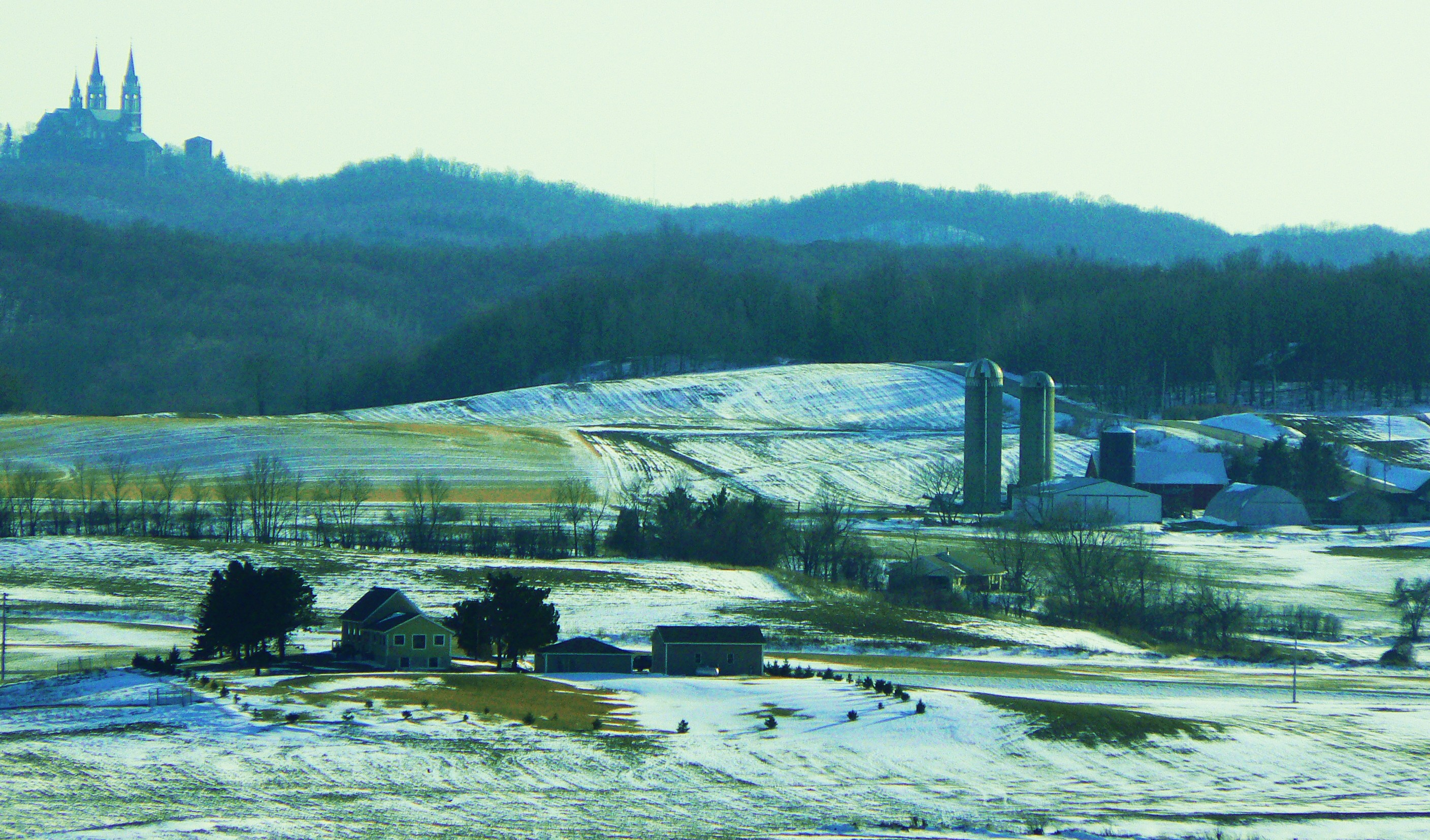
We have been experiencing some very unusual weather for January here in Wisconsin.  We have no snow, and it’s 50 degrees Fahrenheit.  Now, we often get what I call a “January thaw”, but this year, it’s been all thaw and no freeze.  I worry about the polar bears further north trying to adjust to these conditions.  And while I’m sure that climate changes are part of the natural process, I can’t imagine that 7 billion people aren’t having an impact on this.

I did another training day at the Nature Center.  We were learning about winter tracking.  Well, there isn’t any snow to see tracks in.  But there’s mud and other evidence that critters are alive and well, even in winter.  I like the fact that Wehr Nature Preserve is a “passive recreation” area.  That means that we don’t allow jogging, biking, skiing, snowmobiling, or pets on the trails.  There are plenty of other places for that.   Believe it or not, though, my most exciting animal encounter yesterday happened at dusk at a city park, right near a noisy train track and a major through road.  In the stream by the sidewalk, this muskrat was heading toward his home with a bit of a root in his mouth.

I snapped this picture as he headed under the footbridge where I was standing.  On the other side, he swam about 8 more feet away and then disappeared under the water with a flip of his tail.  The underwater entrance to his burrow must have been nearby.  I was so excited to see him with his vertical tail rudder, just skimming happily through the stream!

And then, the sky….I couldn’t stop taking pictures.

On a night like last night, I could well imagine setting off on a camel to follow yonder light just because its luminescence compelled me.  It invites me to slow down and enter a silent world, removed, far off.   The traditions of the ancient festivals of Twelfth Night and Epiphany support an opportunity to view the world differently, upside down, where God comes in and shakes up our status quo, socially, politically, theologically.  Things are not as we suppose they are.  They are always changing, always new and more mysterious than we can fathom.  Time stands open for us to feel a great discovery.  “Aha!  There!  I see it!”  The great challenge is then never to put that experience into a box, or build a booth around it, a tabernacle or edifice.   Be stupefied and humbled forever.  And keep your eyes open for the next epiphany.

Unknown's avatar

Peace On Earth

It is Day #23 in the December countdown.  Today’s gift is Peace.  Ahh, peace.  Take a deep breath.  Relax the muscles around your skull; feel  your ears and eyebrows pull backward; close your eyes and roll your head. Do you feel a sense of well-being?  Julian of Norwich claims that God himself spoke these often quoted words to her, “All shall be well, and all shall be well, and all manner of thing shall be well.”  Do you believe that’s true?  Do you believe that’s possible?  I do, although I don’t always act as though I do. I forget.

Wikipedia uses these phrases to define peace:  “safety, welfare, prosperity, security, fortune,  friendliness… a relationship between any people characterized by respect, justice and goodwill… calm, serenity, a meditative approach”.  Where does peace come from?  Buddha, the Dalai Lama and many others will tell you that peace comes from within, not without.

“The first peace, which is the most important, is that which comes within the souls of people when they realize their relationship, their oneness with the universe and all its powers, and when they realize that at the center of the universe dwells the Great Spirit, and that this center is really everywhere, it is within each of us.” – Black Elk

But perhaps, there are things outside of you that will remind you of the peace which dwells within you.

“Climb the mountains and get their good tidings. Nature’s peace will flow into you as sunshine flows into trees. The winds will blow their own freshness into you, and the storms their energy, while cares will drop away from you like the leaves of Autumn.” – John Muir

Do you feel peace in your mind and body and soul all at once?  Do you descend into peace from your head down?

“I do not want the peace which passeth understanding, I want the understanding which bringeth peace.” – Helen Keller

I suppose each of us must find his/her own journey into peace.  Anxieties and conflicts are particular and personal.  Facing each one head on is not a passive task.  Making peace is not for the weak of heart.  “Blessed are the peacemakers, for they shall be called children of God.”  Is God about making peace?  Is making peace the work of the Universe?  Is it perhaps that joyful effort that gives life meaning?

“Peace is not merely a distant goal that we seek, but a means by which we arrive at that goal.”  – Martin Luther King, Jr.

If we can make peace between ourselves and God, ourselves and Nature, can we then make peace between ourselves and others?

“If we are peaceful, if we are happy, we can smile and blossom like a flower, and everyone in our family, our entire society, will benefit from our peace.” – Thich Nhat Hahn

“What can you do to promote world peace? Go home and love your family.” – Mother Theresa

Steve constantly reminds me that in every situation, especially in those that cause anxiety and conflict to arise, I have 3 choices.  I can hide/run away.  I can try to change the situation.  I can change myself.  The first option doesn’t exactly make peace; it simply avoids confrontation.  You can hide away all day long and still feel the fear of whatever it is that scared you.  So, why do I often employ that choice?  Because I lack courage and I’m lazy.  I sometimes pick that choice first to give me time to screw up my will and motivation.  I don’t want to get stuck there, though.

Trying to change the situation requires engagement.  Making peace with hunger, poverty, sickness, and distress this way requires an understanding of  causes and effects on all different levels.  It requires negotiation, and it requires cooperation.  You don’t always get all that is required to change a situation.  Not all situations can be changed.  Death is the big one that comes to mind here.  You can’t hide or run away from it, and you can’t change the situation so that you don’t have to experience it.  Now what?

Change yourself.  Sometimes the only way to make peace with something is to change your thinking, your belief, your approach, your attachment, your aversion, your ignorance or some other aspect of yourself.  “If you can’t beat ’em, join ’em!” is the simplistic way to say it.  If you’d “rather fight than switch” (old cigarette commercial – pop philosophy at it’s finest), then you have chosen to fight, not to make peace.  Our egos make it really tough to change ourselves.  Sometimes we’d rather fight, sometimes we’d rather die, sometimes we’d rather do anything than change ourselves.  You have to ask yourself very seriously what your ultimate goal is to get past this one.  Is your goal to keep your ego intact or is your goal to make peace?   I’ve come across a lot of phrases that address this ego dilemma: “take up your cross”, “turn the other cheek”, “deny yourself”, “die to self”.  I think that dogma is probably more an ego thing than a peace thing.   If you can’t let go of your religious beliefs in the interest of peace, then your religion is more about yourself than it is about God, in my humble opinion.   I love the part of the movie “Gandhi” where he counsels a Hindu man who is distraught at having murdered a Muslim child.  “Raise a Muslim child and make sure you raise him as a Muslim, not as a Hindu. This is the only way you can purge your sins.”  This is true wisdom about peace.

Give peace a chance. It requires your will, it requires your strength, and it requires you to lay aside will & strength.  I am looking forward to enjoying the peace that my family and I have created.  We are still creating it, and will be our whole lives long.  That’s what children of God do.

Unknown's avatar

Have Some Divinity

The premise is this: for each day in December, instead of counting down on an Advent calendar, I’m counting the free gifts we all get every day.  Today’s gift is divinity, but I don’t mean the candy.  I mean The Divine, The Sacred, The Holy and experiences of them.  Don’t we all have the opportunity to receive that every day?  If you look for it, will you find it?  I think so.

So, what is sacred?  How do you recognize the divine and holy?  In art, there’s always a halo or a sunbeam to give you a clue.  What about here on earth?

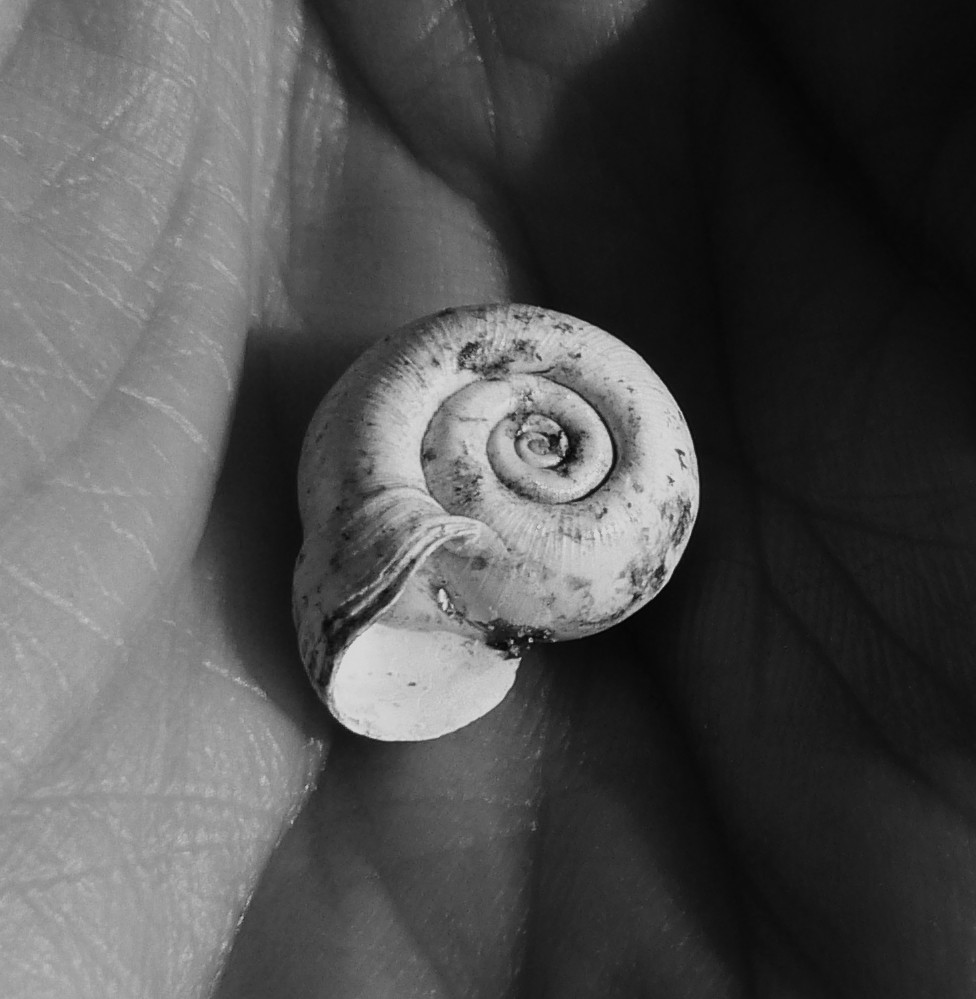
‘Namaste’ is the Sanskrit greeting recognizing the existence of another person and the divine spark in that person, with the hands pressed together in front of the heart chakra.  I think the divine spark exists in every living thing as the breath of life.  Every encounter with a living thing is an experience of the divine.  We hardly ever act like that is true, however.  But we could.  Native Americans and many African tribes have hunting rituals that celebrate the sacred exchange of life.  The hunted animal is divine, sacrificing itself for the life of the hunter, and the hunter shows a holy appreciation.  Often, when I look at macro photography of living things, flower stamens, insects, mosses, I am compelled to worship the divine in the detail.  Life is sacred and beautiful.  Looking closely and deeply is a way to practice recognizing that.

Seeing macro, but lacking the lens

In a dualistic world view, the mundane and the divine are polar opposites.  One is worldly, one is sacred.  If this world were imbued with holiness, if God became incarnate and entered flesh in this world, those opposites would run together like watercolors.  Many cultures believe this is the truth about life.  The waters under the firmament and the waters above the firmament are separated in one telling of the creation story, but the Spirit of God was moving over all of the waters from the very beginning, even in that story.  The understanding that divinity is everywhere has inspired people all over the globe for centuries.  This place we inhabit is special; it’s valuable.  It’s all holy.  This is the beginning of respect for the Universe and everything in it.  Somewhere in Western history, that idea lost its power.  Earth and everything in it became base and fallen.  Good turned to bad and life turned to death.  I’m not sure if that new idea has been very helpful.  I rather think it hasn’t.  And I don’t think it has to be that way.  It’s an idea, after all.  So if it’s not a helpful idea, why support it?  How would you rather live?  In a fallen world or in a world where the sacred and divine can be found everywhere?  Just wondering out loud.  I’m not saying that one idea is right and the other wrong.  The glass is neither half full nor half empty.  It’s a glass, and there’s water in it.  The rest is conceptual.  Why argue?  Choose how to live with the glass and the water.   As for me and my house, “I choose happy.”  (One of Jim’s conclusive statements.)

I hope this gives you something to ponder for today.  If you like, you can add a scene of Edmund Pevensie in Narnia being asked by the White Witch what he craves.  “It is dull, Son of Adam, to drink without eating.  What would you like best to eat?”  “Turkish Delight, please your Majesty!” he responds.  What if he had said, “Divinity”?  Same story, nuanced.  I would like to taste the sacred in this world, and I believe it’s here.

Unknown's avatar

I’ve Got Music

How to unwrap this truly spectacular gift?  It pulsates and glows and pulls you in, as your heart resonates and your soul throbs.  Music received and believed regenerates like faith.  I cannot think that it is merely a human construct, yet I cannot prove the music of the heavenly spheres.  Is it invented?  Is it natural?  Is it free?  Perhaps it is everything.

All deep things are song.  It seems somehow the very central essence of us, song; as if all the rest were but wrappages and hulls!  ~Thomas Carlyle

Without music life would be a mistake.  ~Friedrich Wilhelm Nietzsche


Music is the mediator between the spiritual and the sensual life.  ~Ludwig van Beethoven

My idea is that there is music in the air, music all around us; the world is full of it, and you simply take as much as you require.  ~Edward Elgar

Music expresses that which cannot be said and on which it is impossible to be silent.  ~Victor Hugo

Is there a culture on earth without music?  Rhythm: sound and silence are as basic as biology.  Heartbeat, breath.  Melody is anything with a voice.  Do animals make music?  Do plants?  Does the earth itself sing?  Sound waves flood space.  Is that music?

Does music have an important part in your life, in your living?

Steve has a mental invention: “the sound pack”.  He imagines carrying around a device that would provide a soundtrack to your life as you live it, matching music to your moods and experiences.  It differs from an iPod in that it is all original music.  Of course, he hasn’t actually built a prototype. I have never gotten into the habit of wearing ear buds and listening to music constantly.  My arachnoid cyst would probably explode if I did.  It’s more comfortable for me to take my music in without other distractions, especially as the white noise in my head increases.  Imagine that you lived 200 years ago, before recorded sound.  What place would music have in your life then?

Chicago Master Singers publicity photo - Jim at upper left

I sing to myself when I drive, making up lines and verses as I go along, like the Spirituals of the south, especially if I’m anxious.  Driving up to Steve’s house from Illinois, I’d get off the Interstate at Swan Blvd and hum, “Here I am on a street like a long-necked bird…”, the murmur of a bluesy minor key calming my nerves.  I would sing to my little brother on the drive home from the beach when he was a boy.  He’d be asleep by the time we reached the driveway, damp head on my shoulder.   I loved singing to him.  When he was an infant, I would reach into his crib and lift his sleeping body so that I could take him to the rocking chair and sing him back to sleep again. 

Of course, I sang to my own children.  And they sang back.  Harmony is an amazing satisfaction.  I am looking forward to my kids visiting me on Christmas Eve.  I’m hoping we can take a stroll around the neighborhood and trot out some of our favorite carols….and maybe some Beetles.   Have you ever heard people singing in the streets?  Do you look up in delight?  Wonder why they seem so happy?  I do. 

One morning, I awoke to the sound of my sweetheart singing beneath my window.  “Michelle, ma belle, Sont des mots qui vont tres bien ensemble….”  Instead of the melody, though, it was the baritone part of a barbershop arrangement.  Didn’t matter.  It was in French and warmed by a May breeze.  I opened my window and drank it in. 

I have not experienced oneness with an instrument except my own voice.  I am truly impoverished by that fact, I think.  I did buy a harmonica this year with high hopes, but I am just too impatient.   My mother-in-law was a concert pianist.  My mother is an accomplished accompanist as well.  I wish that I had been more disciplined and practiced the piano more.  I wish that I had spent more time with the guitar, too.  I suppose having a good voice tempts you to be lazy in that way.  If Jascha Heifetz could sing, would he have been the violinist that he was?

What if we required our politicians to be experienced ensemble musicians?  Would they come to office with a better understanding of unity, of teamwork, of collaborative leadership?  Imagine a string quartet of President, Vice-President, Speaker of the House, and Senate Majority Leader practicing long hours together on an Adagio by Schubert.  Perhaps the entire country would be in better shape.


Unknown's avatar

Christmas 1982

Ever had a piece of music bring up a memory, a time and place from the past, with such clarity that you felt you were actually there?  Last night it happened.  I came home from my Memoirs class, having read my essay aloud with such a rush of nervous adrenaline that my heart was still pounding.  I decided to have  a glass of Chardonnay and listen to some of Steve’s recently acquired CDs with him.  So, I was relaxing and in “memory mode” when he put on a CD of the Tallis Scholars singing a mass by John Taverner, written around the turn of the century – the 16th century.   Oh, the flood of my heart!

I was 20 years old.  Jim and I had become engaged on my birthday over the summer.  I went back down to So. Cal. to school, to continue with my bachelor’s degree in Vocal Performance.  Jim and my mother were in a Bay Area singing group together, called Renascense (or some archaic spelling pronounced ren-NAY-sense).  I came home for Christmas and was invited to one of their concerts.  I close my eyes and picture them:  Jim in his black tuxedo, ginger mustache,  the smatterings of a beard he’s grown for Rigoletto.  He is 22, teddy bear-like with twinkling blue eyes, blonde hair and a killer Italian grin.  But while he’s singing, he is an angel, mouth perfectly forming straight vowels, eyebrows imploring heaven.  He is a tenor.  His voice melts butter.   My mother is dressed in a mail order catalog nightgown, polyester, rust-colored, that has been trimmed with gold & black cord around the waist and across her bosom in an X.  Only women who have sung in choirs can imagine how absolutely ludicrous these outfits can be.  No woman looks good in a choir uniform, let alone one that has been made to look “period” on the cheap.  It is ridiculously embarrassing, but I forgive her.  She sings alto in a hooty voice that blends well.  Her quality is not stellar, but her musicianship is indispensable.

I have been so homesick away from school.  I have been staring at my diamond ring, counting the days until break.  I sit in the concert hall and look at these two people whom I love more than any others on the face of the earth, and I am so proud of them.  I’m proud of their dedication to music and their fond relationship to each other.  I admire them completely, and I am jealous.  I want to be with them; I want to be them.  I want to feel the music in my breast float to the clerestory of the church and entwine in that beautiful polyphony.  I ache for this memory.  And then the tenor line soars above the rest, and it is Jim himself, singing to me.  The recording is perfection.  I can tell that it isn’t Jim, but there are moments when it definitely could be.  My will takes over and I make it him, in my mind.   I am there, in that sanctuary, and Jim is singing to me, alive, young, vibrant with love and mystery and warmth.

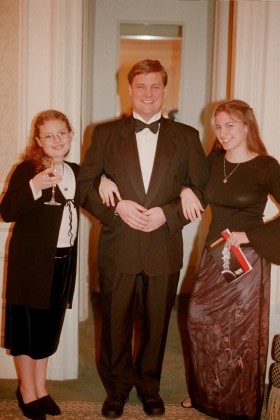
Jim before his Carnegie performance - 2001?

Music folds time in patterns that defy chronology.  I sail far away on its transcendent waves.  It is a grace to travel toward those we love without limits.