Unknown's avatar

An American Adventure: Part Twelve

Memorial Day weekend around Moab, Utah was amazingly congested. This year, the Colorado river ran higher than usual from the recent snowstorm.  Recreational sites dot Highway 128 at regular intervals, and they all seemed to be full of boaters, campers, and bikers – humans with big, metal toys. We were searching for an entirely different kind of adventure, so we drove on north…and ended up at Dinosaur National Monument on the Green River.

However, the campsites with shade and accessible by our 2-wheel drive sedan were full up, and we didn’t have the energy to search for dispersed camping in the Ashley National Forest. We decided to break down and spend the night in an inn. After nine days, a hot bath was just too tempting! I have to say, I have a hard time ignoring my appreciation for plumbing. I can do it, but I can too easily undo it, too. Just 6 days into our adventure, I boiled some water on the campfire to wash our hair. The feel of water on my thirsty scalp out there on the canyon edge was exhilarating! Steve and I both have hair that grows almost down to our waists, though. Washing it and rinsing it thoroughly takes a lot of water. Without a handy renewable supply, it seems a poor choice.

But here’s another chance for awareness: how do I use water? What do I use it for? How much do I use? Can I use less? Should I use less?

Unknown's avatar

An American Adventure: Part Eleven

The Needles

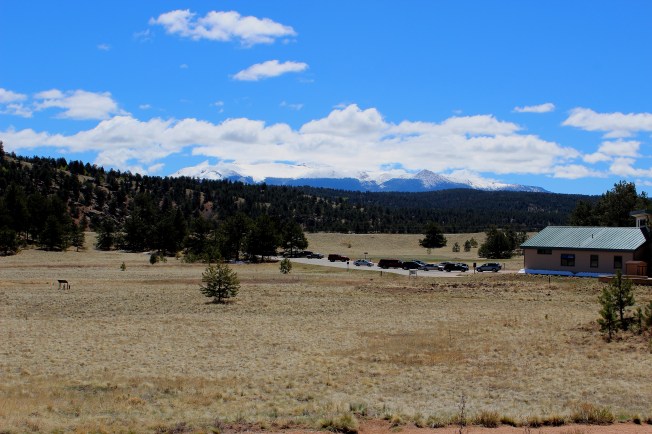
We left our mountain camp very early and made breakfast at a picnic table beside the Visitor Center. The early morning light was gorgeous, and it was still quite cool. I was eager to get started!

We drove to the trailhead on a dirt road of switchbacks and wondered how more than one car could be accommodated on such a narrow thoroughfare. The parking lot was occupied by several vehicles, and hikers were checking their gear and getting started. After clamoring up the initial ascent on the trail, though, we slowed to allow others to pass and to feel the expanse of the place and let its still beauty sink in. I took a big breath and felt the tears sting in my eyes. The clouds were opening up, the sun was rising through them, the quiet sentinels invited us to enter holy ground. I felt welcomed and embraced and deeply happy. 

I thought of my first trip out West when I was ten years old. My father was fond of exclaiming throughout our journey, “Look! Geology sticking out all over!” I had seen the exhibit at the Visitor Center explaining how all this was formed, but it did not compare to the feeling of being in this living landscape. I began to feel the sentience of the rocks, the sage, and the open spaces. How can I share that? I fear that photos don’t even give you a hint. But perhaps they do. (click on the first to view a slide show of larger images)

As we topped the pass into the Chesler Park area, a small family of hikers passed us. The father was carrying his daughter in a backpack…and she looked to be about 6 years old. I was impressed! I was gratified to see more families hiking together as we made our way back to the car, couples with babies in packs and even a pregnant Mom trailing a very quizzical boy and his Dad at enough distance to give her a break (as she explained)! A hiker with service dog carrying fitted water packs also passed us. Closer to the parking lot, a troupe of costumed folk began the steep ascent. I was amazed to see a hiker in top hat and butterfly wings coming up the trail toward me. (So amazed that I didn’t get a good photo.) 

When we reached the car lot, it was full. Overfull. Cars lined the narrow roadway back to the last switchback. It was just past noon on the Saturday of Memorial Day weekend. Which made us think about park usage. Who visits the National Parks? What motivates them to come out? How do they relate to this place?

Now that I’m back in Wisconsin, I’m eager to hear Terry Tempest Williams lecture at the Madison Public Library on July 7 on her book The Hour of Land: A Personal Topography of America’s National Parks. I trust that she will share some answers. 

Unknown's avatar

An American Adventure: Part Ten

Exploring Canyonlands

We entered Canyonlands National Park in The Needles district on the Friday of Memorial Day weekend and sought to get ourselves acquainted with the short trails along the main road before heavier traffic arrived. There is a self-guided nature trail showing typical flora & fauna and a Native granary and a trail to a cowboy campground just off the paved road. All around are the beautiful layered and eroded rock formations that give this section of the park its name.

All of these seemed to serve as an introduction to the landscape, but every long view we got that day made us eager to leave the paved road and the congested trail loops and get out further and deeper into this tremendous terrain. 

  So we decided to head up to our cooler campground for the afternoon and get a very early start the next day on a longer hike. 

Unknown's avatar

An American Adventure: Part Nine

Canyonlands National Park

Memorial Day weekend kicks off the summer season for travel, and desert areas draw big crowds early, before it gets blistering hot. New park staff are learning the ropes, and kids clamor for their attention to complete the Junior Ranger workbooks. We were warned by a Forest Service ranger at the district headquarters that road construction, park development and crowds had created a 5-mile traffic jam between Canyonlands and Arches National Parks.

We decided to adjust our goals. We camped in the Manti-La Sal National Forest in the Abajo Mountains south of the Visitor Center in The Needles district of Canyonlands. We didn’t go to the Island in the Sky area or to Arches at all. This turned out to be a great compromise, I think. It meant that after hiking in the hot, dusty canyons, we could drive uphill to our campground in the forest where it was much cooler. The temperature difference between the canyon high and the mountain low in one day was 40 degrees.

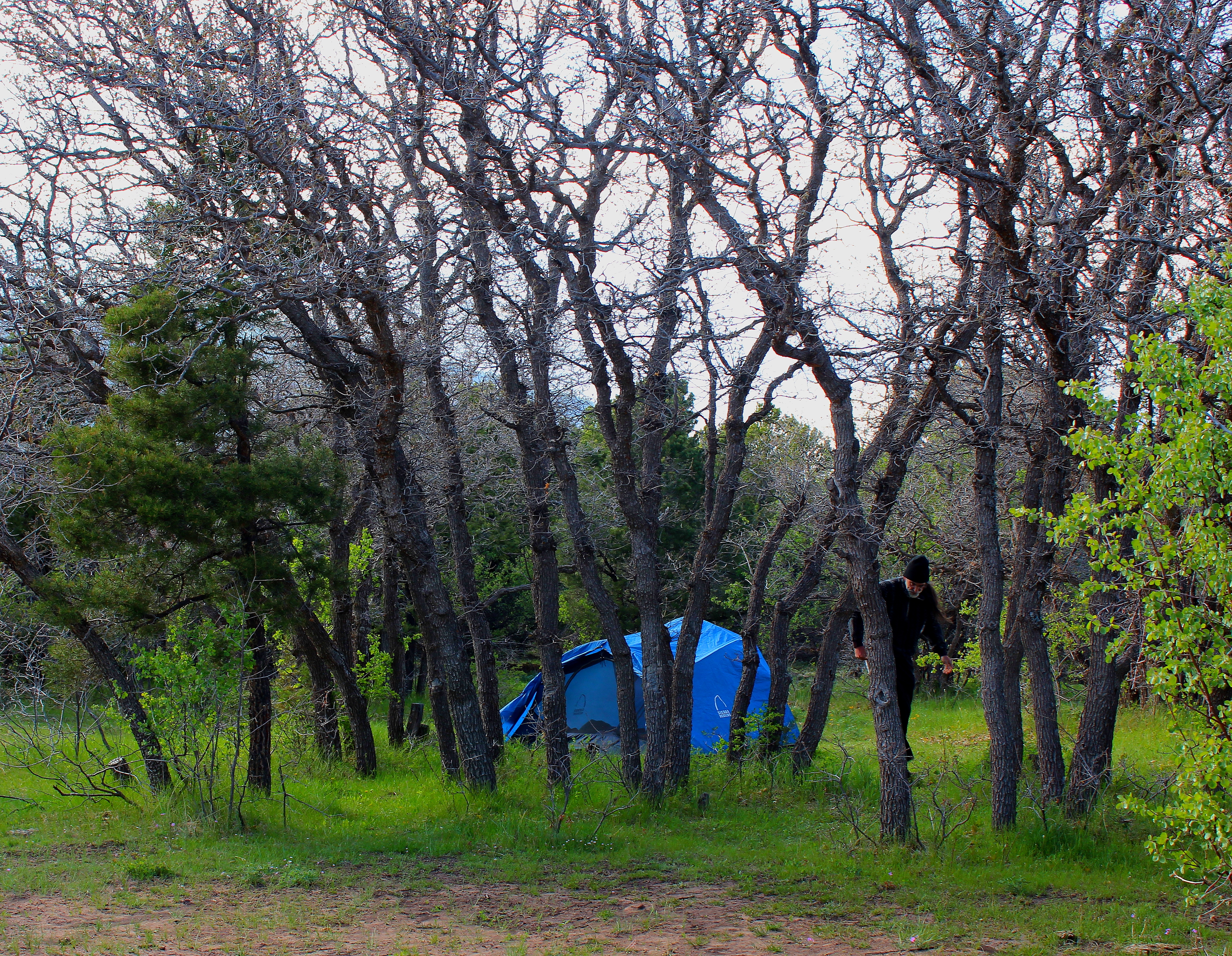
It also meant that we could drive through a stunning change in ecosystems, both ways. It was absolutely breath-taking. Our tent was pitched under aspen and oak, in view of a snow field atop the mountain. 

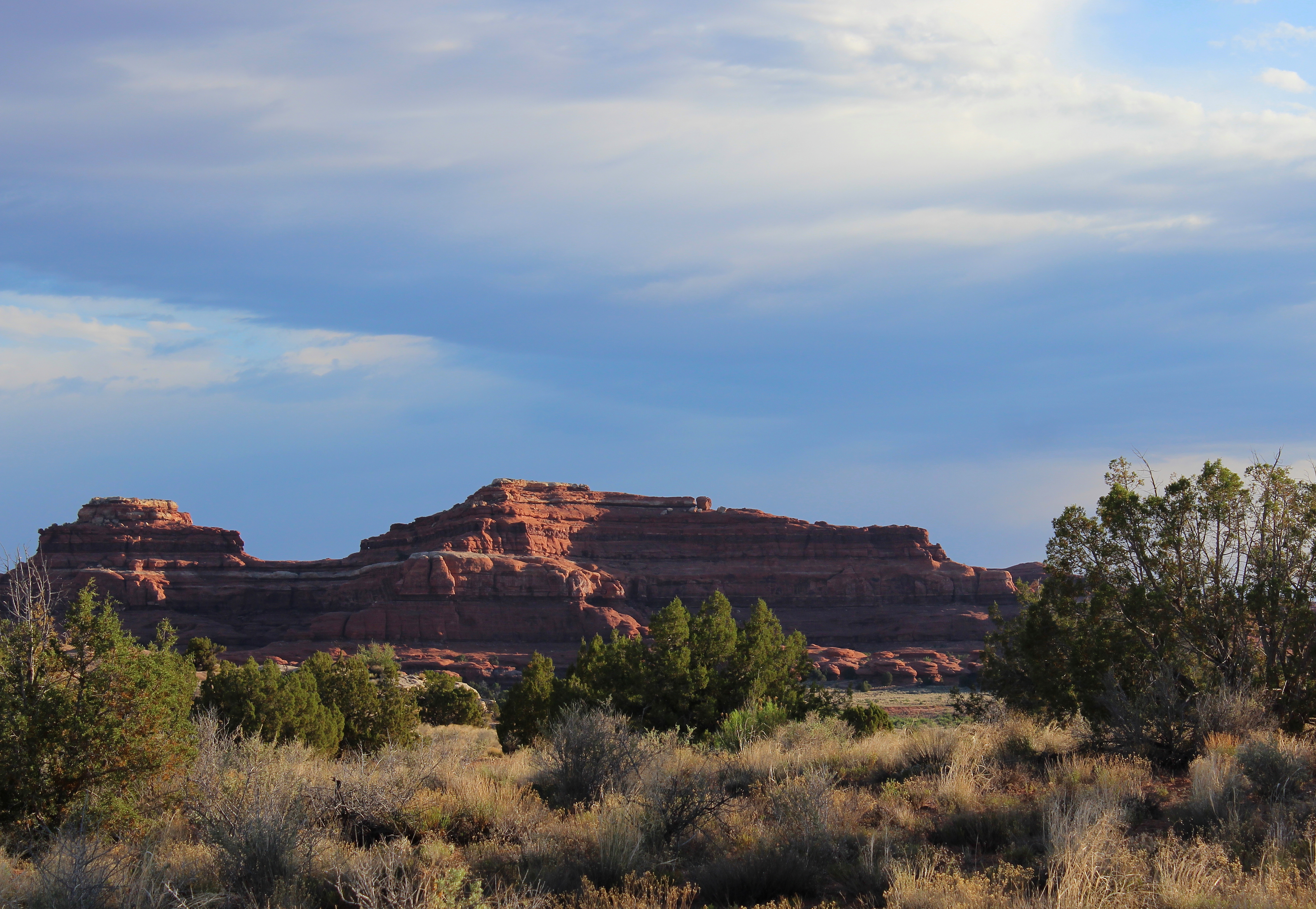
From around the bend in the road, we could see down into the canyonlands. As we descended down into the Indian Creek valley, the exposed red and white sandstone layers and the dramatic effects of erosion captured my attention. 

This part of the country is more vast and wild than any I had ever seen. I was acutely aware of its majesty and vulnerability. 

As you read this, consider your ideas of land use and ownership. This was and is a continual topic of conversation for me and Steve. 

Unknown's avatar

An American Adventure: Part Eight

Hovenweep

Steve has been telling me about Hovenweep National Monument for as long as I’ve known him. It’s his favorite. He hadn’t seen it for 26 years, though, and was anxious to know how “progress” had changed it. What he remembered was a sort of shack out in the middle of “nowhere” staffed by a few Park Service rangers and visiting archaeologists.  The roads were unpaved, and the ruin sites widely spread apart. We discovered that the roads were updated, because our map dates from 1990. Signs clearly mark the way, but it is still far from any town. The rural school bus was just ahead of us, and free-grazing livestock lined the roadway. 

The Visitor Center is new. And the rangers are young and have no memory or pictures of what it used to be like. 

The roads connecting the ruin sites are still dirt roads, though. We elected to walk the trails instead, and set off on an 8-mile (round trip) desert walk…which ended up to be a 10-mile one because we veered off the path down a wash and ended up at a barbed wire fence and then retraced our steps. That was an interesting part of the journey of awareness as well. How do you feel when you suspect you’re off the trail? How does your mental state effect your pace, your energy? What does a well-traveled path offer you psychologically and physically?

When we had completed this hike, which was the longest of our trip, I felt truly exhilarated. My face was pretty red, I had gnat bites on my calves (that haven’t faded yet), and my knees and hips were a bit sore, but I was thrilled! This desert is a vibrant ecosystem, hosting many interesting plants and animals…including around 2500 human animals at one point, about 750 years ago. Have a look:


Unknown's avatar

An American Adventure: Part Seven

Desert Communities

We walked the interpretive trail at Sand Canyon, imagining pueblo life on the Colorado Plateau. Steve’s previous work in the archaeology of the area made him an excellent guide. I could picture a lively community centered around the spring of water, foraging and farming, hunting and harvesting on a scale that the surrounding resources could sustain. He found a potsherd by the side of the trail and showed me how the designs were made with a thumbnail. Working with hand tools and simple technology, their lives seemed gracefully balanced. What a contrast to the ways of the motorized, air-conditioned, insta-tech 21st Century! Taking the foot path down the canyon, we tried to match our pace with the Ancients, mentally and physically, and be more aware of the choices we have made. For example, what makes us concerned about “being prepared”? Did the people who lived here carry water with them or did they know where to get it along the way? How did they perceive themselves in this environment? Were they “adventurers”, “survivors”, “explorers” or inhabitants, belonging to their surroundings? And what kinds of attitude arise out of those perceptions?

Here is a gallery of photos from that walk. (to see them in a larger format, as a slide-show, just click on the first one)

Unknown's avatar

An American Adventure: Part Six

Canyons of the Ancients

Initially, when I proposed this trip to Steve, I said I wanted to see “Canyonlands”. I had just finished reading another Ed Abbey novel, The Fool’s Progress, after having submerged myself in Desert Solitaire late last summer. What I began to realize as our journey went on is that the American West is full of canyons of many descriptions. The rock type, the elevation, the water speed and volume – lots of things effect how a canyon is formed and what kind of environment is created around it.

Our campsite in the Black Canyon was visited by mule deer (just as we were setting about making dinner – obviously they were not shy!) foraging for vegetation and shaded by pinyon pines and serviceberry bushes at an elevation of about 9,000 feet. Our next campsite was on B.L.M. (Bureau of Land Management) land near Canyons of the Ancients National Monument, one canyon west of Sand Canyon. We were on a rock outcropping surrounded by juniper and yucca at an elevation of about 6,500 feet.

Oh, but before we got down to that level, we drove through Telluride. For those of you who haven’t heard of it, it’s a swanky ski resort town. The storm the week before had left the mountaintops covered in white, while the spring green aspen leaves were bright in the sunlight. It was a truly spectacular drive!


Descending to drier, warmer temperatures near the Four Corners region brought a dramatic change in the landscape. Steve started getting really excited; this is the country of his heart – the high desert of the Colorado Plateau. He became enamored of this place more than 25 years ago while volunteering on archaeology projects. He seems to thrive in the heat, both physically and emotionally.

We scouted through BLM roads and discovered a campsite on the rim of this little canyon. This is public land. There is no fee for camping here. Cattle were grazing in the area, but this side of the dirt road didn’t have much grass. There were some trails for ATVs and dirt bikes in the area, too, but not near the rim. It was Monday, so weekend recreation was over; we saw only three vehicles in three days. There’s no running water and no latrine, but someone had already made a fire circle and there was plenty of juniper and Gambel oak to gather for firewood. This is just what we look for in dispersed camping.  


It’s ironic that most people think of the desert as uninhabitable. The truth is, this is where ancient peoples set up robust communities: pueblos. In the next two days, we visited some. And we enjoyed this place and its hospitality more than any other this trip. 

Unknown's avatar

An American Adventure: Part Four

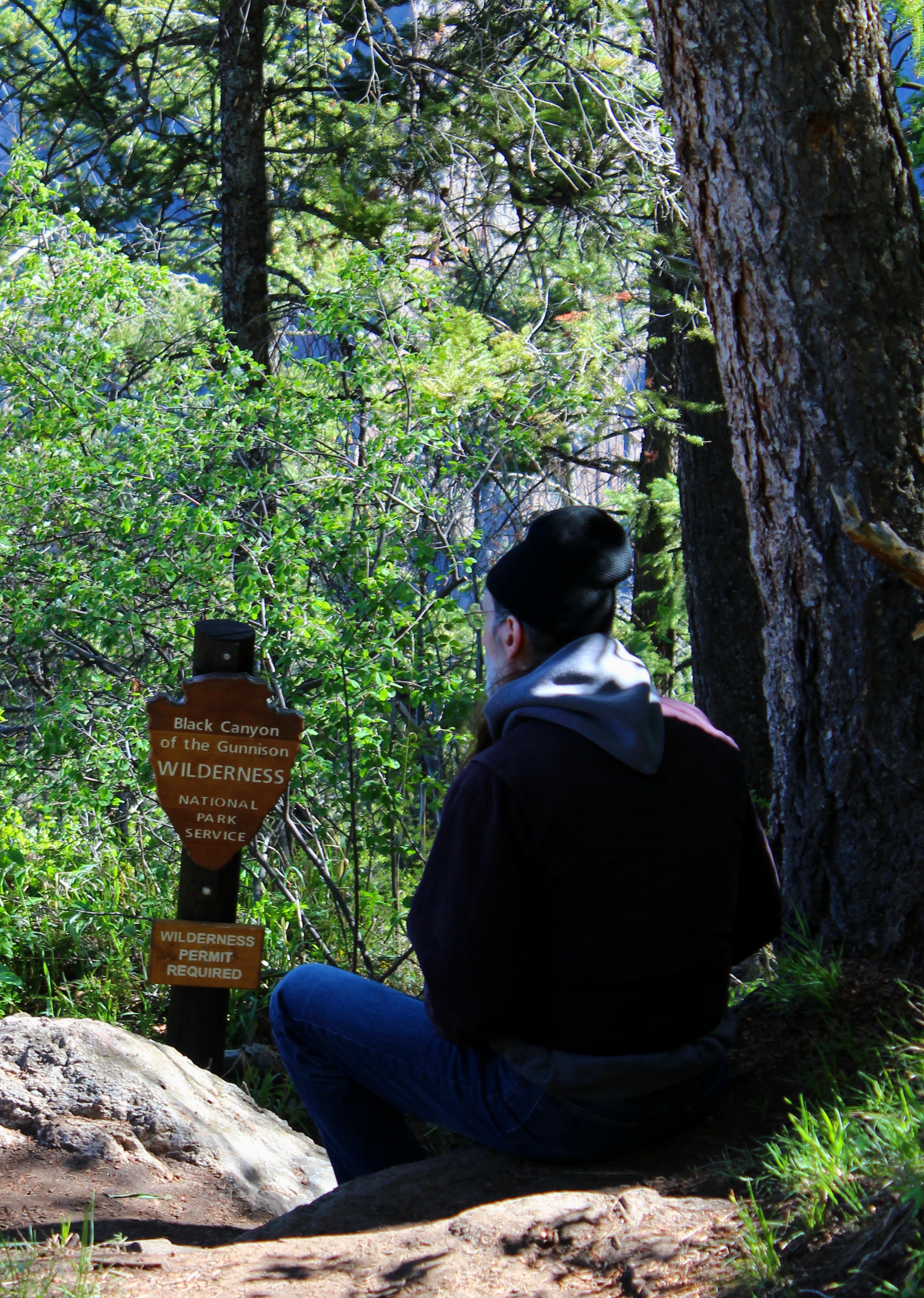
Black Canyon of the Gunnison National Park

I was 9 years old and seeing the mountains of Colorado for the first time the last time I was here. Frankly, the only thing I remember of it from back then is the name. It kind of scared me.


It is a National Park, a deep gorge, a wild river, a cross-section of geography, and a wilderness where humans are temporary visitors at best. From the Visitor Center parking lot, a glimpse of the scale of  its depth is merely a tease. 


After a good night’s sleep, we walked the canyon rim from the campgrounds to the Visitor Center and got a closer look. 

The early morning silence, the delicate frost in the shadows, the warm fragrance of juniper and sage, the glimmer of rushing water at the canyon floor…I had stepped into a holy sanctuary that Sunday morning and wept with awe and joy…and sadness.I feel the threat to wild land as a pain deep in my gut. The river that carved this place is running high this year and being “managed” and diverted and manipulated to provide irrigation and recreation and serve a host of human needs. I don’t know how all the demands are weighed on this issue. My desire is to listen to the place itself, to let it simply Be, and to learn what I can with my brain, my heart, and my soul. 

A volunteer guided us on a wildflower walk later that afternoon and introduced us to Western species new to us. Many of the Gambel oaks had just budded when that late snowstorm hit, and their tiny, crisp, shriveled leaves looked woefully sad. They are a hardy bunch and will hopefully recover, but the acorn yield in the fall will likely be diminished. The colorful blooms along the trail seemed to be not at all harmed. 

This plant tour proved very useful. We saw a lot of Oregon grape, which is quite common and looks a lot like poison oak when it shows up as just three leaves with a reddish tinge. However, it does get additional leaves and yellow flowers which make it obviously distinct.

The campsite we found later in the Manti-La Sal National Forest was covered with it. I was glad to know I wasn’t risking a poison oak rash every time I went in the brush to pee!

Unknown's avatar

An American Adventure: Part Three

Watershed and Finally…Bed. 

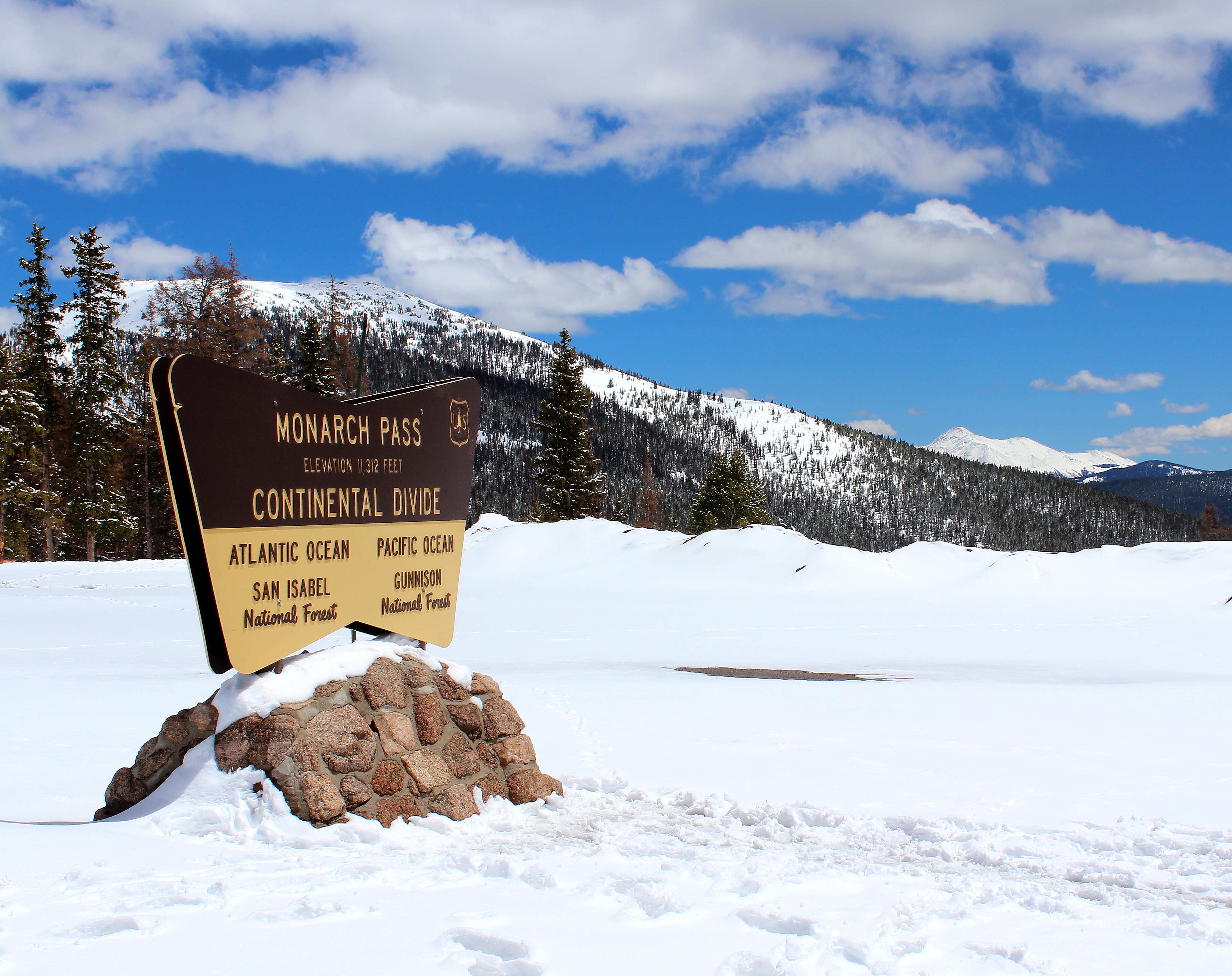
Since Florissant Fossil Beds National Monument had no campground, we were still looking for a place to stretch out horizontally and get some serious sleep. We decided to press on to the Gunnison National Forest. This meant crossing the Continental Divide.

I work for a land trust that focuses on the watershed of the Cedar Lakes, which includes a Sub-continental divide. Up on Washington Street, Highway 33, about two miles from my home, there is a brass plaque denoting this spot. From that hilltop, the water in the east flows down the Milwaukee River to Lake Michigan and out to the Atlantic Ocean via the St. Lawrence seaway. The water to the west of that divide flows to the Mississippi River and down to the Gulf of Mexico.  That divides the Eastern portion of the continent of North America. It is, therefore, the sub-continental divide. It’s on a hilltop. In Wisconsin. At an elevation of about 1,180 feet above sea level.

This is the Continental Divide that we drove over in Colorado. 

At 11,312 feet above sea level, it looks nothing like Wisconsin. 

So, after reaching this high point in our motor trip, we figured it was time to look for a campground. We followed the Gunnison River down the mountain at a steep decline. Every time we saw the road signs indicating a grade of 6% or more, Steve would call out “Truck on a wedge”. It sounded to me like short order diner slang, so I’d respond with “Truck on a wedge, hold the pickle!” This is what happens when you’re punchy.

After cruising the recreational areas through this canyon and downshifting to lower gears to avoid wearing down the brake pads too much, Steve noticed that the engine light on the dashboard of my 2005 Honda Accord (with 172K miles on it already) was lit up. Whaaaaat?

Decision point.  Do we press on into the early evening looking for a campground on the mountain or do we get the car into town before 5 p.m. on this Saturday night to see what that engine failure light is about? This is when I learn that I am the person who would rather have as much information as I can get before making longer term choices.

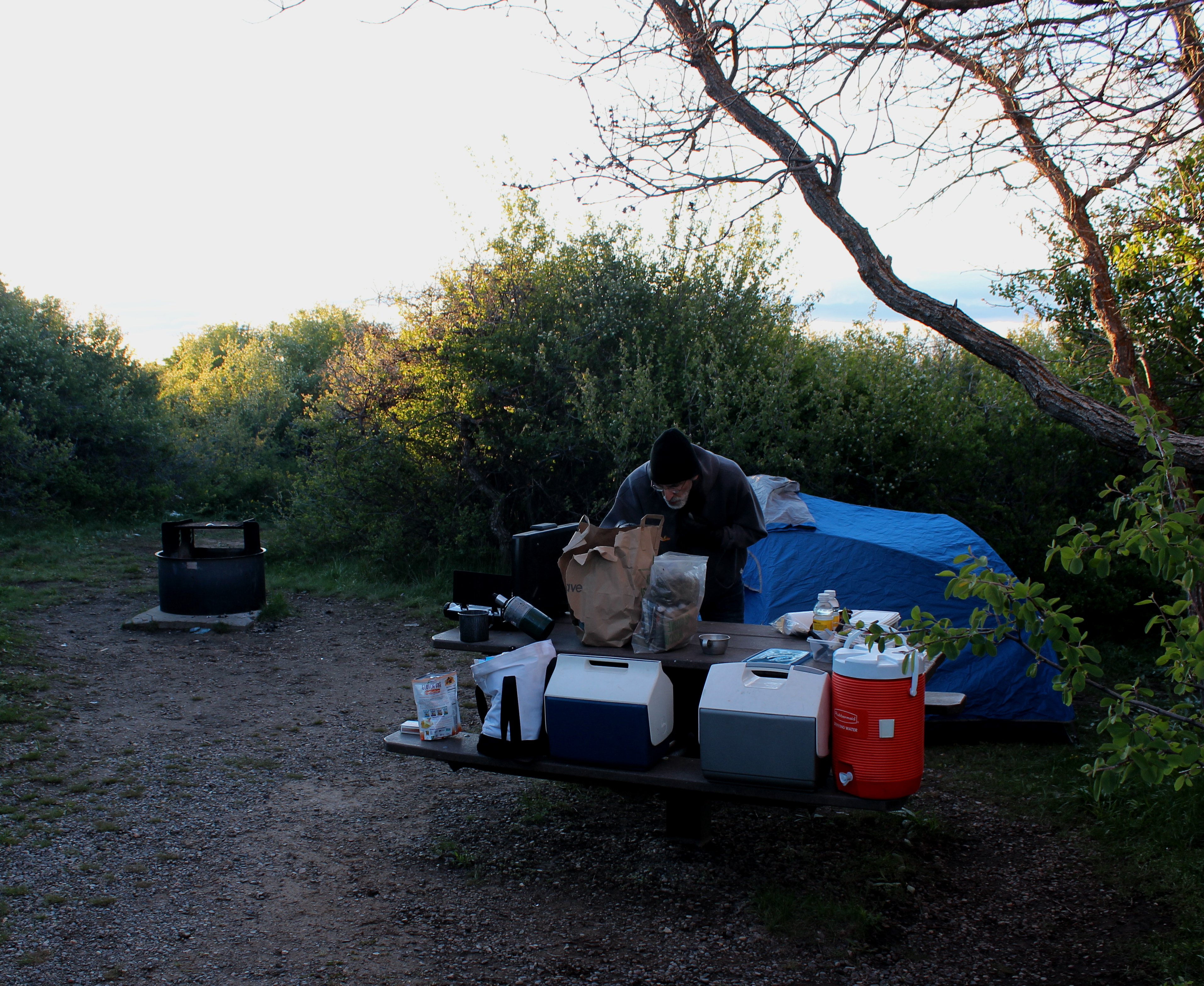
We learned at an auto parts store that the light was telling us that only the oxygen sensor has failed. The car was not going to die and leave us stranded on a mountain. The part was available (at another store). The labor wasn’t, at least not until Monday morning.  We bought the part and headed back into the mountains towards Black Canyon of the Gunnison National Park. We didn’t have the daylight or stamina to search for free dispersed camping in the forest this time. So we made camp in the park at a developed camp site. 

Steve was exhausted and hadn’t had dinner. Further decision-making would have to wait. 

Unknown's avatar

An American Adventure: Part Two

“National parks are the best idea we ever had. Absolutely American, absolutely democratic, they reflect us at our best rather than our worst.”  ― Wallace Stegner

The American landscape is spectacular. While other aspects of my country have deeply disappointed me lately, the land itself stands with timeless dignity. Preserving and respecting it is perhaps the best insurance we have against even more desperately dismal times. Experiencing our natural history firsthand teaches a kind of wisdom that is inimitable. In the face of sweeping geology, teeming biology, mysterious archaeology and the interconnection of every aspect of life, how can we not be humbled and fascinated?

FFB view

National Parks and Monuments provide opportunities to camp out at a living history museum. Steve and I prefer to spend several days in one spot and explore in depth…but this time, we didn’t do that. By the end of our two weeks, we had gone through eight national sites. The Memorial Day weekend crowds were one factor. The start of the summer season also influenced the Park Service staff resources.  Park Service rangers are the best. I love having these enthusiastic and well-informed guides on hand — they are so much better than Google! Walking through the park and asking them questions gets my inner four-year-old awake and engaged. It’s more difficult to get this kind of ranger time when they are new to their post and in training or helping out a crowd of Junior Ranger visitors. Still, each one we met was friendly, intelligent and helpful. I wish there were more of them.

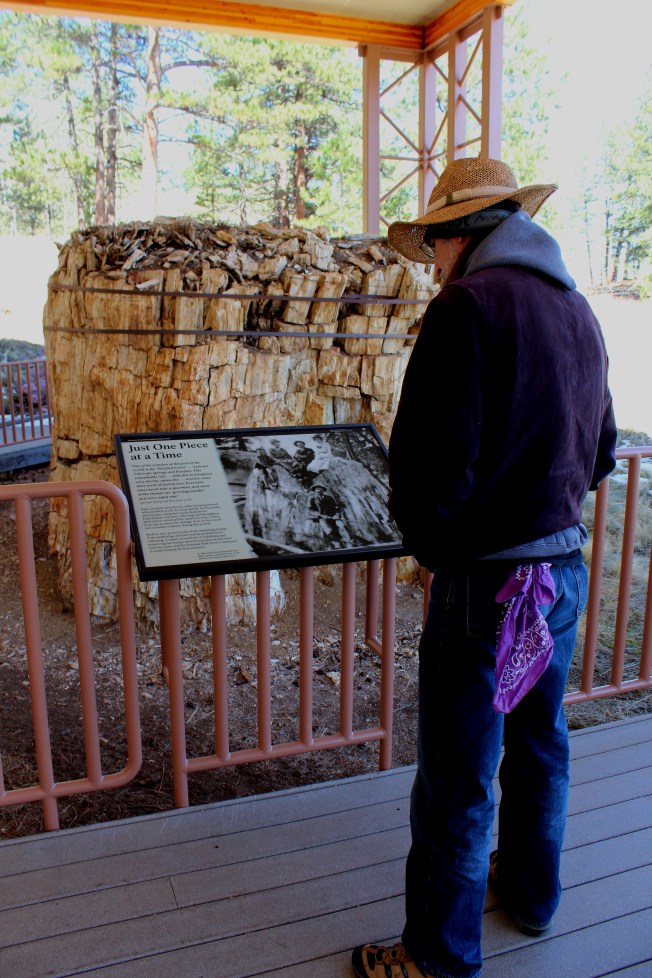
FFB exhibit

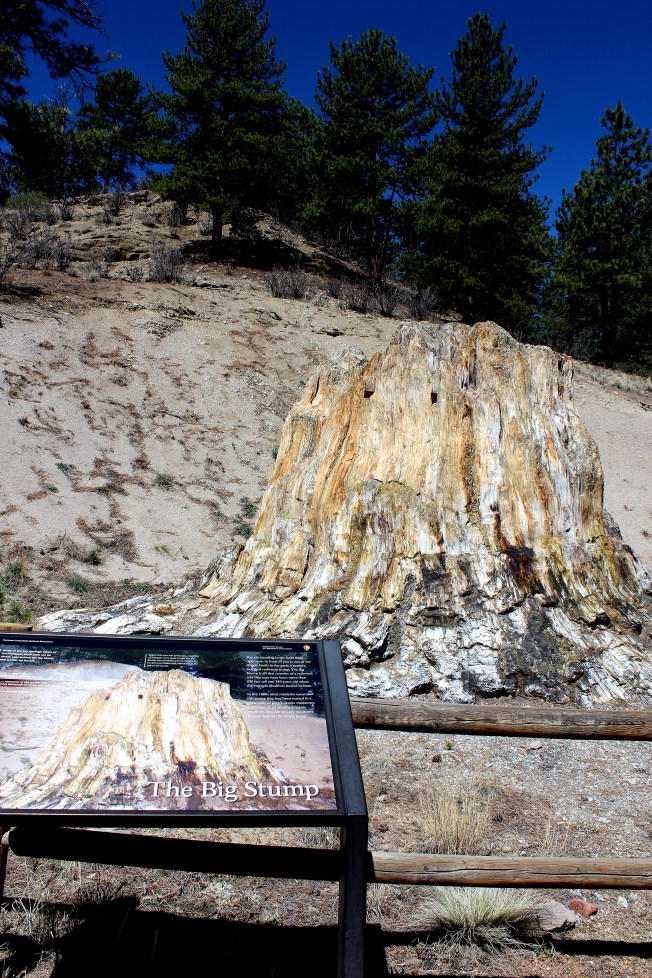
Florissant Fossil Beds National Monument was the first park we visited, so I bought my inter-agency Annual Pass there. The site exhibits petrified sequoia trees and fossils from the Ecocene. My new word for that day was permineralization. Walking the trails, groggy and cramped from 30 hours in the car, was a sweet liberation.  

stump