Unknown's avatar

Going Deeper

‘There is something rich and alive in these people. They want to be able to breathe the Great Breath. They are like children, helpless. And then they’re like demons. But somewhere, I believe, they want the breath of life and the communion of the brave, more than anything.’

She was surprised at herself, suddenly using this language. But her weariness and her sense of devastation had been so complete, that the Other Breath in the air, and the bluish dark power in the earth had become, almost suddenly, more real to her than so-called reality. Concrete, jarring, exasperating reality had melted away, and a soft world of potency stood in its place, the velvety dark flux from the earth, the delicate yet supreme life-breath in the inner air. Behind the fierce sun the dark eyes of a deeper sun were watching, and between the bluish ribs of the mountains a powerful heart was secretly beating, the heart of the earth.  — from The Plumed Serpent by D. H. Lawrence

Steve and I are reading this novel aloud.  The chapter that follows this quote describes a sensual ritual inspired by the god Quetzalcoatl.  D.H. writes with a rhythmic repetition that is especially enhanced in the hearing of it.  The protagonist, Kate, is an Irish woman opening herself to the experience of Mexico in the 1920s; the political and racial and sexual tensions pulsate under the glaring sun and a dark softness broods beneath them.  Last night, we listened to some selections of Richard Strauss (Four Last Songs), Shostakovich (Movements III and IV of the 5th symphony), and Wagner (prelude and Liebestod from “Tristan und Isolde”) and talked about sinking into deeper places in the soul.  Obsession, ego, openness, control.  And under-girding it all, the space for life and love to unfold, which I might call “God”.  It’s like moving from a caress to a deep-tissue massage.  How much can you stand?  Does it feel dangerous?  I feel a “safety valve” kick in when I am in that dark night which always brings me back to the light.  I don’t know if that’s my ego wrestling control out of the situation or an intrinsic optimism that says that the space where everything takes place is basically safe.  When I am seized by grief or anxiety, I can only cry so much…and then I stop.  Steve seems to have a Slavic tolerance for brooding that far exceeds mine.

And today, Steve is dizzy and nauseated.  He took an antihistamine yesterday for his allergies, and he never takes drugs.  So he is sleeping it off beside me, breathing deeply and regularly.  A squirrel hangs upside down outside the window eating maple seeds amid the green and golden foliage.  The body, bodies, the earth: we move in and out of shadow and sunshine and time.  Nothing lasts, not brooding or joy, cohesion or disbursement.  The universe is in motion.  No wonder we feel dizzy sometimes.

Sky and water on a moving planet
Unknown's avatar

Harvest and Hunting

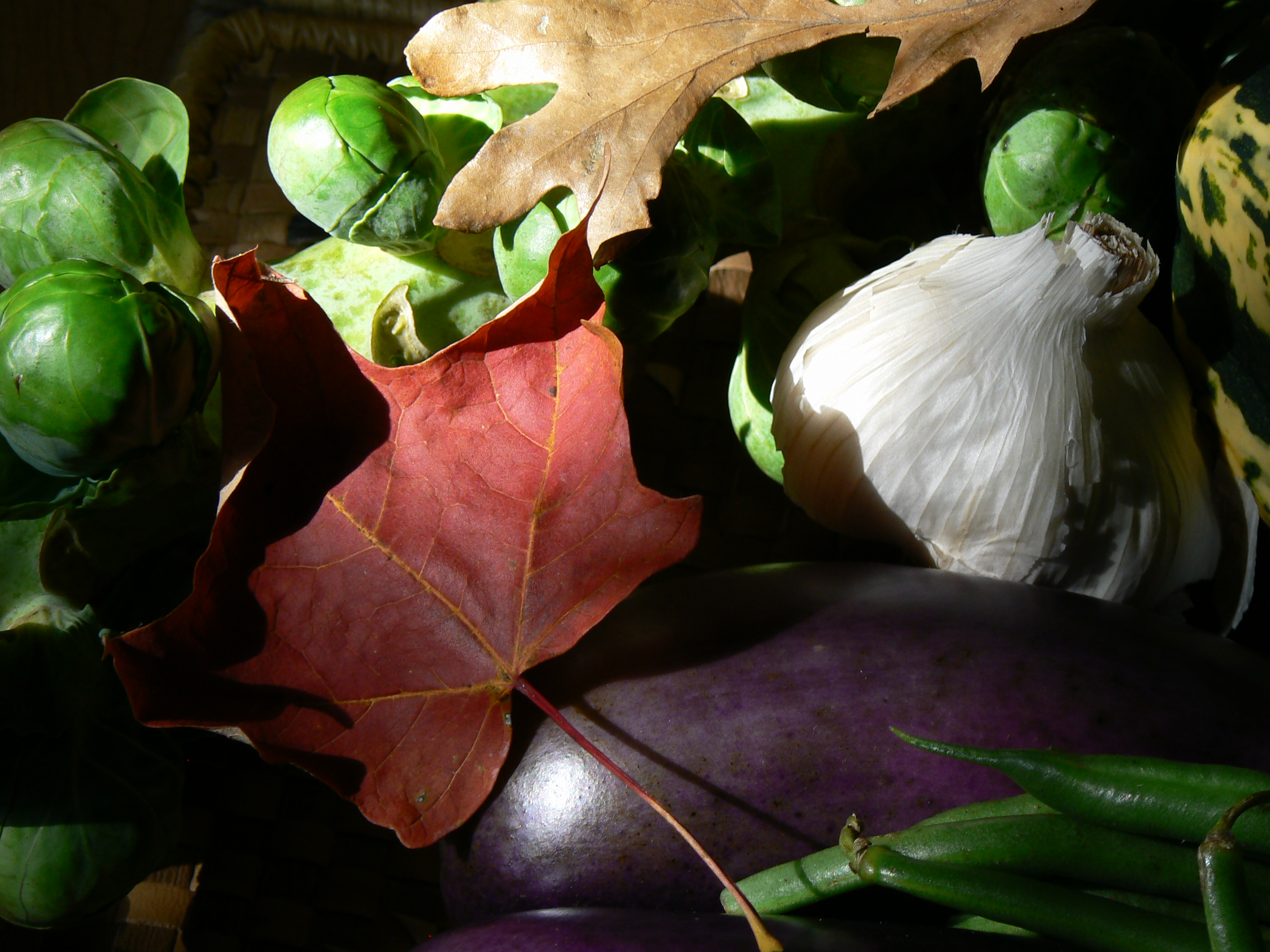
Next Saturday will be the last Farmer’s Market day for ‘Tosa.  Today’s was spectacular, though.  Here’s a picture of my morning harvest.

Oh, it’s so beautiful, I have to show you another:

As we walked to the market place in the village, we noticed a deer on someone’s front lawn grazing on fallen crabapples as the leaves blew around her.  Such a picturesque view of Fall, but unfortunately, I didn’t have my camera with me.  This evening,  I made a risotto using the Japanese eggplant, green beans, garlic, onion, and red pepper.  Supplemented with a couple of unfinished bottles of red wine plus a loaf of Kalamata rosemary bread, also from the Farmer’s Market.  Dessert was Amaretto and brownies.

In the afternoon, Steve and I went walking in the Vernon State Wildlife Area.  Emily will remember this place.   Oh, and we took the D.H. Lawrence novel we’re reading with us.

Our reading spot

Our reading was punctuated by the sound of rifle fire not far away.  Also, up the river was a duck blind and a bunch of decoys.

Not the real thing

We had a lot of questions.  Are there supposed to be people hunting waterfowl in a wildlife refuge?  The signs that were posted were confusing.  There’s no waterfowl hunting whatever beyond certain signs.  No one is allowed in the refuge area from Sept. 1 to November 30 except for gun deer hunters.  You can’t hunt on the dikes between the signs.  We took the long way around the perimeter of the area, and ended up on the railroad tracks for a while to avoid the marshy path.

Taking a higher road out of the marsh

We finally got back to the parking lot at about 4:30pm and noted more cars and people in camouflage gear with guns taking to the trails.  What was going on?  The sign in the parking lot did indicate that Hunting was one of the features of this wildlife area.  But is it deer hunting season already?  As concerned citizens, we wanted to know.  Steve jumped online when we returned home and learned that this weekend is Youth Deer Hunt weekend.  The Wildlife Area is a public hunting area, and only a portion of it is a refuge.  From the Department of Natural Resources website: “Youth hunting events give hunters ages 10 to 15 an opportunity to hunt and gain valuable experience without competing against adult hunters. Special seasons for a variety of species allow only youngsters to hunt during these days under the supervision of their mentor.”  Here is a picture:

From the DNR website

This morning, we were talking about children taking responsibility and how there ought to be a way to give kids a more meaningful role in society – somewhere between child labor and “playing” at adult roles while mom or dad do all the real stuff because adults are more efficient.  So I’m asking myself, is “hunter” a meaningful role in today’s society?  Are these kids helping the family to eat for the winter?  Are they participating in a traditional family role?  Do they partake in any ritual of acknowledging the deer’s part in this event, as many hunting cultures do?  I don’t want to be dogmatic, and I don’t like killing for sport.  I wonder what these kids are taught by their “mentors” about hunting.  I suppose I would have to speak to a hunter to find out.  I have questions.

Unknown's avatar

Righteous Depression

Ya know, in general, I think I’m a pretty happy, positive person.  I want to be like that.  Also peaceful, calm and occasionally insanely silly.  I did have a wicked period of postpartum depression after my first child was born and a bout with post-traumatic stress syndrome when Jim had heart surgery at 31. Okay, but I’m a pretty happy person, I think.  I’ve noticed now that since I’m a widow, if I get started crying about something, I can go on leaking for hours.  Now, could this be due to my new agenda of trying to face the reality of the world honestly?  The truth is the truth hurts.  Suffering exists in the world.  Various coping strategies and religions exist primarily to soften the blow of that blunt piece of honesty.  I am trying to be open, and it leaves me vulnerable.  Ouch.  It felt better to be Polyanna.

What to do about the responsibility and challenge to look deeply into the suffering of the planet, to become aware of the failures of systems and cultures, of relationships and communication from the large-scale to the intimate?  I feel sad about the truth.  Can I call this righteous depression?  Is this deep or simply pathological?

I am suddenly reminded of one of my life stories.  My sister and I were in a car accident when I was 17 and she was 20.  She was driving, and flipped the car at 80 miles per hour on the Interstate.  We were transported in an ambulance together to the Lincoln, NE hospital.  I was aware that they had been doing CPR on her the whole time with no response.  I had seen her covered in blood slumped next to me in the car before I was extricated from it.  I was in shock, but I was able to comprehend what was going on.  The hospital has policies about who can release information to patients, though, and everything must be done according to protocol.  So I found myself in an examining room with a nurse.  I had been checked out and aside from a bump on the head and some cuts, I am fine.  I know that my sister is not fine.   A nurse comes in and sits in the chair in the corner and says something about how they’re also examining my sister.  “It’s very bad,” she says, looking worried and vague, but directly at me.  “It’s just very bad.”  I felt like she was trying to talk to me in code or something.  She wanted to say something specific, but she couldn’t.  Instead, she just kept repeating how bad it was.  Was this supposed to prepare me for something?  Or was it supposed to fill me with a sense of doom and dread?  I realize she was probably a very sympathetic woman who felt terrible at being in the position of not having more comforting things to say or even more authority to speak the truth.  The result was just….awkward.  What do I do with this?  I suppose I could put her out of her misery and say, “It’s okay.  I’ve guessed that she’s dead.  I will deal with it.  I have a plan.”  Honestly, this is what I want to do in these situations.  I want to take responsibility and make everyone around me feel better.  Then I suppose I can feel righteously depressed.  It’s bad; it’s very bad, but I am going to try to do the right thing.

There are some very seriously bad things happening around us.  Global climate change, deforestation, greenhouse gases, ozone depletion, drought, famine, economic devastation, war, oppression and domination, political atrocities, nuclear poisoning, chemical poisoning, racial hatred, bullying, on and on and on.  How much of this can I be open to?  What if I bit off just a tiny portion and tried to chew on that only, to save myself from being overwhelmed?  What if I tried to absorb the totality and sank into a dark depression?  What do we do with deep sadness?  Share it?  Ignore it?  Fight it?  Meditate?  I’m open to suggestions.

Unknown's avatar

You’re Grounded!

I have this thing about wanting to do things “right”.  I grew up with a strict father who had a clear sense of what he thought was right, and I was always trying to please him.  I find myself feeling anxious about whether or not I’ve made the right decisions or acted in the best possible way or been “good” in every way I can.  The more interactions I have, the more I have to feel anxious about.  So, in a busy week, I feel more stress.  Yesterday, I spent 7 hours making pea soup.  It turned out fine, although I had to do some re-direction and repair in the middle (turns out that whole dried peas don’t cook the same way as split peas).  Not a big deal, but I felt like I had “failed” to be super-efficient and triumphant in that endeavor.  My relationship with my cooking contained some anxiety and thus drained energy from me rather than invigorating me.  We have a relationship to everything on the planet, and this is living.  Living can be a drain, or it can be energizing, or anywhere in between.  It depends on whether you’re blocking energy or “surfing” on it.  In other words, you can be at war with life, or you can be at peace with it.  Our relationship with food is a good example of this.  Did you know that the use of pesticides and herbicides came out of the technology of WWI?  The chemicals that were developed for warfare were applied to food production.  Agribusiness declared war on the earth in order to use its technology and generate a wartime economy.  Conflict, manipulation, “strong-arming” the earth in order to wrestle food from it is a particular kind of relationship.  Organic farming uses a more peaceful relationship to obtain food, working with nature and not against it.

I have been trained, in a way, to think that doing things in a prescribed “right” way is the least stressful.  I have been a pretty compliant person.  But this anxiety of compliance also produces stress.  Is there another way?  Yes.  Being grounded and open.  I’m never going to know the “right” way to do everything because there isn’t a right way.  There are a million ways.  And that’s okay.  Steve and my sister share a birthday.  They both have a way of reminding me that the way I am is wonderful, but it’s not the only way.  They both play “devil’s advocate” and bring up something that I hadn’t thought about without saying I’m wrong.  It took me some time to take this as a gift and not as a chastisement.  I was used to taking everything short of complete praise as chastisement.  I used to be somewhat afraid of both of these important people whom I love so much.  They are challenging (and they are smarter than I am).  I have a relationship with them that can be conflictual or peaceful depending on my posture of defensiveness or openness.

So, I’m still thinking about all my relationships to the residents of earth, from the dominant one I have with Steve (three year anniversary today of our very first date) to the invisible ones I have with the bacteria in my own body.   My sister points out that “What are you feeling?” is perhaps a better question than “How are you feeling?”  What am I feeling in these relationships?  Am I feeling energized?  Drained?  Peaceful?  Afraid? Stiff? Open? Anxious?  Sad? Mad? Glad?  Being open to what I’m feeling allows discussion and movement and flow and change.

Letting go of the anxiety of having “right” relationships and exploring what I feel is what I mean by being grounded and open.  What surfaces in our relationships to other species when we do this?  Here’s one thing that came to mind: the euthanizing of animals who have attacked humans.  I have read several news articles lately about grizzly bear attacks, wild cat attacks and even a deer attack (a buck with antlers that inflicted some serious wounds) that ended with the report that these animals “had to be euthanized”.  I always thought that euthanasia was “mercy killing”, like putting a wounded animal out of its misery.  These stories don’t indicate that the animals were in misery, they were simply protecting territory or defending themselves from a perceived threat.  It seems that they were killed as a punishment for attacking a human.  Some of the articles mention that the possibility of rabies warrants “mercy”, but the animal is killed before any diagnosis of rabies is made.   What is the feeling?  Do these animals need to be punished because they’ve injured a human?  Is this about anger and a preference for humans?  Are we at war with animals?  If we end up in the same place at the same time, is it kill or be killed because you are my enemy?   Why shouldn’t an animal take out a human who has shot at it or who represents a food source in a depleted environment?  Are we somehow exempt from being in that kind of relationship?  Why?  For that matter, are we supposed to be exempt from being on the “losing” side of a relationship with listeria bacteria?  Are we “better” or “more valuable”?  Why? (or why not?)

How much can we be open to in our relationships with the world?

What do you feel about buzzards?

What about lotus flowers?

Unknown's avatar

Juxtaposed on a Planet

Last night I wondered why I’m not an insect.  There are only 4,000 species of mammals on the earth and over 100,000 species of insects.  There are even more microbes.  I was thinking how simply one of those animals lives in the soil, a short life with clear intent.  My life as a human seems so much more complicated.  Even so, by human standards, my life is pretty simple now.  I don’t have a job, and I’m done raising kids.  Today, I walked to a restaurant to have breakfast with Steve and his mom, then walked to the grocery store to buy vegetables.  I am making soup and working on the computer.  I made a phone call to my mother and left a voice message.  Pretty uneventful, you might say, but still involving a lot of decisions.  How did I impact the planet today?  Why did I buy that item?  Why did I use electricity?  Why did I throw that in the garbage?  Where did I spend my time and energy and why?  How did I get here, where I am today?

Yesterday I felt pretty exhausted by my busy week.  Socially, I had spent time with all my family and Steve’s plus met strangers on our camping trip.  Geographically, I had covered over 500 miles.  Physically, I had hiked some but sat in a car more.  Psychically, I had given a lot of energy to my most important relationships.  When I’m with my kids, I feel nameless parts of myself going out to them.  I look at them, all 4 together with full-grown energy, and I feel spent in some way.  I wonder about insects who live to reproduce and then die in a matter of hours.  That seems pretty simple.  What do I do with the years I may still be living?

The web of interconnections on the planet is unfathomable.  I feel like I dabble my foot in here and there, watching ripples emanate and then wonder what I did.  What was the meaning, what will be the result, was that responsible?  I have awareness but not full understanding.  I have appreciation and take action based on my best intentions, and may never even know the impact.  I am not in control.  I wonder if simplifying my life is really an effort to have more control.  I suppose I act in faith, as does everyone, in the end.

Sometimes the things that I see connected here on earth don’t make much sense.  How did we get giraffes in Madison WI?

Barn, windmill, maple tree, giraffe. One of these things is not like the others.

My human brain wants to separate things and put them into tidy, little boxes organized by my own way of thinking.  I want a rational world, everything doing its job in its place.  Then, all I have to do is figure out what my job is and what my place is and do it.  No more problems, no more conundrums, no more philosophical issues.  Neat.  Ah, but as Alan Watts says, the world is “wiggly”.  Lines are blurred.  Connections are made, broken, re-made, detoured, disappear, and appear willy-nilly.  Is there something I must do?  My energy is spent just thinking about it sometimes.  I suppose there is another way, a Middle Way, a way that has to do with finding the flow of energy and going with it.  I found a website today that talks about our ecological thoughtprint.  Before we place a footprint on the planet, or maybe as we place our footprints on the planet, we have a thoughtprint.  Learning about how we think about our connections and using that knowledge to help us to make better connections is a valuable lesson.  Education doesn’t begin with an A, but I think it belongs in the ‘awareness, appreciation, action, attitude, activism’ list.

Unknown's avatar

Activism

I am building a vocabulary of A-words: awareness, appreciation, action, attitude and activism.  I just got back from Madison where my family walked in a fundraiser for the American Diabetes Association.  Yesterday, we saw the film “Think Global Act Rural” (“Solutions Locales Pour un Desordres Global”) in a showing by the Milwaukee Film Festival.  Go to the website at http://www.thinkglobalactrural.com to see more about it.  I recommend it for its intense presentation of the failure of the Green Revolution and its depiction of organic farming solutions.  I can’t recommend its artistry, though.  The jumpy, out-of-focus camera handling is distracting to me, and the sequence of segments is a bit disjointed as well.  But the information is astonishing.  Of course, these two events are interconnected.  As a species, we have been poisoning ourselves and starving ourselves and getting further and further from being able to maintain a healthy relationship with food and food production.  Statistics can be eye-opening and misleading at the same time.  Rather than throw some shocking numbers up, I’d like to challenge you to look deeply into a few questions:

1) Do you think that spending time and effort in obtaining food is something basic to life?  Is that a right, a responsibility, a duty, or a privilege?  How would you describe it?  Is it something too “base” for beings as intelligent as we are?  Or is it ennobling to use our intelligence to do it well and graciously?  What do you think of farmers and their work?

2) How would you feel if you discovered that multinational corporations were purposely studying global food production to figure out ways to create monopolies on all aspects of it?  How would you feel if you realized that because of that control, a change or break-down in their system would mean that access to food would be cut off entirely for the populations that had become dependent on them?  And that, very likely, would include you.

3) How much do you know about the food web, how plants make food, how soil and sun deliver the necessary building blocks for plant life, etc?  If you had only yourself and nature to depend on, how would you eat?

4) How much does the quality of a person’s health depend on their diet, do you think?  Do you think that the medical industry creates a dependency on costly health care and de-emphasizes the importance of a naturally healthy lifestyle?  Do you think about “the bottom line” and who may be making money on your lifestyle choices?

5) Are you satisfied with the way that you live?  Do you think your neighbors are?  Your nation?  How about the people in other countries?  How about the planet?  Are you satisfied with the way that life on this planet is going?  (Yeah, this is broad, but whatever you’re thinking, try to follow it out to that end.  And do be serious.  It’s far too easy to be clever.)

Unknown's avatar

Changing Attitudes

Awareness, Appreciation, Action.  Somewhere in there, Attitude is also an issue.  I suppose our attitude springs from our appreciation or understanding of a situation.  Camping in a state or national campsite is an opportunity to observe different attitudes in action.  We like to camp in the middle of the week, after Labor Day, in remote areas without a lot of “recreational” amenities so that we can find quiet and wildlife.  Here’s where we were Tuesday night:

The entire campground was empty except for the host and two other rather large camping trailers occupying the handicapped spaces.  One of the sites had twinkly lights up and a dog, but they were very quiet.  We heard coyotes howling and cicadas thrumming quite loudly all night, which was just what we wanted to hear.  On Thursday, we were in the National Forest and had set up our tent at the end of the camping loop, quite alone.  When we came back from our day hike, the spot next to us was occupied.  Gear covered the picnic table.  It looked like a large group had left one car behind and gone off for the day.  We prepared our evening meal in quiet and enjoyed that.  They returned later, made a fire, and started preparing their dinner.  It was dark by this time, and Steve and I were setting out on our “night hike”.  We like taking a walk in the dark after dinner, no flashlight.  The campers next to us were equipped with head lamps, like miners.  They were also equipped with plenty of beer.  About 10 minutes before 10 o’clock, official quiet hours, they turned on their music.  We were just about to go to bed.  We decided to go over and talk to them.  We gently told one of them that we were disturbed by the noise they were making, that it was park policy to have quiet hours at 10pm, and that we would appreciate it if they would attempt to quiet down.  He thanked us for alerting them and went to speak to the group.  Back in our tent, the noise level seemed only minimally diminished.  The music was off, but the laughter erupted continually and carried down the canyon.  Steve eventually spoke to them again, his quiet, deep voice coming in underneath their raucous chatter.  They got a little quieter, and some of them soon turned in, after banging the latrine door and some garbage cans first.   At least one person stayed up all night long and kept the fire going.

We got up early and broke camp.  One woman from their party came over to apologize about the noise and said that she knew her voice and laughter could get out of hand.  We told her that we appreciated her coming over to apologize.  They were state college students who had been observing the snake migration, a tradition of sorts.  They were only staying one night.  Their reasons for being there were not the same as ours, but that wasn’t the conflict.  The conflict was in attitude.  What posture do you take in nature?  Is it a resource or playground for us to use as we wish?  Is it a sanctuary for us to tiptoe into reverently?  Those are only two examples, the possibilities are endless.  I was thinking of some articles I’d read recently on bullying.  I was thinking about Fred Rodgers and his two minutes of silence during an awards acceptance speech.   My mother sent me this news item today about a teacher who turned his front yard into a garden and promptly drew complaints from neighbors about the “nuisance”.

http://kitchengardeners.org/blogs/roger-doiron/stand-solidarity-adam-guerrero

Attitude.  We are not all on the same page about any issue.  How do you communicate your attitudes?  How do you respect others’?  How do you invite people to change their attitude and allow some new experience?  I wonder if the college campers heard the owls and coyotes that were active that night.  I want to be gentle and kind and peaceful in my approach to changing attitudes.  I don’t want to get aggressive or give in to power plays.  I do want to promote awareness and appreciation and action.

Unknown's avatar

The Ultimate Simplicity of Unity

Health comes from wholeness.  This is true for every individual body on the face of the planet right up to the Earth itself.  If the spherical (3-dimensional) network of interconnections is intact and working in harmony, we enjoy good health.  Damaging those connections and setting up division between body and soul, body and earth, ourselves and others, creates a loneliness that we compensate using violence and competition.  Violence to part is violence to the whole.  We undo the fabric of life this way.  Whenever we insist on the “rights of the individual”, we chip away at those connections.  (see Jessa’s comment on the last post)  How do we practice unity and health?  How do we take up a posture of balance in our relationship to Creation or the Universe?  Do we have the maturity and courage to desire this responsibility on our own so that it isn’t an “obligation”?

This morning, I have been reading an essay by Wendell Berry called “The Body and The Earth” from The Unsettling of America published in 1977.  It is an extremely articulate and broad analysis of that “spherical network” that moves fluidly from agriculture, to Shakespeare and suicide, to sexual differences and divisions, and more.  Here is an excerpt from the beginning which describes the mythic human dilemma:

“Until modern times, we focused a great deal of the best of our thought upon such rituals of return to the human condition.   Seeking enlightenment or the Promised Land or the way home, a man would go or be forced to go into the wilderness, measure himself against the Creation, recognize finally his true place within it, and thus be saved both from pride and from despair.  Seeing himself as a tiny member of a world he cannot comprehend or master or in any final sense possess, he cannot possibly think of himself as a god.  And by the same token, since he shares in, depends upon, and is graced by all of which he is a part, neither can he become a fiend; he cannot descend into the final despair of destructiveness.  Returning from the wilderness, he becomes a restorer of order, a preserver.  He sees the truth, recognizes his true heir, honors his forebears and his heritage, and gives his blessing to his successors.  He embodies the passing of human time, living and dying within the human limits of grief and joy.”

Last night, Steve handed me his own definition of living holistically: establishing (or re-establishing) a personal responsibility towards all aspects of the universe.  He defines responsibility here as love, that is “presence with or an acknowledged relationship with” and the desire to improve that relationship.  He noted that this responsibility comes from free will, not as an obligation.  This is the posture of openness, the basic attitude to begin any discussion about living sustainably or in unity and harmony.  Think of it as the beginning of a tai chi exercise or a yoga session.  You take a balanced position: heels together and toes out for tai chi; heels together, toes together, palms together in front of your heart for yoga.  Breathe deeply, opening connections to the respiratory system, the digestive system, the circulatory system.

Steve assumes the position

This is only the beginning, but as Mary Poppins would say, “Well begun is half done.”  This part takes practice, just like meditation.  Return to your breath.  Return to a position of openness as you try to save the planet.  We are not gods and we are not fiends.  We are humans who love the universe, who desire to improve our relationship with every aspect of it.

Unknown's avatar

C’mon People Now; Ev’rybody Get Together

Harambee is a Swahili word that means “all pull together”.   Many community organizations use it in their name.  I understand this concept very clearly, being the linear thinker that I am.  I visualize a load at the end of a rope.  The object is to move the load in one direction, so everyone grabs the rope and pulls together in that direction.  I would love to figure out how to jump onto that rope line and move the planet back from the brink of disaster.  Problem solved, “ta-dah”, now we party.  However, our interconnected web of global systems presents a more complicated “load”.  If you start pulling in one direction, something else will be effected and will move.  How will that effect everything else?  That’s something to take into consideration.  In fact, the whole thing has to be considered at the same time, holistically.  So how do you visualize that?  Steve was talking about a gyroscope-type model, with himself as the hub.  He mentioned staying balanced and grounded in that center.  I thought that sounded rather egocentric, but then he spoke about the Buddhist idea that “no one can be at peace until we’re all at peace”.  Then, I visualized a round tabletop that was balanced on top of a ball at the center.  With all of life on the tabletop, we would have to arrange ourselves simultaneously and evenly around the table so that it doesn’t tip in any one direction.  Nature sort of works like this.  Take populations: when one gets too large, the food web makes a sort of correction to bring it back in balance.  Human beings are way out of balance on that tabletop.  We have tipped everything in our direction; we are way too heavy in many different ways.  How do we pull back in toward the center and make room for all the rest of life to be in balance?  How do we look at the entire tabletop at once?

Steve has often pointed out to me that I am “not an athlete” (for example, when I’m getting in his way while he’s carrying a heavy box of books).  He talks about how really good athletes have a way of anticipating how and where to move in just the right way to be in the right place at the right time.  Think of soccer goalies or basketball rebounders.  They seem to have eyes in the back of their head or peripheral vision and electromagnetic sensors that enable them to assess the total situation far better than the average person.  There’s a grace and an instinct that gives them that special edge over the merely agile and strong. We need to have that kind of sense about our global situation.  How do we move to counteract the imbalances in our systems?

I wish I were more of a visionary and that I had an answer for you.  I am a freight train in many ways.  I pull slowly and persistently, but I’m not the leader you’re looking for.  I may be the droid, though. : )  But I believe that leadership is out there.  There must be athletes in global perspective somewhere on this planet.  Let’s start a forum.  Let’s get together to work on sustainability.  Let’s balance this tabletop before we all go crashing over the edge.

On track to sustainability

Unknown's avatar

Biological Diversity

Today, a group of special needs adults came to the Wehr Nature Center for a field trip.  They saw a puppet show about how animals survive the winter.  We passed the puppets among them to let them meet the characters before the show.  Afterwards, we passed some real animals around, a box turtle and a snake named Fancy, for them to touch “with one finger”.   Then, we divided the group in half and went outside.  Those that were more ambulatory took a walk around the nature center, the others sat up on the observation deck overlooking the pond.  This was a very diverse group, and I couldn’t tell what they were noticing or taking in.  We tried to point out things that they could see, hear, touch, or smell (we didn’t dare do any tasting!).  Some of them were pretty absorbed by their own selves and other people in the group.  Some were able to engage at times in what was around them on the path.  One man, Charlie, pointed up to a tree covered with Virginia creeper vines that had turned red and just started laughing!  He was so excited!  I loved that reaction.  That made my day.  Lester spent the time pointing out behaviors in the group or hiding behind people.  He held my hand for a while on the trail.  When we all congregated on the observation deck, he introduced some of his friends to the staff, one by one.  Finally, we got them all loaded back on the bus and waved good-bye.  There were 30 in all, including 2 in wheelchairs.  Most were men.  All the caregivers were women.

This made Charlie laugh

I am grateful to have been reminded that biological diversity includes every species and every variation in the species, including ours.  Respecting and including all of life is an exercise in awareness every moment of every day.  I want to be able to be gracious and friendly to every living thing I encounter, and I want to put myself in a position to encounter a wide variety.  I suppose that is my desire for my own edification, but I think that it is advantageous for everyone and builds tolerance and peace in the world.  Observing people in nature is interesting.  Some of the volunteers were talking about kids who react negatively to things in nature.  One girl got very agitated and upset over the sticker-burrs that were clinging to her sweater after a hike.  It makes you wonder how unfamiliar she must have been with the outdoors.  We are often scared by things that are unknown.  As we understand things better, we are able to be more compassionate.  Steve’s favorite Bible verse is “For God so loved the world…” and he stops there.  God loves the world.  Steve loves the world.  What would be the result if more people learned to love the world and taught their children to do the same?  “And it was very good.”

I love Turtles

I love the colors and textures under my feet