Unknown's avatar

Autumn Sentiments

The autumn years of life.  The harvest of a lifetime.  Gathering together the products of work and character.  There’s something nostalgic and lonesome about autumn, sweet and melancholic.  Glossy photos of food and family and warm colors seem so appetizing.  I am planning to host Thanksgiving dinner for Steve’s family, and I keep daydreaming about how the table will look.  I want my home to be filled with warmth and love, good smells, earthy colors, sparkles of glass, silver, and candlelight.  Of course, this will be on a modest scale.  Martha Stewart does not live anywhere near here.  I have song lyrics stuck in my head from Barry Manilow’s “Paradise Cafe 2:00am” CD… “Oh, how I hate to see October go.”  How will I get my Thanksgiving vegetables now that the farmer’s market is closed?  The acorn squash and broccoli we had last night were delicious, dressed only in butter, salt & pepper.  The earth is so good to us and autumn is the applause before a winter curtain.  How do you feel when you’re giving a standing ovation, damp-faced and shining, heart bursting, swallowing hard, delaying your exodus into the next moment?  I feel that way about autumn.  I remember driving home from dropping one of my children off at preschool one cloudy November day and bursting into tears.  I tried to figure out what that was about and ended up writing this poem:

Change

In autumn, the trees start to sing once again

of the bittersweet mystery of change.

Is it beauty or pain now attached to my soul?

Is it grief…or relief…or nostalgia?

In the scarlet and gold,

the blood-red of life’s hold…on my heart

and the warmth of its love

mingles memories and years

into afternoon tears

falling softly…as leaves…to the ground.

Unknown's avatar

Cats and the Philosophy of Health Care

At our Socrates Cafe meeting on Saturday, we discussed the ethics of rationing health care.  How are decisions made about administering medical care?  Should health care be awarded to the wealthiest, the most fit, the least at-risk or the most at-risk?  Is health care a commodity that can be administered according to social and economic guidelines?  Is health care distinct from “illness care”?  And so on.  Our group is rather small and not especially representative of any particular demographic.  I don’t think we’re “solving” anything, we’re just enjoying discussion and engagement and some brain activity.  I’m exploring the results of allowing other people to comment on the products of my own bizarre thinking.  Which is kind of what blogging is about as well.

As I put in my own perspective on this issue, I realize that I speak from experiences that have centered mostly around my husband’s illness and death and from observances of non-human beings.  Jim used to chalk up a lot of his medical interventions as “better living through technology”.  He was the recipient of some very technical and somewhat heroic (although now pretty standard) procedures.  It was a complicated arena of insurance issues, multiple specializing doctors, drug interactions and availability, and the donor list system.  There were layers of decision-making involved and a fabric of responsibility that was pretty nebulous.  When his pulmonologist found out that he’d died, he asked me, “What are you doing about it?”  I wasn’t sure what he was talking about.  “I’m grieving!” I answered.  “I mean legally,” he explained.

Who is responsible for my health?

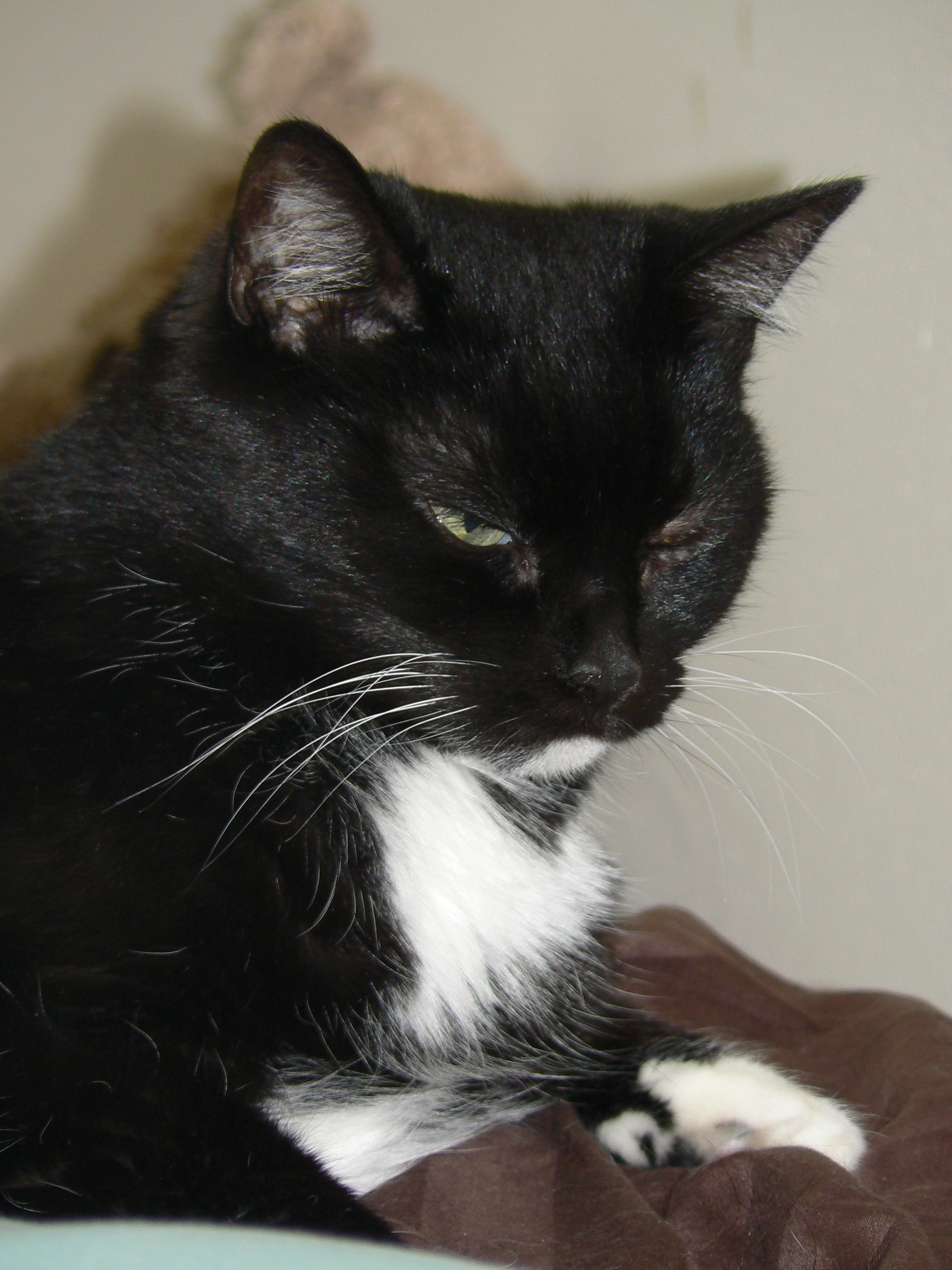
As for the observance of non-humans and their health, I look to the pets I have known.  Specifically cats.  I learned a lot from Pinkle, who somehow got injured up in the attic one day.  She simply stopped using her back legs until they had healed.  She slept.  She ate.  She tried out putting weight on them gradually, and eventually got back to doing all the things she had been doing.  She didn’t complain.  She didn’t seem miserable.  She didn’t worry or push herself or engage in any neurotic behavior that we could detect.  She took responsibility for herself, for the most part, and we provided food and shelter and quiet.  Phantom is another cat I have observed.  She is 16 years old now, and not living with me any more.  She had some urinary tract issues in the past when I did care for her.  I gave her antibiotics in pill and liquid form (which was an ordeal she did not welcome) and changed her food.  She had a bladder stone removed surgically as well.  That was maybe 10 years ago.  Her litter mate died of cancer a couple of years ago.  Cats don’t complain about pain much, and they don’t complain about death.  My kids tell me that Tabitha was purring as she died of the injection that ended her suffering.  Cats (and many other animals) have a tendency to seek out a quiet place to die.  They don’t make a big fuss.  We’re the ones who fuss.

Phantom del'Opera

Pinkle Purr (see poem by A.A. Milne)

What if we focused on healthy living and didn’t sweat so much about “illness care”?  What if we made it our social/economic/political responsibility to work hard to provide clean water, clean air, healthy food, shelter, education about health, and quiet (less stress) for as many of us as we can, and let illness play out as it would naturally?  What if we as a community took responsibility for supporting health but abstained from taking responsibility for preventing death?  It’s not like we’d be successful in that effort ultimately anyway, right?  We’d do our best to give you the basic needs, and the rest is up to you and nature.  That’s how human life went before technology kicked in, and plenty of people lived to reproduce (or we wouldn’t be here today).   Is there anything wrong with that model?

That’s my two cents for the health care debate.

Unknown's avatar

The Shadow Side of Abundance

I’ve connected a few strands in the cobweb of my mind.  Follow me, if you will.

I’ve been thinking about my shadow side, my dark side, and I’ve located an area that I think could be it.  It lurks in my ego, in the part of me that craves attention for myself at the possible expense of others.  This is where I am tempted to be manipulative and fake.  The origins of this desire are nebulous, but I can identify manifestations in my childhood.  I was daughter #4 in my family, the youngest child for 11 years, the only blonde, with a ski-jump nose and a pouty lower lip.  I was cute (pardon my use of this hated word, Steve!), especially to strangers.  My family used to tease me for being “touched by waiters” because every time we went out to eat, the waiter would pat me on the head or something.  I loved being cute.  I loved the attention because my deep-seated fear was that I was redundant.   With three older sisters, there was always someone near at hand who was smarter, more accomplished, and better than me at everything.  I struggled to find a niche where I could have my own spotlight.  I actually found that in music, so I majored in Voice Performance in college.  My mother was very musical, but a rather shy performer.  I pushed myself to overcome my natural fear of being judged so that I could stand out every once in a while.  This thread leads to….

Salieri in “Amadeus”.  His dark ego leads him to all kinds of hateful thoughts about Mozart and about the God who favors him.  This fear of redundancy gripped him.  He saw the world as a competitive arena.  “This town ain’t big enough for the both of us” is a theme in a lot of movies, actually.  Walking to the farmer’s market today, I noticed redundancy all over.  Nature is full of it.  How many leaves gather in the gutter?  How many stands of squash and potatoes gather for market?  How many people, how many birds, how many mice or ants or whatever do we really need?  What is the point of abundance and why is redundancy a bad thing?  Follow “Amadeus” to….

Cynthia Nixon, who played Mozart’s maid and Salieri’s “spy”.  This is the only performance of hers that I’ve actually seen.  I did find an article on her when I read and researched the Pulizer Prize winning play, “Wit”.  I discovered that she is in a lesbian relationship now, and she was quoted as saying that she never thought of herself as a lesbian.  What she did say was that “here was this undeniable person”.  That phrase stuck with me.  I wonder at all the things we find redundant and ask if we are denying them.  Of all the leaves that I encountered on this windy day, did I deny most of them and only notice a few?  I actually picked up only one to look at it more closely.

We don’t know what to do with abundance.  We can’t possibly take it all in, so we deny much of it and acknowledge only a portion.  The rest we call “redundant” because we have no use for it.  But Nature is abundant for some reason.  Could it be that it’s not just for us?  Oh, that’s hard for our egos to imagine.  Think of the use of pesticides.  Why in the world would there be so many little critters who eat vegetation?  We don’t need them. It must be a mistake.  Let’s kill them off.  What’s the result?  Dead soil – no humus, no living matter mixed with the rock, no space for air and water and roots.

Do we need all these beetles? Hey, maybe it's not about what 'we' need.

We live in an abundant world, and we are part of that abundance.  How do we refrain from denial and keep our minds open to more than we can comprehend?  The balance between abundance and scarcity in Nature keeps populations in flux and unpredictable.  Therefore, I suppose redundancy has its place in an uncertain future.  This is an ancient wisdom.  When we eliminate redundancy because it doesn’t make sense to our economic mindset, we are dangerously engaged in hubris.  Why are we allowing our seed banks to be monopolized and diminished, for instance?   Why are we allowing the rate of extinction to skyrocket?  Why are we allowing our denial to be imprinted on the planet?  We act in ignorance because we have no choice, that is to say that we will never understand the world completely.  But we need not act impetuously out of false assumptions driven by our egos.

Unknown's avatar

Change

Today I tagged along with a group of 4-6th graders as they participated in a program called “Let’s Go Climb a Moraine”.  The staff naturalist gathered them all at the beginning of the hike and said that he hoped they would remember one important word from the day’s experience.  “Glacier?” they guessed.  No.  CHANGE.  Everything on the planet is changing.  Even the land.  For example, Wisconsin was once underwater at about the equator, back in the days of Pangaea.  The glaciers shaped landforms.  A beaver changes the landscape by chewing down trees and creating dams.  People are making all kinds of changes to the earth as well.  Naturalist Howard also asked the kids, “Why do we bother to study and learn about the earth?  The more we know about the earth, the better we’re able to do what?”  Protect it.  Take care of it.

And change?  Why do we bother to look at change and be aware of it?

So we won’t be so afraid of it, perhaps.

Change is inevitable.  Eventually, everything changes.  Some changes take a long, long time and are not even noticed in a few lifetimes.  Other changes happen in an instant.  Does change make you feel unsettled, anxious, frightened, panicked?  Are you comfortable with change?  Do you delight in change?  “Depends on what the change is.”  Sure.  That’s a fair question, but would you be able to accept every change eventually?  Are there some changes that you would never accept?  What do we teach about change?

New colors on the trees

My children are going to be living quite differently from the way I did.  There is change in the air.  Our economic situation seems like a popcorn kernel about to burst.  Something’s gotta give.  And I think that will be a very good thing.  I think that the older I get, the more open I am to change.  You might say the opposite would be more typical, and perhaps it is, but the longer I live, the more changes I see and the more I get used to change.

Steve really enjoyed our hike and remarked, “My life’s been good to me.”  It made me think of John Denver’s song, “Poems, Prayers and Promises”.

The days they pass so quickly now
Nights are seldom long
And time around me whispers when it's cold
The changes somehow frighten me
Still I have to smile
It turns me on to think of growing old
For though my life's been good to me
There's still so much to do
So many things my mind has never known
I'd like to raise a family
I'd like to sail away
And dance across the mountains on the moon

I have to say it now
It’s been a good life all in all
It’s really fine
To have the chance to hang around
And lie there by the fire
And watch the evening tire
While all my friends and my old lady
Sit and watch the sun go down

And talk of poems and prayers and promises
And things that we believe in
How sweet it is to love someone
How right it is to care
How long it’s been since yesterday
What about tomorrow
What about our dreams
And all the memories we share

I’ll always have a place in my heart for Henry John Deutschendorf, Jr.

Unknown's avatar

Righteous Depression

Ya know, in general, I think I’m a pretty happy, positive person.  I want to be like that.  Also peaceful, calm and occasionally insanely silly.  I did have a wicked period of postpartum depression after my first child was born and a bout with post-traumatic stress syndrome when Jim had heart surgery at 31. Okay, but I’m a pretty happy person, I think.  I’ve noticed now that since I’m a widow, if I get started crying about something, I can go on leaking for hours.  Now, could this be due to my new agenda of trying to face the reality of the world honestly?  The truth is the truth hurts.  Suffering exists in the world.  Various coping strategies and religions exist primarily to soften the blow of that blunt piece of honesty.  I am trying to be open, and it leaves me vulnerable.  Ouch.  It felt better to be Polyanna.

What to do about the responsibility and challenge to look deeply into the suffering of the planet, to become aware of the failures of systems and cultures, of relationships and communication from the large-scale to the intimate?  I feel sad about the truth.  Can I call this righteous depression?  Is this deep or simply pathological?

I am suddenly reminded of one of my life stories.  My sister and I were in a car accident when I was 17 and she was 20.  She was driving, and flipped the car at 80 miles per hour on the Interstate.  We were transported in an ambulance together to the Lincoln, NE hospital.  I was aware that they had been doing CPR on her the whole time with no response.  I had seen her covered in blood slumped next to me in the car before I was extricated from it.  I was in shock, but I was able to comprehend what was going on.  The hospital has policies about who can release information to patients, though, and everything must be done according to protocol.  So I found myself in an examining room with a nurse.  I had been checked out and aside from a bump on the head and some cuts, I am fine.  I know that my sister is not fine.   A nurse comes in and sits in the chair in the corner and says something about how they’re also examining my sister.  “It’s very bad,” she says, looking worried and vague, but directly at me.  “It’s just very bad.”  I felt like she was trying to talk to me in code or something.  She wanted to say something specific, but she couldn’t.  Instead, she just kept repeating how bad it was.  Was this supposed to prepare me for something?  Or was it supposed to fill me with a sense of doom and dread?  I realize she was probably a very sympathetic woman who felt terrible at being in the position of not having more comforting things to say or even more authority to speak the truth.  The result was just….awkward.  What do I do with this?  I suppose I could put her out of her misery and say, “It’s okay.  I’ve guessed that she’s dead.  I will deal with it.  I have a plan.”  Honestly, this is what I want to do in these situations.  I want to take responsibility and make everyone around me feel better.  Then I suppose I can feel righteously depressed.  It’s bad; it’s very bad, but I am going to try to do the right thing.

There are some very seriously bad things happening around us.  Global climate change, deforestation, greenhouse gases, ozone depletion, drought, famine, economic devastation, war, oppression and domination, political atrocities, nuclear poisoning, chemical poisoning, racial hatred, bullying, on and on and on.  How much of this can I be open to?  What if I bit off just a tiny portion and tried to chew on that only, to save myself from being overwhelmed?  What if I tried to absorb the totality and sank into a dark depression?  What do we do with deep sadness?  Share it?  Ignore it?  Fight it?  Meditate?  I’m open to suggestions.

Unknown's avatar

You’re Grounded!

I have this thing about wanting to do things “right”.  I grew up with a strict father who had a clear sense of what he thought was right, and I was always trying to please him.  I find myself feeling anxious about whether or not I’ve made the right decisions or acted in the best possible way or been “good” in every way I can.  The more interactions I have, the more I have to feel anxious about.  So, in a busy week, I feel more stress.  Yesterday, I spent 7 hours making pea soup.  It turned out fine, although I had to do some re-direction and repair in the middle (turns out that whole dried peas don’t cook the same way as split peas).  Not a big deal, but I felt like I had “failed” to be super-efficient and triumphant in that endeavor.  My relationship with my cooking contained some anxiety and thus drained energy from me rather than invigorating me.  We have a relationship to everything on the planet, and this is living.  Living can be a drain, or it can be energizing, or anywhere in between.  It depends on whether you’re blocking energy or “surfing” on it.  In other words, you can be at war with life, or you can be at peace with it.  Our relationship with food is a good example of this.  Did you know that the use of pesticides and herbicides came out of the technology of WWI?  The chemicals that were developed for warfare were applied to food production.  Agribusiness declared war on the earth in order to use its technology and generate a wartime economy.  Conflict, manipulation, “strong-arming” the earth in order to wrestle food from it is a particular kind of relationship.  Organic farming uses a more peaceful relationship to obtain food, working with nature and not against it.

I have been trained, in a way, to think that doing things in a prescribed “right” way is the least stressful.  I have been a pretty compliant person.  But this anxiety of compliance also produces stress.  Is there another way?  Yes.  Being grounded and open.  I’m never going to know the “right” way to do everything because there isn’t a right way.  There are a million ways.  And that’s okay.  Steve and my sister share a birthday.  They both have a way of reminding me that the way I am is wonderful, but it’s not the only way.  They both play “devil’s advocate” and bring up something that I hadn’t thought about without saying I’m wrong.  It took me some time to take this as a gift and not as a chastisement.  I was used to taking everything short of complete praise as chastisement.  I used to be somewhat afraid of both of these important people whom I love so much.  They are challenging (and they are smarter than I am).  I have a relationship with them that can be conflictual or peaceful depending on my posture of defensiveness or openness.

So, I’m still thinking about all my relationships to the residents of earth, from the dominant one I have with Steve (three year anniversary today of our very first date) to the invisible ones I have with the bacteria in my own body.   My sister points out that “What are you feeling?” is perhaps a better question than “How are you feeling?”  What am I feeling in these relationships?  Am I feeling energized?  Drained?  Peaceful?  Afraid? Stiff? Open? Anxious?  Sad? Mad? Glad?  Being open to what I’m feeling allows discussion and movement and flow and change.

Letting go of the anxiety of having “right” relationships and exploring what I feel is what I mean by being grounded and open.  What surfaces in our relationships to other species when we do this?  Here’s one thing that came to mind: the euthanizing of animals who have attacked humans.  I have read several news articles lately about grizzly bear attacks, wild cat attacks and even a deer attack (a buck with antlers that inflicted some serious wounds) that ended with the report that these animals “had to be euthanized”.  I always thought that euthanasia was “mercy killing”, like putting a wounded animal out of its misery.  These stories don’t indicate that the animals were in misery, they were simply protecting territory or defending themselves from a perceived threat.  It seems that they were killed as a punishment for attacking a human.  Some of the articles mention that the possibility of rabies warrants “mercy”, but the animal is killed before any diagnosis of rabies is made.   What is the feeling?  Do these animals need to be punished because they’ve injured a human?  Is this about anger and a preference for humans?  Are we at war with animals?  If we end up in the same place at the same time, is it kill or be killed because you are my enemy?   Why shouldn’t an animal take out a human who has shot at it or who represents a food source in a depleted environment?  Are we somehow exempt from being in that kind of relationship?  Why?  For that matter, are we supposed to be exempt from being on the “losing” side of a relationship with listeria bacteria?  Are we “better” or “more valuable”?  Why? (or why not?)

How much can we be open to in our relationships with the world?

What do you feel about buzzards?

What about lotus flowers?

Unknown's avatar

Juxtaposed on a Planet

Last night I wondered why I’m not an insect.  There are only 4,000 species of mammals on the earth and over 100,000 species of insects.  There are even more microbes.  I was thinking how simply one of those animals lives in the soil, a short life with clear intent.  My life as a human seems so much more complicated.  Even so, by human standards, my life is pretty simple now.  I don’t have a job, and I’m done raising kids.  Today, I walked to a restaurant to have breakfast with Steve and his mom, then walked to the grocery store to buy vegetables.  I am making soup and working on the computer.  I made a phone call to my mother and left a voice message.  Pretty uneventful, you might say, but still involving a lot of decisions.  How did I impact the planet today?  Why did I buy that item?  Why did I use electricity?  Why did I throw that in the garbage?  Where did I spend my time and energy and why?  How did I get here, where I am today?

Yesterday I felt pretty exhausted by my busy week.  Socially, I had spent time with all my family and Steve’s plus met strangers on our camping trip.  Geographically, I had covered over 500 miles.  Physically, I had hiked some but sat in a car more.  Psychically, I had given a lot of energy to my most important relationships.  When I’m with my kids, I feel nameless parts of myself going out to them.  I look at them, all 4 together with full-grown energy, and I feel spent in some way.  I wonder about insects who live to reproduce and then die in a matter of hours.  That seems pretty simple.  What do I do with the years I may still be living?

The web of interconnections on the planet is unfathomable.  I feel like I dabble my foot in here and there, watching ripples emanate and then wonder what I did.  What was the meaning, what will be the result, was that responsible?  I have awareness but not full understanding.  I have appreciation and take action based on my best intentions, and may never even know the impact.  I am not in control.  I wonder if simplifying my life is really an effort to have more control.  I suppose I act in faith, as does everyone, in the end.

Sometimes the things that I see connected here on earth don’t make much sense.  How did we get giraffes in Madison WI?

Barn, windmill, maple tree, giraffe. One of these things is not like the others.

My human brain wants to separate things and put them into tidy, little boxes organized by my own way of thinking.  I want a rational world, everything doing its job in its place.  Then, all I have to do is figure out what my job is and what my place is and do it.  No more problems, no more conundrums, no more philosophical issues.  Neat.  Ah, but as Alan Watts says, the world is “wiggly”.  Lines are blurred.  Connections are made, broken, re-made, detoured, disappear, and appear willy-nilly.  Is there something I must do?  My energy is spent just thinking about it sometimes.  I suppose there is another way, a Middle Way, a way that has to do with finding the flow of energy and going with it.  I found a website today that talks about our ecological thoughtprint.  Before we place a footprint on the planet, or maybe as we place our footprints on the planet, we have a thoughtprint.  Learning about how we think about our connections and using that knowledge to help us to make better connections is a valuable lesson.  Education doesn’t begin with an A, but I think it belongs in the ‘awareness, appreciation, action, attitude, activism’ list.

Unknown's avatar

How are you feeling today?

Last night I read a play that really impressed me.  It is a piece of writing that satisfies on many levels.  It’s called “W;t” (or “Wit”) by Margaret Edson, and it won the Pulitzer Prize for drama in 1999.  I recommend it highly, especially to the Approximate Chef and Memma.  You will love the protagonist, a 50 year old professor of seventeenth century poetry, specializing in John Donne.  She has stage 4 ovarian cancer, and the action is set entirely in the hospital.  Her understanding of life, of living from your wits, is rigorous, exacting, detailed, intelligent.  Being treated for cancer puts her in a situation that is painful, humiliating, and collaborative.  The script is brilliant and suddenly tender at the end in a way that doesn’t degenerate into sentimentality, but strikes firmly at the heart.  If I were to see this live in the theater, I’m sure I would be unable to rise from my seat for a good half hour after the curtain fell.  I’d be savoring every emotion.  Read it and you’ll see what I mean.  One of the “running gags” is that the intern keeps reminding himself of the “clinical” practice of asking the patient how she is feeling.  The question may seem moot, or insensitive, or humorous, but it points to self-awareness regularly, which for most of us is sorely needed.

I am noticing the subtle changes of aging.  I hear popping and cracking in my joints whenever I get up in the middle of the night to go to the bathroom.  I feel stiffness in the morning from sleeping on our rock-hard futon.  I have never been very flexible, and today, I tried to do yoga along with a DVD.  I found myself mesmerized by the instructor’s body and thinking of my sister Dharam, who has taught yoga, acrobatics and dance for 30 years.  It is so beautiful to watch, and I feel like my body will never be able to do it.   Memma can do it; she is fluid and flexible and of a completely different body type.  I wonder if all bodies can if they practice regularly.  The problem is fear.  I am afraid and mistrust my own body.  The way to dismantle fear is with understanding.  I had a massage a week ago, and as each muscle was touched, I felt as if I were being introduced to it for the first time.  “Oh!  That’s my muscle going from there…to…there.  It feels a bit tight and tender; I wonder if I can relax it?  Breathe….”  I am trying not to think things like, “Oh, my god!  I am so stiff and creaky!  There must be something really wrong with me.  I probably have bone cancer!”

I keep reminding myself that I just had a full physical, mammogram and pap, and blood work done, all with normal results.  If I hadn’t, I could probably convince myself that I had one foot in the grave.  My hypochondria is fully actualized.  I’m sure part of that is due to living with Jim throughout the stages of his illness and death.  The vigilance we developed became a blessing and a curse.  The trick is finding balance, finding the Middle Way.  As I stand with my toes and heels together, arms at my side, breathing deeply through my nose, I remember this.  Balance.  Breath.  Practice.  Love myself.  Ask myself compassionately, “How are you feeling today?”

Feeling fine, thanks!

Unknown's avatar

Sundays: Prayers and Practices

Sundays were full of ritual in our house.  We went to church every week to sing in the choir, to serve at the altar, to teach or learn in Sunday School, and to meet up with familiar folk.  There were the formal rituals of the liturgy and the informal rituals of getting everyone up and dressed and in the car.  After church, we had rituals of brunching on bagels and sleeping in front of the Bears’ game.  These habits gave our Sundays a certain shape and form that became very comfortable to me.  I didn’t think very hard about them after a while.  They seemed fairly easy and routine, a balance of early busy-ness and later laziness.  We’d dress up and then let down.  It was what we did, week after week.  Gradually, this practice began to unravel as the kids grew up, moved out, and developed their own habits.  When they came back into my home, this routine was questioned.  Do I have to get up and dress up and go to church?  I’m used to sleeping in on Sundays now.  Why do you do this routine anyway?  Is it obligation?  Okay, you committed to being in the choir.   You’re obligated, I’m not.  Do you think I’m obligated to you because you’re my mother?  It became obvious that it was time to think critically about our family habits and evaluate them.  I admit that I was not above manipulation.  I  liked to have my kids with me in church.  I liked to hear them sing.  I liked being seen by others as a mother with devoted children.  I wanted to have time together as a family because I worried about how ‘dysfunctional’ we were becoming.  I thought I could get what I wanted by imposing ‘rules’, but when my authority over them came into question, I resorted to bribing them with food…or guilt.  “It’s a family thing!  Don’t you want to go to brunch at Egg Harbor with us?”  Occasionally, I would even be satisfied if they skipped church and met up with us at a restaurant afterwards.

After Jim died and I began dating Steve, I invited him to come to church with me.  He observed the whole morning routine respectfully and rather silently.  I finally asked for his feedback.  His first comment was that I had become a totally different person than the one he knew.  I had adopted a persona that he didn’t recognize.  I had put on my social ‘face’ and performed my part in the choir, but he saw nothing of the spirituality we talked about while hiking in the prairie.  He asked me whether I thought my church habits contributed to my spiritual growth, and I couldn’t answer right away.  He also asked me why I neglected to inquire about his bagel preferences when I picked up brunch afterwards.  That was embarrassing!  I was in my familiar bubble and not even thinking about my guest.  “We always do it this way, and you can just follow along,” is something I am very used to accepting and enforcing.  Steve doesn’t like to be treated that way, though.  He values participating as an equal in what is happening.   His theological questions came next.  If you’ve never been to an Episcopal mass before, you would probably be bursting with questions about the symbolism alone by the end of the service.  Steve was wondering if there would be an occasion that he could stand up and ask about what was going on.   Can you imagine?  “Uh, excuse me?  Hi.  I’m Steve and this is my first time here.  Can you tell my why you’re doing that with that cup (or candle or incense diffuser or garment or….) and what that means?”  I had to admit that the whole social construct was not designed to be very inclusive or open.  It was another case of “we always do it this way, and you can just follow along”.  I began to wonder how much of my long-standing religious faith was about simply following along.
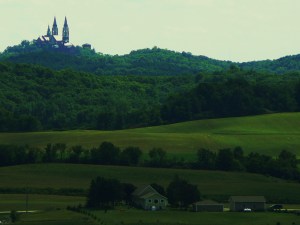
Holy Hill, from far away

Here, I am living without religious habit or routine for the first time in my life.  I have decided that I don’t want to live without practice, though, because practice leads to mindfulness.  I am working out how and what to practice.  Back in May, I began to write my own Daily Offices, reminders for certain times of the day.   Here’s what I put together:

I.  Matins – Make Love Every Morning

I become aware of a new day, of the sun rising in the east once more. I feel the security of its constant faithfulness and a deep gratitude and contentment washes over me. I appreciate the sun. I hear birdsong or a cat mew, and I become aware that other creatures greet the new day with me, each one appreciating this regular phenomenon in her own way. I feel the lightness of the sky reflected in the lightness of my body. Food digested, shadow of darkness lifted, I feel buoyant and relaxed and open. The energy of a new day and new opportunities fills me with each breath. I notice the particulars of this morning, the weather, my body, my surroundings, where I am, who is with me. I am grateful for these particulars as they are. I am aware that each of my loved ones greets the morning in some way, and I think of them with appreciation for the connection we have on this planet. I am aware of myself. I am appreciative of my body, of my inner being, and I hold myself in a place of unconditional love. I belong on the earth today. I have an important part to play here along with everything else. I want to be aware of that all day long. I become aware of any anger or fear that might arise in me as I spend time with myself. I notice any of these “stuck spots” with compassion. I review my 3 options: run away, change my circumstances, change myself.

 II.  None – The Ninth Hour – After School Snack

I pause after a few hours’ work to refresh myself. I am grateful for the food I eat and for the earth that nourishes me. I appreciate the way my body repairs itself while resting. I note the work that I have done so far today, the satisfaction of taking responsibility for my life. I become aware of any places I may have become “stuck” today. I re-direct my energy so that flow resumes. I notice changes in the sun’s light, in the weather, in the activity and mood of the afternoon. I feel grateful for these particulars as they are. I spend time with myself and nurture my inner child coming back home.

 III.  Compline – Now I Lay Me Down To Sleep

As I slow down at the end of the day, I pay attention to any anxieties that have gathered around me during the day. As darkness falls, I let go of these anxieties, breathing out slowly and gratefully. I look deeply within for the security and safety I seek, remembering that the world proceeds according to natural laws, life and death have their place, my days will be as they will be, and fear need not preoccupy my thoughts. I ask for peace, for every living thing to be free from suffering.

I was having panic attacks back in Spring because of the enormous transitions I was going through, and wanted to practice being mindful that the world is a continuously unfolding and wonderful place, not a dangerous place of uncertainty and chaos.  Thich Nhat Hahn talks about tending the gardens we grow in our lives by nurturing seeds that we want to see in full bloom.  I want peace to bloom in my garden.  I want love to bloom without manipulation.  I want a mindful connection to the Divine to bloom.  I want responsibility and intentional participation to bloom.  I want to develop practices that will encourage these to grow.

Unknown's avatar

Dear Prudence

Last night, we watched the movie “Into the Wild” which tells the story of Christopher Johnson McCandless, who walked into the wilderness of Alaska to live off the land and do battle with some personal demons.   After 113 days, he died of starvation.  The story brings up some very interesting questions about society, “prudence”, and responsibility.

“Society!  So – ci – e – ty!!!” yells Vince Vaughn in a bar scene.   His character is bonding with Chris in a less-than-articulate but heartfelt acknowledgement that we fuck each other up regularly.  Parents and children, systems, administrations, organizations, rules, protocol and expectations.   It’s all pretty neurotic when you step back and look at it.   Some days, maybe most of us would like to walk to Alaska to get away from it all, to experience the freedom and dignity of making our own choices and engaging with the world head on.   After 100 days of complete solitude, Chris writes that he is lonely.  I think of that Life of Mammals scene with all the baboons on an African mountain.  We are social animals; it’s in our DNA, and we can’t walk away from that.  Maybe that’s another part of life to engage head on.

The first time my mother met Steve, she made a comment about him being “prudent”.  He denied it immediately.  To him, ‘prudence’ has to do with conforming to the cultural norm for being sensible.   However, other definitions indicate “wisdom, judiciousness” as its characteristics.   Chris had no desire to conform to any cultural norm; to him, the culture was hypocritical and dishonest.  It wasn’t sensible at all.  His personal wisdom and judgment seemed pretty embryonic, which is probably why he wanted to challenge it and gain maturity through experience.  He was certainly intelligent.  But why didn’t he take the time to prepare more thoroughly for his wilderness adventure?  Why did he choose not to use a compass or a map?  Why didn’t he tell anyone where he was going or make any emergency plans?  Those decisions bring up the question of responsibility.

It seems that most people assume that our primary responsibility is to survive.   Many people held Chris responsible for his return from the wild.   The fact that he didn’t return led many to suspect that he was basically suicidal.  Are the oldest people in our society the most “responsible” ones?   Is cheating death for as long as possible the mark of wisdom?  If we’re all going to die some day, our success in survival is simply an incremental one.   It seems to make life about quantity.   What about quality and the way we live?   Would it be responsible to sacrifice your life for something you value highly?  Some people believe that Chris was doing that.  They think he was a hero.  Others think his adventure was “a pointless fuck up”.

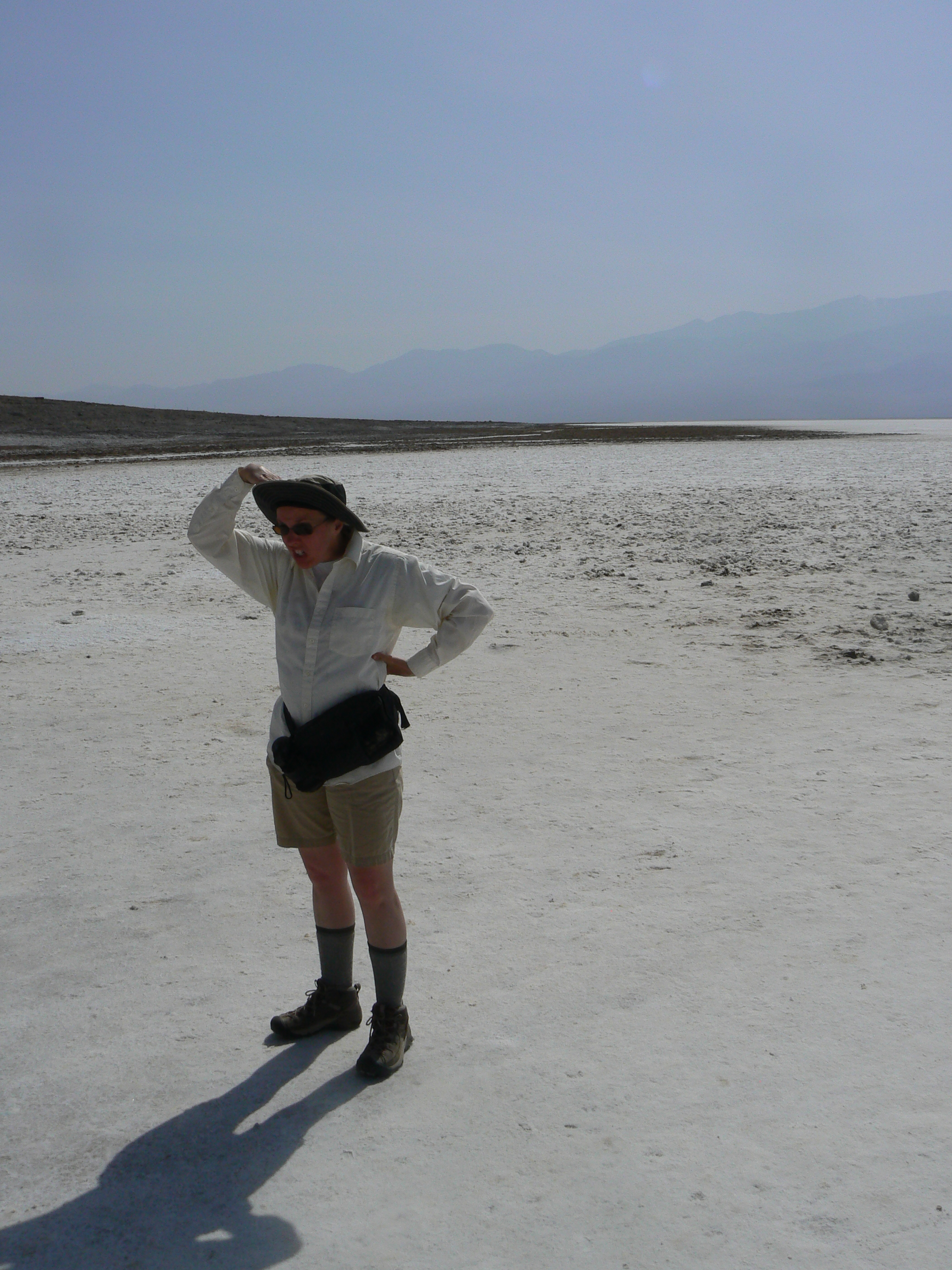
Prudence in Death Valley: wear a hat, bring water

This judgement about what is responsible is the stuff that made me a neurotic mother.  Am I “responsible” for navigating the waters of life for myself , my husband, and all my children?  How much responsibility do I take?  Which risks are worth it?  Do I allow my kids to walk to school alone, to learn to drive, to travel?   Do I ‘allow’ my diabetic husband to eat ice cream?  If someone in my family dies, does that mean that I have failed?  We’re all going to die; does that mean I’m doomed to fail at life?  You see – this can start a very vicious cycle of paranoia and dread.  Is it wise to live with that?

I think that I used to abdicate that issue of responsibility and pass it on to God.  I figured He was responsible for my life and my death, and I was off the hook.  That was useful for a while.  My grandmother used to hedge her bets by saying, “Trust in God, but do your homework.”   I suppose that’s useful advice as well.   I find that Buddhism gives a useful perspective, too.  It says simply that life and death is what we’re given, and that we can choose how we live.  Jim used to say, “I can be sick and miserable or I can be sick and happy.  I choose happy.  Pain is inevitable; misery is optional.”   All good stuff to think about.