Unknown's avatar

That Bwessed Awwangement

Today is my parents’ wedding anniversary.  They were married in 1955, and my dad died in 2010.   My mother was 20 when she got married, not even legally allowed to drink the champagne cocktails they served.  I was 21.  We wore the same veil and the same hooped petticoat when we walked down the aisle.  We said the same words from the Episcopal nuptial mass.  We are both widows now.  Time and society have changed Marriage quite a bit, and I’m sure that will continue.   We redefine our social institutions, and why not?  We made them up.  Kind of like the bowling game Steve invented (see my post “Hope for a recovering perfectionist”), your experience grows outward into broader concentric circles.  If you’re a linear person, you may not see it this way at first, but imagine an aerial view of the game as it progresses, and that may help.  So, what is marriage for?  When I was 21, I was absolutely thrilled to be getting married.  It had been a goal of ours for 5 and a half years!  Jim and I wanted to marry and “have lots of sex and babies” (best Alan Rickman voice there).  We wanted to merge our lives, our fortunes, our fate, our names, the whole bit.  And we wanted to do it in the context of a social community that we had become invested in: our families and our church.   This commitment to our relationship, the larger circle of people supporting us, and to our belief in a personal God who was also invested in us, was a very spiritual thing.  It was central to our lives and how we lived them out.  I didn’t think very much about the legal arrangement; it was rather swallowed up and incorporated in the religious ritual.  I enjoyed a very successful, loving marriage for 24 years.  And I don’t want another one.  My experience has shifted into another circle.

I have always and will always value relationships very highly.  I have a wonderful relationship with Steve.   We started talking about getting married in December of 2008.  My previous experience was that when you talk about marriage with a boy, you’re engaged and then you get married.  Well, when Steve talks about something, he really explores it deeply.  We now laugh and recall that what he really meant to communicate back then was that he was not afraid of marriage.  He is willing to marry.  But what kind of marriage would it be?  How would we define it?  How would we want to live it out?  What is the purpose of a legal marriage?   How is our personal ‘contract’ with each other different than a social contract?  What part do we want ‘society’ to play in our life, including family, the state, the country, the world?  At this stage of my life, I’m not about setting up a family that will interact with society.  I am about developing a committed, working partnership that will support our growth into deeper living on many levels.  We may encounter some legal situations that would give us good reasons to get married…like if we travel internationally and find that married couples navigate the system more easily, or if we start filing taxes as a family business or something…and we may decide to marry then.   I definitely wouldn’t want to change my name.  I want to have the same last name as my children.  Besides, I would rather die than give up the only thing that may possibly give me an Italian identity!

What about the giddiness of being in love, of beginning something special that you share with your friends and family, of having a big party with presents?  Well, we’ve talked about that, too.  Speaking of “Don’t Super-size Me” (my last post), have you ever been to a wedding that wasn’t out of scale in some way?  There is so much going on in weddings.  Traditions upon traditions upon social customs upon personal expression, etc.  Steve and I are often confused by those layers of social business, and we prefer to communicate one-on-one.  So maybe, when we have a place that we feel will be our settling place for some time, we will want to invite people who are part of our social contract to hear more about our partnership in that place and celebrate it with us.  Actually, we are doing that anyway every time we invite people over for dinner.

Committed partners

And then there’s dancing.  I didn’t have dancing at my wedding.  I don’t think my mother did, either.  Steve and I are going dancing tonight…at Old World Wisconsin in a barn with a bunch of strangers and their children.  This will be our third time.   I love dancing there.  I feel connected to my body, to people, to music, to my thoughts, my emotions, to the prairie and nature and the wooden floor, to history and to life.  For me, that’s a blessed arrangement indeed.  So, like the song says, “I hope you dance.”

Unknown's avatar

Follow Your Bliss

“Do you care what’s happening around you?  Do your senses know the changes when they come? Can you see yourself reflected in the seasons?  Do you understand the need to carry on.”  I was humming this John Denver song yesterday as I walked around the neighborhood with my camera, looking for signs of autumn.

I noticed something peculiar about some of the maple trees.  I had seen this from my bedroom window a few days before.  Black spots on the leaves, as if the rain we had the other day had pelted them with something corrosive.  I took these down by the city pool.

And this is my “treehouse” tree, the one outside my bedroom window.

I wanted an answer to what made those mysterious spots, so I took my camera with me to the Wehr Nature Center where I had volunteered to sort fliers for school groups.  I went to one of the staff naturalists, who referred me to another, Mark, who knew something about plant diseases.  Mark said that it was probably a fungal disease and mentioned one, verticillium wilt, that is deadly to trees.  He told me that I should look up a plant pathologist from UW Madison, Brian Hudelson, on the internet who diagnoses plant diseases from samples, for a fee.  With visions from my childhood of elm trees felled all up and down the street for carrying Dutch Elm disease, I went to my computer looking for this tree specialist.

I found out that Dr. Brian Hudelson is the plant pathologist on the NPR show “Garden Talk”.   His website contains instructions for taking samples and a fee chart for services from the diagnostic clinic he runs.  Since these are city trees, I wondered if he’d answer my question based on just photos.  I pulled my best Nature Center Volunteer card and wrote to him as a good citizen concerned about the health of our village trees.  He responded immediately with a pdf information page on Tar Spot fungus.  Fortunately, it’s not fatal to the tree and can be treated.  I was so relieved that I sent back an immediate “thank you”.  This was his reply:

Priscilla:

Glad to help, and please don’t worry about misspelling my name.  I really didn’t notice.  I tell everyone that I respond to pretty much anything (including expletives).  Everyone really just calls me Brian.  If you want to call me Dr. something, call me Dr. Death.  That’s been a nickname and radio handle for years (and DOES tickle the evil little boy in me).

Definitely let me know if you need information in the future.  Happy to help.

Brian (:))

I am so excited to be working with people who are passionate about what they do!  Susan called me from her orientation day at UW Madison that afternoon.  She was wondering if she should have her head examined for paying for a master’s program in linguistics by working full time.  I told her that she was finally doing something about which she had always dreamed, that she was doing exactly what Joseph Campbell (author of The Power of Myth and professor at Sarah Lawrence for years) had advised all his students to do:  Follow Your Bliss.   This is the way to true happiness.  I want to see myself, my children, everybody get to fly.  What is life for, anyway, if not to live it passionately?

This morning at breakfast, Steve read me this poem.  We both had tears in our eyes afterwards.

The Writer — Richard Wilbur

In her room at the prow of the house
Where light breaks, and the windows are tossed with linden,
My daughter is writing a story.
I pause in the stairwell, hearing
From her shut door a commotion of typewriter-keys
Like a chain hauled over a gunwale.
Young as she is, the stuff
Of her life is a great cargo, and some of it heavy:
I wish her a lucky passage.
But now it is she who pauses,
As if to reject my thought and its easy figure.
A stillness greatens, in which
The whole house seems to be thinking,
And then she is at it again with a bunched clamor
Of strokes, and again is silent.
I remember the dazed starling
Which was trapped in that very room, two years ago;
How we stole in, lifted a sash
And retreated, not to affright it;
And how for a helpless hour, through the crack of the door,
We watched the sleek, wild, dark
And iridescent creature
Batter against the brilliance, drop like a glove
To the hard floor, or the desk-top,
And wait then, humped and bloody,
For the wits to try it again; and how our spirits
Rose when, suddenly sure,
It lifted off from a chair-back,
Beating a smooth course for the right window
And clearing the sill of the world.
It is always a matter, my darling,
Of life or death, as I had forgotten. I wish
What I wished you before, but harder.

I am thinking of my kids; Josh and Becca will be driving back to Illinois from Oregon beginning tomorrow.  I wish them a lucky passage.  I wish all of us a flight that follows our bliss.

Unknown's avatar

Hope for a recovering perfectionist

Western thinking is set up in a dualistic manner.  We have pairs of opposites: good and bad, right and wrong, black and white, body and soul.  Things are separated and put into boxes.  I was raised on this philosophy in my Judeo-Christian upbringing.   Human nature or sin nature is in opposition to divine nature.  We are told to die to sin and human nature and live out of divine nature.  It’s an either/or proposition.  And it’s impossible to do.  I simply cannot stop being human – and I don’t really want to.  When I think I ought to because of some person’s judgment, then I end up hating my humanness, and hating myself.  I feel guilty for being imperfect and human.  It is a cause of suffering.   When Jesus comes along to take the blame for my sins, the system isn’t really undone, it still seems like we are the Bad Ones and he is the Good One.

Eastern thinking is not dualistic.  It is both/and.  Good and bad are not separate.  Nor are right and wrong, body and soul, etc.  Every decision is somewhat good and somewhat bad.  Joseph Campbell talks about this in The Power of Myth.  The great mythic tales often point out this seeming ambiguity and emphasize that this is the real nature of life.  Yin and yang are not separate; two sides of a coin are not separate.   I am not separate from my human nature, from my mistakes, from my less effective parenting episodes.  They’re all me, and they do not need to be separated from me and judged.  We tend to get all up in arms about issues and pick a side, thinking that this is the obviously correct side.  Really, things are about 60/40 at best.  I often bring this up when one of my children is fretting about a decision and terrified that they will make “the wrong” choice.  Nonsense, I say.  You will make “a choice”, and if things don’t go in a way that seems beneficial after that choice, then you can make other choices.   Steve told me that when he was a kid, he had a plastic bowling set and used it to play a game that he made up.  He’d set up the pins in the usual pyramid arrangement, then bowl the ball and scatter them.  He would then set the pins up exactly as they had fallen, and bowl the next frame in the new arrangement.  Each time, he would just set the pins up where they were and start from there.  He never knew how the game would play out…I suspect that his pins were all over the yard after a half an hour.  I suppose the object of the game wasn’t the traditional “Knock ’em all down, Daddy”, meaning knock ’em all down at once.  It became more “Knock ’em all down eventually”.  After all my years of living, I rather think this new model is more like how life plays out.

So Steve & I have adopted a metaphor of decision-making that we call “Pointing the Canoe”.  We make good decisions, I believe, ones that take some time and try to consider many aspects.  They are not perfect decisions that knock all the pins down at once, but they are decisions that we hope will bring us closer to the light on the horizon.  I don’t know how to make a perfect decision, and if I live in fear of that, I most likely won’t make any decisions at all.  I make a good decision, and then I look up at the horizon.  If I’m not heading toward the place I want to get to, I make another decision.  I point my canoe and paddle on one side or the other, and I get there eventually.

Every week, we get together to have a Summit Meeting.  This is where we discuss the decisions we are making and how to point the canoe so that we’ll be living the life we want to live.   We put our values out on the horizon and see how we’re lining up.  We want to live more simply and sustainably.  We want to be spending most of our time, not on “small fires”, but on things that we find very important, like Spirituality, Music and Nature.  We want to be kind.

Today, I got to live out of a decision I made last week.   I interviewed at a county park that has a Nature Center.  I wanted to volunteer to be an interpretive trail guide and be involved in educating people about nature.  Today, I spent 5 hours at Astronomy Day telling kids (and their parents) about NASA’s Discovery program and the Dawn Spacecraft that is sending back information about asteroids.   I don’t know how long I’ll be doing this volunteer work; it’s not a perfect answer to “what should I do with the rest of my life?” (because it’s not paying me anything and won’t sustain me), but it’s closer.   I am also a Certified Teacher with TakeLessons.com now.  This means that a music lessons match-up organization in San Diego is trying to get me private voice students.  I’m not sure if that’s what I want to be doing with the rest of my life, but it is teaching and it is music, so it might bring me a bit closer.  I have yet to get my first student.

I still spend a lot of time wondering about who I am and what I “should” be doing.  It feels good to be in the canoe and moving toward my horizon, doing my own paddling.  I have been so fearful about how to live my life after being widowed.  Not so much any more.  Recovering from perfectionism helps.

Unknown's avatar

Happiness Is

A couple of days before my 5th birthday, I got the chance to perform on a stage for the first time.  It was in a talent review put on by the Wabaningo Club of the Sylvan Beach neighborhood association.  That was where my grandmother owned a beach cottage on Lake Michigan.  I rehearsed the song “Happiness Is….” from the musical You’re a Good Man, Charlie Brown and performed it with 13 other little kids, including my sister, a second cousin, and the two daughters of my parent’s friends, the Pulvers.  I know these details because I found the program online in the Wab Club’s archives.  All I remember is standing on the stage and looking out at people’s faces, smiling at me.  I saw a photo of this group performance hanging on the wall of the Pulvers’ cottage in 2007, 40 years later.   I stuck out.  I was a step in front of the whole line up, my eager face displaying a huge, open mouth.  I guess I was kind of a ham.

The songs lists a bunch of cute, juvenile reasons for happiness.  Two kinds of ice cream, five different crayons, getting along — “everything and anything at all that’s loved by you”.   It rather assumes that things outside of you are what will make you happy.   I bought into this idea pretty thoroughly, and I know a lot of others who did (and do), too.  My list included having approval, good grades, someone who loves me, kids who are successful, good health, and a bunch of other stuff.  I would get anxious, upset, and sometimes downright terrified if I felt that any of these conditions might end.  In moments of loss, when something that had made me happy changed, I would often hear people comfort me by saying, “God loves you.  It’s OK.”  But again, that felt like something outside of me that I could lose, another idea of happiness that made me fret about whether I possessed it or not.

In a videotaped speech of Anthony de Mello’s, I heard about the idea of “attachment” and how we suffer from it.  We suffer in the loss, the impermanence of our attachments.  I’ve been thinking about this for about 10 years now.  I think back on how the attachments I had to certain ways of being affected my parenting.  We went through a lot of suffering as a family.  I felt so angry that we couldn’t seem to do things according to my expectations.  I rejected the way things were and tried to fix them.  I asked God to fix them.  And we kept suffering.   Slowly, I began to loosen my grip.  Finally, I prayed that I would be able to accept things as they are and be strong enough to accept the things that were to come, even though I was terrified of what that might be.  Yes, Jim died.  That was what I was fearing the most.  Interestingly, when that became a reality instead of a fear, some of the suffering was relieved.  More suffering was relieved when I began to look at other realities with less judgment and more acceptance. I am still working on the practice of non-attachment and the understanding of happiness.  Here’s a quote that puts it quite simply:

“The Kingdom of God is also said to be like a treasure that someone finds and hides in a field.  Then, in his joy, he sells all he has and buys that field.  If you are capable of touching that treasure, you know that nothing can be compared to it.  It is the source of true joy, true peace, and true happiness.  Once you have touched it, you realize that all the things you have considered to be conditions for your happiness are nothing.  They may even be obstacles for your own happiness, and you can get rid of them without regret.  We are all looking for the conditions for our own happiness, and we know what things have made us suffer.  But we have not yet seen or touched the treasure of happiness.  When we touch it, even once, we know that we have the capacity of letting go of everything else.

“That treasure of happiness, the Kingdom of Heaven, may be called the ultimate dimension of reality.  When you see only waves, you might miss the water.  But if you are mindful, you will be able to touch the water within the waves as well.  Once you are capable of touching the water, you will not mind the coming and going of the waves.  You are no longer concerned about the birth and the death of the wave.  You are no longer afraid.  You are no longer upset about the beginning or the end of the wave, or that the wave is higher or lower, more or less beautiful.  You are capable of letting these ideas go because you have already touched the water.” — Thich Nhat Hahn Living Buddha, Living Christ

Steve at Lake Michigan, on the shore opposite the cottage

Anthony de Mello quoted Kabir, an Eastern poet, saying, “I laughed when they told me the fish in the water was thirsty.”  I keep thinking about that one…

Unknown's avatar

Claiming Rights of Passage

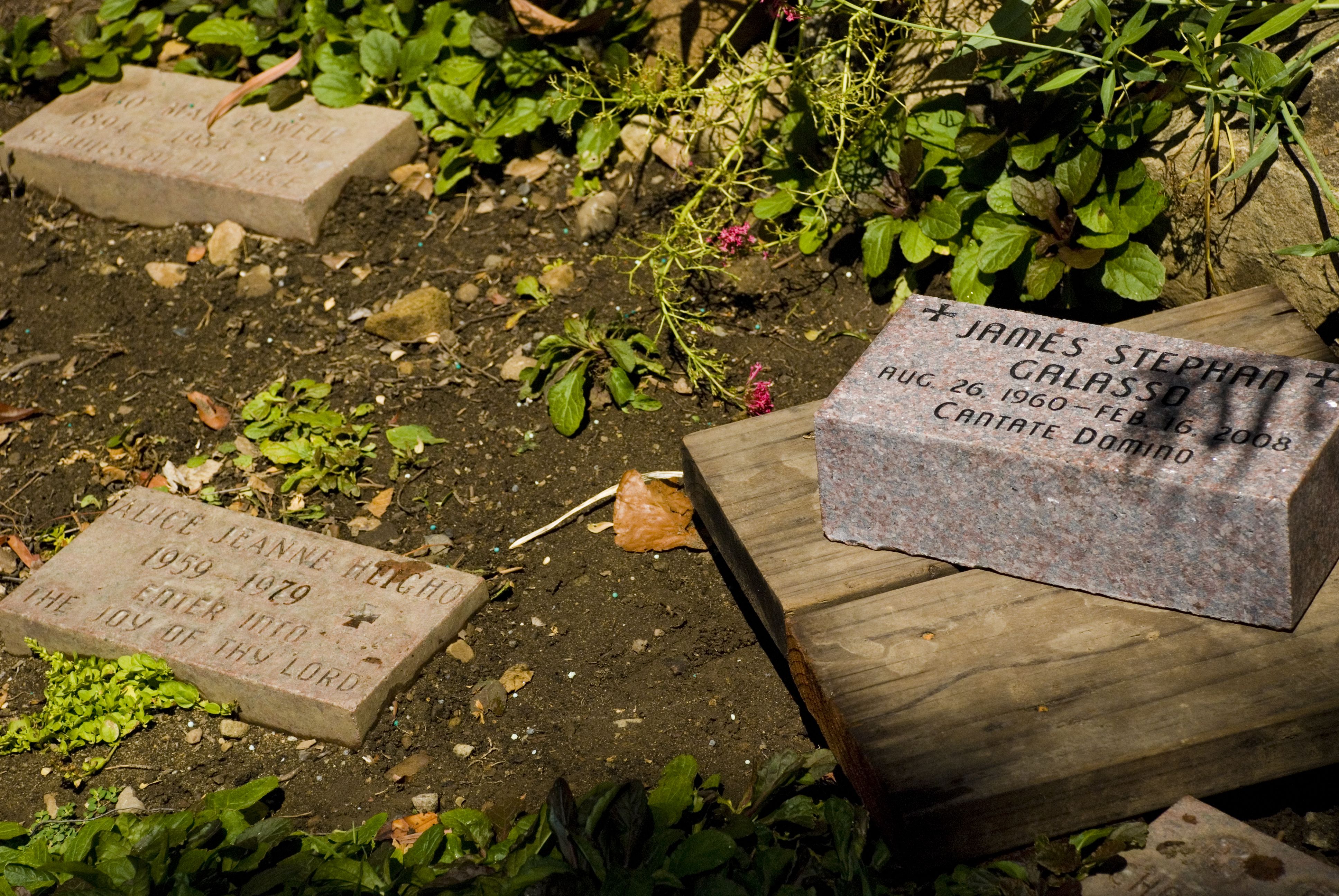
St. Luke’s columbarium

A few years ago, I went to an exhibit on mummies at the Milwaukee Public Museum.  It was fascinating.  Listening to the whispered comments and questions of other patrons was fascinating as well.  We have a very scattered cultural approach to death, with so many various ways of marking the rite of passage, including not really marking it at all.  Our American culture, as a whole, has been dominated by technology to the point that important parts of our lives are relegated to “experts” and taken out of our hands completely.   My mother fought against this trend in the late 50s when she insisted on breastfeeding her babies instead of allowing the “experts” to convince her that artificial formula on an artificial schedule was better for them.   Birth experiences have become sterilized, institutionalized, and anesthetized as well in the mainstream.  My 4 were all born in a hospital under the HMO system (but not under any pain killers!) because in my 20s, I wasn’t brave enough to seek more creative options.   However, my sister birthed one of her children at home, and I once assisted a friend who had a home birth.  It’s not impossible to choose to take full responsibility in this event.  Death is another part of life that more and more people deal with by proxy.  Of course, the hospice movement is a wonderful example of the purposeful effort to maintain the grace and dignity of this stage of life by bringing it back into the home, away from institutions.  I recently watched an Ingmar Bergman movie set at the turn of the century, called Cries & Whispers (well, it’s actually called something in Swedish, but that’s the English title).  This intense family drama deals with the death of a spinster sister from cancer.  The action all takes place at home, in this case an elegant manor.  The doctor’s largest role is in an affair with one of the sisters, in flashback.  When I think of the family drama of my husband’s death, experts and technology played a huge part.  Unfortunately, that became a distraction from entering into the rite of passage, from experiencing the more intimate aspects of the dynamics that were changing my family.  What I mean to say is that it enabled denial.

The last photo of Jim; coming out of surgery Feb. 5

What does it mean to choose to take responsibility for my life?  Not to delegate the more painful or complicated bits to an “expert”, not to live by proxy or by representative?  In which situations do I most often abdicate my ability to decide a course of action?  Financial, political, medical, social, spiritual, emotional, physical.  I am only beginning to wake up and ask myself these questions.  Steve often puts it to me this way: in every situation, you have at least 3 options.  1) Run away and hide  2) Try to change the situation  3) Change yourself.

This is a good time for me to think about aging, about how I want to live and address the changes that are happening now and will continue to happen.  What do I want?  I want to experience life in a more authentic way, not behind a duck blind or a proxy, not behind a curtain of denial or dogma, not by avoiding discomfort or hard work.  I want to make decisions about who I am and how to live proactively.  How do I embody this?  At this point, I am still figuring out who I am and want to be and recognizing places where that has been dictated and I have responded without looking deeper.   My father and my husband took great care of me.  I want to learn to do that myself.   I often dream about Jim returning as if he’d never died.  Last night, I had a powerful dream about him, set in the house I sold, with my young children around.  My consciousness struggled with it; I knew that the house was emptied and I’d moved.  I couldn’t understand why the furniture was back and the place looked so “lived in”.  I couldn’t understand why Jim was there.  He told me he was going out to work because he wanted to support me and the kids.  In a choked whisper, I closed the door behind him and said, “Don’t come back.”  I woke up crying.  Talking about this dream with Steve, I realized that I do want him to come back and float through my subconscious and consciousness without confusing me, without affirming me or correcting me, just visiting.  I suppose when I gain the confidence to affirm and care for myself, my dreams will change.

Unknown's avatar

You Are Radiant of the Spirit

I was raised by very devout Christians, members of the Episcopal Church.  My father was a professor of math and science and later a technical writer for IBM.  He was not, as Madeleine L’Engle defines it, a “fundamental literalist”.   He taught us the Bible, and he taught us Darwin’s theory of evolution.  He believed in the literal interpretation of Darwin’s writings, not the Bible’s.  But he did believe, as did I, in our need for salvation.  There is a certain elegance in Christian apologetics.  My father admired C.S. Lewis especially.  The rational, reasonable, intellectually satisfying story of a creation of God having been separated from the divine by a sinful nature and then rescued and redeemed from Death by a loving, heart-broken Father God is poetic and dignified in many ways.  The same story appears in many different forms in many different cultures.  Perhaps it is satisfying because it is so seemingly universal.  My father was very much an authoritarian.  I was separated from him by every infraction of his rules.  I longed to be forgiven and loved.  I knew that story of punishment and death by heart.  I didn’t know there could be another experience.  I didn’t think to ask if it was the only way to look at what is real about humanity.   Finally, someone asked me, “Who says you’re separated from the divine?  What if you’re not?”  I began to look at a different ancient grace.

Doodling and coloring is one way I meditate on a new idea

Call it “the indwelling of the Holy Spirit”, greet it “Namaste”, wake up to it through a practice of meditation, it’s the same.  After I read the book The Power of Myth, I borrowed the videotape from the library of Bill Moyers’ interview with Joseph Campbell.  My favorite part is where Joseph Campbell says to Bill, “You are radiant of the Spirit,” and Bill responds in animated and personal surprise, “Me?!  A journalist?”  After hours of talk, he finally realizes that the Myth has something to do with him – himself.  I thought about this for a while and told Steve that I felt a similar disconnect from life, as if I am observing everything from a duck blind.  I could talk about what is happening “out there”, externally, quite easily, but I have difficulty identifying and placing my internal experience in the picture.   I was taught to be suspicious of emotions, to “lean not on your own understanding”,  and although that teaching was powerful, I now realize it is not altogether helpful or even consistent with the way Jesus talks about spirituality.  When Jesus confronts the Pharisees, he is often challenging them to get rid of their dogma and be open to using their consciousness.  “Who says you’re separated from the divine?  What if you’re not?”  What if…indeed.   My recommended reading list includes The Power of Myth and Living Buddha, Living Christ by Thich Nhat Hahn.  Also The Gift: Poems by Hafiz, the Great Sufi Master of which my favorite is The God Who Only Knows Four Words:

Every

Child

Has known God,

Not the God of names,

Not the God of don’ts,

Not the God who ever does

Anything weird,

But the God who only knows four words

And keeps repeating them, saying:

“Come dance with Me.”

Come

Dance.

Unknown's avatar

Uncontained and immortal beauty

Ralph Waldo Emerson wrote in his essay on Nature in 1836:

“Nature never wears a mean appearance.  Neither does the wisest man extort all her secret, and lose his curiosity by finding out all her perfection.  Nature never became a toy to a wise spirit.  The flowers, the animals, the mountains, reflected all the wisdom of his best hour, as much as they had delighted the simplicity of his childhood…The lover of nature is he whose inward and outward senses are still truly adjusted to each other; who has retained the spirit of infancy even into the era of manhood….Standing on the bare ground, –my head bathed by the blithe air, and uplifted into infinite space, — all mean egotism vanishes.  I become a transparent eye-ball.  I am nothing.  I see all.  The currents of the Universal Being circulate through me; I am part or particle of God…I am the lover of uncontained and immortal beauty.”


Nature is an ancient embodiment of grace.  The elegance of form, motion, manner, action and moral strength inherent in the natural world can be revealed and described in detail by science, but not in totality.  The mystery of this grace remains.  There is a random, chaotic element that defies analysis and inspires awe.  The morality of what is defies dogmatism.  Death is intrinsic to the grace of life, not an aberration or problem to be solved.  I have not always believed this, although I have always loved Nature.

During my child-rearing years, I frequently walked to a prairie preserve in my neighborhood for sanctuary and solace.  I began to have a very special relationship with “my prairie”.  My entire demeanor would change the minute I set foot inside the gateway.  I would feel myself relax, physically and emotionally, and whatever was simmering at the core of my being would bubble up and spill over.  Often, I would cry copiously, hoping I wouldn’t meet anyone on the paths.  Just as often, I would be exuberantly lifted by sunshine, color and fragrance and dance my way over the grass.   After settling in to the quiet, I would observe the wisdom of the place and learn something to take back with me into the suburban world.   For many years, I would visit the prairie in the middle of the day while the kids were in school and feel rather guilty and unproductive to be enjoying the grace of the place instead of “working”.  It occurred to me one day that someone should at least be doing the job of enjoying it.  It seemed a huge pity that the dazzling elegance of the sky, the land, the creatures and all that thrummed and buzzed and swished should go unnoticed.  I felt that their Creator should be thanked, and in those days, I believed that was the God of the Bible, the same Father God who rescued and redeemed us from Death.

Death is a biggie, in my life and in my culture.  When I was 16, I was in a car accident with my 20 year old sister where she died beside me.  When I was 29, I was a prayer warrior who fought off Death when my infant daughter had spinal meningitis.  When I was 45, I woke one Saturday morning and found my husband cold and lifeless beside me.  Death was The Bad Guy who sneaked into the Garden and stole our birthright.  God was The Good Guy who caught him and gave it back.   Illness is just Death sneaking around, and I have been a paranoid hypochondriac at times because of that way of thinking.  But that isn’t the only way of thinking, I found out.

Once, when I entered my prairie, I was shocked to go around the bend in the path and see the ground burnt jet black.  The vibrant green shoots of grass across the path from that section of land made a startling comparison.  This controlled burn was part of the park management program for spring.  Dry stubble and thick hanks of grass had been burned down to decaying ash in order for the new life to grow up.  I wasn’t sure what to make of the change in my sanctuary.  I felt that something bad had infiltrated the Garden.  I took it rather personally, and although I understood the scientific reasons for it, my spirit was troubled.  I wanted to know the wisdom of this observation.  I found it explained quite elegantly later, by Thich Nhat Hahn in his book No Death, No Fear: Comforting Wisdom for Life.  He gives many examples of how life is in a state of continuation such that there is no beginning point or end point.  We have no birth day or death day.  Paper is the forest, the logger, the clouds, the sunshine, the ash when it is burned, the heat that we feel after the smoke blows away, the soil that is enriched and the tree that grows in the soil.  “If you are a scientist and have very sophisticated instruments, you can measure the effects of that heat even in distant planets and stars.  They then become a manifestation, a continuation of the little sheet of paper.  We cannot know how far the sheet of paper will go.”

Continuation is the ancient grace of Nature.  Ancient and immortal and always new.

Yesterday was a wonderful continuation day for me.  My daughter Emily and Steve and I walked in Chicago’s oldest cemetery and found cicadas everywhere – their sound, their carapaces, their bodies.  Death is not a Bad Guy, just a concept.  I am comforted by this wisdom.

Me, when I started this blog.