Unknown's avatar

To Ad or Not To Ad

That is the question: whether it is nobler to support the hosting web manager directly or to suffer the slings and arrows of outrageous advertisements that defray his costs.  Or to take up arms against capitalism and occupy cyberspace, thereby ending it.

My apologies to the honorable Bard.  I woke to a dilemma this morning when my sister noticed a “goofy” ad showing up on my blog that was totally incongruous to the serious, graceful tone that I’m trying to achieve.  I found out that through the Terms of Service that I agreed to when I started this blog, I had given my permission for WordPress to run ads on my page to defray their costs.  If I want to ensure that there will be no ads on my blog page, I can pay a yearly fee of about $30.  So much for the idea of truly “free” hosting.   To be fair, though, this is only the second time since August I have seen an ad on ANY blog that I’ve visited.  I suppose I harbor a vain hope that there is a way to avoid capitalism in my daily life, and unfortunately, that is just not possible.  What I do have is choices about how I will interact with this system.

What kind of choices do I get to make?  Well, I can choose to avoid advertising by paying the fee, like I would do with Public Television (if I had a TV).  I can choose to support local small businesses, like the family operations that fixed my car this week.  I can choose “no ad” products at the market and avoid mega-stores and franchises.   I can unsubscribe to all the junk mail I get online or through the Postal Service.  Come to think of it, I need to find a better way of doing that.  I am still getting junk mail in my late husband’s name at my current boyfriend’s address, which is kind of creepy in an absurd sort of way.  It will be four years in February since he died.  How do you turn that sewage off??

The fact that advertising is so ubiquitous is one of the things that makes it so objectionable.  We are bombarded to the point that we stop paying attention.  Our awareness is compromised, and that goes against the very thing I am trying to develop in my life.   How many advertisements do you see in your average day?  If someone came up with statistics about how many you encounter, how much time you spend reading them or viewing them in video, how much time you spend trying to dispose of them or avoid them, how much money you spend funding them (whether directly or indirectly), and how much noise and visual pollution they add to the environment, don’t you suppose you’d be surprised?  Possibly appalled?  Angry? Or wouldn’t you care?

I think that the sheer volume of advertising and the phoniness of it creates an atmosphere that is potentially damaging to the human spirit.  I want to point my canoe in another direction entirely.  My relationship with my blog host is not one that will allow me to get away from using currency, but I can get away from using advertising.  I wish I could trade singing lessons or a home cooked meal for the use of cyberspace. … Yeah, that would be neat.

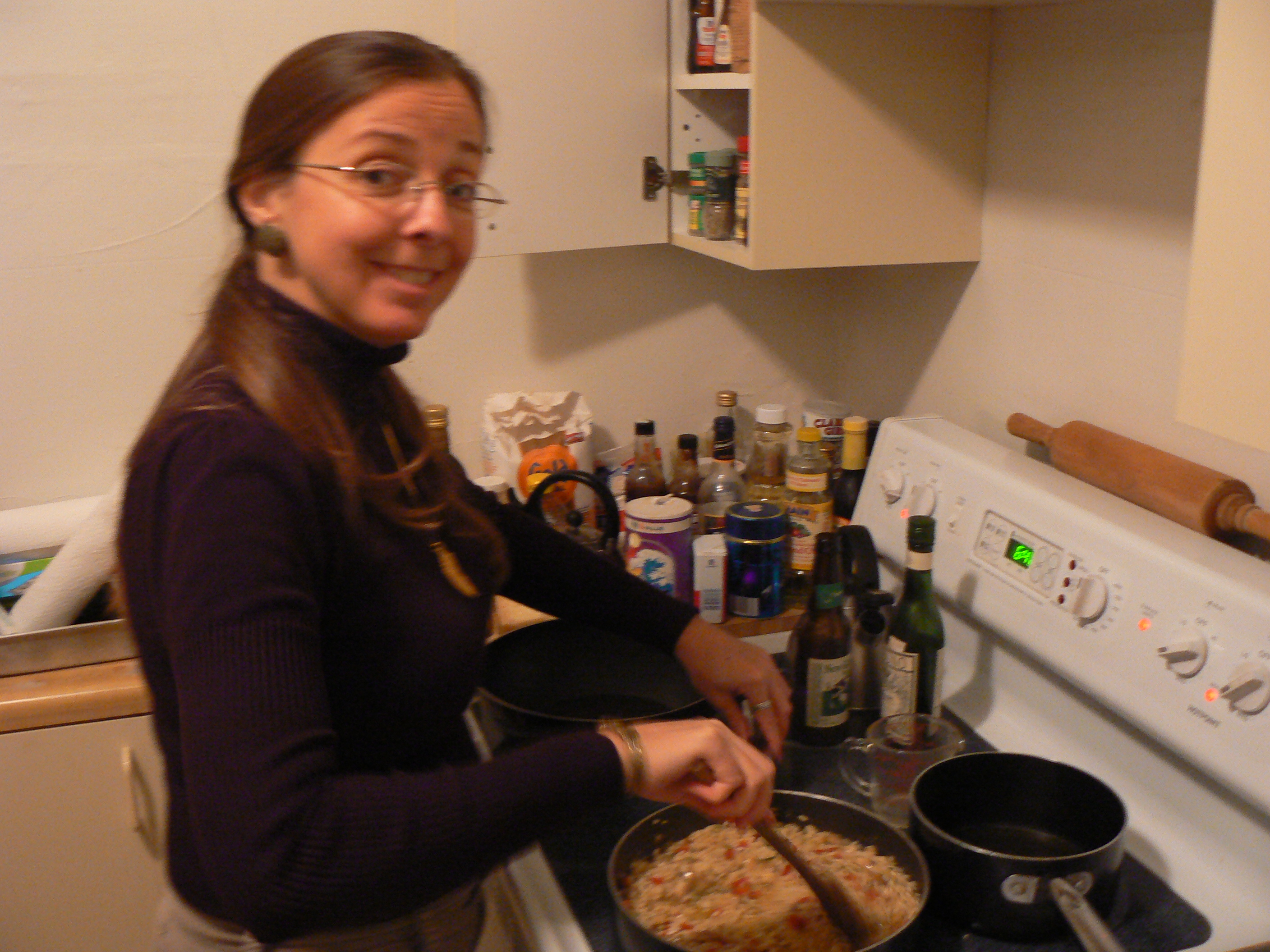
Hey, WordPress! I'm making risotto tonight!

Unknown's avatar

Getting Along

Sundays will always prompt me to meditate.  How should I behave?  How can I walk in a good and gracious and loving and peaceful path today?  Contentiousness makes me squirm uncomfortably.  Much of it is social, but it can lead me to deeper awareness.  For example, who cares if you rake the leaves off your lawn and why?  I have had conversations about this topic with Steve, his mother, and my neighbors.  Each of them has a perspective on this, and they are not all in agreement.  Which of these are important to me?  What rationales am I giving for my behavior in this situation?  Well, finally I decided to rake the leaves up this morning while Steve was sleeping.  I had a dream last night that some teenagers were assigned by community service sentences to rake the leaves on our property.  I saw that they had done it, and I was relieved.  If I feel this relief in my dream, I figured I should just relieve myself.  So I raked and encountered my landlord during the process.  I feel I have a better relationship with myself and my neighbors now.  The leaf relationship with Steve and his mother is still a work in progress.

Our reading time with D.H. Lawrence’s The Plumed Serpent reached a rather dramatic point.  Ramon, who is ushering in the age of Quetzlcoatl, removes the images and statuary from the local Catholic church and burns them in a big bonfire.  He exclaims through a hymn that Jesus and Mary have left Mexico and gone back to heaven.  Adios, they sing.  Quetzlcoatl is returning.  I can tell there’s going to be a religious war in the upcoming chapters.  Somewhere deep in my psyche a little voice is saying, “Uh-oh.  That’s really bad.  You are going to be in SOOOO much trouble for reading this book about de-throning Jesus!  It’s bad enough that you stopped going to church, etc.”  Wow.  So what is a gracious and peaceful path in the midst of a religious war?  How do we engage in philosophical exploration and practice peaceful co-existence when we’ve been taught to have red flags and warning lights go off whenever we venture into this dangerous territory?  Is it real danger or is the danger manufactured to scare us into our corners?

I feel estranged from my former church friends, and I’m still trying to figure out how to deal with that gracefully.  I was very active there for 20 years.  I haven’t been in communication with any of them much for the last 3 years, and I wonder about that a lot.  Were those true friendships?  It was a very social church.  Was it just about acquaintance and pleasantries?  Was the intimacy that sometimes arose merely circumstantial?  Today I got an e-mail from my dearest friend from there.  She is suffering.  I feel so moved that she included me in her update that I keep tearing up as I write this.

I have changed so much over the last few years.  I have stripped off a lot of familiar ways of being in order to try some newer, more open, more aware versions.  I still feel very tentative and emotional about it sometimes.   But I am really grateful to be in a place where I examine my motivations and actions more closely than ever.   It is a lively place, and I think I will see grace here.

Unknown's avatar

Living Heroically

Discipline without coercion.  Is it possible for individuals?  For communities?  Dare we believe that without obligation, people will make efforts to do their best and work toward the common good?  Are people who do that “heroes”?

We dangle punitive measures and capitalistic rewards in front of the masses and hope that will encourage us to be model citizens, and then we have to deal with the greedy monsters that evolve wondering “What’s in it for me?”  If I am of the 1% and super-wealthy, what incentive do I have to share?  And what is the percentage of the 99% who hope that one day, they will become super-wealthy also and so feel no inclination to put restrictions on the rich?  How many people are likely to come to a sense that they have “enough” all on their own and turn their surplus over to others?  And when will that sense of “enough” kick in?  What standard of living do we feel entitled to?  What would it feel like to say, “This is all I need.  I am not afraid to trust that I have enough”?  Would it feel like freedom?

How do you discipline yourself without feeling a sense of obligation?  Do you eat healthy foods because you want to?  Or because some outside influence is holding up a consequence or reward?  Do you make music because some authority is telling you to practice or for the sheer joy of it?  Do you do what you do out of passion or fear?

On our first date, Steve played a kind of “twenty questions” game with me.  I was trying to guess his three heroes in order to get to know him better.  He maintains that each of these inspirational figures have a passion for something and demonstrate it joyfully.  The first one is David Attenborough of the BBC Natural History Unit, groundbreaking writer and presenter of nature programs.  The second is Julia Child, The French Chef.  I was in total accord to this point, and also loved that they are easy to imitate in voice and mannerism to add levity to any undertaking (and we do this frequently).  The third one was rather tough to guess, mostly because he wasn’t human.  “An athlete” was about as close as I got.  Finally, Steve led me to thinking about equestrian athletes, and I immediately thought of Secretariat.  I found that rather a head-scratcher, though.  How could a horse be a hero?  And then he showed me the youtube clip of the final race in the1973 Triple Crown.  It still makes him cry.

A horse cannot be coerced by the promise of fame and fortune, can it?  There was no whipping, no carrot on a stick.  Secretariat ran for the pure joy of running, it would seem.  Feeling the power of his legs, the wind in his mane, the freedom of doing what he was born and bred and loved to do that day.  Did he have a reward afterward?  Did he develop a taste for winning?  I suppose you could debate the emotions of a horse forever and never learn anything conclusive.  You could also debate whether or not his race was something that created “good”.  Many people were undoubtedly uplifted; just listen to the audio on the tape.  His grace and beauty are captivating.  And maybe a bunch of people were making money off of it, but the horse wasn’t.  For that reason, it seems rather pure to me.

So what would it mean for you and me to be the heroes of our own lives?  To be the best we could be not out of obligation or fear of reprisal or for monetary gain, but just for the joy of living out our own passion and interest, for the love of it?  What would it be like to allow that to be our reward, our life work, and not ask fame or fortune from it?  Would we share any surplus of our efforts?  What if we all lived like that?  Would we be able to balance the table top, enjoy sustainability and equality, as a community and perhaps as a planet?  Is this a utopian ideal and totally unrealistic?

Probably.  But I would love to feel the wind in my hair, too…

...like her. (My daughter, in France, living her passion.)

Unknown's avatar

Bravi!

I just returned from watching the HD live simulcast of the Metropolitan Opera’s matinee performance of Wagner’s Siegfried.  After five and half hours in another world, I’m not really sure what day it is.  But it doesn’t matter.  I’ve been convening with the gods and had a ringside (oh, pun appreciated!) seat at a resurrection which left me breathless and sobbing.  Brunhilde (two dots over the ‘u’) is wakened from her 18 year slumber by a kiss from Siegfried.  It may sound like Sleeping Beauty, but with Wagner’s incredible score underneath instead of Disney, it is a much more transcendent moment.  Deborah Voigt is an amazing actress as well as a singer.  In due time, she rises and greets the sun with a smile that lights the stage and a melody that thrills you to gooseflesh and tears.  Have you ever felt dead?  Hopeless?  Trapped?  Futureless? Depressed?  “There’s got to be a morning after….” is the same sentiment with inferior music. Her salutation of the day and the realization that she is alive reminds me of the Suryanamaskar in yoga, not that she does the position, but the joy of it shows in her entire being.  The passion behind the resurrection in this story is her banishment by Wotan, her father, god of Valhalla and enforcer of all the rules.  That scene as well struck me in the heart and gut as I pictured my own stern father turning his back on his daughter.  Their parting was a wrenching and painful death, again reducing me to tears in the darkness of the theater…last June.  She doesn’t awake until Act III of the next opera, which is what I saw today.

Oh, life!  Light in your eyes, the touch of your own warm flesh, breath in your lungs.  What compares with realizing the richness of being alive?  We can barely endure a moment of this stunning gift.  Something of sentience crashes in on the sparkle like a sledgehammer on an icicle.  Now that I’m alive, there’s so much to fear!  Brunhilde quickly realizes she’s lost her immortality, her armor and shield, and her autonomy.  I know the place where my morning turns on a dime from sunny dawn to mental lists of obligations and anxieties.  It’s like the Easter let down after the trumpet recessional when you know you have to leave the church and the music and go back to your business.  Listening to Deborah sing those first phrases, I hitch my entire being to her joy and long to go with her into that rapture and never come back.

A human emotion, pure and powerful, captured in Art.  It seems simple enough but somehow requires genius…or open innocence…or both.  I feel compelled to become attached, to grab this jewel and hang on, to build a booth around this transfiguration, but that would be a strangle hold.  I let it go, grateful for its presence and passing, and hopeful that another day the sun will rise and I with it.


Unknown's avatar

Solitary, Connected, Attached

Letters to a Young Poet by Rainer Maria Rilke

Letter Six

Rome
December 23, 1903
My dear Mr. Kappus,

I don’t want you to be without a greeting from me when Christmas comes and when you, in the midst of the holiday, are bearing your solitude more heavily than usual. But when you notice that it is vast, you should be happy; for what (you should ask yourself) would a solitude be that was not vast; there is only one solitude, and it is vast, heavy, difficult to bear, and almost everyone has hours when he would gladly exchange it for any kind of sociability, however trivial or cheap, for the tiniest outward agreement with the first person who comes along, the most unworthy. . . . But perhaps these are the very hours during which solitude grows; for its growing is painful as the growing of boys and sad as the beginning of spring. But that must not confuse you. What is necessary, after all, is only this: solitude, vast inner solitude. To walk inside yourself and meet no one for hours – that is what you must be able to attain. To be solitary as you were when you were a child, when the grown-ups walked around involved with matters that seemed large and important because they looked so busy and because you didn’t understand a thing about what they were doing.

And when you realize that their activities are shabby, that their vocations are petrified and no longer connected with life, why not then continue to look upon it all as a child would, as if you were looking at something unfamiliar, out of the depths of your own solitude, which is itself work and status and vocation? Why should you want to give up a child’s wise not-understanding in exchange for defensiveness and scorn, since not-understanding is, after all, a way of being alone, whereas defensiveness and scorn are participation in precisely what, by these means, you want to separate yourself from.

Think, dear Sir, of the world that you carry inside you, and call this thinking whatever you want to: a remembering of your own childhood or a yearning toward a future of your own – only be attentive to what is arising within you, and place that above everything you perceive around you. What is happening in your innermost self is worthy of your entire love; somehow you must find a way to work at it, and not lose too much time or too much courage in clarifying your attitude toward people. Who says that you have any attitude at all? – I know, your profession is hard and full of things that contradict you, and I foresaw your lament and knew that it would come. Now that it has come, there is nothing I can say to reassure you, I can only suggest that perhaps all professions are like that, filled with demands, filled with hostility toward the individual, saturated as it were with the hatred of those who find themselves mute and sullen in an insipid duty. The situation you must live in now is not more heavily burdened with conventions, prejudices, and false ideas than all the other situations, and if there are some that pretend to offer a greater freedom, there is nevertheless none that is, in itself, vast and spacious and connected to the important Things that the truest kind of life consists of. Only the individual who is solitary is placed under the deepest laws like a Thing, and when he walks out into the rising dawn or looks out into the event-filled evening and when he feels what is happening there, all situations drop from him as if from a dead man, though he stands in the midst of pure life. What you, dear Mr. Kappus, now have to experience as an officer, you would have felt in just the same way in any of the established professions; yes, even if, outside any position, you had simply tried to find some easy and independent contact with society, this feeling of being hemmed in would not have been spared you. – It is like this everywhere; but that is no cause for anxiety or sadness; if there is nothing you can share with other people, try to be close to Things; they will not abandon you; and the nights are still there, and the winds that move through the trees and across many lands; everything in the world of Things and animals is still filled with happening, which you can take part in; and children are still the way you were as a child, sad and happy in just the same way – and if you think of your childhood, you once again live among them, and the grown-ups are nothing, and their dignity has no value….”

photo by miguel ugalde

“What is happening in your innermost self is worthy of your entire love.”

Steve dozed beside me until a few minutes past noon this morning, my fingers lightly stroking his arm, his temple, his chest; he felt so warm.  My mind wandered to the last time I touched my husband’s body, deathly cold and precious.  Time evaporated as a tear wet my cheek.  The experience of focused touch would perhaps be a Thing in Rilke’s mind, an action of solitude.  I find myself capable of hours of tactile exploration reminiscent of early motherhood, caressing the skin of my newborn.  I wonder if I am building attachment, an edifice of suffering that will darken my future.  Perhaps I am merely demonstrating connection, an awareness of the reality of the universe.  I contemplate the possibility that I am in a holy state – “with my body I thee worship” – enacting the ritual of Lover and Beloved all by myself.  I feel supremely womanly in this posture and suppose it is something born of biology rather than will, but the mystery of it transcends a scientific framework.  I sense the vastness of solitude in the midst of intimacy.  This paradox is a place of love and vocation to the poet, and I want to know it better.

Unknown's avatar

Friendship

I woke from a dream this morning feeling the hostility of people whom I thought were my friends.  It made me wonder about myself and about friendship.  My late husband, Jim, was a very popular person.  About 300 people came to his memorial service.  Collecting friends was as easy as collecting dust for him.  Everyone liked him.  He was easy-going, out-going, always going.  He had friends from the P.B.A. (bowling buddies), friends from church, friends from music groups he was in, friends to golf with, friends he worked with, friends from Junior High School he still played cards with on occasion, friends he met through me, even, who probably liked him better.  He was gifted in the social dance and spun like a well-balanced top.  I admire that, and I’m not like that.  Does that mean there’s something wrong with me?

Before I got too heavily into my little pity party, Steve woke up and asked me what I was thinking.  Then he asked, “So, what is a friend?”

With my friends the sun and the prairie

I have never really had more than one good friend at a time.  Neither has Steve.  We’re both introverted, which is one way to label us.  What does that mean?  We go inward, downward.  We get introspective and deep.  We challenge ourselves, and we challenge others. Often, this makes other people uncomfortable.  Steve has no problem being uncomfortable; he’s just that confident and always has been.  When I feel uncomfortable or that I’ve made someone else uncomfortable, I get very judgmental of myself.  I hide from the discomfort.  That can make me seem aloof, I suppose.  When I am with my one friend whom I trust, I can risk being uncomfortable and be honest.  This is what I want most in a friendship.  I have a lot of questions that I want to ask, but I’m afraid to ask most of them.  It takes me a long time to feel that I’m in a safe enough space to be my questioning, challenging, unsure self.  Providing that space is a wonderful gift.  Really interacting with me in that space is a rare and holy experience, and one that I think I have sought out throughout my life.  I have been in prayer groups, Bible study groups, leadership groups, workshop groups, meditation groups, and interactive groups of all kinds ever since my teenaged years looking for that.  I thought I was just looking for acceptance, but now I think I was looking for much more.  I don’t crave being social.  I crave the mystery and vulnerability of authenticity.  I want to feel free to go into dangerous inner territory, and I’d like a companion to help me feel safe.

Years ago, my spiritual director asked me if I thought Jim was my “soul mate”.  I replied, “Sometimes.”  We’d get to places of depth, and then he’d pull up.  I accepted that.  Then I’d go to another prayer group or walk alone in the prairie or write some poetry.  It worked.  We were very good companions, but different.  There is no “right” way to be a friend.  We aren’t guaranteed a soul-mate.  Although, if you look at Yahoo news items, they will give you a list of how many friends you’re “supposed” to have and what kind and then give you 6 tips on how to make more friends.  I imagine that is fear-based, and that’s what I want to avoid.  “I’m afraid that no one likes me” “I’m afraid there’s something wrong with me” “I’m afraid I’ll die alone and unloved”.   I am who I am.  I will be who I will be.  We all die on our own.  I will go down to the depths with myself, if no one else, and that will be fine.  God is within me, at the depths, around me, everywhere.  That space that allows me to be how I am is God.  There is nothing to be afraid of.

After breakfast, Steve played his favorite song.  It always makes him (and now me) cry.  The last verse goes like this:

His head was bent in sorrow/ green scales fell like rain/ Puff no longer went to play along the cherry lane.

Without his life-long friend, Puff could not be brave/ So Puff that magic dragon sadly slipped into his cave.


Life changes.  Sometimes we slip into a cave and become our own best friend.  We can still explore the depths there and thrill to that dangerous territory.

Unknown's avatar

The Shadow Side of Abundance

I’ve connected a few strands in the cobweb of my mind.  Follow me, if you will.

I’ve been thinking about my shadow side, my dark side, and I’ve located an area that I think could be it.  It lurks in my ego, in the part of me that craves attention for myself at the possible expense of others.  This is where I am tempted to be manipulative and fake.  The origins of this desire are nebulous, but I can identify manifestations in my childhood.  I was daughter #4 in my family, the youngest child for 11 years, the only blonde, with a ski-jump nose and a pouty lower lip.  I was cute (pardon my use of this hated word, Steve!), especially to strangers.  My family used to tease me for being “touched by waiters” because every time we went out to eat, the waiter would pat me on the head or something.  I loved being cute.  I loved the attention because my deep-seated fear was that I was redundant.   With three older sisters, there was always someone near at hand who was smarter, more accomplished, and better than me at everything.  I struggled to find a niche where I could have my own spotlight.  I actually found that in music, so I majored in Voice Performance in college.  My mother was very musical, but a rather shy performer.  I pushed myself to overcome my natural fear of being judged so that I could stand out every once in a while.  This thread leads to….

Salieri in “Amadeus”.  His dark ego leads him to all kinds of hateful thoughts about Mozart and about the God who favors him.  This fear of redundancy gripped him.  He saw the world as a competitive arena.  “This town ain’t big enough for the both of us” is a theme in a lot of movies, actually.  Walking to the farmer’s market today, I noticed redundancy all over.  Nature is full of it.  How many leaves gather in the gutter?  How many stands of squash and potatoes gather for market?  How many people, how many birds, how many mice or ants or whatever do we really need?  What is the point of abundance and why is redundancy a bad thing?  Follow “Amadeus” to….

Cynthia Nixon, who played Mozart’s maid and Salieri’s “spy”.  This is the only performance of hers that I’ve actually seen.  I did find an article on her when I read and researched the Pulizer Prize winning play, “Wit”.  I discovered that she is in a lesbian relationship now, and she was quoted as saying that she never thought of herself as a lesbian.  What she did say was that “here was this undeniable person”.  That phrase stuck with me.  I wonder at all the things we find redundant and ask if we are denying them.  Of all the leaves that I encountered on this windy day, did I deny most of them and only notice a few?  I actually picked up only one to look at it more closely.

We don’t know what to do with abundance.  We can’t possibly take it all in, so we deny much of it and acknowledge only a portion.  The rest we call “redundant” because we have no use for it.  But Nature is abundant for some reason.  Could it be that it’s not just for us?  Oh, that’s hard for our egos to imagine.  Think of the use of pesticides.  Why in the world would there be so many little critters who eat vegetation?  We don’t need them. It must be a mistake.  Let’s kill them off.  What’s the result?  Dead soil – no humus, no living matter mixed with the rock, no space for air and water and roots.

Do we need all these beetles? Hey, maybe it's not about what 'we' need.

We live in an abundant world, and we are part of that abundance.  How do we refrain from denial and keep our minds open to more than we can comprehend?  The balance between abundance and scarcity in Nature keeps populations in flux and unpredictable.  Therefore, I suppose redundancy has its place in an uncertain future.  This is an ancient wisdom.  When we eliminate redundancy because it doesn’t make sense to our economic mindset, we are dangerously engaged in hubris.  Why are we allowing our seed banks to be monopolized and diminished, for instance?   Why are we allowing the rate of extinction to skyrocket?  Why are we allowing our denial to be imprinted on the planet?  We act in ignorance because we have no choice, that is to say that we will never understand the world completely.  But we need not act impetuously out of false assumptions driven by our egos.

Unknown's avatar

Think Big

How often do you think big….sooooo big!?

How do you keep the bigger picture in mind in a culture so enamored of minutiae?  What reminds you to “look up from your life”?  What words do you use to communicate the unknowable edges of the universe?  How do you maintain a posture of humility in an egocentric nation?  How often do you forsake the light of a screen to seek the light of the stars?

After traveling for 4 weeks to the west coast and back, my favorite memory became the night sky over Bandolier National Monument in New Mexico.  The heavens came down to the horizon without tall trees to push them back.  The stars spoke to me of vast possibilities, of fates and predictions thrown to the night winds.  I had the feeling that anything could happen.  I was far away from home, far away from my past.  I looked up and felt that it was time for me to dream new things.  I felt that my younger ambitions had already played their hand — I had been married to my teenage sweetheart until we were parted by death, I had raised 4 children to the age of majority, I had dabbled in the entertainment of various interests — and that greater things still revolved untouched before me.  I cried tears of relief and felt rested in the engulfing spaciousness.

My former spiritual director used to talk about “the MORE” of life.   The MORE is the mystery, the vastness, the infinity of which we can be aware without ever grasping.  The trick is to be aware of that while living out a particular life of responsibility.  Loving the whole universe can be done by practicing love for a specific part.  Here are some ways that has been illustrated: Mother Theresa used to say, “We can do no great things only small things with great love.”  My husband and I used to lead workshops for engaged and married couples for our church.  I told the couples that “my marriage informs my image of God and my image of God informs my marriage”.  Wendell Berry writes (in The Body and the Earth) “To live in marriage is a responsible way to live in sexuality, as to live in a household is a responsible way to live in the world.  One cannot enact or fulfill one’s love for womankind or mankind, or even for all the women or men to whom one is attracted.  If one is to have the power and delight of one’s sexuality, then the generality of instinct must be resolved in a responsible relationship to ta particular person.  Similarly, one cannot live in the world: that is, one cannot become, in the easy, generalizing sense with which the phrase is commonly used, a ‘world citizen.’  There can be no such thing as a ‘global village.’  No matter how much one may love the world as a whole, one can live fully in it only by living responsibly in some small part of it.  Where we live and who we live there with define the terms of our relationship to the world and to humanity.  We thus come again to the paradox that one can become whole only by the responsible acceptance of one’s partiality.”  So, think universally, act locally.

Living between mountains and grains of sand

What is thinking universally?  How do you keep the MORE of life in mind?  And how do you act on this mindset?

Wendell Berry, again, from Home Economics:

“To call the unknown by its right name, ‘mystery’, is to suggest that we had better respect the possibility of a larger, unseen pattern that can be damaged or destroyed and, with it, the smaller patterns.  This respecting of mystery obviously has something or other to do with religion, and we moderns have defended ourselves against it by turning it over to religion specialists, who take advantage of our indifference by claiming to know a lot about it.  What impresses me about it, however, is the insistent practicality implicit in it.  If we are up against mystery, then we dare act only on the most modest assumptions.  The modern scientific program has held that we must act on the basis of knowledge, which, because its effects are so manifestly large, we have assumed to be ample.  But if we are up against mystery, then knowledge is relatively small, and the ancient program is the right one.  Act on the basis of ignorance.  Acting on the basis of ignorance, paradoxically, requires one to know things, remember things — for instance, that failure is possible, that error is possible, that second changes are desirable (so don’t risk everything on the first chance), and so on.”

Remembering that we act on the basis of ignorance (because we really have no choice) should keep us humble.  Allowing that every seemingly random thing, like the way the rain falls from the sky, might be a pattern that we are just too myopic to recognize should keep us looking to the bigger picture.  Practicing love without the will to power (as Jung defines it) in particular relationships should keep us honest.  That is the way I want to point my canoe.

Unknown's avatar

“I”, Myself, and Ego

Who am I, anyway?

My mother suggested that I may be becoming a “Buddapalian”, blending Buddhism and Episcopalian traditions.  The point of divergence between the two is a critical juncture, then.  The Christian tradition supposes a Creator God who is superior in every way to the created human and source of everything in the universe.  Humans are morally inferior and have been instructed that obedience and subservience is the correct posture to take in relationship with God.  We need to be saved and cannot do that for ourselves.  God gets credit and blame for everything in this world view, really.  Humans fall and fail but aren’t ultimately responsible for that, as God set the whole thing up in the first place as author and initiator of the salvation story.  Throughout my life, this story dominated my thinking.

Then someone asked the question, “Why does there have to be a Source of life?  What if that’s just a human construct?”  We humans are used to doing and making things and finding cause and effect.  We see ourselves as agents, and so we assume agency is the way the world began.  Maybe it isn’t.  Buddhism talks about conditions “arising” so that something is manifest, and then conditions change and the thing is not manifest.  There is no agent.  Humans aren’t a Creator’s creature, we are a life form that arose out of certain conditions.  We can be aware of conditions and grateful for them.  Steve once looked around on a sunny day, spread his arms wide and said, “Who do I thank?”  It seemed a very natural question, and being the human I am, I wanted to give him an answer.  I couldn’t prove that answer was true, however.  He also asked me about being separated from God and needing salvation.  “What if you’re not?”  I had to begin to look to experience to answer that.  I don’t feel separated from Life.  I don’t see Life being separated from anything, even Death.  They seem more like two sides of the same coin.  I see this more and more as I study the natural world.

A humble smile

So what is a sentient being’s responsibility and position in life?  That’s what I am working out.  I don’t know that I need to feel superior or inferior to any other being that lives.  I am not the Source of most of the wonderful things in life, so I don’t thank myself for them, but I do want to take responsibility for my decisions, my actions, my thoughts and my attitudes.  Both Christianity and Buddhism have a lot to teach about responsibility and ego.  Their teaching comes from very different basic suppositions about the world, but both come to a place of humility.  I am a life form with a pretty complex brain that enables me to be aware of quite a bit…including the fact that this brain dominates my world view but not the world.  So I take it with a grain of salt and try to be open and do my best to respect everything.

Unknown's avatar

Going Deeper

‘There is something rich and alive in these people. They want to be able to breathe the Great Breath. They are like children, helpless. And then they’re like demons. But somewhere, I believe, they want the breath of life and the communion of the brave, more than anything.’

She was surprised at herself, suddenly using this language. But her weariness and her sense of devastation had been so complete, that the Other Breath in the air, and the bluish dark power in the earth had become, almost suddenly, more real to her than so-called reality. Concrete, jarring, exasperating reality had melted away, and a soft world of potency stood in its place, the velvety dark flux from the earth, the delicate yet supreme life-breath in the inner air. Behind the fierce sun the dark eyes of a deeper sun were watching, and between the bluish ribs of the mountains a powerful heart was secretly beating, the heart of the earth.  — from The Plumed Serpent by D. H. Lawrence

Steve and I are reading this novel aloud.  The chapter that follows this quote describes a sensual ritual inspired by the god Quetzalcoatl.  D.H. writes with a rhythmic repetition that is especially enhanced in the hearing of it.  The protagonist, Kate, is an Irish woman opening herself to the experience of Mexico in the 1920s; the political and racial and sexual tensions pulsate under the glaring sun and a dark softness broods beneath them.  Last night, we listened to some selections of Richard Strauss (Four Last Songs), Shostakovich (Movements III and IV of the 5th symphony), and Wagner (prelude and Liebestod from “Tristan und Isolde”) and talked about sinking into deeper places in the soul.  Obsession, ego, openness, control.  And under-girding it all, the space for life and love to unfold, which I might call “God”.  It’s like moving from a caress to a deep-tissue massage.  How much can you stand?  Does it feel dangerous?  I feel a “safety valve” kick in when I am in that dark night which always brings me back to the light.  I don’t know if that’s my ego wrestling control out of the situation or an intrinsic optimism that says that the space where everything takes place is basically safe.  When I am seized by grief or anxiety, I can only cry so much…and then I stop.  Steve seems to have a Slavic tolerance for brooding that far exceeds mine.

And today, Steve is dizzy and nauseated.  He took an antihistamine yesterday for his allergies, and he never takes drugs.  So he is sleeping it off beside me, breathing deeply and regularly.  A squirrel hangs upside down outside the window eating maple seeds amid the green and golden foliage.  The body, bodies, the earth: we move in and out of shadow and sunshine and time.  Nothing lasts, not brooding or joy, cohesion or disbursement.  The universe is in motion.  No wonder we feel dizzy sometimes.

Sky and water on a moving planet