Unknown's avatar

Juxtaposed on a Planet

Last night I wondered why I’m not an insect.  There are only 4,000 species of mammals on the earth and over 100,000 species of insects.  There are even more microbes.  I was thinking how simply one of those animals lives in the soil, a short life with clear intent.  My life as a human seems so much more complicated.  Even so, by human standards, my life is pretty simple now.  I don’t have a job, and I’m done raising kids.  Today, I walked to a restaurant to have breakfast with Steve and his mom, then walked to the grocery store to buy vegetables.  I am making soup and working on the computer.  I made a phone call to my mother and left a voice message.  Pretty uneventful, you might say, but still involving a lot of decisions.  How did I impact the planet today?  Why did I buy that item?  Why did I use electricity?  Why did I throw that in the garbage?  Where did I spend my time and energy and why?  How did I get here, where I am today?

Yesterday I felt pretty exhausted by my busy week.  Socially, I had spent time with all my family and Steve’s plus met strangers on our camping trip.  Geographically, I had covered over 500 miles.  Physically, I had hiked some but sat in a car more.  Psychically, I had given a lot of energy to my most important relationships.  When I’m with my kids, I feel nameless parts of myself going out to them.  I look at them, all 4 together with full-grown energy, and I feel spent in some way.  I wonder about insects who live to reproduce and then die in a matter of hours.  That seems pretty simple.  What do I do with the years I may still be living?

The web of interconnections on the planet is unfathomable.  I feel like I dabble my foot in here and there, watching ripples emanate and then wonder what I did.  What was the meaning, what will be the result, was that responsible?  I have awareness but not full understanding.  I have appreciation and take action based on my best intentions, and may never even know the impact.  I am not in control.  I wonder if simplifying my life is really an effort to have more control.  I suppose I act in faith, as does everyone, in the end.

Sometimes the things that I see connected here on earth don’t make much sense.  How did we get giraffes in Madison WI?

Barn, windmill, maple tree, giraffe. One of these things is not like the others.

My human brain wants to separate things and put them into tidy, little boxes organized by my own way of thinking.  I want a rational world, everything doing its job in its place.  Then, all I have to do is figure out what my job is and what my place is and do it.  No more problems, no more conundrums, no more philosophical issues.  Neat.  Ah, but as Alan Watts says, the world is “wiggly”.  Lines are blurred.  Connections are made, broken, re-made, detoured, disappear, and appear willy-nilly.  Is there something I must do?  My energy is spent just thinking about it sometimes.  I suppose there is another way, a Middle Way, a way that has to do with finding the flow of energy and going with it.  I found a website today that talks about our ecological thoughtprint.  Before we place a footprint on the planet, or maybe as we place our footprints on the planet, we have a thoughtprint.  Learning about how we think about our connections and using that knowledge to help us to make better connections is a valuable lesson.  Education doesn’t begin with an A, but I think it belongs in the ‘awareness, appreciation, action, attitude, activism’ list.

Unknown's avatar

Changing Attitudes

Awareness, Appreciation, Action.  Somewhere in there, Attitude is also an issue.  I suppose our attitude springs from our appreciation or understanding of a situation.  Camping in a state or national campsite is an opportunity to observe different attitudes in action.  We like to camp in the middle of the week, after Labor Day, in remote areas without a lot of “recreational” amenities so that we can find quiet and wildlife.  Here’s where we were Tuesday night:

The entire campground was empty except for the host and two other rather large camping trailers occupying the handicapped spaces.  One of the sites had twinkly lights up and a dog, but they were very quiet.  We heard coyotes howling and cicadas thrumming quite loudly all night, which was just what we wanted to hear.  On Thursday, we were in the National Forest and had set up our tent at the end of the camping loop, quite alone.  When we came back from our day hike, the spot next to us was occupied.  Gear covered the picnic table.  It looked like a large group had left one car behind and gone off for the day.  We prepared our evening meal in quiet and enjoyed that.  They returned later, made a fire, and started preparing their dinner.  It was dark by this time, and Steve and I were setting out on our “night hike”.  We like taking a walk in the dark after dinner, no flashlight.  The campers next to us were equipped with head lamps, like miners.  They were also equipped with plenty of beer.  About 10 minutes before 10 o’clock, official quiet hours, they turned on their music.  We were just about to go to bed.  We decided to go over and talk to them.  We gently told one of them that we were disturbed by the noise they were making, that it was park policy to have quiet hours at 10pm, and that we would appreciate it if they would attempt to quiet down.  He thanked us for alerting them and went to speak to the group.  Back in our tent, the noise level seemed only minimally diminished.  The music was off, but the laughter erupted continually and carried down the canyon.  Steve eventually spoke to them again, his quiet, deep voice coming in underneath their raucous chatter.  They got a little quieter, and some of them soon turned in, after banging the latrine door and some garbage cans first.   At least one person stayed up all night long and kept the fire going.

We got up early and broke camp.  One woman from their party came over to apologize about the noise and said that she knew her voice and laughter could get out of hand.  We told her that we appreciated her coming over to apologize.  They were state college students who had been observing the snake migration, a tradition of sorts.  They were only staying one night.  Their reasons for being there were not the same as ours, but that wasn’t the conflict.  The conflict was in attitude.  What posture do you take in nature?  Is it a resource or playground for us to use as we wish?  Is it a sanctuary for us to tiptoe into reverently?  Those are only two examples, the possibilities are endless.  I was thinking of some articles I’d read recently on bullying.  I was thinking about Fred Rodgers and his two minutes of silence during an awards acceptance speech.   My mother sent me this news item today about a teacher who turned his front yard into a garden and promptly drew complaints from neighbors about the “nuisance”.

http://kitchengardeners.org/blogs/roger-doiron/stand-solidarity-adam-guerrero

Attitude.  We are not all on the same page about any issue.  How do you communicate your attitudes?  How do you respect others’?  How do you invite people to change their attitude and allow some new experience?  I wonder if the college campers heard the owls and coyotes that were active that night.  I want to be gentle and kind and peaceful in my approach to changing attitudes.  I don’t want to get aggressive or give in to power plays.  I do want to promote awareness and appreciation and action.

Unknown's avatar

The Ultimate Simplicity of Unity

Health comes from wholeness.  This is true for every individual body on the face of the planet right up to the Earth itself.  If the spherical (3-dimensional) network of interconnections is intact and working in harmony, we enjoy good health.  Damaging those connections and setting up division between body and soul, body and earth, ourselves and others, creates a loneliness that we compensate using violence and competition.  Violence to part is violence to the whole.  We undo the fabric of life this way.  Whenever we insist on the “rights of the individual”, we chip away at those connections.  (see Jessa’s comment on the last post)  How do we practice unity and health?  How do we take up a posture of balance in our relationship to Creation or the Universe?  Do we have the maturity and courage to desire this responsibility on our own so that it isn’t an “obligation”?

This morning, I have been reading an essay by Wendell Berry called “The Body and The Earth” from The Unsettling of America published in 1977.  It is an extremely articulate and broad analysis of that “spherical network” that moves fluidly from agriculture, to Shakespeare and suicide, to sexual differences and divisions, and more.  Here is an excerpt from the beginning which describes the mythic human dilemma:

“Until modern times, we focused a great deal of the best of our thought upon such rituals of return to the human condition.   Seeking enlightenment or the Promised Land or the way home, a man would go or be forced to go into the wilderness, measure himself against the Creation, recognize finally his true place within it, and thus be saved both from pride and from despair.  Seeing himself as a tiny member of a world he cannot comprehend or master or in any final sense possess, he cannot possibly think of himself as a god.  And by the same token, since he shares in, depends upon, and is graced by all of which he is a part, neither can he become a fiend; he cannot descend into the final despair of destructiveness.  Returning from the wilderness, he becomes a restorer of order, a preserver.  He sees the truth, recognizes his true heir, honors his forebears and his heritage, and gives his blessing to his successors.  He embodies the passing of human time, living and dying within the human limits of grief and joy.”

Last night, Steve handed me his own definition of living holistically: establishing (or re-establishing) a personal responsibility towards all aspects of the universe.  He defines responsibility here as love, that is “presence with or an acknowledged relationship with” and the desire to improve that relationship.  He noted that this responsibility comes from free will, not as an obligation.  This is the posture of openness, the basic attitude to begin any discussion about living sustainably or in unity and harmony.  Think of it as the beginning of a tai chi exercise or a yoga session.  You take a balanced position: heels together and toes out for tai chi; heels together, toes together, palms together in front of your heart for yoga.  Breathe deeply, opening connections to the respiratory system, the digestive system, the circulatory system.

Steve assumes the position

This is only the beginning, but as Mary Poppins would say, “Well begun is half done.”  This part takes practice, just like meditation.  Return to your breath.  Return to a position of openness as you try to save the planet.  We are not gods and we are not fiends.  We are humans who love the universe, who desire to improve our relationship with every aspect of it.

Unknown's avatar

C’mon People Now; Ev’rybody Get Together

Harambee is a Swahili word that means “all pull together”.   Many community organizations use it in their name.  I understand this concept very clearly, being the linear thinker that I am.  I visualize a load at the end of a rope.  The object is to move the load in one direction, so everyone grabs the rope and pulls together in that direction.  I would love to figure out how to jump onto that rope line and move the planet back from the brink of disaster.  Problem solved, “ta-dah”, now we party.  However, our interconnected web of global systems presents a more complicated “load”.  If you start pulling in one direction, something else will be effected and will move.  How will that effect everything else?  That’s something to take into consideration.  In fact, the whole thing has to be considered at the same time, holistically.  So how do you visualize that?  Steve was talking about a gyroscope-type model, with himself as the hub.  He mentioned staying balanced and grounded in that center.  I thought that sounded rather egocentric, but then he spoke about the Buddhist idea that “no one can be at peace until we’re all at peace”.  Then, I visualized a round tabletop that was balanced on top of a ball at the center.  With all of life on the tabletop, we would have to arrange ourselves simultaneously and evenly around the table so that it doesn’t tip in any one direction.  Nature sort of works like this.  Take populations: when one gets too large, the food web makes a sort of correction to bring it back in balance.  Human beings are way out of balance on that tabletop.  We have tipped everything in our direction; we are way too heavy in many different ways.  How do we pull back in toward the center and make room for all the rest of life to be in balance?  How do we look at the entire tabletop at once?

Steve has often pointed out to me that I am “not an athlete” (for example, when I’m getting in his way while he’s carrying a heavy box of books).  He talks about how really good athletes have a way of anticipating how and where to move in just the right way to be in the right place at the right time.  Think of soccer goalies or basketball rebounders.  They seem to have eyes in the back of their head or peripheral vision and electromagnetic sensors that enable them to assess the total situation far better than the average person.  There’s a grace and an instinct that gives them that special edge over the merely agile and strong. We need to have that kind of sense about our global situation.  How do we move to counteract the imbalances in our systems?

I wish I were more of a visionary and that I had an answer for you.  I am a freight train in many ways.  I pull slowly and persistently, but I’m not the leader you’re looking for.  I may be the droid, though. : )  But I believe that leadership is out there.  There must be athletes in global perspective somewhere on this planet.  Let’s start a forum.  Let’s get together to work on sustainability.  Let’s balance this tabletop before we all go crashing over the edge.

On track to sustainability

Unknown's avatar

Biological Diversity

Today, a group of special needs adults came to the Wehr Nature Center for a field trip.  They saw a puppet show about how animals survive the winter.  We passed the puppets among them to let them meet the characters before the show.  Afterwards, we passed some real animals around, a box turtle and a snake named Fancy, for them to touch “with one finger”.   Then, we divided the group in half and went outside.  Those that were more ambulatory took a walk around the nature center, the others sat up on the observation deck overlooking the pond.  This was a very diverse group, and I couldn’t tell what they were noticing or taking in.  We tried to point out things that they could see, hear, touch, or smell (we didn’t dare do any tasting!).  Some of them were pretty absorbed by their own selves and other people in the group.  Some were able to engage at times in what was around them on the path.  One man, Charlie, pointed up to a tree covered with Virginia creeper vines that had turned red and just started laughing!  He was so excited!  I loved that reaction.  That made my day.  Lester spent the time pointing out behaviors in the group or hiding behind people.  He held my hand for a while on the trail.  When we all congregated on the observation deck, he introduced some of his friends to the staff, one by one.  Finally, we got them all loaded back on the bus and waved good-bye.  There were 30 in all, including 2 in wheelchairs.  Most were men.  All the caregivers were women.

This made Charlie laugh

I am grateful to have been reminded that biological diversity includes every species and every variation in the species, including ours.  Respecting and including all of life is an exercise in awareness every moment of every day.  I want to be able to be gracious and friendly to every living thing I encounter, and I want to put myself in a position to encounter a wide variety.  I suppose that is my desire for my own edification, but I think that it is advantageous for everyone and builds tolerance and peace in the world.  Observing people in nature is interesting.  Some of the volunteers were talking about kids who react negatively to things in nature.  One girl got very agitated and upset over the sticker-burrs that were clinging to her sweater after a hike.  It makes you wonder how unfamiliar she must have been with the outdoors.  We are often scared by things that are unknown.  As we understand things better, we are able to be more compassionate.  Steve’s favorite Bible verse is “For God so loved the world…” and he stops there.  God loves the world.  Steve loves the world.  What would be the result if more people learned to love the world and taught their children to do the same?  “And it was very good.”

I love Turtles

I love the colors and textures under my feet

Unknown's avatar

How are you feeling today?

Last night I read a play that really impressed me.  It is a piece of writing that satisfies on many levels.  It’s called “W;t” (or “Wit”) by Margaret Edson, and it won the Pulitzer Prize for drama in 1999.  I recommend it highly, especially to the Approximate Chef and Memma.  You will love the protagonist, a 50 year old professor of seventeenth century poetry, specializing in John Donne.  She has stage 4 ovarian cancer, and the action is set entirely in the hospital.  Her understanding of life, of living from your wits, is rigorous, exacting, detailed, intelligent.  Being treated for cancer puts her in a situation that is painful, humiliating, and collaborative.  The script is brilliant and suddenly tender at the end in a way that doesn’t degenerate into sentimentality, but strikes firmly at the heart.  If I were to see this live in the theater, I’m sure I would be unable to rise from my seat for a good half hour after the curtain fell.  I’d be savoring every emotion.  Read it and you’ll see what I mean.  One of the “running gags” is that the intern keeps reminding himself of the “clinical” practice of asking the patient how she is feeling.  The question may seem moot, or insensitive, or humorous, but it points to self-awareness regularly, which for most of us is sorely needed.

I am noticing the subtle changes of aging.  I hear popping and cracking in my joints whenever I get up in the middle of the night to go to the bathroom.  I feel stiffness in the morning from sleeping on our rock-hard futon.  I have never been very flexible, and today, I tried to do yoga along with a DVD.  I found myself mesmerized by the instructor’s body and thinking of my sister Dharam, who has taught yoga, acrobatics and dance for 30 years.  It is so beautiful to watch, and I feel like my body will never be able to do it.   Memma can do it; she is fluid and flexible and of a completely different body type.  I wonder if all bodies can if they practice regularly.  The problem is fear.  I am afraid and mistrust my own body.  The way to dismantle fear is with understanding.  I had a massage a week ago, and as each muscle was touched, I felt as if I were being introduced to it for the first time.  “Oh!  That’s my muscle going from there…to…there.  It feels a bit tight and tender; I wonder if I can relax it?  Breathe….”  I am trying not to think things like, “Oh, my god!  I am so stiff and creaky!  There must be something really wrong with me.  I probably have bone cancer!”

I keep reminding myself that I just had a full physical, mammogram and pap, and blood work done, all with normal results.  If I hadn’t, I could probably convince myself that I had one foot in the grave.  My hypochondria is fully actualized.  I’m sure part of that is due to living with Jim throughout the stages of his illness and death.  The vigilance we developed became a blessing and a curse.  The trick is finding balance, finding the Middle Way.  As I stand with my toes and heels together, arms at my side, breathing deeply through my nose, I remember this.  Balance.  Breath.  Practice.  Love myself.  Ask myself compassionately, “How are you feeling today?”

Feeling fine, thanks!

Unknown's avatar

Sundays: Prayers and Practices

Sundays were full of ritual in our house.  We went to church every week to sing in the choir, to serve at the altar, to teach or learn in Sunday School, and to meet up with familiar folk.  There were the formal rituals of the liturgy and the informal rituals of getting everyone up and dressed and in the car.  After church, we had rituals of brunching on bagels and sleeping in front of the Bears’ game.  These habits gave our Sundays a certain shape and form that became very comfortable to me.  I didn’t think very hard about them after a while.  They seemed fairly easy and routine, a balance of early busy-ness and later laziness.  We’d dress up and then let down.  It was what we did, week after week.  Gradually, this practice began to unravel as the kids grew up, moved out, and developed their own habits.  When they came back into my home, this routine was questioned.  Do I have to get up and dress up and go to church?  I’m used to sleeping in on Sundays now.  Why do you do this routine anyway?  Is it obligation?  Okay, you committed to being in the choir.   You’re obligated, I’m not.  Do you think I’m obligated to you because you’re my mother?  It became obvious that it was time to think critically about our family habits and evaluate them.  I admit that I was not above manipulation.  I  liked to have my kids with me in church.  I liked to hear them sing.  I liked being seen by others as a mother with devoted children.  I wanted to have time together as a family because I worried about how ‘dysfunctional’ we were becoming.  I thought I could get what I wanted by imposing ‘rules’, but when my authority over them came into question, I resorted to bribing them with food…or guilt.  “It’s a family thing!  Don’t you want to go to brunch at Egg Harbor with us?”  Occasionally, I would even be satisfied if they skipped church and met up with us at a restaurant afterwards.

After Jim died and I began dating Steve, I invited him to come to church with me.  He observed the whole morning routine respectfully and rather silently.  I finally asked for his feedback.  His first comment was that I had become a totally different person than the one he knew.  I had adopted a persona that he didn’t recognize.  I had put on my social ‘face’ and performed my part in the choir, but he saw nothing of the spirituality we talked about while hiking in the prairie.  He asked me whether I thought my church habits contributed to my spiritual growth, and I couldn’t answer right away.  He also asked me why I neglected to inquire about his bagel preferences when I picked up brunch afterwards.  That was embarrassing!  I was in my familiar bubble and not even thinking about my guest.  “We always do it this way, and you can just follow along,” is something I am very used to accepting and enforcing.  Steve doesn’t like to be treated that way, though.  He values participating as an equal in what is happening.   His theological questions came next.  If you’ve never been to an Episcopal mass before, you would probably be bursting with questions about the symbolism alone by the end of the service.  Steve was wondering if there would be an occasion that he could stand up and ask about what was going on.   Can you imagine?  “Uh, excuse me?  Hi.  I’m Steve and this is my first time here.  Can you tell my why you’re doing that with that cup (or candle or incense diffuser or garment or….) and what that means?”  I had to admit that the whole social construct was not designed to be very inclusive or open.  It was another case of “we always do it this way, and you can just follow along”.  I began to wonder how much of my long-standing religious faith was about simply following along.

Holy Hill, from far away

Here, I am living without religious habit or routine for the first time in my life.  I have decided that I don’t want to live without practice, though, because practice leads to mindfulness.  I am working out how and what to practice.  Back in May, I began to write my own Daily Offices, reminders for certain times of the day.   Here’s what I put together:

I.  Matins – Make Love Every Morning

I become aware of a new day, of the sun rising in the east once more. I feel the security of its constant faithfulness and a deep gratitude and contentment washes over me. I appreciate the sun. I hear birdsong or a cat mew, and I become aware that other creatures greet the new day with me, each one appreciating this regular phenomenon in her own way. I feel the lightness of the sky reflected in the lightness of my body. Food digested, shadow of darkness lifted, I feel buoyant and relaxed and open. The energy of a new day and new opportunities fills me with each breath. I notice the particulars of this morning, the weather, my body, my surroundings, where I am, who is with me. I am grateful for these particulars as they are. I am aware that each of my loved ones greets the morning in some way, and I think of them with appreciation for the connection we have on this planet. I am aware of myself. I am appreciative of my body, of my inner being, and I hold myself in a place of unconditional love. I belong on the earth today. I have an important part to play here along with everything else. I want to be aware of that all day long. I become aware of any anger or fear that might arise in me as I spend time with myself. I notice any of these “stuck spots” with compassion. I review my 3 options: run away, change my circumstances, change myself.

 II.  None – The Ninth Hour – After School Snack

I pause after a few hours’ work to refresh myself. I am grateful for the food I eat and for the earth that nourishes me. I appreciate the way my body repairs itself while resting. I note the work that I have done so far today, the satisfaction of taking responsibility for my life. I become aware of any places I may have become “stuck” today. I re-direct my energy so that flow resumes. I notice changes in the sun’s light, in the weather, in the activity and mood of the afternoon. I feel grateful for these particulars as they are. I spend time with myself and nurture my inner child coming back home.

 III.  Compline – Now I Lay Me Down To Sleep

As I slow down at the end of the day, I pay attention to any anxieties that have gathered around me during the day. As darkness falls, I let go of these anxieties, breathing out slowly and gratefully. I look deeply within for the security and safety I seek, remembering that the world proceeds according to natural laws, life and death have their place, my days will be as they will be, and fear need not preoccupy my thoughts. I ask for peace, for every living thing to be free from suffering.

I was having panic attacks back in Spring because of the enormous transitions I was going through, and wanted to practice being mindful that the world is a continuously unfolding and wonderful place, not a dangerous place of uncertainty and chaos.  Thich Nhat Hahn talks about tending the gardens we grow in our lives by nurturing seeds that we want to see in full bloom.  I want peace to bloom in my garden.  I want love to bloom without manipulation.  I want a mindful connection to the Divine to bloom.  I want responsibility and intentional participation to bloom.  I want to develop practices that will encourage these to grow.

Unknown's avatar

Bibliophilia

Steve's office, next to the bedroom

Books are amazing.  They’re so diverse, so intriguing, so satisfying.  I live with about 40,000 of them in this house, and yet, there are so many more to look at.  We went to a Friends of the Library Book Sale in West Berlin today.  Tables and tables full of boxes of books lined the room.   Every time I think I might be getting sick of looking at books, a cover catches my eye.  A picture or a title throws a thought against my consciousness, and I’m hooked again.  I can’t resist a book on natural history or a cookbook on chocolate or a biographical picture book on Roberto Benigni.  The world is a fascinating place.  So, after the book sale, where did we go?  To a bookstore… to meet with the Socrates Cafe group.  Steve has been talking about them since we first started dating, but he hasn’t gone to a meeting for about a year.  They were very glad to see him again.  I was introduced to the group of 2 women and 7 men as the only newbie.  We put 3 questions up on the dry erase board and voted for our favorite.  “Is life meaningless?” was the winner.   Is life meaningless?  We’re surrounded by books, words and pictures about life.  If  life is meaningless, we’re certainly doing our damnedest to create meaning to put in it.  Ah, but is there a capital M – Meaning as in a meaning that was put into life by something or someone bigger and other than us?  The discussion goes on.  The group dynamic plays out on the stage.  An hour and a half goes by, and then the leading couple asks us out to dinner.  A charming pair of psychologists make great dinner companions, in my book (pun intended).  I had a thoroughly enjoyable day.  It felt great to meet with and talk to new people.  I feel like I’ve brought a hundred new friends home with me as well.  I feel alive and engaged!  Life has meaning and death has meaning; everything has meaning and everything is valuable!  I feel like Walt Whitman in one of his litanies of affirmation.  If you spent an hour browsing through a library or a bookstore, how would you feel?  Expanded?  Sensitized,  like tiny hairs of consciousness were prickled on your mind?

Before the meeting, we walked on the shore of Lake Michigan looking past the breakers where spinnakers danced on the horizon.  Gusts of wind and sunshine exhilarated our senses.  I wish I had brought my camera.  I like to try to hold on to the bedazzlement of life.  I suppose that books do the same thing, symbolically trying to capture something of wonder.  From the snatches that I read this morning, here is a dazzling quote:

“I wish I could translate the hints about the dead young men and women, And the hints about old men and mothers, and the offspring taken soon out of the laps.  What do you think has become of the young and old men?  And what do you think has become  of the women and children?  They are alive and well somewhere.  The smallest sprout shows there is really no death, And if ever there was it led forward life, and does not wait at the end to arrest it, And ceas’d the moment life appear’d.

All goes onward and outward, nothing collapses, And to die is different from what any one supposed, and luckier.”   Walt Whitman, “Song of Myself” from Leaves of Grass

Unknown's avatar

Dear Prudence

Last night, we watched the movie “Into the Wild” which tells the story of Christopher Johnson McCandless, who walked into the wilderness of Alaska to live off the land and do battle with some personal demons.   After 113 days, he died of starvation.  The story brings up some very interesting questions about society, “prudence”, and responsibility.

“Society!  So – ci – e – ty!!!” yells Vince Vaughn in a bar scene.   His character is bonding with Chris in a less-than-articulate but heartfelt acknowledgement that we fuck each other up regularly.  Parents and children, systems, administrations, organizations, rules, protocol and expectations.   It’s all pretty neurotic when you step back and look at it.   Some days, maybe most of us would like to walk to Alaska to get away from it all, to experience the freedom and dignity of making our own choices and engaging with the world head on.   After 100 days of complete solitude, Chris writes that he is lonely.  I think of that Life of Mammals scene with all the baboons on an African mountain.  We are social animals; it’s in our DNA, and we can’t walk away from that.  Maybe that’s another part of life to engage head on.

The first time my mother met Steve, she made a comment about him being “prudent”.  He denied it immediately.  To him, ‘prudence’ has to do with conforming to the cultural norm for being sensible.   However, other definitions indicate “wisdom, judiciousness” as its characteristics.   Chris had no desire to conform to any cultural norm; to him, the culture was hypocritical and dishonest.  It wasn’t sensible at all.  His personal wisdom and judgment seemed pretty embryonic, which is probably why he wanted to challenge it and gain maturity through experience.  He was certainly intelligent.  But why didn’t he take the time to prepare more thoroughly for his wilderness adventure?  Why did he choose not to use a compass or a map?  Why didn’t he tell anyone where he was going or make any emergency plans?  Those decisions bring up the question of responsibility.

It seems that most people assume that our primary responsibility is to survive.   Many people held Chris responsible for his return from the wild.   The fact that he didn’t return led many to suspect that he was basically suicidal.  Are the oldest people in our society the most “responsible” ones?   Is cheating death for as long as possible the mark of wisdom?  If we’re all going to die some day, our success in survival is simply an incremental one.   It seems to make life about quantity.   What about quality and the way we live?   Would it be responsible to sacrifice your life for something you value highly?  Some people believe that Chris was doing that.  They think he was a hero.  Others think his adventure was “a pointless fuck up”.

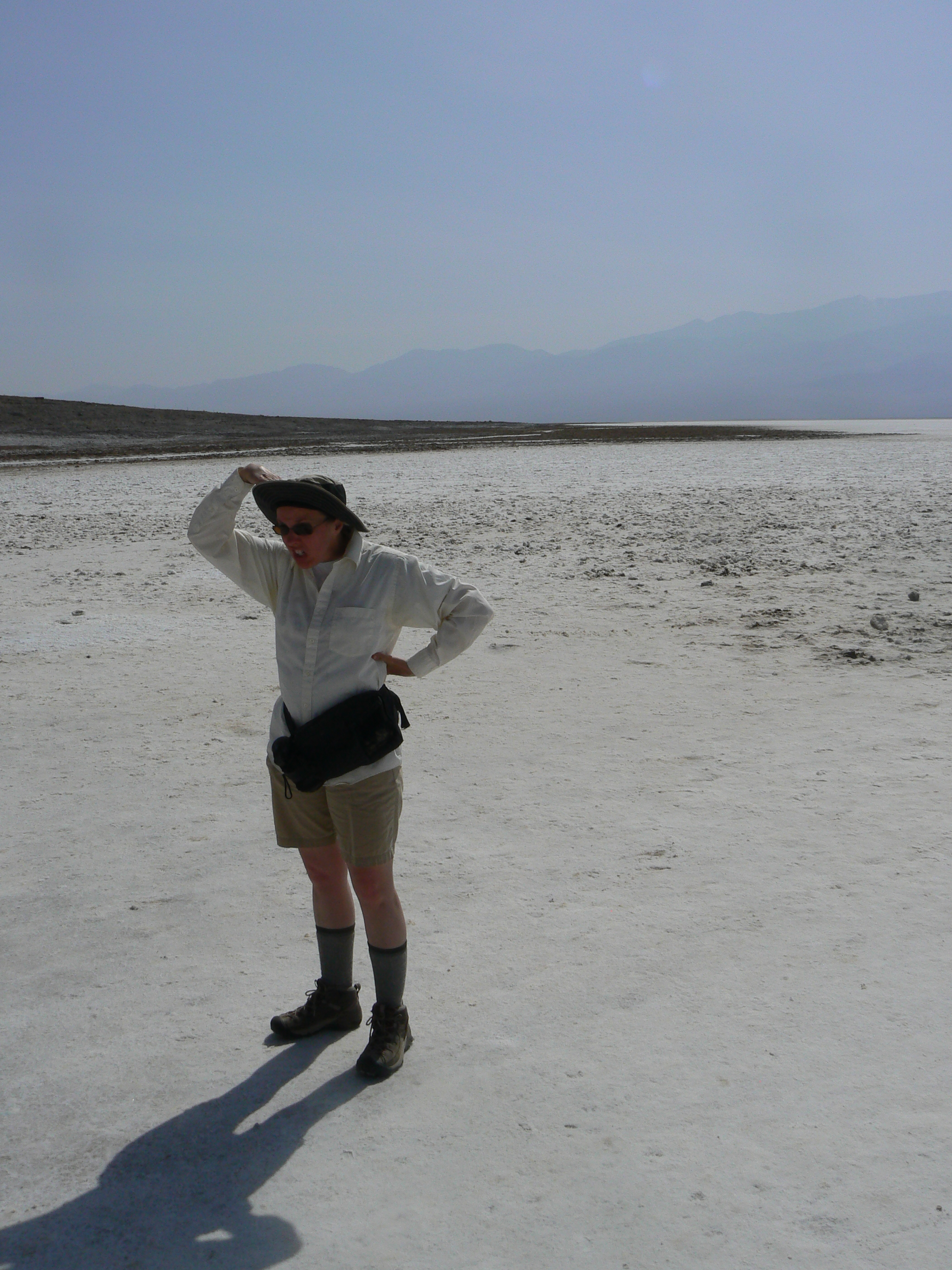
Prudence in Death Valley: wear a hat, bring water

This judgement about what is responsible is the stuff that made me a neurotic mother.  Am I “responsible” for navigating the waters of life for myself , my husband, and all my children?  How much responsibility do I take?  Which risks are worth it?  Do I allow my kids to walk to school alone, to learn to drive, to travel?   Do I ‘allow’ my diabetic husband to eat ice cream?  If someone in my family dies, does that mean that I have failed?  We’re all going to die; does that mean I’m doomed to fail at life?  You see – this can start a very vicious cycle of paranoia and dread.  Is it wise to live with that?

I think that I used to abdicate that issue of responsibility and pass it on to God.  I figured He was responsible for my life and my death, and I was off the hook.  That was useful for a while.  My grandmother used to hedge her bets by saying, “Trust in God, but do your homework.”   I suppose that’s useful advice as well.   I find that Buddhism gives a useful perspective, too.  It says simply that life and death is what we’re given, and that we can choose how we live.  Jim used to say, “I can be sick and miserable or I can be sick and happy.  I choose happy.  Pain is inevitable; misery is optional.”   All good stuff to think about.

Unknown's avatar

“Jerry”, Faulkner and the Laundromat

*Note: this was originally posted on Sept. 15, 2011.  It has been edited for submission to Into The Bardo, A Blogazine.  “The Bardo” is a place of transition, perhaps akin to Purgatory.  It is common ground and a sacred space of sorts.  It’s intriguing to think of the Laundromat as a place like that.*

David Attenborough makes a point in The Life of Mammals video about “Social Climbers” – monkeys.  He says that you can tell how large a monkey’s social group is by the size of his brain.  Baboons live in large, complex social structures and have the largest brains of all the monkeys.  Surviving and thriving in a social environment means that you have to be able to assess situations and make an array of decisions – how to make allies and with whom, how and when and whom to fight, how to secure a mate and improve your chances of passing on your genes.  Navigating social life is even more brain-bending if you’re human, I think.  More subtleties are involved.  Here’s a case in point: the laundromat.

When Jim and I were first married, I did laundry at the laundromat.  I hated going there, for several reasons.  First of all, I was pregnant.  The smells nauseated me; the physical demands of standing to fold and hoisting large loads of clothes around exhausted me.  It was a depressing place to be physically, but perhaps even more uncomfortable was the social aspect.  You never know what strangers you might encounter.  I have had some rather pleasant days at the laundromat.  I met a psychic, once, who was very interesting.  She could tell I was skeptical and not receptive, but she kept on talking to me nevertheless.  Gradually, I relaxed and figured out how to respect her and appreciate her and communicate that to her.  We parted with a hug and wished each other well.  Mostly, I get a pleasant experience if I can do my laundry in silence and read a few short stories at the same time.  What I often find is that the laundromat is a place to observe human suffering, my own and others’.

I happened to have selected a book of short stories by William Faulkner as my laundry companion.  I grabbed it off of Steve’s stack figuring that short stories would fit nicely into those periods of time between cycles, and I wouldn’t mind being interrupted or distracted as much as I would if I were trying to tackle “heavier” reading.  What I didn’t think about was that these stories of post-Civil War race relations would be cast for me on a backdrop of the urban reality of this century…and that the same awkward tensions would result.   I felt like some of his characters, eavesdropping in the kitchen, when people in the laundromat would chatter on their cell phones to friends and social agents.   Outwardly, I guess I was trying to be invisible.   I couldn’t help picking up snatches of their lives and wondering about their stories.   For example, Jerry and his family…

I’ve seen Jerry twice now.  Yesterday, I recognized him as I approached the laundromat.  He was wearing a diaper under sweatpants, shoes, and no shirt.  He was hitting his head repeatedly and grunting.  Or maybe it was more like moaning.   The woman he was with may have been his mother.  She was in a wheelchair with an artificial leg that looked like a sandbag.  He was with another woman as well, perhaps his sister.  She was the one doing the laundry.  I remembered them from a month ago.  They came with about 7 large, black garbage bags full of clothes.  They took a social services shuttle bus to get there; I knew this from hearing the mother make cell phone calls about being picked up.  This woman had the sweetest, kindest voice you would ever hope to hear.  Her voice was full of compassion and pain; it was lilting and rich and Southern.  I would cast her as a black Mammy in one of Faulkner’s stories.  Her manners were impeccable.  If she had to pass around me, she excused herself, and I felt like apologizing profusely for being in the way.  Her daughter (?), the other woman, spoke almost unintelligibly as she did the laundry and corralled Jerry.  Even the woman in the wheelchair told her, “I can’t understand what you’re saying.”    Jerry likes to wander.  They don’t want him to wander out to the street and get hit by a car.  They don’t want him to bother the other people in the building.  Their voices called out periodically, “Jerry.  Jerry, come over here.”  “Jerry, honey.  Stop!  Jerry, come here.”

When Jerry wanders near me, I don’t know what to do.  I keep my head down and my eyes in my book.  Would I frighten him if I made eye contact?  Would he frighten me?  Another gentleman was there.  He helped bring Jerry back inside when he wandered out.  The mother thanked him, “You’re so sweet.  Thank you, sir.”  They exchanged names.  He told her that he has a grandson who was hit by a car at age 7; the grandson is now 25 and has brain damage.  “Oh, so you know.  You understand,” she sighed.  I learned that Jerry is 32 years old.

In the other corner of the room, there was a mother with a 5-year old daughter, London.   She looked about 5, anyway.  London had a pacifier.  I heard her mother yelling at her.  “London!  Get up offa that floor!  Sit your butt down here!”  Her voice was sharp and angry.  London began to cry.  There is not much to interest a 5 year old in the laundromat.  She hadn’t brought any toys or books to occupy her.  The mother talked on her cell phone while London played with the lid of the laundry hamper.  I made eye contact with the child as we went about our business.  She silently bent her wrist toward me, while sucking her pacifier.  “Oh, did you hurt yourself?” I asked.  “London!  Get out of the way!” her mother said.

In the Faulkner story, Master Saucier Weddell is trying to get back to Mississippi from Virginia.  He is the defeated.  He and his traveling companion, his former slave who is very attached to him and his family, find themselves in Tennessee at a farmhouse.   These victors are extremely suspicious.  They think Mr. Weddell is a Negro.  Actually, he’s Cherokee and French.  The story is short, but intense.  The traveler and the farmer’s younger son end up being killed in an ambush by the farmer and his Union soldier son, Vatch.  The last two sentences read, “He watched the rifle elongate and then rise and diminish slowly and become a round spot against the white shape of Vatch’s face like a period on a page.  Crouching, the Negro’s eyes rushed wild and steady and red, like those of a cornered animal.”

I finished my laundry in silence.  I waved my fingers and mouthed “goodbye” to London who had been banished to the corner.  Her mother didn’t see me.

At home, the late afternoon sun shines down on the quilt on my bed.  Steve isn’t home, and it’s very quiet.  I feel like crying.  My brain is not big enough to figure out why.

001