Unknown's avatar

“I”, Myself, and Ego

Who am I, anyway?

My mother suggested that I may be becoming a “Buddapalian”, blending Buddhism and Episcopalian traditions.  The point of divergence between the two is a critical juncture, then.  The Christian tradition supposes a Creator God who is superior in every way to the created human and source of everything in the universe.  Humans are morally inferior and have been instructed that obedience and subservience is the correct posture to take in relationship with God.  We need to be saved and cannot do that for ourselves.  God gets credit and blame for everything in this world view, really.  Humans fall and fail but aren’t ultimately responsible for that, as God set the whole thing up in the first place as author and initiator of the salvation story.  Throughout my life, this story dominated my thinking.

Then someone asked the question, “Why does there have to be a Source of life?  What if that’s just a human construct?”  We humans are used to doing and making things and finding cause and effect.  We see ourselves as agents, and so we assume agency is the way the world began.  Maybe it isn’t.  Buddhism talks about conditions “arising” so that something is manifest, and then conditions change and the thing is not manifest.  There is no agent.  Humans aren’t a Creator’s creature, we are a life form that arose out of certain conditions.  We can be aware of conditions and grateful for them.  Steve once looked around on a sunny day, spread his arms wide and said, “Who do I thank?”  It seemed a very natural question, and being the human I am, I wanted to give him an answer.  I couldn’t prove that answer was true, however.  He also asked me about being separated from God and needing salvation.  “What if you’re not?”  I had to begin to look to experience to answer that.  I don’t feel separated from Life.  I don’t see Life being separated from anything, even Death.  They seem more like two sides of the same coin.  I see this more and more as I study the natural world.

A humble smile

So what is a sentient being’s responsibility and position in life?  That’s what I am working out.  I don’t know that I need to feel superior or inferior to any other being that lives.  I am not the Source of most of the wonderful things in life, so I don’t thank myself for them, but I do want to take responsibility for my decisions, my actions, my thoughts and my attitudes.  Both Christianity and Buddhism have a lot to teach about responsibility and ego.  Their teaching comes from very different basic suppositions about the world, but both come to a place of humility.  I am a life form with a pretty complex brain that enables me to be aware of quite a bit…including the fact that this brain dominates my world view but not the world.  So I take it with a grain of salt and try to be open and do my best to respect everything.

Unknown's avatar

Sundays: Prayers and Practices

Sundays were full of ritual in our house.  We went to church every week to sing in the choir, to serve at the altar, to teach or learn in Sunday School, and to meet up with familiar folk.  There were the formal rituals of the liturgy and the informal rituals of getting everyone up and dressed and in the car.  After church, we had rituals of brunching on bagels and sleeping in front of the Bears’ game.  These habits gave our Sundays a certain shape and form that became very comfortable to me.  I didn’t think very hard about them after a while.  They seemed fairly easy and routine, a balance of early busy-ness and later laziness.  We’d dress up and then let down.  It was what we did, week after week.  Gradually, this practice began to unravel as the kids grew up, moved out, and developed their own habits.  When they came back into my home, this routine was questioned.  Do I have to get up and dress up and go to church?  I’m used to sleeping in on Sundays now.  Why do you do this routine anyway?  Is it obligation?  Okay, you committed to being in the choir.   You’re obligated, I’m not.  Do you think I’m obligated to you because you’re my mother?  It became obvious that it was time to think critically about our family habits and evaluate them.  I admit that I was not above manipulation.  I  liked to have my kids with me in church.  I liked to hear them sing.  I liked being seen by others as a mother with devoted children.  I wanted to have time together as a family because I worried about how ‘dysfunctional’ we were becoming.  I thought I could get what I wanted by imposing ‘rules’, but when my authority over them came into question, I resorted to bribing them with food…or guilt.  “It’s a family thing!  Don’t you want to go to brunch at Egg Harbor with us?”  Occasionally, I would even be satisfied if they skipped church and met up with us at a restaurant afterwards.

After Jim died and I began dating Steve, I invited him to come to church with me.  He observed the whole morning routine respectfully and rather silently.  I finally asked for his feedback.  His first comment was that I had become a totally different person than the one he knew.  I had adopted a persona that he didn’t recognize.  I had put on my social ‘face’ and performed my part in the choir, but he saw nothing of the spirituality we talked about while hiking in the prairie.  He asked me whether I thought my church habits contributed to my spiritual growth, and I couldn’t answer right away.  He also asked me why I neglected to inquire about his bagel preferences when I picked up brunch afterwards.  That was embarrassing!  I was in my familiar bubble and not even thinking about my guest.  “We always do it this way, and you can just follow along,” is something I am very used to accepting and enforcing.  Steve doesn’t like to be treated that way, though.  He values participating as an equal in what is happening.   His theological questions came next.  If you’ve never been to an Episcopal mass before, you would probably be bursting with questions about the symbolism alone by the end of the service.  Steve was wondering if there would be an occasion that he could stand up and ask about what was going on.   Can you imagine?  “Uh, excuse me?  Hi.  I’m Steve and this is my first time here.  Can you tell my why you’re doing that with that cup (or candle or incense diffuser or garment or….) and what that means?”  I had to admit that the whole social construct was not designed to be very inclusive or open.  It was another case of “we always do it this way, and you can just follow along”.  I began to wonder how much of my long-standing religious faith was about simply following along.
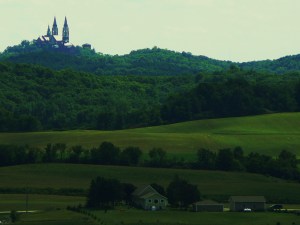
Holy Hill, from far away

Here, I am living without religious habit or routine for the first time in my life.  I have decided that I don’t want to live without practice, though, because practice leads to mindfulness.  I am working out how and what to practice.  Back in May, I began to write my own Daily Offices, reminders for certain times of the day.   Here’s what I put together:

I.  Matins – Make Love Every Morning

I become aware of a new day, of the sun rising in the east once more. I feel the security of its constant faithfulness and a deep gratitude and contentment washes over me. I appreciate the sun. I hear birdsong or a cat mew, and I become aware that other creatures greet the new day with me, each one appreciating this regular phenomenon in her own way. I feel the lightness of the sky reflected in the lightness of my body. Food digested, shadow of darkness lifted, I feel buoyant and relaxed and open. The energy of a new day and new opportunities fills me with each breath. I notice the particulars of this morning, the weather, my body, my surroundings, where I am, who is with me. I am grateful for these particulars as they are. I am aware that each of my loved ones greets the morning in some way, and I think of them with appreciation for the connection we have on this planet. I am aware of myself. I am appreciative of my body, of my inner being, and I hold myself in a place of unconditional love. I belong on the earth today. I have an important part to play here along with everything else. I want to be aware of that all day long. I become aware of any anger or fear that might arise in me as I spend time with myself. I notice any of these “stuck spots” with compassion. I review my 3 options: run away, change my circumstances, change myself.

 II.  None – The Ninth Hour – After School Snack

I pause after a few hours’ work to refresh myself. I am grateful for the food I eat and for the earth that nourishes me. I appreciate the way my body repairs itself while resting. I note the work that I have done so far today, the satisfaction of taking responsibility for my life. I become aware of any places I may have become “stuck” today. I re-direct my energy so that flow resumes. I notice changes in the sun’s light, in the weather, in the activity and mood of the afternoon. I feel grateful for these particulars as they are. I spend time with myself and nurture my inner child coming back home.

 III.  Compline – Now I Lay Me Down To Sleep

As I slow down at the end of the day, I pay attention to any anxieties that have gathered around me during the day. As darkness falls, I let go of these anxieties, breathing out slowly and gratefully. I look deeply within for the security and safety I seek, remembering that the world proceeds according to natural laws, life and death have their place, my days will be as they will be, and fear need not preoccupy my thoughts. I ask for peace, for every living thing to be free from suffering.

I was having panic attacks back in Spring because of the enormous transitions I was going through, and wanted to practice being mindful that the world is a continuously unfolding and wonderful place, not a dangerous place of uncertainty and chaos.  Thich Nhat Hahn talks about tending the gardens we grow in our lives by nurturing seeds that we want to see in full bloom.  I want peace to bloom in my garden.  I want love to bloom without manipulation.  I want a mindful connection to the Divine to bloom.  I want responsibility and intentional participation to bloom.  I want to develop practices that will encourage these to grow.

Unknown's avatar

Dear Prudence

Last night, we watched the movie “Into the Wild” which tells the story of Christopher Johnson McCandless, who walked into the wilderness of Alaska to live off the land and do battle with some personal demons.   After 113 days, he died of starvation.  The story brings up some very interesting questions about society, “prudence”, and responsibility.

“Society!  So – ci – e – ty!!!” yells Vince Vaughn in a bar scene.   His character is bonding with Chris in a less-than-articulate but heartfelt acknowledgement that we fuck each other up regularly.  Parents and children, systems, administrations, organizations, rules, protocol and expectations.   It’s all pretty neurotic when you step back and look at it.   Some days, maybe most of us would like to walk to Alaska to get away from it all, to experience the freedom and dignity of making our own choices and engaging with the world head on.   After 100 days of complete solitude, Chris writes that he is lonely.  I think of that Life of Mammals scene with all the baboons on an African mountain.  We are social animals; it’s in our DNA, and we can’t walk away from that.  Maybe that’s another part of life to engage head on.

The first time my mother met Steve, she made a comment about him being “prudent”.  He denied it immediately.  To him, ‘prudence’ has to do with conforming to the cultural norm for being sensible.   However, other definitions indicate “wisdom, judiciousness” as its characteristics.   Chris had no desire to conform to any cultural norm; to him, the culture was hypocritical and dishonest.  It wasn’t sensible at all.  His personal wisdom and judgment seemed pretty embryonic, which is probably why he wanted to challenge it and gain maturity through experience.  He was certainly intelligent.  But why didn’t he take the time to prepare more thoroughly for his wilderness adventure?  Why did he choose not to use a compass or a map?  Why didn’t he tell anyone where he was going or make any emergency plans?  Those decisions bring up the question of responsibility.

It seems that most people assume that our primary responsibility is to survive.   Many people held Chris responsible for his return from the wild.   The fact that he didn’t return led many to suspect that he was basically suicidal.  Are the oldest people in our society the most “responsible” ones?   Is cheating death for as long as possible the mark of wisdom?  If we’re all going to die some day, our success in survival is simply an incremental one.   It seems to make life about quantity.   What about quality and the way we live?   Would it be responsible to sacrifice your life for something you value highly?  Some people believe that Chris was doing that.  They think he was a hero.  Others think his adventure was “a pointless fuck up”.

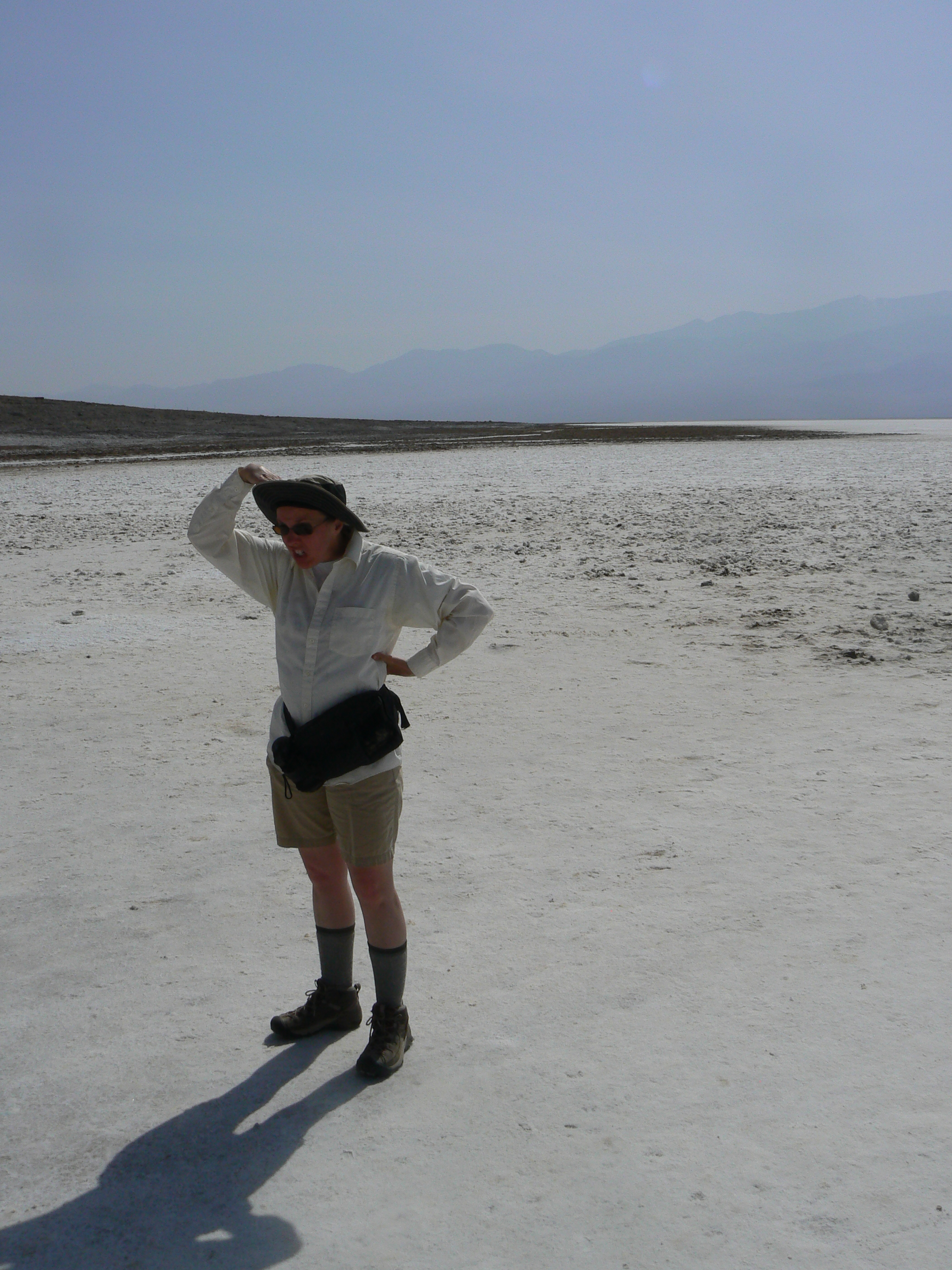
Prudence in Death Valley: wear a hat, bring water

This judgement about what is responsible is the stuff that made me a neurotic mother.  Am I “responsible” for navigating the waters of life for myself , my husband, and all my children?  How much responsibility do I take?  Which risks are worth it?  Do I allow my kids to walk to school alone, to learn to drive, to travel?   Do I ‘allow’ my diabetic husband to eat ice cream?  If someone in my family dies, does that mean that I have failed?  We’re all going to die; does that mean I’m doomed to fail at life?  You see – this can start a very vicious cycle of paranoia and dread.  Is it wise to live with that?

I think that I used to abdicate that issue of responsibility and pass it on to God.  I figured He was responsible for my life and my death, and I was off the hook.  That was useful for a while.  My grandmother used to hedge her bets by saying, “Trust in God, but do your homework.”   I suppose that’s useful advice as well.   I find that Buddhism gives a useful perspective, too.  It says simply that life and death is what we’re given, and that we can choose how we live.  Jim used to say, “I can be sick and miserable or I can be sick and happy.  I choose happy.  Pain is inevitable; misery is optional.”   All good stuff to think about.

Unknown's avatar

The Daily Planet

Awareness, Appreciation, and Action.   I have an idea about awareness.  Here’s the issue: our culture has gotten so technical and anthropocentric that we are no longer aware of the changes and events of the planet.  We live mostly in cities, far removed from wilderness or even farmland and our connection to the earth.  We are more aware of Lindsay Lohan’s activity in the fashion world than we are of the seasonal changes happening in the natural world.   I get “news” items popping up on my browser all the time about some celebrity and her latest beau or who was seen wearing the same red dress and who wore it better.  OMG!  Is this news?  I don’t think so.  What if I could replace all those items with some news about the natural world?  What is happening in monarch migration, for example.   Or how are various species preparing for the winter?  Who hibernates, who sleeps, who migrates, who stays put?  And I would want local news for each area.  We know so little about our local ecology.  What if we had a daily conservation report similar to the Dow Jones?  How are soils doing in my area?  How is the water and the air?  What species became extinct today across the nation?   Which species are making a comeback?   The Old Farmer’s Almanac is still being published; it covers weather patterns, moon cycles and gardening advice.  How many people still read even this much information about the earth?  We just had a gorgeous harvest moon last night.  How many people in my city know what a “harvest moon” is, and how many do you suppose looked up and noticed it?   More to the point: how many care?

An American goldfinch takes his daily echinacea

Caring for our planet is our responsibility.  The Bible talks about stewardship, Buddhism talks about respecting all of life.  As technology advances, it seems that we develop new and more elaborate ways to abuse and exploit the planet faster than we come up with ways to protect it and safeguard its resources.  How backwards is that?  Carl Sagan wonders in his Cosmos series if the reason we haven’t been contacted by other intelligent life forms is that once a civilization develops to the point of having the technology necessary for galactic space travel, they have destroyed themselves and their planet in the process.  A sobering thought.

I care.  I want to be more aware.  I appreciate lots and want to know more.  Most of all, I want to know what actions I can take to really do something about the care of our planet.  I figured education would be a good place to start.  Tomorrow I’m off to the Wehr Nature Center to help run a field trip program about insects.  What do you know about creatures who “Fly, Flutter and Crawl”?   Would that kind of information be more important to you than knowing which celebrity pasta sauces scored highest in a taste test?  Just wondering, not judging.

Unknown's avatar

Music, Art, & Bodies: Graces & Commodities

Steve just got a new CD.  You know how many books he has?  Well, he has almost as many CDs.  One of our projects this summer has been to take them all out of their jewel cases and put them in sleeves, to save space.  Then, we have to file and categorize them.  Classical music (in the broad sense) makes up most of the collection.  Jazz, movie soundtracks (he’s a big Ennio Morricone fan), world folk/country, singer/songwriters, and novelties are other big categories.  He has very little Rock/Pop, and no Punk or Grunge or new genres like that.   So, the latest purchase was Cecilia Bartoli’s Sacrificium.  I love this artist.  She is thoroughly Italian, with a wild animation in her face that makes you wonder if she is controlling her voice or if it is controlling her.  Watch her on youtube and you’ll see what I mean.  She specializes in the works of Rossini and Mozart, and in this new CD, she takes on the vocal fireworks of the premier castrati of Napoli.  The melismas and ornamentations are phenomenal.  Close your eyes and imagine a castrato singing the same thing.  It’s tough for us in this century, but in the 1600s, there were about 4,000 boys a year in Italy alone who sacrificed their bodies to achieve this sound.  The liner notes contain an article entitled “Evviva il coltellino!” which translates as “Long live the little knife!”  Imagine shouting this in the opera house instead of “Bravo!” after the leading character’s aria.  Why was this such a hot trend?  Well, the Catholic Church forbade women to perform in churches or on the stage, but paid good money to the composers and performers of Baroque pieces for alto or soprano voices.  Could it be that the Church condoned or actually supported mutilation of the body?  Oh, yeah, this is after the Spanish Inquisition.  (Another fascinating book Steve has is on the instruments of torture used during the Spanish Inquisition.  With illustrations.) Well, they did and they didn’t.  “The castrato mania even rages in Rome and the Papal States, where indulgence in these rare flowers occurs in up to forty different theaters at one time.  Although castration is forbidden there, on pain of death, thirty-two popes over the centuries delight in the singing of castrati in the Sistine Chapel.  In the Holy City, ecclesiastical dignitaries frequent the theaters in droves.”  The manufacturing of castrati was a big business for two centuries, and didn’t die out completely until the beginning of the nineteenth century.  The Italians were willing to sacrifice their progeny for their art.

Cecilia as a castrato

When I was in 6th grade, I asked my dad if I could get my ears pierced.  His response verbatim has now been memorized by my children as well as myself: “That is mutilation of the body for purposes of vanity, and I will not subscribe to it.”  What about for purposes of art?  Or livelihood?  Or to exact the truth from a tight-lipped prisoner?  (see Dick Cheney).  So far, I have no piercings or tattoos, and I think one of my children can say the same.  I don’t want to be judgmental or dogmatic about what choices should be made for what values, but I do want to support thinking deeply about it and taking responsibility for your choice.  I want to treat myself and every living thing as a “Thou” and not an “It”.  Your relationship with a “thou” depends on respect and communication and understanding.  As I understand myself, I know that I value honoring my father, not because his judgment on ear-piercing is “right”, but because of the relationship we had.  I don’t want to pierce my ears as much as I want to honor my father.  I do wear clip-on earrings on occasions when I want to dress up.  To me, this represents making a choice based on “The Middle Way”, one of the practices of Buddhism.  Music, art, our bodies, land, food, water…so many things can be seen as a grace and as a commodity.  Political arguments are made all the time about how we regulate or deregulate our use of these things.   We wonder if we can legislate morality so that people make the “right” decision.  Often, we get stuck and find ourselves drawing lines in the sand and treating each other like “Its”.  What would happen if we made a stronger commitment to treat ourselves like “Thous” and worked toward respecting, communicating, and understanding?  Would we be able to make decisions along “The Middle Way”…and then make new decisions in light of new understanding?   Trying to adopt this practice has made me a better mother, I know that for sure, especially since my children became adults.  Perhaps the hard line I took on some things was beneficial when my kids were little.  I don’t regret the standards I set, but I sometimes regret the way that I went about trying to enforce them.  I don’t agree with James Dobson, the author of the very first book I read on parenting.  I remember him saying that in conflicts between children and parents, it was the parents’ responsibility always to win.  I think that sets up an “It” relationship.  Steve has a quote from Carl Jung tacked on the refrigerator: “Where love rules, there is no will to power; and where power predominates, there love is lacking.  The one is the shadow of the other.”  I want my relationships to be loving, above all else, and I want to make decisions with”Thou” in mind.  That includes the thou that is myself.

Unknown's avatar

Hope for a recovering perfectionist

Western thinking is set up in a dualistic manner.  We have pairs of opposites: good and bad, right and wrong, black and white, body and soul.  Things are separated and put into boxes.  I was raised on this philosophy in my Judeo-Christian upbringing.   Human nature or sin nature is in opposition to divine nature.  We are told to die to sin and human nature and live out of divine nature.  It’s an either/or proposition.  And it’s impossible to do.  I simply cannot stop being human – and I don’t really want to.  When I think I ought to because of some person’s judgment, then I end up hating my humanness, and hating myself.  I feel guilty for being imperfect and human.  It is a cause of suffering.   When Jesus comes along to take the blame for my sins, the system isn’t really undone, it still seems like we are the Bad Ones and he is the Good One.

Eastern thinking is not dualistic.  It is both/and.  Good and bad are not separate.  Nor are right and wrong, body and soul, etc.  Every decision is somewhat good and somewhat bad.  Joseph Campbell talks about this in The Power of Myth.  The great mythic tales often point out this seeming ambiguity and emphasize that this is the real nature of life.  Yin and yang are not separate; two sides of a coin are not separate.   I am not separate from my human nature, from my mistakes, from my less effective parenting episodes.  They’re all me, and they do not need to be separated from me and judged.  We tend to get all up in arms about issues and pick a side, thinking that this is the obviously correct side.  Really, things are about 60/40 at best.  I often bring this up when one of my children is fretting about a decision and terrified that they will make “the wrong” choice.  Nonsense, I say.  You will make “a choice”, and if things don’t go in a way that seems beneficial after that choice, then you can make other choices.   Steve told me that when he was a kid, he had a plastic bowling set and used it to play a game that he made up.  He’d set up the pins in the usual pyramid arrangement, then bowl the ball and scatter them.  He would then set the pins up exactly as they had fallen, and bowl the next frame in the new arrangement.  Each time, he would just set the pins up where they were and start from there.  He never knew how the game would play out…I suspect that his pins were all over the yard after a half an hour.  I suppose the object of the game wasn’t the traditional “Knock ’em all down, Daddy”, meaning knock ’em all down at once.  It became more “Knock ’em all down eventually”.  After all my years of living, I rather think this new model is more like how life plays out.

So Steve & I have adopted a metaphor of decision-making that we call “Pointing the Canoe”.  We make good decisions, I believe, ones that take some time and try to consider many aspects.  They are not perfect decisions that knock all the pins down at once, but they are decisions that we hope will bring us closer to the light on the horizon.  I don’t know how to make a perfect decision, and if I live in fear of that, I most likely won’t make any decisions at all.  I make a good decision, and then I look up at the horizon.  If I’m not heading toward the place I want to get to, I make another decision.  I point my canoe and paddle on one side or the other, and I get there eventually.

Every week, we get together to have a Summit Meeting.  This is where we discuss the decisions we are making and how to point the canoe so that we’ll be living the life we want to live.   We put our values out on the horizon and see how we’re lining up.  We want to live more simply and sustainably.  We want to be spending most of our time, not on “small fires”, but on things that we find very important, like Spirituality, Music and Nature.  We want to be kind.

Today, I got to live out of a decision I made last week.   I interviewed at a county park that has a Nature Center.  I wanted to volunteer to be an interpretive trail guide and be involved in educating people about nature.  Today, I spent 5 hours at Astronomy Day telling kids (and their parents) about NASA’s Discovery program and the Dawn Spacecraft that is sending back information about asteroids.   I don’t know how long I’ll be doing this volunteer work; it’s not a perfect answer to “what should I do with the rest of my life?” (because it’s not paying me anything and won’t sustain me), but it’s closer.   I am also a Certified Teacher with TakeLessons.com now.  This means that a music lessons match-up organization in San Diego is trying to get me private voice students.  I’m not sure if that’s what I want to be doing with the rest of my life, but it is teaching and it is music, so it might bring me a bit closer.  I have yet to get my first student.

I still spend a lot of time wondering about who I am and what I “should” be doing.  It feels good to be in the canoe and moving toward my horizon, doing my own paddling.  I have been so fearful about how to live my life after being widowed.  Not so much any more.  Recovering from perfectionism helps.

Unknown's avatar

Happiness Is

A couple of days before my 5th birthday, I got the chance to perform on a stage for the first time.  It was in a talent review put on by the Wabaningo Club of the Sylvan Beach neighborhood association.  That was where my grandmother owned a beach cottage on Lake Michigan.  I rehearsed the song “Happiness Is….” from the musical You’re a Good Man, Charlie Brown and performed it with 13 other little kids, including my sister, a second cousin, and the two daughters of my parent’s friends, the Pulvers.  I know these details because I found the program online in the Wab Club’s archives.  All I remember is standing on the stage and looking out at people’s faces, smiling at me.  I saw a photo of this group performance hanging on the wall of the Pulvers’ cottage in 2007, 40 years later.   I stuck out.  I was a step in front of the whole line up, my eager face displaying a huge, open mouth.  I guess I was kind of a ham.

The songs lists a bunch of cute, juvenile reasons for happiness.  Two kinds of ice cream, five different crayons, getting along — “everything and anything at all that’s loved by you”.   It rather assumes that things outside of you are what will make you happy.   I bought into this idea pretty thoroughly, and I know a lot of others who did (and do), too.  My list included having approval, good grades, someone who loves me, kids who are successful, good health, and a bunch of other stuff.  I would get anxious, upset, and sometimes downright terrified if I felt that any of these conditions might end.  In moments of loss, when something that had made me happy changed, I would often hear people comfort me by saying, “God loves you.  It’s OK.”  But again, that felt like something outside of me that I could lose, another idea of happiness that made me fret about whether I possessed it or not.

In a videotaped speech of Anthony de Mello’s, I heard about the idea of “attachment” and how we suffer from it.  We suffer in the loss, the impermanence of our attachments.  I’ve been thinking about this for about 10 years now.  I think back on how the attachments I had to certain ways of being affected my parenting.  We went through a lot of suffering as a family.  I felt so angry that we couldn’t seem to do things according to my expectations.  I rejected the way things were and tried to fix them.  I asked God to fix them.  And we kept suffering.   Slowly, I began to loosen my grip.  Finally, I prayed that I would be able to accept things as they are and be strong enough to accept the things that were to come, even though I was terrified of what that might be.  Yes, Jim died.  That was what I was fearing the most.  Interestingly, when that became a reality instead of a fear, some of the suffering was relieved.  More suffering was relieved when I began to look at other realities with less judgment and more acceptance. I am still working on the practice of non-attachment and the understanding of happiness.  Here’s a quote that puts it quite simply:

“The Kingdom of God is also said to be like a treasure that someone finds and hides in a field.  Then, in his joy, he sells all he has and buys that field.  If you are capable of touching that treasure, you know that nothing can be compared to it.  It is the source of true joy, true peace, and true happiness.  Once you have touched it, you realize that all the things you have considered to be conditions for your happiness are nothing.  They may even be obstacles for your own happiness, and you can get rid of them without regret.  We are all looking for the conditions for our own happiness, and we know what things have made us suffer.  But we have not yet seen or touched the treasure of happiness.  When we touch it, even once, we know that we have the capacity of letting go of everything else.

“That treasure of happiness, the Kingdom of Heaven, may be called the ultimate dimension of reality.  When you see only waves, you might miss the water.  But if you are mindful, you will be able to touch the water within the waves as well.  Once you are capable of touching the water, you will not mind the coming and going of the waves.  You are no longer concerned about the birth and the death of the wave.  You are no longer afraid.  You are no longer upset about the beginning or the end of the wave, or that the wave is higher or lower, more or less beautiful.  You are capable of letting these ideas go because you have already touched the water.” — Thich Nhat Hahn Living Buddha, Living Christ

Steve at Lake Michigan, on the shore opposite the cottage

Anthony de Mello quoted Kabir, an Eastern poet, saying, “I laughed when they told me the fish in the water was thirsty.”  I keep thinking about that one…

Unknown's avatar

Claiming Rights of Passage

St. Luke’s columbarium

A few years ago, I went to an exhibit on mummies at the Milwaukee Public Museum.  It was fascinating.  Listening to the whispered comments and questions of other patrons was fascinating as well.  We have a very scattered cultural approach to death, with so many various ways of marking the rite of passage, including not really marking it at all.  Our American culture, as a whole, has been dominated by technology to the point that important parts of our lives are relegated to “experts” and taken out of our hands completely.   My mother fought against this trend in the late 50s when she insisted on breastfeeding her babies instead of allowing the “experts” to convince her that artificial formula on an artificial schedule was better for them.   Birth experiences have become sterilized, institutionalized, and anesthetized as well in the mainstream.  My 4 were all born in a hospital under the HMO system (but not under any pain killers!) because in my 20s, I wasn’t brave enough to seek more creative options.   However, my sister birthed one of her children at home, and I once assisted a friend who had a home birth.  It’s not impossible to choose to take full responsibility in this event.  Death is another part of life that more and more people deal with by proxy.  Of course, the hospice movement is a wonderful example of the purposeful effort to maintain the grace and dignity of this stage of life by bringing it back into the home, away from institutions.  I recently watched an Ingmar Bergman movie set at the turn of the century, called Cries & Whispers (well, it’s actually called something in Swedish, but that’s the English title).  This intense family drama deals with the death of a spinster sister from cancer.  The action all takes place at home, in this case an elegant manor.  The doctor’s largest role is in an affair with one of the sisters, in flashback.  When I think of the family drama of my husband’s death, experts and technology played a huge part.  Unfortunately, that became a distraction from entering into the rite of passage, from experiencing the more intimate aspects of the dynamics that were changing my family.  What I mean to say is that it enabled denial.

The last photo of Jim; coming out of surgery Feb. 5

What does it mean to choose to take responsibility for my life?  Not to delegate the more painful or complicated bits to an “expert”, not to live by proxy or by representative?  In which situations do I most often abdicate my ability to decide a course of action?  Financial, political, medical, social, spiritual, emotional, physical.  I am only beginning to wake up and ask myself these questions.  Steve often puts it to me this way: in every situation, you have at least 3 options.  1) Run away and hide  2) Try to change the situation  3) Change yourself.

This is a good time for me to think about aging, about how I want to live and address the changes that are happening now and will continue to happen.  What do I want?  I want to experience life in a more authentic way, not behind a duck blind or a proxy, not behind a curtain of denial or dogma, not by avoiding discomfort or hard work.  I want to make decisions about who I am and how to live proactively.  How do I embody this?  At this point, I am still figuring out who I am and want to be and recognizing places where that has been dictated and I have responded without looking deeper.   My father and my husband took great care of me.  I want to learn to do that myself.   I often dream about Jim returning as if he’d never died.  Last night, I had a powerful dream about him, set in the house I sold, with my young children around.  My consciousness struggled with it; I knew that the house was emptied and I’d moved.  I couldn’t understand why the furniture was back and the place looked so “lived in”.  I couldn’t understand why Jim was there.  He told me he was going out to work because he wanted to support me and the kids.  In a choked whisper, I closed the door behind him and said, “Don’t come back.”  I woke up crying.  Talking about this dream with Steve, I realized that I do want him to come back and float through my subconscious and consciousness without confusing me, without affirming me or correcting me, just visiting.  I suppose when I gain the confidence to affirm and care for myself, my dreams will change.

Unknown's avatar

You Are Radiant of the Spirit

I was raised by very devout Christians, members of the Episcopal Church.  My father was a professor of math and science and later a technical writer for IBM.  He was not, as Madeleine L’Engle defines it, a “fundamental literalist”.   He taught us the Bible, and he taught us Darwin’s theory of evolution.  He believed in the literal interpretation of Darwin’s writings, not the Bible’s.  But he did believe, as did I, in our need for salvation.  There is a certain elegance in Christian apologetics.  My father admired C.S. Lewis especially.  The rational, reasonable, intellectually satisfying story of a creation of God having been separated from the divine by a sinful nature and then rescued and redeemed from Death by a loving, heart-broken Father God is poetic and dignified in many ways.  The same story appears in many different forms in many different cultures.  Perhaps it is satisfying because it is so seemingly universal.  My father was very much an authoritarian.  I was separated from him by every infraction of his rules.  I longed to be forgiven and loved.  I knew that story of punishment and death by heart.  I didn’t know there could be another experience.  I didn’t think to ask if it was the only way to look at what is real about humanity.   Finally, someone asked me, “Who says you’re separated from the divine?  What if you’re not?”  I began to look at a different ancient grace.

Doodling and coloring is one way I meditate on a new idea

Call it “the indwelling of the Holy Spirit”, greet it “Namaste”, wake up to it through a practice of meditation, it’s the same.  After I read the book The Power of Myth, I borrowed the videotape from the library of Bill Moyers’ interview with Joseph Campbell.  My favorite part is where Joseph Campbell says to Bill, “You are radiant of the Spirit,” and Bill responds in animated and personal surprise, “Me?!  A journalist?”  After hours of talk, he finally realizes that the Myth has something to do with him – himself.  I thought about this for a while and told Steve that I felt a similar disconnect from life, as if I am observing everything from a duck blind.  I could talk about what is happening “out there”, externally, quite easily, but I have difficulty identifying and placing my internal experience in the picture.   I was taught to be suspicious of emotions, to “lean not on your own understanding”,  and although that teaching was powerful, I now realize it is not altogether helpful or even consistent with the way Jesus talks about spirituality.  When Jesus confronts the Pharisees, he is often challenging them to get rid of their dogma and be open to using their consciousness.  “Who says you’re separated from the divine?  What if you’re not?”  What if…indeed.   My recommended reading list includes The Power of Myth and Living Buddha, Living Christ by Thich Nhat Hahn.  Also The Gift: Poems by Hafiz, the Great Sufi Master of which my favorite is The God Who Only Knows Four Words:

Every

Child

Has known God,

Not the God of names,

Not the God of don’ts,

Not the God who ever does

Anything weird,

But the God who only knows four words

And keeps repeating them, saying:

“Come dance with Me.”

Come

Dance.

Unknown's avatar

Uncontained and immortal beauty

Ralph Waldo Emerson wrote in his essay on Nature in 1836:

“Nature never wears a mean appearance.  Neither does the wisest man extort all her secret, and lose his curiosity by finding out all her perfection.  Nature never became a toy to a wise spirit.  The flowers, the animals, the mountains, reflected all the wisdom of his best hour, as much as they had delighted the simplicity of his childhood…The lover of nature is he whose inward and outward senses are still truly adjusted to each other; who has retained the spirit of infancy even into the era of manhood….Standing on the bare ground, –my head bathed by the blithe air, and uplifted into infinite space, — all mean egotism vanishes.  I become a transparent eye-ball.  I am nothing.  I see all.  The currents of the Universal Being circulate through me; I am part or particle of God…I am the lover of uncontained and immortal beauty.”


Nature is an ancient embodiment of grace.  The elegance of form, motion, manner, action and moral strength inherent in the natural world can be revealed and described in detail by science, but not in totality.  The mystery of this grace remains.  There is a random, chaotic element that defies analysis and inspires awe.  The morality of what is defies dogmatism.  Death is intrinsic to the grace of life, not an aberration or problem to be solved.  I have not always believed this, although I have always loved Nature.

During my child-rearing years, I frequently walked to a prairie preserve in my neighborhood for sanctuary and solace.  I began to have a very special relationship with “my prairie”.  My entire demeanor would change the minute I set foot inside the gateway.  I would feel myself relax, physically and emotionally, and whatever was simmering at the core of my being would bubble up and spill over.  Often, I would cry copiously, hoping I wouldn’t meet anyone on the paths.  Just as often, I would be exuberantly lifted by sunshine, color and fragrance and dance my way over the grass.   After settling in to the quiet, I would observe the wisdom of the place and learn something to take back with me into the suburban world.   For many years, I would visit the prairie in the middle of the day while the kids were in school and feel rather guilty and unproductive to be enjoying the grace of the place instead of “working”.  It occurred to me one day that someone should at least be doing the job of enjoying it.  It seemed a huge pity that the dazzling elegance of the sky, the land, the creatures and all that thrummed and buzzed and swished should go unnoticed.  I felt that their Creator should be thanked, and in those days, I believed that was the God of the Bible, the same Father God who rescued and redeemed us from Death.

Death is a biggie, in my life and in my culture.  When I was 16, I was in a car accident with my 20 year old sister where she died beside me.  When I was 29, I was a prayer warrior who fought off Death when my infant daughter had spinal meningitis.  When I was 45, I woke one Saturday morning and found my husband cold and lifeless beside me.  Death was The Bad Guy who sneaked into the Garden and stole our birthright.  God was The Good Guy who caught him and gave it back.   Illness is just Death sneaking around, and I have been a paranoid hypochondriac at times because of that way of thinking.  But that isn’t the only way of thinking, I found out.

Once, when I entered my prairie, I was shocked to go around the bend in the path and see the ground burnt jet black.  The vibrant green shoots of grass across the path from that section of land made a startling comparison.  This controlled burn was part of the park management program for spring.  Dry stubble and thick hanks of grass had been burned down to decaying ash in order for the new life to grow up.  I wasn’t sure what to make of the change in my sanctuary.  I felt that something bad had infiltrated the Garden.  I took it rather personally, and although I understood the scientific reasons for it, my spirit was troubled.  I wanted to know the wisdom of this observation.  I found it explained quite elegantly later, by Thich Nhat Hahn in his book No Death, No Fear: Comforting Wisdom for Life.  He gives many examples of how life is in a state of continuation such that there is no beginning point or end point.  We have no birth day or death day.  Paper is the forest, the logger, the clouds, the sunshine, the ash when it is burned, the heat that we feel after the smoke blows away, the soil that is enriched and the tree that grows in the soil.  “If you are a scientist and have very sophisticated instruments, you can measure the effects of that heat even in distant planets and stars.  They then become a manifestation, a continuation of the little sheet of paper.  We cannot know how far the sheet of paper will go.”

Continuation is the ancient grace of Nature.  Ancient and immortal and always new.

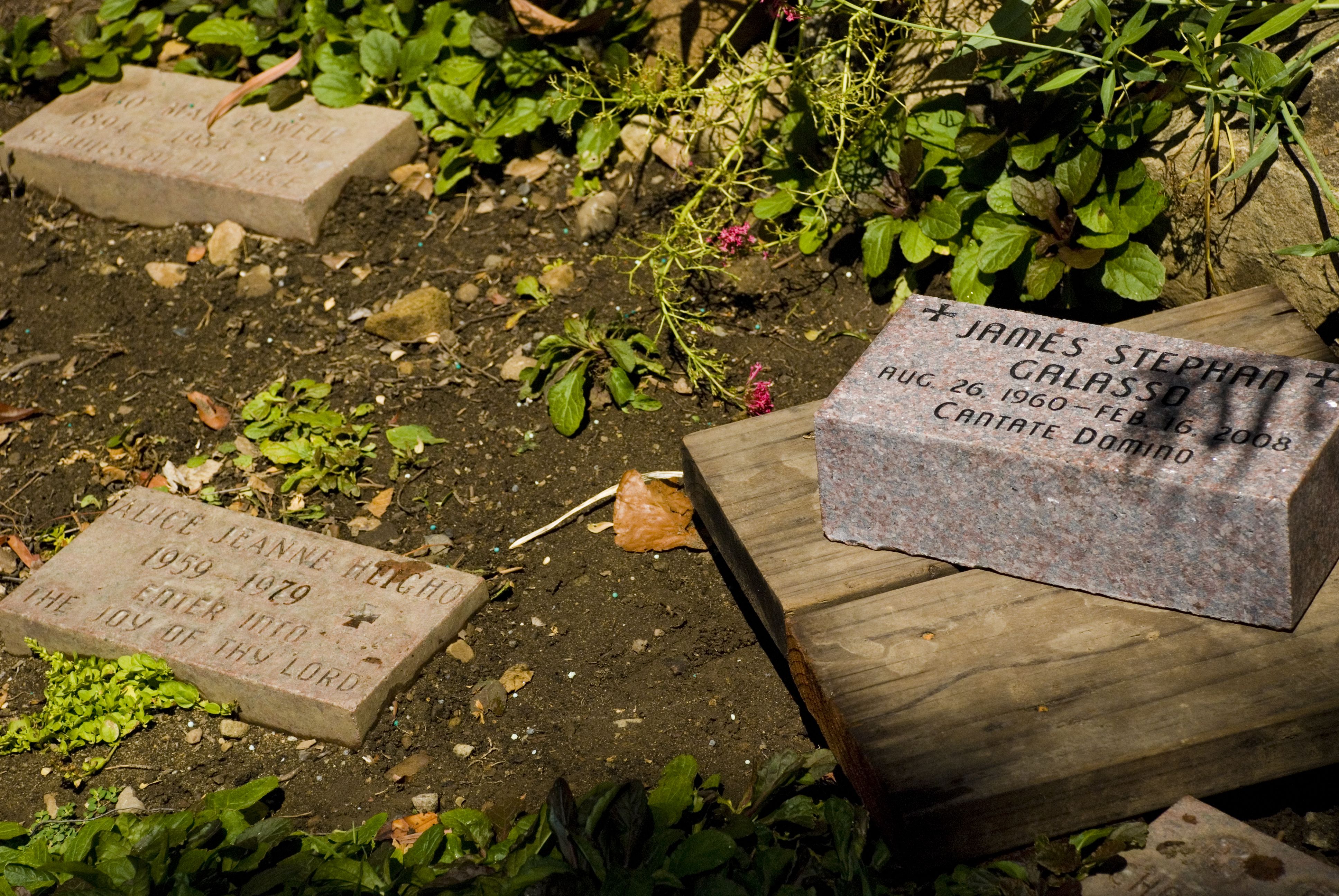
Yesterday was a wonderful continuation day for me.  My daughter Emily and Steve and I walked in Chicago’s oldest cemetery and found cicadas everywhere – their sound, their carapaces, their bodies.  Death is not a Bad Guy, just a concept.  I am comforted by this wisdom.

Me, when I started this blog.