Unknown's avatar

Harvesting Hope

I have just finished reading a very informative book by Jane Goodall on the subject of Food.  Harvest for Hope: A Guide to Mindful Eating has led me to reconsider the way I buy and cook and eat food.  Much of it is based on common sense and natural practices (What would a chimp choose to eat?  Have you ever seen an overweight chimp in the wild?), and much of it exposes the insanity that is our factory food production here in the “civilized” world. How civilized is it to cram thousands of chickens together in a cage, remove their beaks so that they can’t peck each other to death, pump them with antibiotics and force them to cannibalize their own kind by giving them non-vegetarian feed?  And then to slaughter them, ship their polluted flesh over thousands of miles burning fossil fuels, and eat it?  I was not thinking about that when I bought Super Saver packages of chicken breasts at my local super market.  I think about it now.

And here is the surprising gift of hope: my children have been thinking about this for years.  I didn’t lead the way. 

Here is another arena of hope: reclaiming, salvaging and recycling living space.  My daughter and her fiance purchased a home that had been severely water damaged and mold and mildew infested.  The inhabitants had moved out to hospice care and died; the house was abandoned, but the water wasn’t shut off.  In the winter freeze and thaw, the pipes broke and flooded the place.  What a mess!  But Joe comes from a family line of carpenters and construction wizards.  He has completely re-worked the house: plumbing, electric, heating, floor plan and surfaces.  He’s gotten neighbors, friends and family involved in the labor and in donating fixtures. The final step will be relocating the back yard garden.  You see, this house is just a few doors down the street from the one they’ve rented for the past 3 years.  So, by their wedding date one year from this month, they will have their own home and garden.  They are marvelous role models for sustainable living, and I am so proud of them! Yesterday I went down to visit and take pictures.  They sent me home with a bunch of produce from their garden.  I am so grateful and awed by how life unfolds.  The next generation is certainly capable of taking responsibility and working hard in a sustainable direction.  Let’s just hope many of them choose to!

Unknown's avatar

Weekly Photo Challenge: Endurance

The Word Press Daily Post Photo Challenge states: “As we sift through fleeting status updates, toss yet another egg carton in the recycling bin, and watch as seasons change around the world, it can seem like life is made of constant change.”

Well, isn’t it?

And maybe, to step outside of constant change is to see constant continuation.  Thich Nhat Hahn doesn’t celebrate his birthday, he calls it a “continuation day”. 

If you look deeply into the palm of your hand, you will see your parents and all generations of your ancestors. All of them are alive in this moment. Each is present in your body. You are the continuation of each of these people. To be born means that something which did not exist comes into existence. But the day we are “born” is not our beginning. It is a day of continuation. But that should not make us less happy when we celebrate our “Happy Continuation Day.” Since we are never born, how can we cease to be? This is what the Heart Sutra reveals to us. When we have tangible experience of non-birth and non-death, we know ourselves beyond duality. The meditation on “no separate self” is one way to pass through the gate of birth and death. Your hand proves that you have never been born and you will never die. The thread of life has never been interrupted from time without beginning until now. Previous generations, all the way back to single cell beings, are present in your hand at this moment. You can observe and experience this. Your hand is always available as a subject for meditation.

–Thich Nhat Hanh, Present Moment, Wonderful Moment

Continuation and endurance are kindred concepts.  It’s not about effort, it’s about the flow of life: life to life.

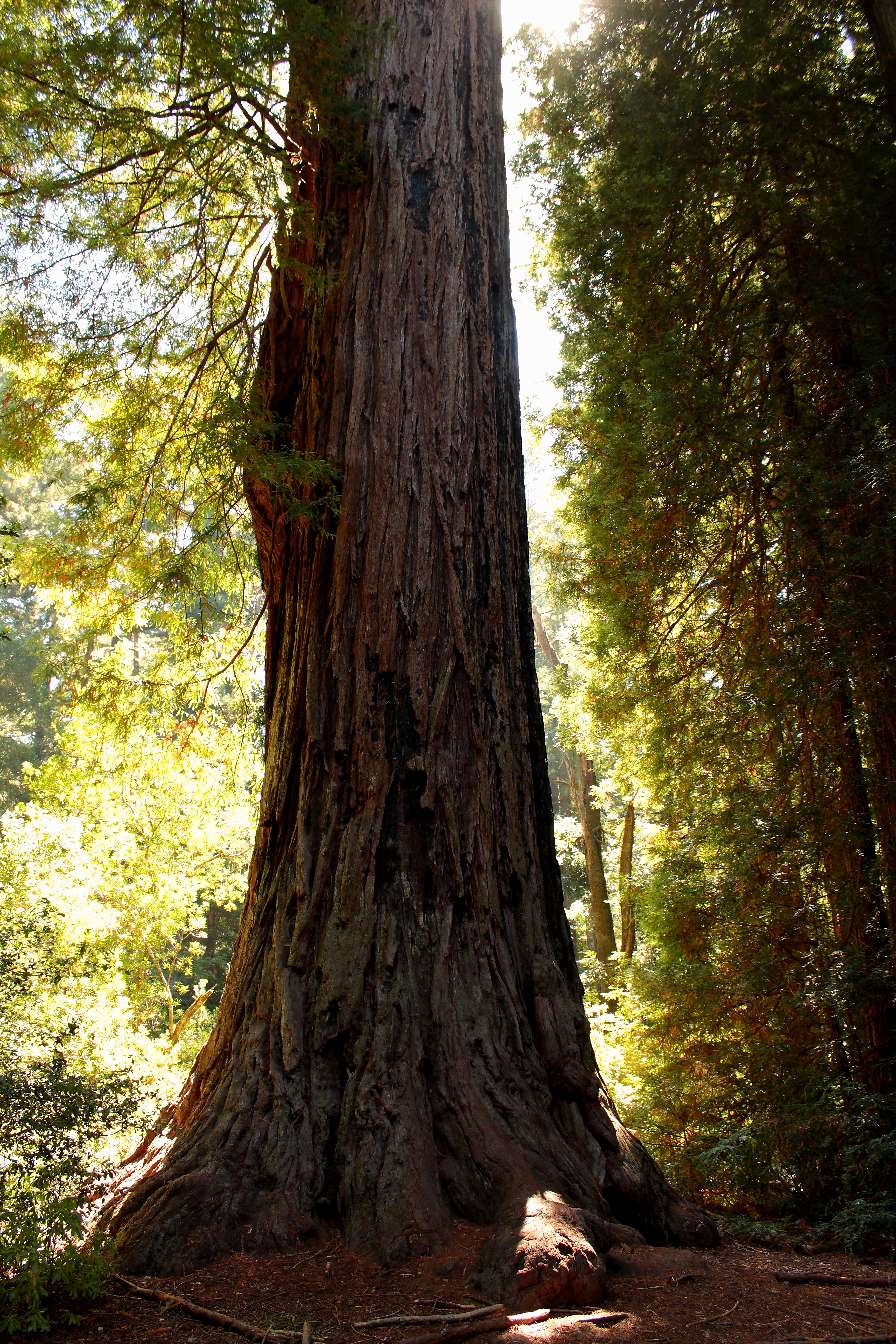
And now, for my illustration.  Sequoia sempervirens, the coastal redwood.  Amongst the oldest living things on earth, the species includes the tallest living trees on the planet.  This particular tree is located in Big Basin Redwoods State Park, about 25 miles from the house I lived in as a high school student, where my brother lives now.  It’s nicknamed The Grandfather.

endurance

If these trees continue to exist in 50 years, they may exist for a thousand.  If they’re gone in 10 years, they’ll be gone forever. Redwoods reproduce by seed cone and asexually through lignotubers, called ‘burls’.  Redwood burls are beautiful swirls of richly colored wood when they are sliced open.  Unfortunately, poachers take these burls for decorative furniture and cut off the reproductive possibilities.  Here’s an article describing how 2 men were arrested and charged for poaching redwood burls in a National Park.

Redwood Poachers

This May 21, 2013 photo provided by the National Park Service shows wildlife biologist Terry Hines standing next to a massive scar on an old growth redwood tree in the Redwood National and State Parks near Klamath, Calif., where poachers have cut off a burl to sell for decorative wood. The park recently took the unusual step of closing at night a 10-mile road through a section of the park to deter thieves. (AP Photo/Redwood National and State Parks, Laura Denn)

What will endure for the next generation?  How do I choose my path, living in continuation and protecting continuation in all life on our interconnected planet?

© 2014, essay and photograph, Priscilla Galasso, All rights reserved

Unknown's avatar

Wilderness Week continues!

September 3 marked the Golden Anniversary of the signing of the Wilderness Act into law by President LBJ.  I posted a kick-off essay about a recent trip to a designated wilderness preserve here in Wisconsin for The Bardo Group.  Subsequently, members of that blogging community posted essays, videos, poetry and photos on the wilderness theme.  Check out the daily posts beginning that week by clicking here.  Favorite pieces gleaned from that site include How Wolves Change Rivers, The Carpathians – “Europe’s Only True Wilderness”, and In Wilderness Is the Preservation of the World.

Just after my kick-off essay went online, I headed to northern California to visit my family and explore some of the natural places unique to that area.  I felt the presence of my father as I re-visited trails we had walked together and that he had walked after I moved out.  A quote that I had read somewhere kept surfacing: “In the end, we will conserve only what we love, we will love only what we understand, and we will understand only what we are taught.”  Baba Dioum included this thought in a speech he made in 1968 In New Delhi, India, to the general assembly of the International Union for Conservation of Nature.  

My father was a teacher of Math and Science professionally.  He taught Religion as a volunteer in the church.  He taught me many things, but in his teaching about Nature, he was less didactic and more mystic.  He simply wanted to be there and to introduce me to a living thing which he loved…the planet. 

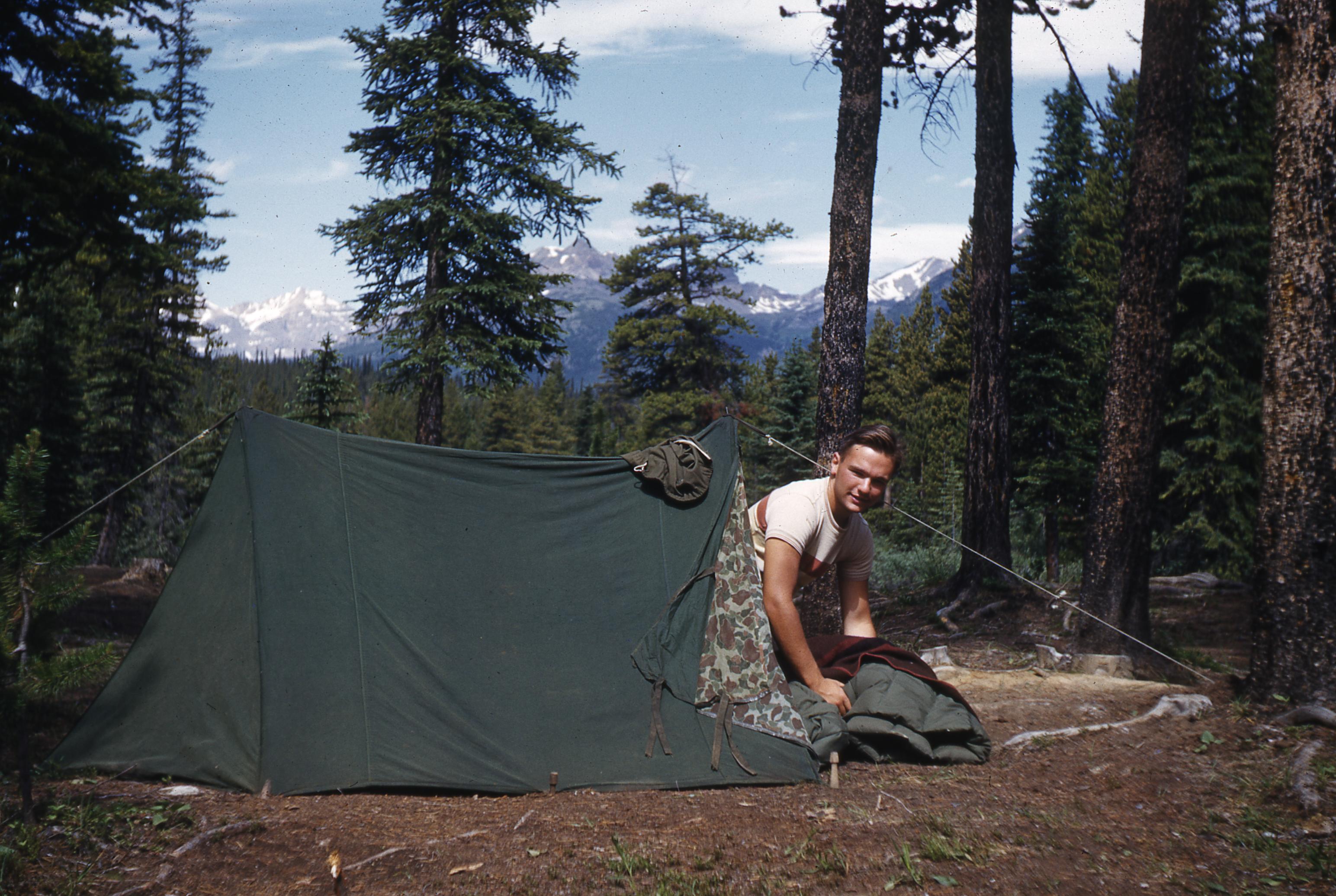
Camping in Alaska the summer after his senior year in High School: 1951.

My Dad in Alaska the summer after his senior year in High School: 1951. (photographer unknown)

Some of the things my father introduced me to:

September 21 is the date marked for the People’s Climate March in New York City.  The United Nations Climate Summit is two days later.  Please consider what your part may be.  What do you hope for our planet?  How do you want those hopes represented by our nations’ leaders?  How can you contribute to the teaching, the understanding, the loving and the preserving of our mutual home?  Thank you for doing your part, whatever that may be.

© 2014, essay and photographs, Priscilla Galasso, All rights reserved

Unknown's avatar

Weekly Photo Challenge: Adventure!

I am late jumping into this week’s challenge because I’ve been on an adventure!  I’ve been in California for the last week visiting family and taking excursions.  I lived in CA for 15 years, but it’s been 4 years since I’ve been there.  In the interim, they’ve established a new National Park.  The Pinnacles have been designated a National Monument since 1908, but 2 years ago it became a National Park.  And it’s still the newest one.   My father and brother used to hike there years ago and raved about it to me.  This week I made my first visit.  California condors have been reintroduced to the area, but I didn’t see one.  I did see a tarantula and a wild bobcat, though!  The tarantula was in one of the caves that was formed when giant boulders from the top of the Pinnacles crashed down into the canyons.  It was very dark under there, and it took me a while to figure out how to photograph the critter.  The CCC built some very helpful trails with stairs and railings in the 1930s that make exploring those caves and getting up to the rim of Pinnacles relatively easy.  What you might not notice in the photos is the silence.  Yes, even in California, one can find silence.  Solitude.  Space.  But those places seem to be shrinking every year as population and development boom.  The state has changed since I left in 1991.  And it will keep changing.  Some changes are good though.  It’s nice to know that condors live there now. 

Unknown's avatar

Celebrating 50 Years of Wilderness Protection

It’s a time for celebration! 2014 marks the 50th anniversary of the 1964 Wilderness Act, the landmark conservation bill that created a way for Americans to protect their most pristine wildlands for future generations.  The 1964 Wilderness Act…created the National Wilderness Preservation System, which protects nearly 110 million acres of wilderness areas from coast to coast. This anniversary is a wonderful chance to celebrate all that’s been achieved for wilderness in the past 50 years and remind Americans of all that we can achieve in the next 50.” (from The Wilderness Society website, http://www.wilderness.org)

wilderness

I read this call to celebration with great delight. My partner Steve is also turning 50 this fall. We’d been searching for a way to live out the next half of our lives more intentionally embodying all that we’ve come to value. He’s been reading up on ‘Deep Ecology’ lately and examining his own philosophy of land ethic, relationship to the Earth, and living responsibly. It can all be a very thick soup to me, but at the mention of “WILDERNESS”, I began to find a kind of clarity. Images, feelings, an intuitive sense of freedom and sanctity began to emerge from the murky definitions and contradictions. Yes, I value ‘wilderness’. I need it. I know this, deep in my soul. What is this recognition about? What does ‘wilderness’ mean, and what do I learn from it?

A wilderness, in contrast with those areas where man and his own works dominate the landscape, is hereby recognized as an area where the earth and its community of life are untrammeled by man, where man himself is a visitor who does not remain.” The Wilderness Act of 1964

tent

What is our relationship to wilderness – or to Nature, for that matter? Are we visitors? Are we managers, stewards, masters? Conquerors? I hear the ‘beep, beep, beep’ of construction vehicles in reverse and the thud of jack-hammers that are currently tearing down the green space near my home and widening the interstate highway to create a Research Park, and I know that a large part of my culture is dedicated to conquering and altering the land and calling it ‘development’.

playing house

I am drawn to the prairie, to the woodlands, to green space wherever I find it, but I don’t want to be a mere visitor. I belong to this planet. My ancestry is here. When I was a little girl, I used to play in the Forest Preserve across the street from my house. I would duck beneath the shady boughs of a bush and sweep out some floor space with a stick. I would set up rooms and fashion utensils of twig and bark. I played House for hours on end, staking my claim, perhaps, to domesticity within that habitat. I want to live on the Earth, with the Earth, not in dominance or enmity, but in peace and harmony. In order to live in peace, however, I have to know when to leave well enough alone. I know this in my relationship with people, and I know this in my relationship with animals. It’s called Respect. Why shouldn’t this be true of my relationship to land and sea and air as well? Let it do what it wants to do. Let it enjoy autonomy, as I do. Let it be “untrammeled by man”.

 If future generations are to remember us with gratitude rather than contempt, we must leave them a glimpse of the world as it was in the beginning, not just after we got through with it.” – Lyndon Baynes Johnson, President who signed The Wilderness Act into law.

secondary wilderness forest

Is it naive to think that there exists any place on Earth that is truly pristine? Perhaps. And that need not be grounds to dismiss the idea of wilderness with a cynical roll of the eyes. I believe there is merit in creating what I call ‘secondary wilderness’ by allowing areas that have been previously used and even exploited to return to a more natural state. There is much to be learned by observing what time and non-human agents will do in a particular environment. Steve and I found a section of secondary wilderness right here in Wisconsin. Although most of the 110 million acres of federally designated Wilderness is west of the Mississippi in mountains, deserts, and Arctic tundra, there are forests in the North that have been abandoned by logging operations and allowed to return to wildlands. The Headwaters Wilderness in the Nicolet unit of the Chequamegon-Nicolet National Forest is 22,000+ acres of previously logged forest that has been left wild since 1984. There are 2 Forest Service roads that divide the area into three sections, but enough contiguous acreage to qualify still for wilderness status. Backpacker Magazine’s site has given it the distinction of “deepest solitude” within that Forest. We headed there just after Memorial Day.

wilderness map

wilderness:(1)  a tract or region uncultivated and uninhabited by human beings (2) :  an area essentially undisturbed by human activity together with its naturally developed life community (Webster’s Collegiate Dictionary)

We found a dispersed campsite across the road from the designated wilderness on the banks of Scott Lake. As we set up camp, we were greeted by two trumpeter swans on the lake, a raucous chorus of frogs and a host of mosquitoes. That night, we had a bit of rain. In the morning, a bald eagle perched high in a dead tree on the far side of the lake, illuminated by the rising eastern sun. Staring at him through my binoculars, I imagined him enjoying an aerial view like ones I’d seen in pictures of Alaska. Could I really be in the wilderness, finally? My rational brain convinced me of the disparities, but my romantic soul glowed. Even here, in Wisconsin, there can be solitude, common-union with nature, and a wild hope.


swans 2

“…in Wildness is the preservation of the World. Every tree sends its fibers forth in search of the Wild. The cities import it at any price. Men plow and sail for it. From the forest and wilderness come the tonics and barks which brace mankind…I believe in the forest, and in the meadow, and in the night in which the corn grows. We require an infusion of hemlock, spruce or arbor vitae in our tea…” Henry David Thoreau, “Walking” 1862

We found a hiking trail into the edge of the wilderness, marked by a series of white diamonds on the trees. The trail was maintained, after a fashion, but not with meticulous interference. I preferred it to those wide, paved “trails” in city parks where cyclists, boarders and baby strollers whiz by all weekend.

The inevitable down side of climbing the wilderness mountain is returning to ‘civilization’, re-entering the spaces that humans have altered and asking a million critical questions about our involvement. Was this action necessary? Was this change beneficial and for whom? How is this decision going to effect this environment, this habitat, this life? How do I take responsibility when my ignorance is so vast? How do I do my best to learn and choose and be aware? What do I do when I see individuals or systems causing destruction?

I learned the 4 pillars of Environmental Education while volunteering at a local Nature Center: Awareness, Appreciation, Attitude and Action. My experience in the wilderness took me on a journey past those milestones: being aware of the solitude, of the multitude of interconnected lives as well; being awed by the variety and majesty of all that I saw; feeling a deep desire to protect, to respect, and to serve Life; and finally, deciding to make changes and choices in my own life and lifestyle, to learn to embody the experience, not just as a vacation or a change from habit, but as a daily practice.

wilderness sunsetSteve & I are planning to attend the National Wilderness Conference in Albuquerque, New Mexico this October. We are eager to explore the sacred space of our common ground, the Earth, with like-minded people who are also interested in fostering the understanding of our life in proximity with each other and with the life around us. I look forward to feeling the refreshment of wilderness in my soul and encountering new ways of expressing the spiritual aspect of this quality of life in art, morality and intellectual discourse.

Please consider this an invitation to join me, if not at the Conference itself, in the exploration of Wilderness as a part of our humanity. Please share comments here and likes here.

Ben Jonson exclaims: ‘How near to good is what is fair!’ So I would say, How near to good is what is wild! Life consists with wildness. The most alive is the wildest. Not yet subdued to man, its presence refreshes him. One who pressed forward incessantly and never rested from his labors, who grew fast and made infinite demands on life, would always find himself in a new country or wilderness, and surrounded by the raw material of life. He would be climbing over the prostrate stems of primitive forest-trees. Hope and the future for me are not in lawns and cultivated fields, not in towns and cities, but in the impervious and quaking swamps.” Henry David Thoreau, “Walking” 1862

.

© 2014, essay and photographs, Priscilla Galasso, All rights reserved

Unknown's avatar

Weekly Photo Challenge: Dialogue

Today’s prompt says, “With an intuitive approach, I considered the photos’ subject matter and graphic attributes and chose those that resonated with each other, creating cross-dependencies and visual analogies. They’re combinations that tell a story.

The resulting dialogue — they story they tell — is the creation of each viewer’s individual perception.

It’s your turn now: for this week’s challenge, bring together two of your photos into dialogue. What do they say to each other?”


Two photos (you can view them in larger format by clicking on them):

What’s in your dialogue?

Unknown's avatar

Weekly Photo Challenge: Zigzag

“The quickest way between two points might be a straight line, but it’s rarely the most interesting one. ” So begins the teasing prompt for this week’s photo challenge.  I’m a pretty straightforward kind of person, myself.  Steve calls it “The Train”.  I get my sights set on a goal, and I steam on ahead without getting diverted.  And often without being aware of people and feelings and other things that are, well, rather important. 

Now, I’m not saying this is a BAD way to be.  It can be useful.  I get things done.  But it’s not the only way to be, either.  Steve is definitely a preferred zig-zagger.  He calls it playing his “bowling pin” game, which goes something like this: set up the pins in their starting formation and bowl.  Wherever the pins have been scattered, set them back up exactly where they are now.  Continue bowling toward the pins in their new place.  Eventually, you get a game that has ranged all over the house, the yard, the neighbor’s yard, and down the block.  Hey!  This could go ANYWHERE!!! Isn’t that EXCITING?!  Yup, he’s an adventurer.  And life with him has definitely opened up new possibilities for me. 

We have managed to travel pretty successfully for more than 5 years now.  I am pretty good at going off track now and enjoying it greatly.  One bit of advice, though.  If your GPS system should happen to fail, don’t ask him for directions.  Ask me.  You’ll be at your destination in under an hour with plenty of gas to spare.  Trust me.  🙂

© 2014, essay and photographs, Priscilla Galasso, All rights reserved

Unknown's avatar

Weekly Photo Challenge: Summer Lovin’

Perfect timing!  Believe it or not, this week’s photo challenge coincides with the first anniversary of my daughter’s wedding.  Susan & Andy became engaged on July 28, 2012 and married one year later.  We joined them for outdoor ceremonies in Madison, WI both years.  The first year, the temperature was in the 90s (Fahrenheit).  And humid. 

P1040716

For the wedding, although the sun was shining, the mercury never reached 70! 

This morning, as Steve & I walked to a local breakfast cafe, I was wearing a sweater and a nylon jacket…it was 59 degrees out.  Summer may not always be HOT, but here in the Midwest, it comes bearing flowers and greenery.  Which is a wonderful way to show Affection, Tenderness, Beauty, Grace…and LOVE!  I’m lovin’ summer here in Wisconsin!


Unknown's avatar

Weekly Photo Challenge: Contrasts

What a cornucopia of contrasts we large-brained creatures enjoy!  All of our five senses combined with time, space, balance, aesthetic, and a host of other concepts gives us a spectrum of comparison and juxtaposition that is unparallelled (maybe – contrasts in perceived electricity, magnetism, light and sound might be more pronounced in other species than I imagine!  How do animals know when and how to migrate or mate or find a spawning place?).   Sensate – sentient – sensational.  The world is a vast canvas of contrasts.

prickly feathery coldPrickly, feathery, cold.  Down on snow, covered with a pine bough. 

I can lose myself in texture and scent and taste even more than with sight and sound.  My guts are more involved, my brain less so.  I am enjoying a book by one of my favorite writers, Walter Wangerin Jr.  What I like about his voice is that it is so thoroughly visceral and ancient.  It makes me feel grounded.  There’s a holiness in that.  Contrast helps me know that I am alive.

Unknown's avatar

Weekly Photo Challenge: Extra, Extra

The Weekly Photo Challenge prompt posted today says: “This week, share a photo that has a little something extra: an unexpected visitor, or a tranquil landscape with a splash of color. A lone carrot in a sea of peas. Draw us in with a humorous detail, or find a photo with an added element that makes it an image only you could capture.”

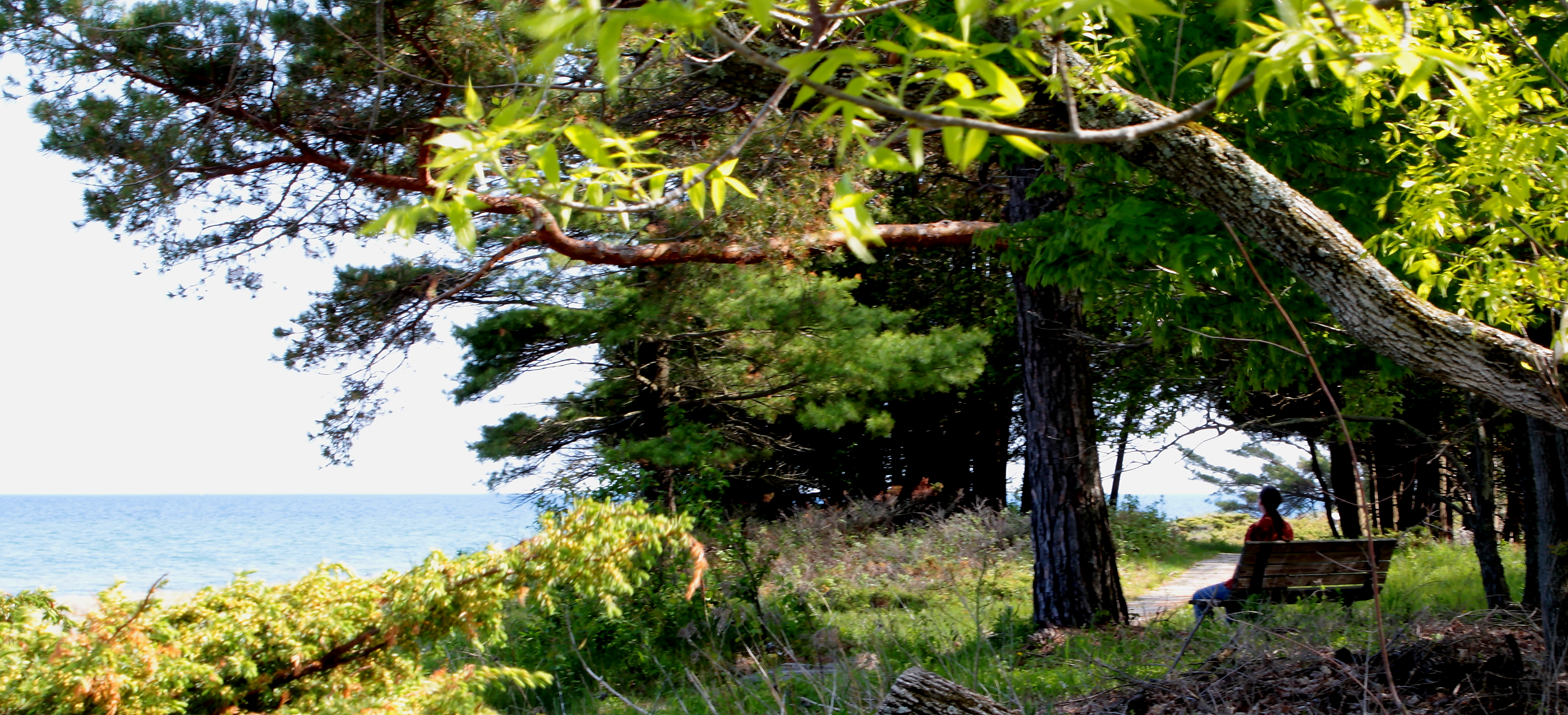
Extra(If you click on the photo, it should open in a larger window for a more panoramic view.)

The significance of this photo has many levels.  Someone just visiting this blog for the first time might see a nice composition of natural scenery and a person enjoying it.  Very pleasant.  Someone who knows this blog a little better might recognize the person as Steve, my partner, who shows up in many of my photos.  Someone who knows my history might recognize the Wisconsin shore of Lake Michigan, opposite my grandmother’s beach cottage where I spent many childhood summers, and understand the sentimental attachment I have to this particular body of water.  Only Steve & I know the thought that prompted him to sit in this place, the person he is memorializing as he pauses on our walk.  The invisible figure in this photo is Steve’s father, Stanley. 

I never met Stanley.  He died one month before I first encountered Steve.  I have been introduced to him many times in concept and story, however.  Stanley was a gentle person, a father who did not assert his authority or enforce many rules.  Steve sometimes describes him as “passive resistant”, but his assessment is one of understanding and acceptance rather than judgment.  Stanley enjoyed going slowly through life, enjoying simple pleasures and quiet places.  He worked many years in the US Postal Service and traveled with his family in his own whimsical way.  Taking a cigarette break was a frequent excuse to absent himself from the social gathering at hand to enjoy a peaceful moment.  When Steve saw this bench along the nature trail at Kohler-Andrae State Park, he said, “This is just the kind of place my father would like.”  He sat down.  I walked down the path to allow him some private time with his dad, and snapped this photo. 

Happy Father’s Day, Stanley.  Thanks for being the person you were and for all you did to make Steve the person he is.  Well done, sir.