Unknown's avatar

Fairy Princess Dreams

Last night we went to see the Bolshoi production of Sleeping Beauty on the cinema screen.  The newly restored Moscow theater features gilded woodwork and royal red upholstery, a royal box and no “cheap” balcony seats.  It is Old World magnificence  and romance in itself.  Add Tchaikovsky’s  lush orchestral score (which includes not one, but two harps!) and the lavish beaded, satin costumes and tutus of classic ballet and you have a Spectacle of epic proportion.  We sat in the 5th row and felt like we were actually on the proscenium during the close up camera shots.  It was breath-taking.  Princess Aurora showcases all her most difficult moves in Act I at her 16th birthday party, partnered by 4 elaborately dressed foreign suitors.  Cymbals accentuate each technically challenging pose, and she becomes the prima ballerina superstar of all my girlhood dreams.  Suddenly, I am 10 years old and sitting next to my father at the Auditorium Theater in Chicago.  The ballet is so beautiful and I am so lucky and so loved and I miss my dad so much that I can’t hold back the tears.   My heart is too full.

My dad proudly attended to the cultural education of his 4 charming daughters.  We had classes at the Art Institute and ballet lessons at a studio on Michigan Avenue every Saturday.  He had season tickets to the ballet for the whole family and to the opera for my mother.   I was absolutely stage-struck as a kid and couldn’t resist trying on poses and gestures in the lobby during intermissions.  I was the youngest of his daughters and probably tried the hardest to please him.  I suppose I felt like a princess in many ways.  I counted on my father’s kingly protection and generosity.  I sometimes slept through life, waiting for Prince Charming to appear and carry me off to a dream of happiness.  I met my prince when I was 15, married him when I was 21, and almost lived the whole freakin’ fairy tale.   But no, I lived a real life.  And I’m glad of it.

I found out that grace takes a lot of hard work, that fathers are imperfect people, and that love is stronger than death and more powerful than beauty.  And it also requires a lot of hard work.  Discipline and commitment can be more lovely than romance.  Facing reality is more invigorating than dreaming.  Pinch me when the spectacle seems overwhelming; I want to know I’m alive.

And David Hallberg is my new fascination.  Not only is he a supremely graceful human being, he blogs, too.  Yup, he’s real.

photo from The New York Times
Unknown's avatar

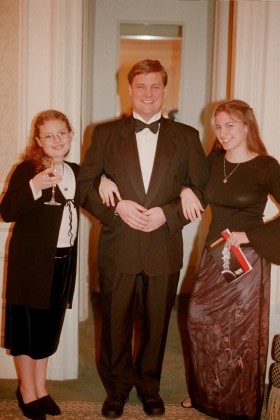
Christmas 1982

Ever had a piece of music bring up a memory, a time and place from the past, with such clarity that you felt you were actually there?  Last night it happened.  I came home from my Memoirs class, having read my essay aloud with such a rush of nervous adrenaline that my heart was still pounding.  I decided to have  a glass of Chardonnay and listen to some of Steve’s recently acquired CDs with him.  So, I was relaxing and in “memory mode” when he put on a CD of the Tallis Scholars singing a mass by John Taverner, written around the turn of the century – the 16th century.   Oh, the flood of my heart!

I was 20 years old.  Jim and I had become engaged on my birthday over the summer.  I went back down to So. Cal. to school, to continue with my bachelor’s degree in Vocal Performance.  Jim and my mother were in a Bay Area singing group together, called Renascense (or some archaic spelling pronounced ren-NAY-sense).  I came home for Christmas and was invited to one of their concerts.  I close my eyes and picture them:  Jim in his black tuxedo, ginger mustache,  the smatterings of a beard he’s grown for Rigoletto.  He is 22, teddy bear-like with twinkling blue eyes, blonde hair and a killer Italian grin.  But while he’s singing, he is an angel, mouth perfectly forming straight vowels, eyebrows imploring heaven.  He is a tenor.  His voice melts butter.   My mother is dressed in a mail order catalog nightgown, polyester, rust-colored, that has been trimmed with gold & black cord around the waist and across her bosom in an X.  Only women who have sung in choirs can imagine how absolutely ludicrous these outfits can be.  No woman looks good in a choir uniform, let alone one that has been made to look “period” on the cheap.  It is ridiculously embarrassing, but I forgive her.  She sings alto in a hooty voice that blends well.  Her quality is not stellar, but her musicianship is indispensable.

I have been so homesick away from school.  I have been staring at my diamond ring, counting the days until break.  I sit in the concert hall and look at these two people whom I love more than any others on the face of the earth, and I am so proud of them.  I’m proud of their dedication to music and their fond relationship to each other.  I admire them completely, and I am jealous.  I want to be with them; I want to be them.  I want to feel the music in my breast float to the clerestory of the church and entwine in that beautiful polyphony.  I ache for this memory.  And then the tenor line soars above the rest, and it is Jim himself, singing to me.  The recording is perfection.  I can tell that it isn’t Jim, but there are moments when it definitely could be.  My will takes over and I make it him, in my mind.   I am there, in that sanctuary, and Jim is singing to me, alive, young, vibrant with love and mystery and warmth.

Jim before his Carnegie performance - 2001?

Music folds time in patterns that defy chronology.  I sail far away on its transcendent waves.  It is a grace to travel toward those we love without limits.

Unknown's avatar

Film Noir et Blanc

Saturday night we went to see a movie:  “Nosferatu: A Symphony of Horrors”.  This silent movie from Germany was accompanied by a live band from St. Louis called The Rats & People Motion Picture Orchestra, which features Wurlitzer electric piano, theramin, vibraphone, electric guitar, two violins, viola, trombone, trumpet and one percussionist.  The theater itself is an old relic.  Typically, the front rows of seats are replaced with old couches and sofas and end tables.  For the crowd on Friday, though, there were rows of seats and cafe tables on the side.  It was a pretty funky set-up, with lots of young people in attendance, and a few old fogeys like myself and Steve.  The theramin player was fascinating to watch.  She also played a violin part.  Her intonation was better on theramin, unfortunately.  It was good creepy, goofy fun, though.  German expressionism is interesting.  How would you stylize fear or death or love?  Silent horror film stars don’t scream.  Their eyes widen; they grimace; they gesture, but they don’t scream.  Make-up and background heighten contrasts.  Here’s the iconic image from the film.

Steve likes the childlike exploration of a basic emotion – fear.  It’s not deep and philosophical, really, nor is it very clever or contrived.  I tend to find the old horror films funny.  I mean, here comes Count Orlok walking through town with his coffin under his arm.  Seriously?  I won’t even go to a modern horror movie, though.  I get too tense.  It’s not good for me.

On Friday night, I finally watched “Citizen Kane”, which we borrowed from the library.  I’d never seen it, although the ending had been spoiled for me many times over the years.  I got hooked by Orson Welles’ genius.  The way he pieces together the story, the radio-inspired musical effects, the dialogue and writing, the visuals and directing, and his acting are just brilliant.  Did you know you can buy a T-shirt with his picture on it that says, “I made Citizen Kane when I was 25.  What the fuck have you done?”  His creativity is evident, and was technically ground-breaking at the time.  I mused about the psychology of the story for hours afterwards.  Agnes Moorehead’s portrayal of his mother was just eerie.   Issues of control and freedom and power squeak out in each scene.  So, I’m in total agreement with everyone who says it’s possibly the best American film ever made.

One more thing: what do you do with leftover movie popcorn?  Feed the squirrels.  I put it out on the old wicker chair.  It’s already gone.  Now it’s snowing.  Food is going to be harder to find.  I might need to see another movie.

Unknown's avatar

If Music Be the Food…Play On!

Steve purchased 32 CDs through an e-Bay auction last week.  Beethoven, Bruckner, Handel, Haydn and Schubert, mostly.  I think he’s trying to collect at least one recording of every Schubert piece…and there are more than 900 compositions cataloged.   Last night, he put on Beethoven’s first symphony when I got home from class.  I poured myself a glass of Cupcake Red Velvet and settled in under the blanket on the squishy couch with him.  Closing my eyes, I got an immediate visual memory of my father in his brown chair with the matching ottoman sitting next to the stereo cabinet, reading glasses and a glass of Kirigin Cellars Vino de Mocha in a wooden coaster beside him on the redwood burl table.   My mother is in the red rocking chair, knitting away on another warm pastel hat for a preemie at the hospital.  There’s a fire in the fireplace, and I imagine myself and Steve lying in front of it on the oriental rug.  We are all enjoying early Beethoven together, eyes closing in pleasure, warm and satisfied against the chill of a dark November.

I wish that this were possible.  I even imagine Jim lying on the tan sofa opposite the fireplace and wish I could picture Steve’s dad there as well.  It comforts me to think that music bringing us all together.  Music has been at the foundation of all of our lives in different ways.  My father and mother courted by going to concerts in college.  Jim’s mother, my mother-in-law, was a concert pianist.  Steve and his dad would listen to records in their den, shutting out all distractions.  My dad, Steve’s dad, and Jim are dead, but they seem to keep resonating music nevertheless.  We listen to music intently, we feel it and breathe it.  There is no TV in the room.  We haven’t got headphones or ear buds.  We let the music fill the space available.   In this way, we live with music and it nourishes us.  That is something we share in common, something sacred, I think.

Of course, there are other ways to relate and other kinds of music.  My kids and I crank up Beetles tunes and sing along or belt out show tunes together.   I’m introducing my youngest to opera now, and wondering how much they choose to listen to “Classical” music on their own.   I know that my oldest cherishes the music she sang with her father when they were in Chicago Master Singers together.  Now, she’s the lead vocalist in a punk band.

But it’s all good.  If we’d lived 150 years ago before recorded music was available, I’m sure we’d be picking up instruments and singing to ourselves all the live long day.  It’s impossible for me to imagine our life without music.  And something about the darkness of the season makes the music seem all the more life-giving.

So, I think I’ll turn off this computer and go downstairs where Steve is playing his CDs.  I’m as thankful for this abundance as I am for food.

Unknown's avatar

Lord Have Mercy

Gospodi pomiluj.  That’s Church Slavonic for “God have mercy”, same as the Greek Kyrie eleison.  I remember learning a setting of those words in High School choir.  The entire text of the piece was just those two words, repeated over and over at increasing dynamic levels.  The suffering of the world thrown high to the ears of God.  There were moments in the opera last night (Boris Godunov) where this poignant plea rang out and reached my heart high in the upper balcony, but unlike a Puccini moment, it didn’t take full hold.  Why not?  Well, I could bicker about the staging, pointing out that the chorus milling about in the background distracted from the Holy Fool’s aria downstage left in front of the floodlight.   I could point out that the composer wasn’t really a professional and didn’t provide enough scene change music to set off these important highlights.  Others came in later (Rimsky-Korsakov, for instance) and tried to make Boris a bit more theater-ready, but the Lyric staged the original version.  But perhaps the more intriguing discussion is about the way Russian suffering compares to Italian – or Buddhist – suffering.

photo credit Dan Rest

This iconic Russian opera includes a large chorus of peasants, children, boyars (advisers), soldiers and priests.  Russia’s suffering is peopled.  By contrast, Puccini’s operas often concentrate on the suffering of one or two lovers.  You feel the depths of their grief in soaring melodies, cry with them, and feel cleansed.  (Think Butterfly, Tosca, Boheme.)  Russia’s suffering would never be so finite.  It’s pervasive.  The czar embodies this and its relentlessness drives him mad.  Well, that and hallucinations of a child he supposedly murdered.  But he cares about his people; he tries to feed them, and they still blame him for every want.  How do you find peace?

Buddhism addresses peace from the inside out.  It isn’t a peace that you could pass on to a population as their leader.  The best you could do is find it for yourself and try to be a role model.  It would be quite a challenge to maintain it as the head of a huge, suffering nation.  Would that be the Emperor of Japan’s story? Or China’s and India’s story?  Actually, the Met is currently showing Phillip Glass’s opera about Ghandi (Satyagraha).  It was simulcast in theaters this past Saturday.  Missed it, but hoping to see the encore screening December 7th.

Here’s another thought about nationalism and identity: there’s Mother Russia and the German Fatherland; what parental figure do we have connecting us to American land?  Uncle Sam?  Does that mean we are orphans?

I have to say that exploring and addressing my personal grief and suffering through Art is like taking a bitter pill with a large spoonful of glittering sugar.  Costumes, twinkly lights, gorgeously rich bass voices and sympathetic violins really take the edge off.  I appreciate the genius and consider myself enormously fortunate.   Thanks for the grace and mercy.  Oh, and I hope Erik Nelson Werner wasn’t badly hurt when he fell off the set in a hasty exit.

Unknown's avatar

A Modest Entry

We are off to see Mussorsky’s opera Boris Godunov at the Lyric in Chicago.  The performance is at 2pm.  Visit with Memma and Pinkle and dinner to follow.

If it’s Godunov for Modest, it’s Godunov for us.

Review to come, if we get home early enough.

______________

Well, I’m back, but too tired to blog now.  I think one of the leads got injured jumping off the set when he couldn’t make his exit; he didn’t show up for the curtain call.  Live theater — there’s nothing like it!  More later….

Unknown's avatar

Living Heroically

Discipline without coercion.  Is it possible for individuals?  For communities?  Dare we believe that without obligation, people will make efforts to do their best and work toward the common good?  Are people who do that “heroes”?

We dangle punitive measures and capitalistic rewards in front of the masses and hope that will encourage us to be model citizens, and then we have to deal with the greedy monsters that evolve wondering “What’s in it for me?”  If I am of the 1% and super-wealthy, what incentive do I have to share?  And what is the percentage of the 99% who hope that one day, they will become super-wealthy also and so feel no inclination to put restrictions on the rich?  How many people are likely to come to a sense that they have “enough” all on their own and turn their surplus over to others?  And when will that sense of “enough” kick in?  What standard of living do we feel entitled to?  What would it feel like to say, “This is all I need.  I am not afraid to trust that I have enough”?  Would it feel like freedom?

How do you discipline yourself without feeling a sense of obligation?  Do you eat healthy foods because you want to?  Or because some outside influence is holding up a consequence or reward?  Do you make music because some authority is telling you to practice or for the sheer joy of it?  Do you do what you do out of passion or fear?

On our first date, Steve played a kind of “twenty questions” game with me.  I was trying to guess his three heroes in order to get to know him better.  He maintains that each of these inspirational figures have a passion for something and demonstrate it joyfully.  The first one is David Attenborough of the BBC Natural History Unit, groundbreaking writer and presenter of nature programs.  The second is Julia Child, The French Chef.  I was in total accord to this point, and also loved that they are easy to imitate in voice and mannerism to add levity to any undertaking (and we do this frequently).  The third one was rather tough to guess, mostly because he wasn’t human.  “An athlete” was about as close as I got.  Finally, Steve led me to thinking about equestrian athletes, and I immediately thought of Secretariat.  I found that rather a head-scratcher, though.  How could a horse be a hero?  And then he showed me the youtube clip of the final race in the1973 Triple Crown.  It still makes him cry.

A horse cannot be coerced by the promise of fame and fortune, can it?  There was no whipping, no carrot on a stick.  Secretariat ran for the pure joy of running, it would seem.  Feeling the power of his legs, the wind in his mane, the freedom of doing what he was born and bred and loved to do that day.  Did he have a reward afterward?  Did he develop a taste for winning?  I suppose you could debate the emotions of a horse forever and never learn anything conclusive.  You could also debate whether or not his race was something that created “good”.  Many people were undoubtedly uplifted; just listen to the audio on the tape.  His grace and beauty are captivating.  And maybe a bunch of people were making money off of it, but the horse wasn’t.  For that reason, it seems rather pure to me.

So what would it mean for you and me to be the heroes of our own lives?  To be the best we could be not out of obligation or fear of reprisal or for monetary gain, but just for the joy of living out our own passion and interest, for the love of it?  What would it be like to allow that to be our reward, our life work, and not ask fame or fortune from it?  Would we share any surplus of our efforts?  What if we all lived like that?  Would we be able to balance the table top, enjoy sustainability and equality, as a community and perhaps as a planet?  Is this a utopian ideal and totally unrealistic?

Probably.  But I would love to feel the wind in my hair, too…

...like her. (My daughter, in France, living her passion.)

Unknown's avatar

Bravi!

I just returned from watching the HD live simulcast of the Metropolitan Opera’s matinee performance of Wagner’s Siegfried.  After five and half hours in another world, I’m not really sure what day it is.  But it doesn’t matter.  I’ve been convening with the gods and had a ringside (oh, pun appreciated!) seat at a resurrection which left me breathless and sobbing.  Brunhilde (two dots over the ‘u’) is wakened from her 18 year slumber by a kiss from Siegfried.  It may sound like Sleeping Beauty, but with Wagner’s incredible score underneath instead of Disney, it is a much more transcendent moment.  Deborah Voigt is an amazing actress as well as a singer.  In due time, she rises and greets the sun with a smile that lights the stage and a melody that thrills you to gooseflesh and tears.  Have you ever felt dead?  Hopeless?  Trapped?  Futureless? Depressed?  “There’s got to be a morning after….” is the same sentiment with inferior music. Her salutation of the day and the realization that she is alive reminds me of the Suryanamaskar in yoga, not that she does the position, but the joy of it shows in her entire being.  The passion behind the resurrection in this story is her banishment by Wotan, her father, god of Valhalla and enforcer of all the rules.  That scene as well struck me in the heart and gut as I pictured my own stern father turning his back on his daughter.  Their parting was a wrenching and painful death, again reducing me to tears in the darkness of the theater…last June.  She doesn’t awake until Act III of the next opera, which is what I saw today.

Oh, life!  Light in your eyes, the touch of your own warm flesh, breath in your lungs.  What compares with realizing the richness of being alive?  We can barely endure a moment of this stunning gift.  Something of sentience crashes in on the sparkle like a sledgehammer on an icicle.  Now that I’m alive, there’s so much to fear!  Brunhilde quickly realizes she’s lost her immortality, her armor and shield, and her autonomy.  I know the place where my morning turns on a dime from sunny dawn to mental lists of obligations and anxieties.  It’s like the Easter let down after the trumpet recessional when you know you have to leave the church and the music and go back to your business.  Listening to Deborah sing those first phrases, I hitch my entire being to her joy and long to go with her into that rapture and never come back.

A human emotion, pure and powerful, captured in Art.  It seems simple enough but somehow requires genius…or open innocence…or both.  I feel compelled to become attached, to grab this jewel and hang on, to build a booth around this transfiguration, but that would be a strangle hold.  I let it go, grateful for its presence and passing, and hopeful that another day the sun will rise and I with it.


Unknown's avatar

Suspension of Meaning

In the quiet hours this morning as Steve slept beside me, the maple tree performed a Wayang shadow dance on the south window.

My mind began to wonder: what is 7 billion?  Are there 7 billion maple leaves in this town?  Has my heart beat 7 billion times?  Have I written 7 billion words?  Are there 7 billion of any other species on earth besides humans right now?  Are there 7 billion ants or bats or mice?  If I am one of 7 billion, does my life have meaning?  Am I unique?  Have I produced anything of value?  Am I a “productive member of society”?  And failing to produce any anxiety about this question, I ask myself: does it matter?

I found myself in a rather peaceful state, suspended as any other late fall maple leaf, not very concerned if the next gust of wind should liberate me forever from my connective  capacity.  Steve stirred and asked me what I was doing.  “Just thinking….”  As he awoke more fully, he told me of his late night reading adventures and the existential anger it stoked.  We began discussing morality and deep ecology and meaning.  At breakfast, we listened to Beethoven and Charles Ives and contemplated the difference in the world of the 1800s and the post WWI era.  He mentioned Nietzsche and his mental breakdown and death.  He was an insomniac and took morphine and chloral hydrate; he also had syphilis.  I thought of my brilliant father’s last 7 years living with Alzheimer’s.  What is it like to be separated from meaning?  Steve finds it frightening.  I imagine that it brings you closer to the state of an animal in the wild.  Do they have need of symbolic representations that are recognizable and repeatable?  Do they need meaning to live their lives?  We would probably find it impossible to function for a day without it.  Perhaps in meditation we suspend it for a time.  Is that what Enlightenment is?

Without the blinds covering my window, the maple leaves are golden and bright.

  They dance as solid dark figures when the veil is lowered.  Are they the same leaves?  Why do we attach different meanings to different states of being?  What if we didn’t?

Just wondering.

Unknown's avatar

Homesteading

Because I’m going on the road today to visit my children, I’m not going to spend a lot of time on the internet.  So here’s my suggestion: spend the time you may have spent reading my blog checking out this website.

www.urbanhomestead.org

This family is amazing.  They settled in an urban house in Pasadena in 1985 and converted it to a working small farm that produces nearly all of their food and subsistence needs, including biodiesel, clothing, health care products, and much more.  They now have an institute and do educational outreach all over the country.  Having lived in Southern California myself for 11 years, I find this fascinating.  I hope you’re inspired.