Unknown's avatar

“I’m sorry; we can’t do that.”

You know how once you get pregnant, all you see around you is pregnant women?  I want to trigger that phenomenon in this post and bring awareness to something I feel is pretty common in our fast-paced American life.  I want to see how often people come up with the “I’m sorry; we can’t do that” line when what they really mean is something else.  Something like, “I’m sorry; I haven’t been trained to do that” or “I’m sorry; my computer can’t do that, and I don’t know how to do anything without the computer” or “I’m sorry; we aren’t willing to do that.  Your request is not as important as other things.”  The real answer is absolutely valid and a fine place to begin negotiations.  The problem is, we don’t often get the real answer.

I worked in customer service for a few years, and I remember the nervousness that accompanied requests to depart from policy.  I didn’t know if I had the authority to make exceptions.  I often didn’t want to be in the position of the middle man going back and forth from the customer to my superior.  It made me feel caught in a conflict that wasn’t mine, especially if it dragged on and on.  Eventually, I got to the point where I rather enjoyed listening to people and trying to come up with creative compromises.  But then I was told that I was spending too much time on these discussions and I should simply state the policy and get off the phone.

Dealing with people is tricky.  They require your time, and time is money.  To be an efficient society, we must streamline our systems.  Any person who does not comply with procedure is throwing a monkey wrench into the works.  So what do we value more, the “works”, the people, or some other ideal?  Once you become aware that you’re getting an “I’m sorry; we can’t do that” response, what do you do?

Here are a few examples of this kind of exchange in real life.  The first one is “How do you want your coffee?”  Steve does not like the prevalent custom of serving coffee in disposable containers.  He likes to drink his latte from a mug.  He rarely orders anything “to go”.  He values conservation of resources and energy and is not too concerned with “convenience”.  We have breakfast often at a local cafe that has recently been hiring new staff.  Young staff.  I am patient and cheerful and as helpful as I can be when I’m placing our order.  I got to ordering Steve’s latte and said, “With that breakfast, I want a latte in a mug with 2% milk.”  “Um, okay.  What size?”  “In a mug.”  “I’m sorry; we can’t do that.”  We happened to have had breakfast there just the day before.  “Well, yesterday you could.”  A more veteran server came up behind him and whispered, “Yes we can.  It’s served in a soup mug.”

I’m not saying this young person did anything wrong.  It was probably about his third day on the job.  The point is that we often get streamlined into making concessions in our decision-making and forget that there are other options.  We don’t have to take the disposable option.  We don’t have to take the profitable option if profit is not our highest goal.   We don’t have to have a lawn or rake our leaves or live in the city or send our kids to public schools or give birth in a hospital.  We don’t have to go “up and to the right” and continue to support a growth economy.  But we’ll probably be told when we suggest an alternative, “I’m sorry; we can’t do that.”

Here’s another example.  I am following a discussion on a blog about an architectural idea coming out of Italy.  The title of the article is “Milan’s Vertical Forest”.  http://pensci.wordpress.com/2011/11/07/milans-vertical-forest   The premise of the idea is to create a “less crowded, less polluted, less inhumane” city by erecting high-rise buildings with open balcony space on all four sides to accommodate trees and greenery that would help clean the air and provide a natural aesthetic.  It sounds great, but it makes me wonder whether it’s assuming “we can’t” do something else instead.  If what Milan wants is forest, why not tear down the high-rises and convert the land into open green space?  If what Milan wants is urban housing, why are they calling it a forest when in reality, it’s just apartments with more balcony space?  Are potted trees really going to thrive there?  And will people actually use all that space for vegetation instead of storing their bicycles and grills and laundry there?  If we really want the city to be less crowded and polluted, why not encourage people to move out and work the small farms in France that are being abandoned, for example?  No, “we can’t do that”, we have to think of solutions that keep people in the city and promote more construction and more growth.  Well, we don’t have to.  Let’s just be honest about what our goals are and discuss from there.

So what happens when you “throw a monkey wrench” into the system and ask for a different option?  Do you get an honest negotiation?  I would like to gum up the works of the political machine and ask for a candidate who would admit that s/he is not perfect in character, is not superior in knowledge about every facet of American life and doesn’t necessarily have to be the prime ideologue, but who would be a skilled administrator willing to represent the people and carry out their ideas.

I don’t want a cardboard cup with the shiny logo and a snappy lid.  I just need a teacup to hold some tea long enough to get it to my mouth.  Any Buddhist will tell you, it’s not about the teacup, it’s about the tea.

Unknown's avatar

Memories

What is a “legitimate memory”?  Does it have to be factual?  Is the emotional memory as valid and important as anything else?  If you polled the people effected by an event, would any two have the same memory of it?  I think that highly unlikely.  Everyone has his own perspective.  There must be thousands of different stories about the holocaust of WWII or about Sept. 11, 2001 in New York City.  What do we gain from a memory?  What is achieved by illustrating and sharing it?  With whom should we share our memories?  If you enjoy engaging in someone else’s memories, does that make you somewhat voyeuristic?  Does the sharing of memories help us to become more emotionally intelligent, more empathic?  Does that make it Art?

Andrew Lloyd Weber imagines cats have memories.

We didn’t really talk about these questions in class last night, but Steve asked me sleepily as he came to bed in the wee hours this morning, “So, why do you want to write memoirs?”  He is supportive, but he is much more interested in research and synthesis.  Also, he doesn’t remember much.  Names, anniversaries, directions and details get lost in a blur.  He will remember a holistic sense of something, an emotional reading.   I go the other way; I’m heavy on detail and can’t articulate an emotion.  Perhaps I am trying to teach myself to become more compassionate and empathic.  I typically repress a lot of emotion.  I am afraid of getting in trouble for acting out my passions.  Especially anger.  I completely deny anger.  I like to think this makes me a more pleasant person, but it probably just makes me more neurotic.

Theater, music, literature, art: they’re about communicating emotion, right?  They make us feel human.  We get connected to others and to ourselves through them.  They are marks of culture and civilization. They help us explore a kind of intelligence and understanding about the human condition.  The emotions in art can be immediate and raw or they can be seeds from the past grown into a living reality.  My son tells me that our brains also make memories when we dream and thereby prepare us to have some experience to draw on in a new situation.

So I’m working on remembering repressed emotions, pulling up experiences from the past in detail.  And I’m also trying to be present in the moment, in now.  Going back and forth is kind of a test of sanity.  One of the things Steve said he liked about me when we started dating was that I was “sane”.  There’s a short cut to sanity, which is to remain shallow and functional.  Then there’s the long route, which is to attempt to feel in depth and yet refrain from wallowing.  I want to take that long and winding road and share what I find on the journey.  I hope that results in a learning experience for me and a few others.

Unknown's avatar

Continuing My Education

I’m rather innocent in the ways of the world, even though I’ve lived almost 50 years in it.  I married my high school sweetheart before I’d even graduated from college and left my parents’ care completely.  My husband was a fabulous provider and only urged me to seek full time employment after my 4 kids had reached their teenaged years.  So really, I’ve never supported myself entirely.   Well, come to think of it, probably nobody “supports himself entirely”.  Let’s just say that I still have much to learn.

So today, I’m starting a class in Memoir Writing through the UW – Milwaukee extension program.  I am so excited to be going back to school!  I have a BA already, so I’m not embarking on a long term degree program, but I am trying to get closer to a goal I’ve had for about 20 years.  I’d like to be a published writer.  When I was 30, I started writing poetry.  I self-published one booklet, and had one poem published in a magazine.  I didn’t receive any pay for these efforts.  I’d like to see if I can actually earn money with this proclivity to write.  Aside from a few curriculum guides commissioned by my former employer, I haven’t had any paying work since last December.  And now, my car needs repairs and registration plates.  It’s time to go out into the world and seek some income.

You have no idea how neurotic I could be about this.  My kids have much more work experience than I.  I have urged them out into the job market on many occasions with peppy confidence talks, and they’ve always had some measure of success.  It’s part of their skill set.  I kind of freeze up inside and whine, “But I don’t know how to do this!  I wasn’t brought up to do this!”  I’m sure some of you are incredulous.  Let me explain: my mother hasn’t had a paying job since she graduated and married in 1955.  She is a brilliant and accomplished woman with a BA from our nation’s most prestigious institute of higher learning (yes, that one, but the women’s version from the pre-co-ed days).  She’s worked on countless volunteer committees and made important contributions to many communities.  But she hasn’t had a paying job.  It’s actually possible to live without one.  I grew up thinking that employment was optional, not mandatory.  And I’m glad that I did.  I think it allows me to think outside a very pernicious box.  It also gnaws at my sense of security at times.

Many people believe that education is primarily a pre-requisite for being more competitive in the job market.  A smaller percentage believe that education is simply engaging with life; it needs no framework from society and no economic impetus.  It’s the joyful occupation of people with brains.  (That would be all of us.)  A Buddhist might look for a Middle Way between the practical and the ideological posture of learning.  That’s where I want to be.  I don’t want to be defined by my wage-earning potential.  I don’t want to be so high in an ivory tower that I can’t find a way to feed myself, either.   I am sure that I can use the skills I have, and new skills that I can acquire, to secure my basic needs.  And I’m pretty sure I can do it in a way that doesn’t enslave me to something I resent.

Maybe this is the meaning behind the statement made by the founder of my Alma Mater: “The paramount obligation of a college is to develop in its students the ability to think clearly and independently, and the ability to live confidently, courageously, and hopefully.”

All that, and they give you a coffee mug, too.

Corny?  Elitist? Profound?  What has your education developed in you?

Unknown's avatar

Happy Halloween!

Steve and I enjoy an ongoing game of “arcane book ideas”.   Yesterday, it was The History of Halloween.  I wonder if that book’s ever been written?  In our neighborhood, trick or treating was commuted to Sunday.  There was a block party followed by an hour and a half of trick or treating at certain houses designated by orange and black balloons tied outside.  It was a very organized affair.  An informative flier went out a week ago with a tear-off response section on the bottom.  There was even a neighborhood bank account set up to receive contributions.  As far as I could tell, the block party was moved indoors because of rain.  The barricades remain on the parkway and never went up.  But we could hear the children, teens, and parents slogging through the drizzle in the dark.

Halloween is a big thing here in the Midwest.  I lived in California for 15 years and never saw more than a dozen trick-or-treaters.  (Okay, spell check didn’t like that term and offered me an alternative: trick-or-anteaters.  Can you imagine?  Love the visual on that idea!)  Maybe people there are just way too suspicious of their neighbors and scared to let their children roam.  We were.  My husband used to reminisce about trick-or-treating in his cul de sac with the parents following doing their own trick-or-drinking.  Candy for the kiddies, cocktails for their parents.  Very Californian.  My mother was the most unpopular Halloween hostess on the block.  She kept trying to think of low-sugar alternative treats.  Most years, it was little boxes of raisins.  One year, it was balloons.  Deflated ones.  This was before choking hazards got much press.  Another year, it was nuts in the shell.  Again, before nut allergies got much press.  I was always so embarrassed (and disappointed) by our “candy bowl”.  She was adamant about limiting sugar for the sake of our teeth long before healthy choices were fashionable.  She was also a stickler for sunscreen before SPF was displayed on every bottle.  Now that I’m almost 50, I should thank her every time I look in the mirror and a full set of teeth and a smooth pair of cheeks smile back.

In my day, Halloween had very few rules.  You went to school in costume, partied all day, and then trick-or-treated all night (or for as long as your mom would let you).  When my kids were young, that was the initial routine.  Then the village posted trick-or-treat hours, usually from 4-7pm.  Then there was the year that parents and teachers decided that too much instruction time was being lost on this dress up holiday with occult overtones.  So they had each grade level run a study-themed costume and activity day.  The third graders were doing a prairie unit, so they all dressed in pioneer outfits and made corn-husk dolls and bobbed for apples and that kind of thing.  The fifth graders were doing a Native American unit, so they wove tiny patches of yarn onto looms, deciphered symbols, and ate popcorn.  I really liked the idea.  They got to dress up and have treats and play games, but they were very creatively centered on specific social studies units.  I was rather a serious mom myself.  But my kids got candy.  Sacks of it.  And I raided their stash every year.  One year, when my oldest was just a toddler and we were living in California, I bought some Halloween candy (Mounds, my favorite) and ended up dipping into it myself before the big night.  I figured we wouldn’t get many visitors anyhow.  Well, we got a few more than I expected, and I ran out of candy.   So when the doorbell rang, my darling daughter ran to the door to see the costumes.  “We don’t have any more candy because my mom ate it all,” she explained.  Well, at least I taught her honesty.

I enjoyed my part at the Nature Center as the witch.  I’m glad we did it two weeks ago when the weather was a bit drier and warmer.  The prosthetic nose and chin were rather a pain.  My pointy toed boots were even worse, though, after three hours on my feet.  But the wide-eyed little tykes in fairy wings and hockey gear were just as adorable as ever.  I will never get tired of playing dress up…or eating chocolate.

Unknown's avatar

Mixing It Up

“Politics and science don’t mix.”  “Religion and science don’t mix.”

These are comments posted on an article about a skeptical physicist who researched global warming under a grant provided by the Charles Koch foundation and found that land temperatures are indeed rising.  I read this article not long after reading an MSNBC article entitled “Do Science and Politics Mix?”.  It focuses on some comments made by Mitt Romney and their interpretation by Lawrence Otto, author of Fool Me Twice: Fighting the Assault on Science in America.  He says that today’s political framework is based on “values” rather than facts.  In other words, politicians are dogmatic about certain positions that they figure will stand them firmly in the good graces of their constituents and tend to dismiss scientific challenges.

Well, hell, what is science for if not to inform your decisions and opinions about politics and religion and education and health and economics and…everything?  I mean, why bother to make observations at all if you’re going to ignore them?  Why not just walk around blindfolded?  And the same goes for science itself.  Let your political and religious and educational and economic observations inform your decisions and opinions about science.  It doesn’t make sense to be dogmatic in any of these areas.

Isn’t our world an interconnected web of infinite variables?  There will always be more data to gather and look at, and there will always be vast areas where we have no data at all or no conclusive data.  Mystery still abounds.  But the point is, keep your eyes and ears and mind open.  Make your decisions and form your opinions with as much humility and flexibility as you can muster.  Always be willing to entertain and embrace new information and ideas.

What would you call that posture?

Squirrels are like fiddlers on the roof: light on their feet

Well, the media calls it “flip-flopping” or “waffling”.  The media seems to like dogma and dislike progressives.  People are fed up with the status quo and call for change, but those who embrace change are mistrusted and “hog-tied” by various conflicting structures.  So we get nowhere new.  What a pity.  What a waste.

Have you ever heard the Zen koan, “If you meet the Buddha on the road, kill him”?

If you believe you have the correct image of what it means to be Enlightened, you’re wrong.  Throw it out and keep practicing and meditating.  As applied to our political situation: if you believe you have the correct platform to reform America, you’re wrong.  Throw it out and keep listening to the people, keep observing the environment in the cities and the farms, keep choosing and deciding and recording consequences. Keep moving forward.  Even if something seems to work, things will change.  Review and renew.  Be light on your feet.

Now, who’s got the courage to do that?

Unknown's avatar

The Sound of Silence

I was at the Wehr Nature Center this morning with a group of 11 first graders, looking for ingredients to cook up a batch of soil.  Soil.  It’s one of the two most precious substances on this planet (along with water).  We wouldn’t have anything to eat if it weren’t for soil.  So why not teach first graders to appreciate it?  We went out on the trail to find the living and non-living ingredients in soil.  It’s been raining pretty heavily and steadily this week, so all the trails are soft with soggy wood chips and all the leaves are damp.  Suddenly, I noticed something: silence.  The cloud cover and the moisture and the dropping temperatures are keeping people away, I surmised.  After waving goodbye to the kids, I decided to spend an hour on the trails alone, relishing the quiet.

There is a graciousness to quiet.  It’s very hard to cultivate in an urban setting.  Noise pollution is ubiquitous, so mostly we deny it.  I am particularly aware of this functional denial because I employ it every moment.  I have a cyst on the arachnoid membrane beneath my skull.  I discovered this about 6 years ago when I went to the doctor with tinnitus and got an MRI.  My hearing was tested, and I got a follow-up image 6 months later.  Basically, the cyst has put some pressure on my auditory nerve and caused the ringing in my right ear.  It’s not growing, and I don’t get headaches, so I opted to leave it alone.  I have ringing in both ears now, but it’s not usually a recognizable tonal ringing, more of an ‘ocean sound’ that causes some hearing difficulties.  It’s very easy to ignore.  When is life ever so quiet that you’d hear the blood rushing in your ears?  The only time that it bothers me is when I am lured by the elusive possibility of complete silence.  Sort of like light pollution.  When does light bother you except when you are lured by the elusive possibility of a perfect starry night?  Or when you’re trying to fall asleep?  And when is it ever a good time to have elective brain surgery??  Certainly not while my husband was dying, and certainly not now when I don’t have medical insurance.  So I’ll skip it.

But stillness and quiet at the side of a pond is a magical gift.  I did startle some mallards who were hiding by the reeds.  Two flew away, but the other two just paddled a few feet out and then turned around.  I came quite close to a fat, male cardinal and a red-headed woodpecker.  I got the feeling that everything was in a subdued mode.  The colors were muted, the sounds were muted, animal activity was less raucous than usual.  A holy hush, perhaps.

The Lord is in his holy temple, let the all the earth be silent before him. (Hab. 2:20)

That reminds me of my Dad.  So did the cardinal.  Dad could whistle the cardinal’s song and used it to call us to attention.  I learned to do it, too.  (My kids probably hate the sound, but it works.)  Who do you think of in silent moments?  What calls to you out of silence?

Unknown's avatar

Homesteading

Because I’m going on the road today to visit my children, I’m not going to spend a lot of time on the internet.  So here’s my suggestion: spend the time you may have spent reading my blog checking out this website.

www.urbanhomestead.org

This family is amazing.  They settled in an urban house in Pasadena in 1985 and converted it to a working small farm that produces nearly all of their food and subsistence needs, including biodiesel, clothing, health care products, and much more.  They now have an institute and do educational outreach all over the country.  Having lived in Southern California myself for 11 years, I find this fascinating.  I hope you’re inspired.


Unknown's avatar

Crimes Against Nature

Have you read about the exotic animal farm incident in Ohio?  If not, here’s the recap.  Apparently, there was a man keeping exotic animals (big cats, monkeys, wolves, etc.) in a small town in Ohio.  He’d had a history of run-ins with the authorities over permits and conditions.  So a few days ago, he opens the cages and then kills himself.  The authorities then decide that the 50-some animals need to be rounded up and shot.  Only a handful were re-located to a zoo.

This just strikes me as a tragedy all around.  First of all, Ohio is no place for a Bengal tiger.  A zoological conservatory would be perhaps a defensible home for a tiger should it require being in Ohio, but a small farm?  Second, if you can’t take care of a Bengal tiger at your home in Ohio, leave it alone.  Let it stay where it was, for crying out loud.  Third, if you get the tiger to your home in Ohio and later discover that you are not doing an adequate job of caring for it, find someone who can help, like that zoological conservatory.  Don’t just let it out to wander the small town streets creating bad press for animals and protective agencies alike!!  What a mess.  It seems like such a string of poor decisions, lack of responsibility, and lack of respect.  If that man had not taken his life, I’m sure he would have been slapped with a few violations and fines.  (okay, a truckload of violations and fines)  But then again, when we fine people for crimes against nature, does that act as a deterrent to others?   Do people really learn to respect animals or habitats because of punitive measures?

The Nature Center where I volunteer has a posted fine of $250.50 (not sure why that particular amount) for bringing pets into the area.  There are other Milwaukee public parks specifically for dog-walking, but Wehr is a preserve, meaning a place where wildlife and habitat are protected.  A place where animals and plants can be free from the stress of dog traffic.  A place where nature lovers can be free from the stress of dog traffic.  In other words, NO DOGS ALLOWED.  One of the volunteers was leading a group of school kids down a path and encountered a couple with a dog.  “Excuse me.  I’m sorry, but dogs are not allowed in the nature preserve,” she said.  “Oh, it’s okay.  We do this all the time,” was their response.

What we have here is a failure to communicate.

We try to teach the kids to respect the nature center.  “Why don’t we want dogs here?  What do you think?” we ask.  “Because they’ll eat the wild animals?”  Well, probably not.  But they will probably scare some, make them nervous and upset.  We want them to feel safe here.  “Why don’t we want people picking flowers and plants here?  We have 50,000 visitors a year.  Even if they only took one plant, what might happen?”  There would be less for the animals to eat, fewer for the insects, and even for the other people to enjoy.

How do you teach respect?  How do you teach empathy?  How do you communicate something about making considered choices about what you buy, what you throw away, and what you do with that big recycling container that sits by your garage unused?  I do not feel comfortable in confrontations, and as a rule, I avoid them.  I have played “police” with my kids, and it was my least favorite part of parenting.  I wish I had been better at teaching respect and consideration without using “rules” and “punishment” because frankly, that seemed to invite more disrespect.  What if I just showed them the consequence of some disrespect that happened and just let them look good and hard until they felt something on their own, and then talked gently with them about what they saw, what they felt, what they thought, and what they wanted for their own actions and decisions?

Take a good look at the pictures of the animals that were shot in Ohio this week.  Look deeply.  Feel deeply.  Think deeply.  Invite someone else to look as well and talk about it.

Unknown's avatar

Mexico in Milwaukee

It’s 49 degrees outside, and raining.  Through the cracks in the window casements of this old duplex comes a rushing wind.  It got dark before dinner.  After a simple supper of red potatoes, acorn squash and chicken breast, Steve and I curl up on the couch to read aloud from D.H. Lawrence’s The Plumed Serpent.  We take turns with each chapter.  Our Spanish accents are not too bad, subtle for the most part.  In a matter of minutes, we are transported across time and climate.

“It was sunset, with a big level cloud like fur overhead, only the sides of the horizon fairly clear.  The sun was not visible.  It had gone down in a thick, rose-red fume behind the wavy ridge of the mountains.  Now the hills stood up bluish, all the air was a salmon-red flush, the fawn water had pinkish ripples.  Boys and men, bathing a little way along the shore, were the colour of deep flame.

Kate and Carlota had climbed up to the azotea, the flat roof, from the stone stairway at the end of the terrace.  They could see the world: the hacienda with its courtyard like a fortress, the road between deep trees, the black mud huts near the broken highroad, and little naked fires already twinkling outside the doors.  All the air was pinkish, melting to a lavender blue, and the willows on the shore, in the pink light, were apple-green and glowing.  The hills behind rose abruptly, like mounds, dry and pinky.  Away in the distance, down the lake, the two white obelisk towers of Sayula glinted among the trees and villas peeped out.  Boats were creeping into the shadow, from the outer brightness of the lake.”

At the end of the chapter, we talk about the book.  What is happening between the characters?  I remember feeling that way once…  What did you think about the parallels drawn between these characters and Salome and John the Baptist?  I like how he describes invisibility and hidden places in the characters and then echoes that in his description of the flora and fauna.  Socially and culturally, this comment is very interesting.  Do you think Lawrence was racist?….

Two hours go by.  We feel close, connected, stimulated emotionally and intellectually.  And warm, relaxed.  This is good.  I’m so glad we don’t own a TV.

Another corner where I curl up with a book

Unknown's avatar

Cats and the Philosophy of Health Care

At our Socrates Cafe meeting on Saturday, we discussed the ethics of rationing health care.  How are decisions made about administering medical care?  Should health care be awarded to the wealthiest, the most fit, the least at-risk or the most at-risk?  Is health care a commodity that can be administered according to social and economic guidelines?  Is health care distinct from “illness care”?  And so on.  Our group is rather small and not especially representative of any particular demographic.  I don’t think we’re “solving” anything, we’re just enjoying discussion and engagement and some brain activity.  I’m exploring the results of allowing other people to comment on the products of my own bizarre thinking.  Which is kind of what blogging is about as well.

As I put in my own perspective on this issue, I realize that I speak from experiences that have centered mostly around my husband’s illness and death and from observances of non-human beings.  Jim used to chalk up a lot of his medical interventions as “better living through technology”.  He was the recipient of some very technical and somewhat heroic (although now pretty standard) procedures.  It was a complicated arena of insurance issues, multiple specializing doctors, drug interactions and availability, and the donor list system.  There were layers of decision-making involved and a fabric of responsibility that was pretty nebulous.  When his pulmonologist found out that he’d died, he asked me, “What are you doing about it?”  I wasn’t sure what he was talking about.  “I’m grieving!” I answered.  “I mean legally,” he explained.

Who is responsible for my health?

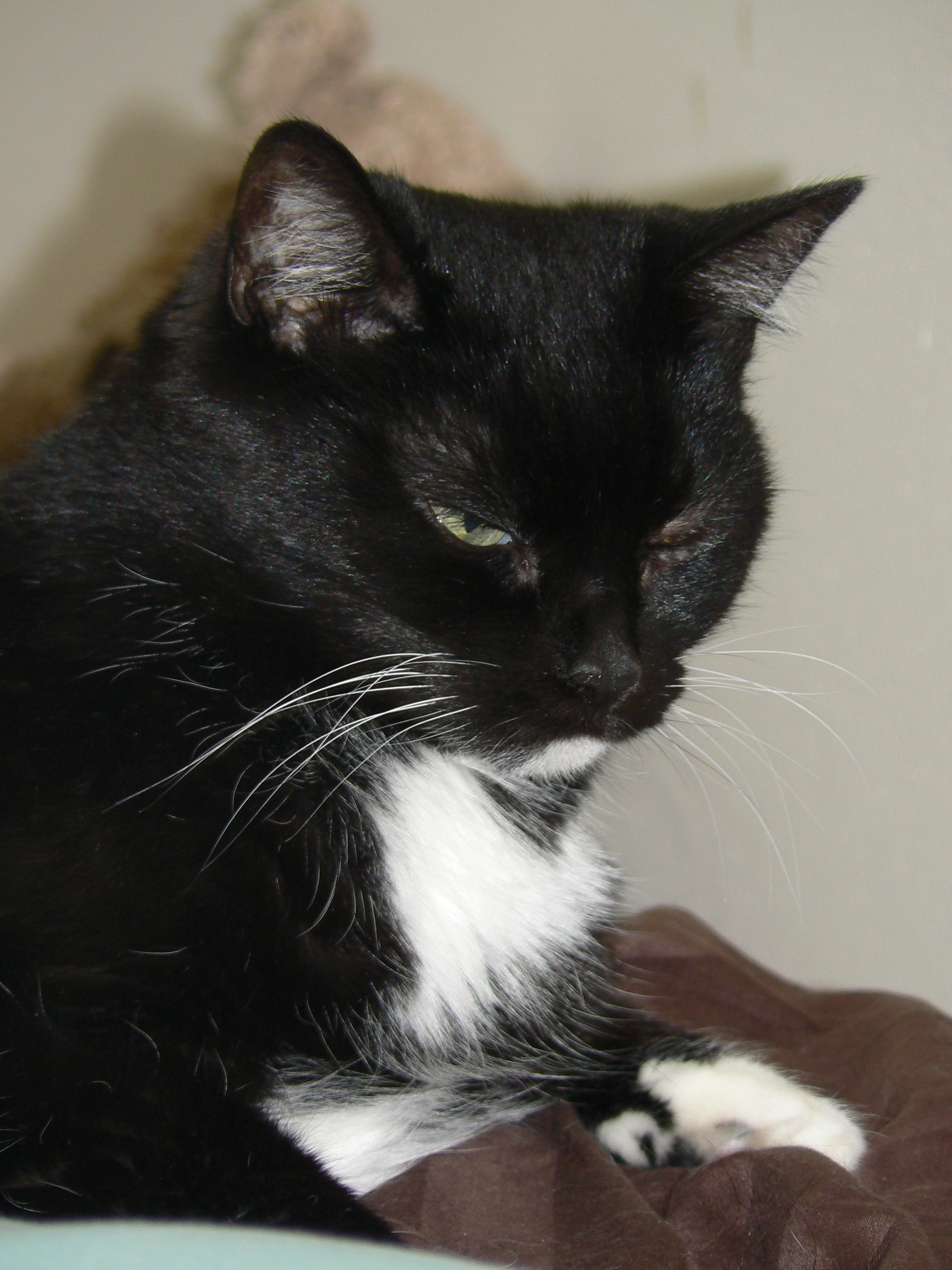
As for the observance of non-humans and their health, I look to the pets I have known.  Specifically cats.  I learned a lot from Pinkle, who somehow got injured up in the attic one day.  She simply stopped using her back legs until they had healed.  She slept.  She ate.  She tried out putting weight on them gradually, and eventually got back to doing all the things she had been doing.  She didn’t complain.  She didn’t seem miserable.  She didn’t worry or push herself or engage in any neurotic behavior that we could detect.  She took responsibility for herself, for the most part, and we provided food and shelter and quiet.  Phantom is another cat I have observed.  She is 16 years old now, and not living with me any more.  She had some urinary tract issues in the past when I did care for her.  I gave her antibiotics in pill and liquid form (which was an ordeal she did not welcome) and changed her food.  She had a bladder stone removed surgically as well.  That was maybe 10 years ago.  Her litter mate died of cancer a couple of years ago.  Cats don’t complain about pain much, and they don’t complain about death.  My kids tell me that Tabitha was purring as she died of the injection that ended her suffering.  Cats (and many other animals) have a tendency to seek out a quiet place to die.  They don’t make a big fuss.  We’re the ones who fuss.

Phantom del'Opera

Pinkle Purr (see poem by A.A. Milne)

What if we focused on healthy living and didn’t sweat so much about “illness care”?  What if we made it our social/economic/political responsibility to work hard to provide clean water, clean air, healthy food, shelter, education about health, and quiet (less stress) for as many of us as we can, and let illness play out as it would naturally?  What if we as a community took responsibility for supporting health but abstained from taking responsibility for preventing death?  It’s not like we’d be successful in that effort ultimately anyway, right?  We’d do our best to give you the basic needs, and the rest is up to you and nature.  That’s how human life went before technology kicked in, and plenty of people lived to reproduce (or we wouldn’t be here today).   Is there anything wrong with that model?

That’s my two cents for the health care debate.